What Happens If You’re Late for a Car Service?
A 30-minute delay usually changes little. A 30-day delay can turn a routine service into overdue maintenance, missed inspections, and avoidable wear. Do not drive if you have a red warning light, low oil pressure, overheating, brake problems, or a tire issue. Ignoring the timing can cost more than the service itself and can make small faults far more expensive. This guide explains what a short delay changes, what a long delay risks, and when to park the car instead.
Service lateness triage table

Use this table to separate a booking problem from a maintenance problem. A short delay is usually a scheduling issue. A longer delay can push the car past the manufacturer’s schedule, especially if the service is time-based as well as mileage-based.
| Delay length | Likely impact | Immediate next step |
|---|---|---|
| Under 2 hours late | Usually little mechanical impact if the car still gets inspected and the service adviser accepts the delay. The bigger issue is whether the shop can still fit you in. | Call before you arrive. Ask whether the grace period still applies and whether the bay is still reserved. |
| 1–2 weeks late | The appointment itself may be lost, and the service may now be outside the date-based interval even if mileage is close. Some items may still be fine; safety checks may no longer be current. | Rebook promptly and tell the adviser the current mileage, date of the missed appointment, and any warning signs. |
| 1–3 months late | Higher chance the car is overdue, especially for time-based services such as oil changes, coolant checks, brake fluid checks, or warranty-covered maintenance records. Risk of wear rises if the fluid or filter is past due. | Arrange service as soon as possible. If the car has warning lights, noises, smells, or overheating, do not assume it is safe to drive. |
| Service overdue with warning lights or noises | This is no longer a simple delay. Oil pressure lights, a check engine light, knocking or ticking noises, or a burning oil smell can point to a condition that needs prompt attention. | Stop driving if the warning is red, if the car is overheating, or if braking or steering feels unsafe. Have the car assessed by a repair shop. |
What changes when you miss the appointment?
A missed appointment can trigger practical problems before it becomes a mechanical one. Shops often have grace windows, late arrival cutoffs, rebooking rules, and no-show or cancellation policies, and those rules vary by location. The service may be moved to another day even if the car itself is still drivable.
Grace windows and late arrival cutoffs
Some repair shops will hold a booking for a short grace period. Others will move the job if the bay schedule has already shifted. A delay of about 15 minutes may be fine at one shop and too late at another, especially if the appointment was tied to an inspection lane, a quick-lube bay, or a specific technician slot.
Call as soon as you know you are late. Do not wait until you are already at the door. Tell the service adviser your name, the booked time, and the reason for the delay. If the shop can still take the car, they may simply push the vehicle into a later slot.
When a shop may rebook you
If the delay is longer than the shop can absorb, the adviser may rebook the visit. That is common when the schedule is full or when the missed service needs a longer block of time than the original appointment allowed. A rebooked visit is not a mechanical failure; it is a calendar issue.
Say your oil-change booking was for 8:00 a.m. and you arrive at 10:15 a.m. with no call ahead. The shop may have already moved on to another customer or closed the quick-service lane. In that case, the most practical next step is a new booking, not an argument about whether the original time should still stand.
How cancellation fees and no-show rules work
Some shops charge a cancellation fee or treat a missed appointment as a no-show. Others waive the fee if you call early enough. Policies vary, so check the booking confirmation or ask the adviser before you miss the time. The shop may also require a deposit for repeat late arrivals.
A missed service appointment can also mean a lost slot that another customer could have used. That is why some shops are strict about cutoff times. If the car is already overdue, a missed booking can delay maintenance further and increase the chance that the next due date slips again.
How late is too late?
Too late depends on the manufacturer service schedule, the mileage interval, and the time interval. A car can be due by mileage, by months, or by both. If either part has been exceeded, the service is overdue. That matters even if the odometer looks close to the target.
Manufacturer schedule versus mileage interval
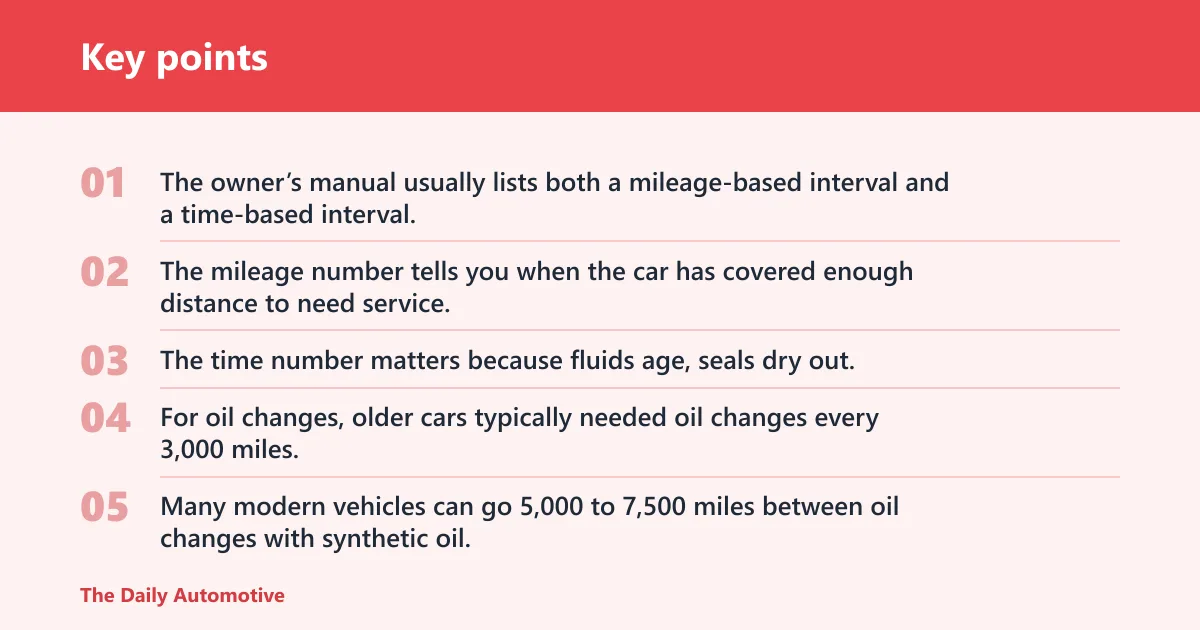
The owner’s manual usually lists both a mileage-based interval and a time-based interval. The mileage number tells you when the car has covered enough distance to need service. The time number matters because fluids age, seals dry out, and inspection items can go stale even if the car has not been driven much.
For oil changes, older cars typically needed oil changes every 3,000 miles. Many modern vehicles can go 5,000 to 7,500 miles between oil changes with synthetic oil. Those are general guideposts, not a replacement for the schedule printed for your vehicle.
What counts as overdue
A service is overdue when the car is past the date or mileage listed in the manufacturer’s schedule. If the manual says 7,500 miles or 6 months and the car is at about 8,100 miles or 7 months, it is overdue on one count even if the other count still looks acceptable. That is the cleanest way to read the schedule.
Suppose a compact sedan has only driven about 2,000 miles since the last oil change, but about 11 months have passed. It may still be low mileage, yet the time-based interval has been missed. That is overdue maintenance, not a harmless delay.
Which services can wait?
Not every service has the same urgency. Oil, brakes, coolant, and transmission fluid are time-sensitive because they affect lubrication, heat control, or stopping ability. Inspection, cabin filter replacement, and tire rotation are more flexible, though they still matter and should not be ignored for long.
Time-sensitive items
- Oil: overdue oil can lose lubrication quality and become sludge-like.
- Brakes: wear, noise, or a soft pedal can become a safety issue fast.
- Coolant: problems here can lead to overheating.
- Transmission fluid: neglect can affect shifting and heat control.
More flexible items
- Inspection: important for identifying issues, but usually less urgent than a warning light or fluid problem.
- Cabin filter: can often wait a short time without immediate risk.
- Tire rotation: usually flexible by a modest amount, though regular rotation helps wear stay even.
A common mistake is assuming a short delay before dropping off your car will always be fine, even when the service shop has a full schedule. A cabin filter that is late by a few weeks is not the same as a brake issue or a coolant problem. If the service includes both a flexible item and a safety-critical one, the safety-critical item wins.
Oil change timing and risk
Oil is where lateness most often turns into real engine risk. Old oil can become sludge-like and clog the engine. Skipping oil changes can increase the risk of overheating and mechanical failure. Delayed oil changes can reduce fuel efficiency, and ignoring oil changes can lead to engine failure and costly repairs.
Older-car benchmark and modern intervals
Older cars typically needed oil changes every 3,000 miles. Many modern vehicles can go 5,000 to 7,500 miles between oil changes with synthetic oil. That wider range is one reason service books matter: the correct interval depends on the engine, oil type, and manufacturer schedule, not on a universal number.
Do not stretch the interval just because the engine still runs smoothly. Oil can degrade before symptoms become obvious. Once the oil film weakens, wear rises, and the engine may have less protection under heat and load.
What degraded oil does to the engine
When oil breaks down, it cannot lubricate, cool, and clean as well. That raises the chance of wear on moving parts, sludge buildup in passages, and hot spots that can lead to overheating. The problem often starts quietly, then becomes expensive after damage has already spread.
Warning signs matter here. Common overdue-oil symptoms include a check engine or oil pressure warning light. Knocking or ticking noises can indicate overdue oil service. A burning oil smell inside the cabin is also a warning sign.
Will late service affect your warranty?
It can. A late appointment does not automatically void a warranty, but missed service can create documentation problems. Manufacturers may ask for maintenance records and proof that scheduled servicing was done on time. If the record is incomplete, a warranty claim can become harder to support.
Maintenance records the manufacturer may ask
Keep invoices, service reminders, and any digital service history tied to the car. The key question is whether the vehicle received the scheduled maintenance the manufacturer expected. If the car is maintained elsewhere, save the paperwork from the independent shop as well.
What can happen if records are missing?
If records are missing, a manufacturer or dealer may question whether the failure was related to skipped maintenance. That does not mean every late service voids coverage. It does mean the burden of proof can shift onto the owner, especially when the claim involves the same system that was overdue.
Missed records can also affect resale. A future buyer may want a service history that matches the schedule. Gaps do not always kill a sale, but they can weaken confidence in the car’s upkeep.
Tell the service adviser
When you are late, give the adviser the facts that help triage the car. State the booked time, how late you are, the current mileage, the last service date, and any warning lights, noises, smells, or drivability changes. If the car has a safety-critical symptom, say so first.
- Call before you arrive if you know you are late.
- Give the exact delay and your booking details.
- Report any warning lights, knocks, ticks, smells, leaks, or overheating.
- Ask whether the shop can still keep the appointment or needs to rebook.
- Do not drive the car if the adviser tells you the symptom needs towing or immediate inspection.
Picture a SUV with a service due this month and a check engine light that came on during the drive to the shop. The late arrival is no longer the main issue. The adviser needs to know about the light before anyone decides whether the car should stay running or be shut off and inspected.
If the car has a red warning light, low oil pressure, overheating, brake problems, or a tire issue, do not keep driving just to preserve the appointment time. Parking the car is the safer move.
Frequently asked questions
What happens if you’re late for a car service?
A short delay usually changes little if the shop can still hold the slot. The practical issue is whether the service adviser will still accept the car, move you into a later bay, or ask you to rebook. If the delay pushes you past the schedule, the maintenance itself may now be overdue.
How late can I be for a car service before they cancel it?
There is no universal cutoff. Some repair shops allow a brief grace period, while others rebook as soon as the reserved slot is missed. The best answer is in the booking confirmation or the shop’s policy. If you know you will be late, call before the appointment time.
Will I be charged if I miss my service appointment?
Possibly. Some shops charge a cancellation fee or treat the visit as a no-show, especially if they held a reserved bay or ordered parts. Others waive the fee if you give enough notice. Ask about the rule when you book, because policies vary by location.
Can I still drive if I delay an oil change by a few weeks?
Sometimes, but only if the car has no warning signs and the delay is small compared with the schedule. The answer changes fast if the oil is already past the mileage or time interval, or if the car shows a check engine light, oil pressure warning, ticking noises, or a burning oil smell.
What should I do if I can’t make my car service time?
Call the service adviser as soon as possible, explain the delay, and ask whether the shop can keep the booking or needs to move it. Give the current mileage and mention any symptoms. If the car has red warnings, overheating, or brake issues, do not drive it in just to keep the slot.
Does being late for car service void my warranty?
Not by itself. What matters is whether you can show that the car received the maintenance required by the manufacturer and whether the service was done close enough to the schedule to satisfy the warranty terms. Keep receipts and records, because missing paperwork can create problems even when the car was eventually serviced.
How long can you go past a service interval safely?
There is no single safe overrun. The risk depends on the item, the mileage gap, the time gap, and the car’s symptoms. Oil is less forgiving than a cabin filter or tire rotation. If the car is overdue and shows warning lights, noises, smells, or overheating, stop treating it as a routine delay.
What happens if I skip regular oil changes
Oil can lose its protective quality, become sludge-like, and clog the engine. That raises the risk of overheating, wear, reduced fuel efficiency, and mechanical failure. In the worst cases, the result is engine failure and costly repairs. The longer the delay, the less margin the engine has left.
Products related to this article
Sponsored / affiliate links. As an Amazon Associate I earn from qualifying purchases. I may earn additional commission from eligible campaigns.