3 Best Engine Coolant Testers for Cars in 2026: We Compared
The best engine coolant testers for 2026 are a refractometer for the most accurate freeze-point check, a floating-ball tester for quick budget checks, and an electronic tester if you want easy-to-read results and multiple coolant types. A bad coolant check can leave you with cracked radiators, overheated engines, or a tow bill in freezing weather. This guide compares the three tester types by accuracy, coolant compatibility, reading ease, and price so you can match the tool to your coolant and skill level.
Quick comparison
| Product | Badge | Best for | Price | ||
|---|---|---|---|---|---|
 |
BRWISSEN Digital Refractometer 5-in-1 Antifreeze CoolantBRWISSEN | Our pick | Digital · 5-in-1 · Antifreeze and DEF | $139.19
Price as of 21 Oct 2026
|
View |
 |
Antifreeze Tester, Coolant Test Strips, Coolant TesterTAVWILLANG | Budget pick | Hydrometer · Dual-Scale · Dial-Type | $9.99
Price as of 21 Oct 2026
|
View |
 |
OEMETA Easy Check Coolant Test Strips (100 Count) –Generic | Also great | Test Strips · 100 Count · Concentration | $74.99
Price as of 21 Oct 2026
|
View |
Use this to split a fast winter check from a more serious cooling-system diagnosis. The right pick depends on quick freeze protection, broader glycol compatibility, or service-level testing.
How we chose
The ranking focuses on coolant compatibility, reading clarity, accuracy, build quality, and real ownership cost. That means the list separates simple freeze-point checks from leak diagnosis and cooling-system service, because those are different jobs.
It also weighs what a tool is actually good for. A budget hydrometer can work for one car and a seasonal check, while a refractometer makes more sense if you work on more than one vehicle or need to read both ethylene glycol and propylene glycol.
| Tester type | Coolant compatibility | Accuracy level | Best use case | Common mistake | Worth buying for one-car owners, mixed-fleet owners, or shop use |
|---|---|---|---|---|---|
| Float or hydrometer tester | Often set up for ethylene glycol only; some units may not suit propylene glycol | Low to moderate, with more reading error from cheap float chambers | Fast winter prep and basic periodic checks | Reading a contaminated sample or trusting an air-bubble-filled chamber | One-car owners: yes. Mixed-fleet owners: maybe. Shop use: no |
| Refractometer | Can support both ethylene glycol and propylene glycol, depending on model | High for freeze-point checks; Robinair 75240 is stated at within +/-1° | Mixed-fleet service, accuracy-minded DIY use, and repeated checks | Skipping calibration or reading a dirty prism | One-car owners: yes if you want precision. Mixed-fleet owners: yes. Shop use: yes |
| Test strips or service kit | Strips are chemistry-specific; service kits do not measure freeze point | Medium for chemistry checks; not a freeze-point tool | Quick condition checks or full cooling-system service | Using strips as a freeze-point instrument or using a pressure kit for freeze testing | One-car owners: strips maybe. Mixed-fleet owners: strips maybe. Shop use: service kit yes |
BGS DIY 1822: best for budget freeze checks
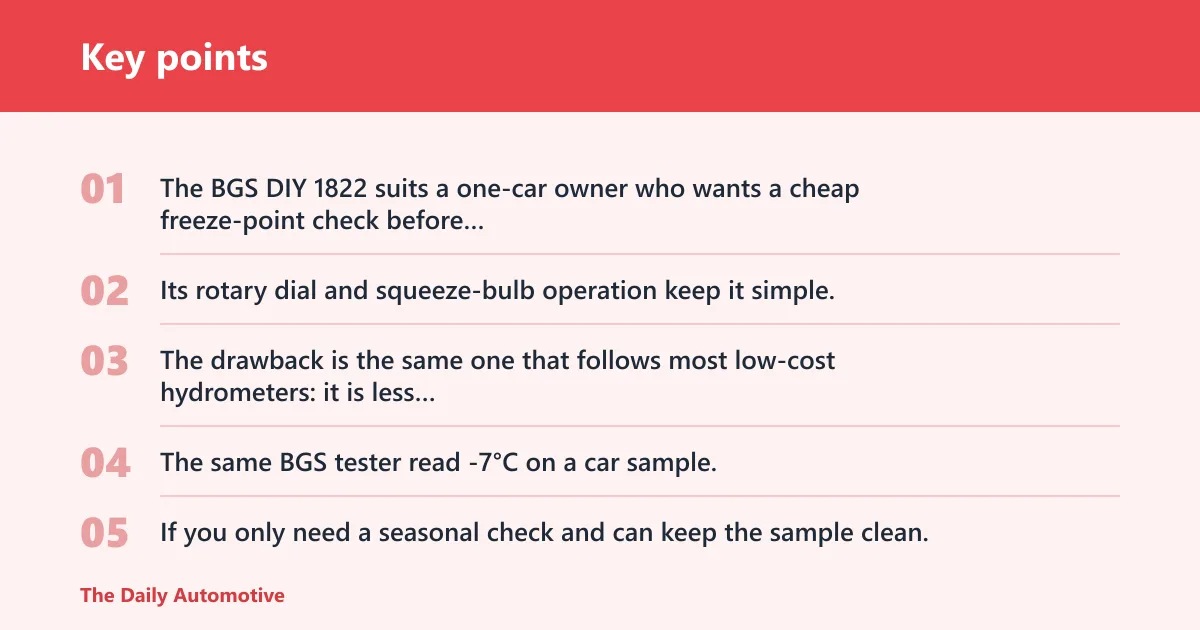
The BGS DIY 1822 suits a one-car owner who wants a cheap freeze-point check before winter or before a long trip. Its rotary dial and squeeze-bulb operation keep it simple, and the reported result to -37°C on fresh Prestone coolant shows why this style still has a place for basic maintenance.
The drawback is the same one that follows most low-cost hydrometers: it is less convincing once the coolant has aged, been mixed carelessly, or picked up contamination. The same BGS tester read -7°C on a car sample, which is a reminder that a sample from the vehicle can tell a different story from fresh coolant in the bottle.
For a budget tool, that gap matters. If you only need a seasonal check and can keep the sample clean, this kind of tester can be hard to ignore at around £7.82.
Halfords Anti-freeze Tester: best for easy reading
The Halfords Anti-freeze Tester is the simplest choice for a beginner who wants a visual result without reading tiny marks or decoding optical scales. Its floating discs give a range-based reading, and that is often easier to understand than a more technical instrument when you just need to know whether the coolant is still suitable for winter.
It also posted a fresh-coolant range of -32°C to -37°C, then a car-sample range of +5°C to -15°C. That spread is useful information, but it also shows the limits of a basic float design: it can be good enough for a quick check, yet not something to trust blindly when the sample is questionable.
If you want a low-cost path to an at-home check and value a plain reading over precision, this is the kind of tester that can make sense at around £13.99.
Robinair 75240: best for accuracy
The Robinair 75240 is the premium reference when accuracy matters more than purchase price. It reads ethylene and propylene glycol, uses automatic temperature compensation, offers three scales, and is stated to read within +/-1°. That combination makes it the strongest fit for mixed-fleet owners and anyone who wants a better freeze-point check than a basic float tester can provide.
A refractometer also solves a common compatibility problem. Many basic coolant testers are calibrated around ethylene glycol, while some vehicles and some shops need to deal with propylene glycol as well. If you maintain more than one vehicle or want a tool that can move between coolant chemistries, a refractometer is usually the smarter purchase.
The tradeoff is ownership cost and care. A refractometer needs a clean prism, careful handling, and a little more attention during use, but that is the price of better reading confidence. For many buyers, the Robinair’s roughly $80–$120 range is a reasonable ceiling only if the tool will be used often.
Which one should you buy?
If you have one car and only need an annual winter check, start with a hydrometer or float tester. The BGS DIY 1822 is the budget call, while the Halfords tester is the easier read if you do not want to interpret a small dial.
If you maintain multiple vehicles, work with mixed coolant types, or want the best freeze-point confidence, buy a refractometer. The Robinair 75240 is the premium choice here, and the Thexton 404 sits in the same category for durability-focused users in fleet or farm settings.
If the job is leak diagnosis or coolant service, skip the freeze tester and buy a pressure tool. The BILITOOLS 28-piece coolant pressure tester and vacuum refill kit is for pressure testing and vacuum refill, not freeze testing, so it answers a different question.
Say your hatchback gets only a winter check each November. A float tester is enough if the coolant type is known and the sample is clean. Suppose you also keep a diesel pickup with a different service schedule. In that case, the refractometer becomes the better long-term buy because it handles broader chemistry and gives a tighter reading.
Coolant tester decision matrix
| Tester type | Coolant compatibility | Accuracy level | Best use case | Common mistake | Worth buying for one-car owners, mixed-fleet owners, or shop use |
|---|---|---|---|---|---|
| Float tester | Best when matched to ethylene glycol; many cheap units do not suit propylene glycol | Basic | Fast winter prep | Air bubbles in the bulb | One-car owners: yes. Mixed-fleet owners: limited. Shop use: no |
| Refractometer | Often supports ethylene glycol and propylene glycol | Higher, with tighter reading control | Repeat checks and mixed coolant ownership | Dirty lens or poor calibration | One-car owners: yes if accuracy matters. Mixed-fleet owners: yes. Shop use: yes |
| Pressure or refill kit | Not a freeze-point tester | Not applicable for freeze-point reading | Leak checks and coolant service | Using it for freeze protection | One-car owners: only if you diagnose leaks. Mixed-fleet owners: yes. Shop use: yes |
Common failure cases to watch
- Wrong glycol type: a tester calibrated for ethylene glycol can mislead you on propylene glycol.
- Air bubbles: they can make a float tester read low or high depending on the chamber design.
- Contaminated sample: oil, rust, or old sludge can distort the result.
- Cheap float under-reading: basic floating-disc tools can give wider spread and less repeatable readings than a refractometer.
Should you buy a hydrometer or refractometer?
Buy a hydrometer if you want the cheapest practical tool for one vehicle and you only need a seasonal freeze check. Buy a refractometer if you want better reading confidence, broader coolant compatibility, and lower frustration when the coolant chemistry is not obvious. For mixed-fleet owners, the refractometer is usually the better long-term choice.
A hydrometer is simpler and cheaper, but a refractometer usually reads more accurately and works better across different coolant types. That matters with Dex-Cool and other extended-life coolants, where the type of coolant in the system matters as much as the freeze-point number you are trying to read.
One common rule is to treat simple testers as a quick screen and the refractometer as the tool for a final answer. If you want one instrument to handle more than one vehicle, the extra cost usually pays back in fewer second checks.
How to test antifreeze freeze protection at home
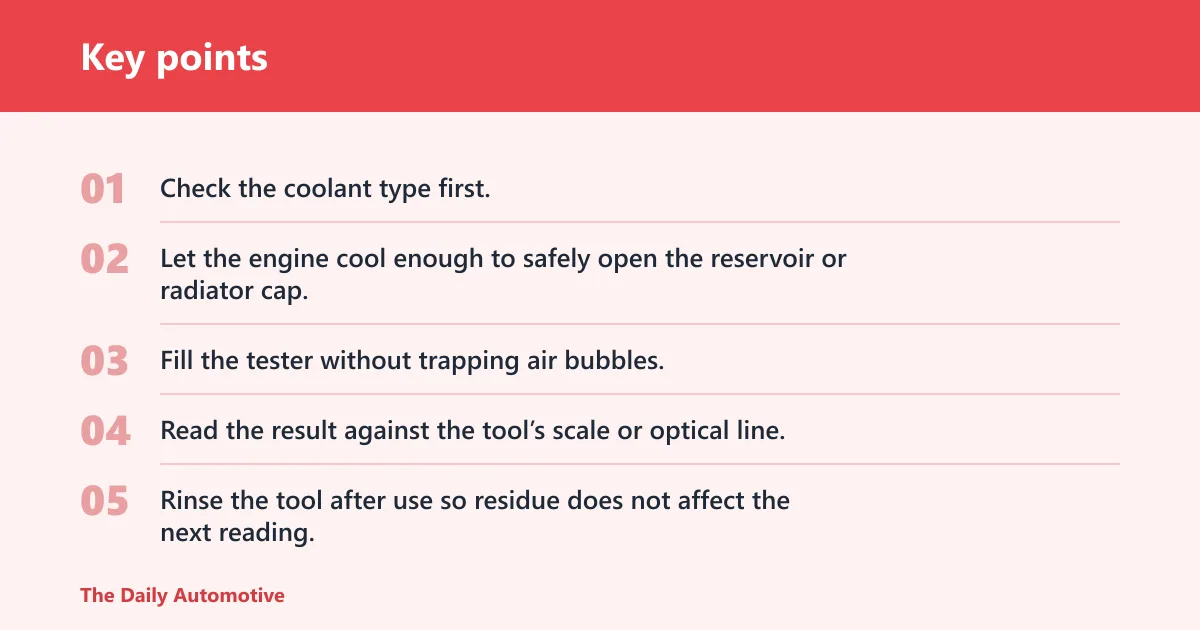
- Check the coolant type first. Do not assume every tester works with both ethylene glycol and propylene glycol.
- Let the engine cool enough to safely open the reservoir or radiator cap, then draw a clean sample.
- Fill the tester without trapping air bubbles.
- Read the result against the tool’s scale or optical line.
- Rinse the tool after use so residue does not affect the next reading.
A common first-timer mistake is pulling a sample from a dirty overflow bottle and treating it as the whole system. Another is testing right after a top-up and reading the mixed pocket near the filler neck instead of the coolant that is circulating through the engine.
Are coolant pressure test kits better than simple antifreeze testers?
No. They answer different questions. A pressure test kit helps you find leaks and confirm whether the cooling system holds pressure, while an antifreeze tester checks freeze protection. If your issue is winter readiness, the simple tester is the right tool. If you suspect a leak, you need the pressure kit.
The BILITOOLS 28-piece coolant pressure tester and vacuum refill kit is useful when the job is service and diagnosis, not freeze-point checking. That is why it belongs in a garage that handles leaks, refill work, or cooling-system maintenance, not as a substitute for a freeze tester.
How accurate are floating-disc coolant testers compared with refractometers?
Floating-disc testers are usually good enough for a rough freeze check, but they are not as precise or as flexible as a refractometer. The reading can shift with sample condition, bubble formation, and coolant type, while a refractometer gives a more controlled optical result and is better for repeat checks.
That difference is why a floating tester suits simple winter prep and a refractometer suits mixed-fleet or more exact work. If you only want a pass-or-fail answer, the float design may be enough. If you want the tighter number, the refractometer is the better tool.
Frequently asked questions
What is the best coolant tester for cars?
The best coolant tester for most cars is a refractometer if accuracy matters, or a floating-ball tester if your goal is a cheap seasonal check. The right choice depends on coolant type, how often you will use the tool, and whether you need a rough screen or a tighter freeze-point reading.
Should I buy a hydrometer or a refractometer for coolant?
Buy a hydrometer if you want the lowest cost and only need a quick check on one vehicle. Buy a refractometer if you want better accuracy, broader coolant compatibility, and a tool that makes more sense for repeated use or more than one vehicle.
Can one coolant tester work with ethylene glycol and propylene glycol?
Some can, but many basic coolant testers are calibrated specifically for ethylene glycol. Refractometers are the safer choice if you need support for both ethylene glycol and propylene glycol. Always check the stated compatibility before buying.
How do I test antifreeze freeze protection at home?
Use a clean sample from a cooled engine, fill the tester without air bubbles, and read the scale or optical line according to the tool’s design. Do not use a pressure kit for this job, because pressure tools find leaks; they do not measure freeze protection.
Do coolant testers work with Dex-Cool and other extended-life coolants?
Some do, but coolant type matters. Dex-Cool and other extended-life coolants can still be checked with the right refractometer or compatible hydrometer, but you should confirm that the tester is suitable for the coolant chemistry in your vehicle before you trust the result.
Which coolant tester is easiest to read for beginners?
Floating-disc testers are usually the easiest for beginners because the reading is visual and quick. The tradeoff is lower precision and weaker compatibility than a refractometer. If you want the simplest result and do not need the tightest number, a float tester is often the easiest place to start.
Products related to this article
Sponsored / affiliate links. As an Amazon Associate I earn from qualifying purchases. I may earn additional commission from eligible campaigns.