3 Best TPMS for Cars in 2026: Based on Specs and Reviews
Choose a TPMS by vehicle size and pressure range: solar cap sensors suit cars and SUVs, higher-range direct-sensor kits suit trucks and towing, and systems with stronger signal handling fit longer trailers. Wrong matches miss leaks or trigger false alarms. Used poorly, TPMS can leave you driving underinflated or chasing constant warning noise. This guide compares aftermarket systems by sensor type, PSI range, power source, and install effort.
Quick comparison
| Product | Badge | Best for | Price | ||
|---|---|---|---|---|---|
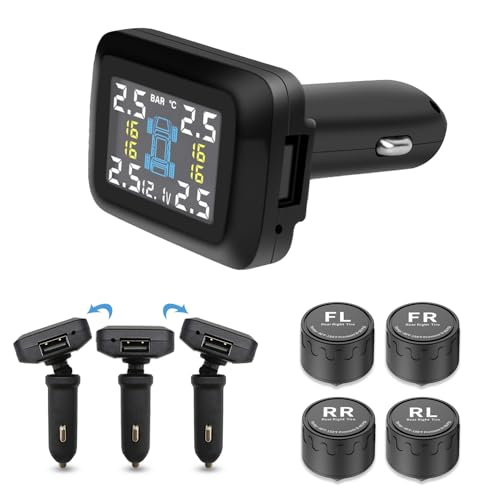 |
Tirpresmos Tire Pressure Monitoring System, Wireless TPMSTirpresmos | Our pick | 0-98 PSI · 6 Alarm Modes · Wireless | $27.99
Price as of 22 Oct 2026
|
View |
 |
Tire Pressure Monitoring System – TPMS Tire PressureVENCEZA | Budget pick | Solar Charger · 4 Sensors · LCD Display | $17.99
Price as of 22 Oct 2026
|
View |
 |
Tymate TM2 RV Tire Pressure Monitoring System, TPMS Set ofTymate | Upgrade pick | 0-144 PSI · 4 Sensors · Color LCD | $59.99
Price as of 22 Oct 2026
|
View |
Factory TPMS only warns after pressure is already low. Aftermarket systems add live per-tire PSI and temperature, which helps you spot a slow leak before the dash light comes on.
How we chose
We compared systems on four factors that determine fit: PSI range, sensor count, power source, and installation burden. We also favored models with clear alert modes because bad thresholds are a common source of false alarms.
One more filter mattered. A system can look simple on paper and still be a poor fit if your vehicle sits for long periods, runs a long wheelbase, or tows where signal reach matters more than convenience.
Which TPMS fits your car?
The best TPMS depends on the failure mode you want to avoid. A sedan needs a different setup than a tow rig, and a trailer setup needs different signal headroom than a compact car. Use the matrix below to match the monitor to your vehicle before you buy.
Decision matrix
| Vehicle type | Required PSI range | Sensor count | Power source | Signal-risk notes | Installation effort | Owner-maintenance burden |
|---|---|---|---|---|---|---|
| Compact sedan | Typically below 50 PSI | 4 sensors | Solar, USB backup, or 12V socket | Low signal risk with short vehicle length | Low if using external cap sensors | Coin-cell replacement if caps are used; display charging checks |
| SUV | Typically below 60 PSI | 4 sensors | Solar or 12V socket | Moderate risk if the display sits far from the rear tires | Low to moderate | Battery upkeep plus periodic threshold checks |
| Half-ton truck | Often needs higher headroom than a car kit | 4 to 6 sensors | 12V socket or USB backup | Higher risk from longer cab-to-bed distance and trailer use | Moderate | More sensors to manage, plus display power planning |
| Truck with trailer | Needs a wider range for tow tires and trailer tires | 6 or more sensors | Wired, USB backup, or solar with backup power | Signal loss becomes more likely on longer combinations | Moderate to high | More sensors, more batteries, more threshold setup |
| Heavy-duty or multi-axle rig | High-pressure coverage needed | 8 to 26 sensors | Wired display with power-saving features | Repeaters or stronger receivers matter more here | High | Highest sensor count and the most upkeep |
Common mismatch failures
| Symptoms | Likely cause | Fix |
|---|---|---|
| Constant low-pressure alarms on normal tires | Thresholds set too tightly, or automatic reference pressure was not learned correctly | Reset the baseline and set alerts to match your cold inflation target |
| No reading from one tire after installation | Sensor count or pairing order is wrong, or the display lost that sensor | Re-pair the missing sensor and confirm the monitor supports your tire count |
| Alerts appear late on a trailer | Signal range is too weak for the vehicle length | Choose a system with better reach or a repeater-style setup |
| Display shuts off during long parking periods | Solar-only charging is not enough in shade or garage parking | Use USB backup or a 12V-powered monitor |
| Inflation number looks wrong after adding air | PSI range mismatch or the monitor is rounding too aggressively | Buy a kit that covers your actual tire pressures and check its stated accuracy |
Suppose your SUV carries four passenger tires at normal road pressures but spends weekdays in a shaded garage. A solar-only monitor can still work, but USB backup matters because the display may not recharge enough between short drives.
A common first-timer mistake is buying a 0–87 PSI kit for a tow setup that needs more headroom. The result is not better safety. It is a monitor that has already run out of useful range when the tires you care about most start to climb.
What to fix before you buy
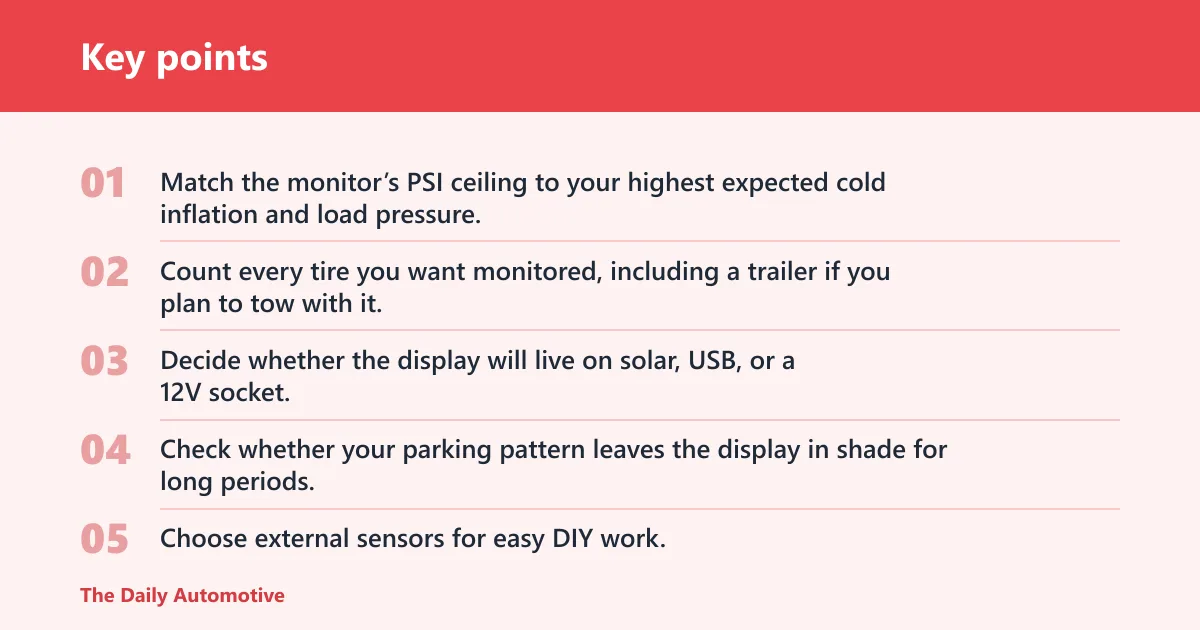
- Match the monitor’s PSI ceiling to your highest expected cold inflation and load pressure.
- Count every tire you want monitored, including a trailer if you plan to tow with it.
- Decide whether the display will live on solar, USB, or a 12V socket.
- Check whether your parking pattern leaves the display in shade for long periods.
- Choose external sensors for easy DIY work, or internal sensors if theft resistance matters more than convenience.
Tirpresmos TM7: best for mixed car and truck use
- Car charger powered with voltage monitoring included
- Real-time tire pressure and temperature monitoring
- Adjustable display angle for flexible placement
The Tirpresmos TM7 suits drivers who want one kit that can cover a passenger car today and a truck or trailer later. Its 0-98 PSI range, six alarm modes, and car-charger power make it flexible for mixed-use households.
What stands out is the built-in voltage monitoring and adjustable display angle. That makes it more useful for a vehicle that sees different drivers, different seating positions, or a dash where the screen cannot sit flat.
The drawback is range headroom. It can fit many cars and light-duty setups, but it is not the best match if you need higher pressure coverage or a larger tire network than four sensors support.
Why its 0-98 PSI range matters
That range covers most passenger vehicles and many light trucks. It also gives more headroom than basic car-only kits, which helps when you want a single display that does not feel cramped near the upper end of normal road pressures.
When 12V power beats solar
A socket-powered display avoids the common solar problem: the car sits parked long enough that the screen charges poorly. If your vehicle spends time in a garage or under shade, wired power removes one more maintenance task.
Who should skip it?
Skip it if you need more than four sensors, if your trailer setup needs stronger signal reach, or if your truck tires sit at pressures above the low-100 PSI zone. A bigger rig needs more ceiling and more tire coverage.
VENCEZA TPMS: best for easy solar setup
- Automatic solar charging with USB backup option
- Six alarm modes including fast and slow leak alerts
- High accuracy sensors with low power consumption
The VENCEZA TPMS fits drivers who want the simplest installation path. Its solar charger, USB backup option, four external sensors, and six alarm modes make it the easiest of the three to live with for daily driving.
Its strongest advantage is convenience. The automatic solar charging reduces cable clutter, while USB backup keeps the monitor alive when sunlight is not enough.
The main drawback is that solar convenience depends on parking. If the vehicle spends long stretches in a garage or under heavy shade, you should expect the USB backup to do more of the work.
Solar display plus USB backup
This is the right combination for normal commuter parking patterns. Solar charging is convenient, but backup charging matters because a display that only sees intermittent sun can fall behind if the vehicle sits often or for long periods.
Why IP67 sensors matter
IP67 waterproof sensors are a useful fit for year-round driving because they tolerate water exposure better than cheaper, looser designs. That matters on winter roads, wet commutes, and vehicles that spend time exposed to spray and dust.
Best fit and limits
This kit makes sense for sedans and SUVs that want easy DIY installation and live per-tire data. It is less attractive for trucks, trailers, or any setup that needs a higher PSI ceiling or more sensor capacity.
Tymate TM2: best for easy solar setup
- Wide 0-144 PSI range suitable for RVs and trucks
- Color LCD display with automatic adaptive backlight
- Supports monitoring up to 10 tires with extended signal
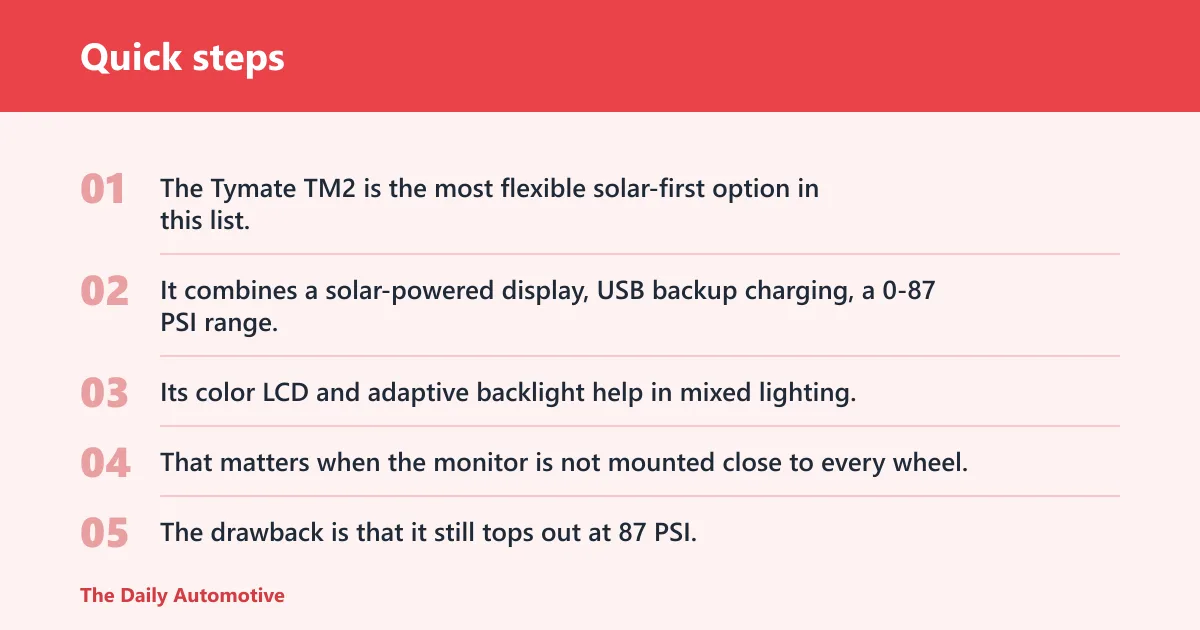
The Tymate TM2 is the most flexible solar-first option in this list. It combines a solar-powered display, USB backup charging, a 0-87 PSI range, and support for up to 10 tires, which makes it a strong fit for larger daily drivers that still want simple setup.
Its color LCD and adaptive backlight help in mixed lighting, and the published signal support gives it more stretch than a basic four-sensor commuter kit. That matters when the monitor is not mounted close to every wheel.
The drawback is that it still tops out at 87 PSI. That is enough for many passenger vehicles, but it is not the right answer for heavier towing or high-pressure commercial use.
Why the range helps more than the headline
Range is the first filter, not the last. A monitor that covers up to 87 PSI is useful if your tires live well under that ceiling, but it will not rescue a kit that cannot read the pressures your vehicle actually needs.
What IP67 sensors add
They add water resistance and more confidence in weather exposure. That is useful if the vehicle sits outside in rain, slush, or roadside spray. It does not remove the need to replace coin-cell batteries in external sensors over time.
Best fit and limits: choose
Choose this if you want a solar display with backup charging and a little more vehicle flexibility than a bare-bones car kit. Skip it if your setup needs a higher PSI ceiling or if you want the tighter pressure control of a threshold-tuned system.
Masoll M13: best for threshold control
The Masoll M13 is the right choice when you care more about setting the monitor to your target pressure than about packing in extra tire count. Its automatic reference pressure, solar-powered monitor, 0-87 PSI range, 1.5 PSI accuracy, and auto wake/sleep make it a tidy fit for many passenger vehicles.
Automatic reference pressure setup
The useful part here is not the name. It is the ability to anchor alerts to a reference instead of constantly guessing where the low and high lines should sit. The M13 uses 25% high and 15% low thresholds, which can simplify setup for drivers who want a set-and-forget baseline.
Accuracy and wake-sleep behavior
Its 1.5 PSI accuracy is enough for meaningful live monitoring on passenger vehicles. Auto wake/sleep also helps reduce annoyance when the car is parked, because the monitor does not need manual attention every time the vehicle is turned off.
Where it fits best
This model fits drivers who want a cleaner threshold-driven experience on a sedan or SUV. It is less compelling if you need more tire count, higher pressure headroom, or stronger support for towing and long wheelbase setups.
Tymate TM12: best for multi-axle and trailer setups
The Tymate TM12 is built for bigger tire networks. With six sensors included, support for up to 12 tires, a four-zone display, a color receiver, and six alarm modes, it fits vehicles where one screen needs to track more than a standard car set.
Six sensors included
That makes the TM12 a more practical starting point for rigs that need six monitored points immediately. It also helps when the setup includes a tow vehicle plus trailer tires, because the monitor is designed for more than the usual four-wheel pattern.
Four-zone display for bigger rigs
The zone layout matters because it reduces confusion. On larger vehicles, the question is not whether the monitor can read a tire. It is whether you can tell at a glance which side or axle has the problem.
When 12 tires supported matters
That ceiling matters for RVs, tow rigs, and complex trailer combinations. It gives the system enough room for a real travel setup, rather than forcing you to split the load across multiple devices.
EEZTire TPMS6ATC: best for high-count vehicles
The EEZTire TPMS6ATC is for the biggest and busiest setups in this guide. It monitors up to 26 tires, handles pressures up to 210 PSI, updates every six seconds, uses a color monitor, and adds motion-sensitive power saving.
Up to 26 tires and 210 PSI
That is far beyond what a normal sedan needs. It is useful for heavy-duty fleets, large trailers, or equipment-rich vehicles where the goal is broad coverage and pressure headroom, not simplicity.
Six-second update interval
A faster update cadence helps when you care about live changes while driving or towing. It does not remove the need for correct setup, but it does reduce the lag between a pressure change and a visible alert.
When this is overkill for cars
For a four-tire passenger car, this is more system than you need. You would be paying for extra tire capacity, higher pressure support, and a larger monitor ecosystem that a normal sedan will never use.
Which one should you buy?
If you want the simplest DIY install for a car or SUV, start with the VENCEZA TPMS. If you want one kit that can do both light daily driving and a wider range of vehicle pressures, the Tirpresmos TM7 is the better all-around pick.
If you park in shade often, choose a monitor with USB backup or 12V power instead of relying on solar alone. Solar is convenient, but it is not a full answer for vehicles that sit still for days or live outside less than they drive.
If your setup is a truck, trailer, or RV-style combination, move up in tire count and signal reach. That is where the Tymate TM12 and EEZTire TPMS6ATC become more relevant than car-first kits.
Do not buy by sensor count alone. A four-sensor kit can be wrong for a trailer, and a 26-tire system can be pointless for a sedan. Match the monitor to the failure mode you actually expect.
Tire pressure monitoring system buying guide
Aftermarket TPMS works alongside factory TPMS, but it does not replace the car’s original warning system. Factory TPMS only tells you when pressure is already low. Aftermarket monitors show live PSI per tire and usually add temperature data, which makes slow leaks easier to catch.
External vs internal sensors
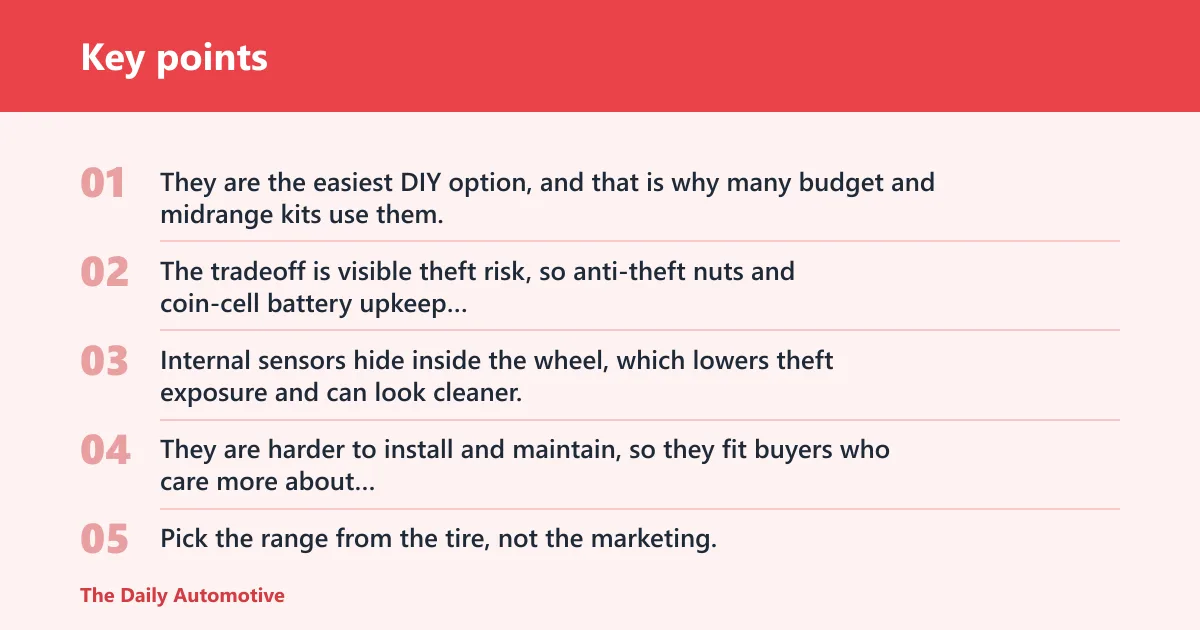
External cap sensors screw onto valve stems. They are the easiest DIY option, and that is why many budget and midrange kits use them. The tradeoff is visible theft risk, so anti-theft nuts and coin-cell battery upkeep matter.
Internal sensors hide inside the wheel, which lowers theft exposure and can look cleaner. They are harder to install and maintain, so they fit buyers who care more about invisibility than quick setup.
PSI range and sensor count
Pick the range from the tire, not the marketing. A car kit should cover your normal cold pressure with room to spare, while towing and truck use call for more headroom. Sensor count should match every tire you want visible on the display.
For a standard car, four sensors are enough. For SUVs and some trucks, a kit that supports more tires or stronger signal handling is safer, especially if the vehicle is long or the display sits far from the rear axle.
Power source, alerts, and theft risk
Solar charging is convenient, and a USB backup is the safer bet when parking is frequent or shaded. A 12V socket is still common because it removes the worry about whether the display got enough daylight.
Look at the alert list too. High and low pressure alarms, rapid leak alerts, and sensor-loss alerts matter more than flashy display graphics. Without those warnings, the monitor can look modern and still miss the problem you bought it to catch.
Picture a tow vehicle with a trailer that loses a sensor behind the bumper. A system that lacks strong signal handling may keep the driver guessing, while one with better update behavior will flag the missing reading instead of hiding the gap.
Can TPMS sensors be stolen from the valve stem? Yes, external cap sensors can be removed, which is why some kits include anti-theft nuts. That does not make them bad. It just means the owner should treat exposed sensors like any other visible accessory.
Frequently asked questions
What is the best TPMS for cars in 2026?
The best TPMS for a normal car is the one that matches your pressure range and parking pattern. For easy DIY use, the VENCEZA TPMS is the most convenient pick here. For a wider pressure range and more all-around flexibility, the Tirpresmos TM7 is the stronger mixed-use choice.
Do aftermarket TPMS work better than factory TPMS?
Aftermarket TPMS does not replace factory TPMS, but it does show more useful live data. Factory systems warn when pressure is already low. Aftermarket monitors give per-tire PSI and temperature, which helps you catch slow leaks and threshold errors earlier.
Should I choose external or internal TPMS sensors?
Choose external sensors if you want the easiest installation and the lowest DIY barrier. Choose internal sensors if theft risk or appearance matters more than convenience. External cap sensors are simple, but they do add visible theft risk and coin-cell upkeep.
How many sensors do I need for a car?
Most cars need four sensors, one per tire. If you want to monitor a trailer or a spare set, you need a kit that supports more than four. Always count the tires you actually want to watch, not the number the kit mentions in the headline.
What PSI range should a car TPMS cover?
A car TPMS should cover your normal cold tire pressure with enough extra headroom to avoid clipping at the top end. The key is not the exact number alone. It is whether the kit can read your tires without sitting near its limit.
Are solar TPMS displays reliable?
Solar displays are convenient, but reliability depends on parking. If the vehicle sits in shade, indoors, or for long periods, solar alone may not keep up. A USB backup or 12V power source is the safer choice for drivers with irregular sunlight.
Will TPMS sensors work with my factory TPMS?
Yes, aftermarket TPMS can work alongside factory TPMS, but it will not erase the original system. The factory warning light still serves as a low-pressure backup. The aftermarket system simply gives you live pressure data and extra alert detail.
Products related to this article
Sponsored / affiliate links. As an Amazon Associate I earn from qualifying purchases. I may earn additional commission from eligible campaigns.