Tymate Tire Pressure Monitoring System Review: TM2 vs TM7
Tymate is a budget TPMS worth buying for cars, SUVs, trailers, fifth wheels, and RVs only if your setup accepts external valve-stem sensors and you can add the right repeater, USB power, or adapter when needed. Poor TPMS setup can hide low pressure until tires are damaged, a wheel-end takes a hit, or you waste money on a system that will not stay linked. This review breaks down setup by vehicle type, where Tymate fits, where it falls short, and what extra hardware may be required.
Verdict


Buy it for short to mid-length towing setups where you want live-ish pressure and temperature readings without paying for a higher-end RV monitor. Skip it if you want factory-style integration, a long-range system that handles awkward trailer layouts, or a clean install with no cap sensors on valve stems.
📊 The review is labeled as updated in January 2026. Source: Tymate TM2 RV Tire Pressure Monitoring System Review: Is It Worth It….
Specs at a glance
| Item | Tymate TM7 | What that means for buyers |
|---|---|---|
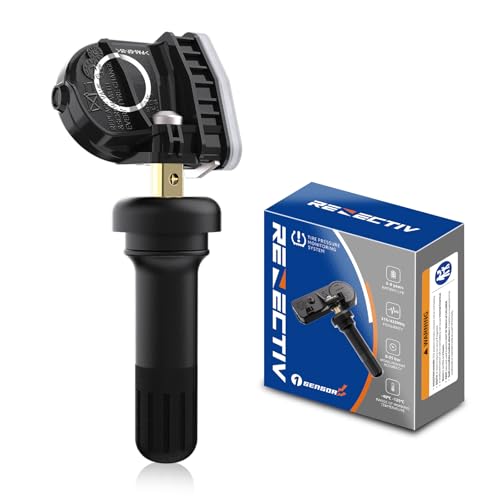
| Sensor style | External cap-style sensors | Easy to add, but they screw onto valve stems and can add friction. |
| Monitoring | Pressure and temperature | Useful for spotting leaks, rising heat, and low-pressure events early. |
| Alarm behavior | Audible alarms | Useful in principle, but alert delay and false alarms are the watch-outs. |
| Display power | Solar charging | Convenient, but it depends on dash placement and light exposure. |
| Pressure range | 0-144 PSI | More practical for RVs and heavier loads than a car-only monitor. |
| Charging | Dual USB charging via vehicle cigarette lighter | Helpful if solar alone is not enough. |
| Display | Color LCD with adjustable backlight | Better than a bare-bones screen, though brightness complaints still matter. |
| Typical position | Budget-friendly RV TPMS | Best when cost matters more than premium fitment polish. |

Who is Tymate for?
Tymate is for drivers who want a low-cost tire monitor for towing, short RV runs, or a car-and-trailer setup that can tolerate external cap sensors. It is less suitable for buyers who want factory integration, hidden sensors, or a long rig with awkward signal paths and no plan for a repeater.
Cars and SUVs
Short-wheelbase cars and SUVs are the easiest fit. The monitor can live on the dash, the sensors stay close to the cab, and the chance of signal trouble is lower than on a long trailer. For daily drivers, the main tradeoff is whether you are willing to use screw-on sensors instead of an internal TPMS retrofit.
Travel trailers and fifth wheels
This is the main use case, but it is also where setup matters most. Trailer tires can fail without much warning from the driver’s seat, so pressure and temperature alerts matter. The problem is range: longer trailers and fifth wheels are more likely to need a booster, especially if the monitor sits deep in a truck cab or the trailer has multiple axles.
Tow rigs that need a booster
Long truck-and-trailer combinations, especially those with a fifth wheel or a heavily loaded travel trailer, are the point where a repeater becomes part of the purchase decision instead of an accessory. Picture a crew-cab pickup towing a 35-foot travel trailer; if the display drops a wheel or takes too long to reconnect, the system is not doing the one job you bought it for.
Pros and cons
What works well
- Budget-friendly way to get live-ish pressure and temperature visibility.
- External cap-style sensors are simpler than many internal retrofit options.
- Audible alarms and temperature monitoring give you more than a basic pressure gauge.
- Solar charging reduces dependence on constant plugging-in.
- The TM7’s 0-144 PSI range makes it more realistic for RV and towing use.
What holds it back
- Cap sensors can add valve-stem stress and leak risk.
- Bright-sun visibility complaints are common.
- Long rigs may need a repeater or booster to stay connected.
- Startup and pairing can be more fragile than buyers expect.
- Alerts are only useful if the display stays linked and readable.
What works with Tymate
Tymate’s best feature is basic, practical monitoring: pressure and temperature alerts for each tire, plus audible warnings when readings move outside the set range. That matters most on towing setups, where heat and slow leaks can turn into roadside failures if nobody is watching the tires closely.
Pressure and temperature alerts
The monitor displays tire pressure and temperature, and the review describes audible alarms for out-of-range conditions. That combination is the whole reason to buy a TPMS in the first place. A slow pressure drop on a trailer tire can be easy to miss until the sidewall is already running hot.
Say your travel trailer starts the morning at normal pressure and one tire leaks over a few hours. A decent TPMS should warn you before the tire becomes visibly damaged or overheated. That is the value here, provided the sensor link stays alive.
Solar-charged cab display
The review says the product relies on solar charging and dash placement. That can help on a clean, uncluttered setup because you do not have to think about constant charging. It also creates a dependency: if the monitor lives in a shaded corner, the sun may not keep up.
Budget-friendly monitoring for towing
For drivers who want a monitor that is cheaper than many premium RV systems, Tymate fills a clear lane. The TM7’s 0-144 PSI range is especially relevant if you tow heavier loads or want one unit that can span passenger vehicles and trailers without feeling under-specced.
What does not work as well

The weak points are predictable, and they matter. External cap-style sensors are convenient, but they are not invisible. They screw onto the valve stem, which adds handling friction and can create leak or stress complaints if the stem or cap interface is marginal.
External cap-style sensor friction
Cap-style sensors are easy to understand, but they are also easy to bump, over-tighten, or leave poorly seated. The review notes valve stem issues such as leaks or stress. That is the main reason some buyers prefer internal sensors or a shop-installed retrofit.
Range limits on longer rigs
Range is the deciding factor for RV use. A short pickup-to-trailer setup is one thing. A long fifth wheel or toad setup is another. If the monitor has to talk through a lot of metal, length, and road noise, a repeater becomes less optional and more necessary.
A common first-timer mistake is buying a budget TPMS for a 40-foot towing combination and assuming all four or six sensors will link cleanly from day one. If pairing takes longer than expected or one wheel keeps dropping off, the issue is usually placement, range, or booster setup, not just the display.
Display visibility and alarm issues
A recurring complaint is that the screen is dim or small in bright sun. That matters because a TPMS that alarms silently in a glare-filled cab is not doing enough. The screen also has to wake up and reconnect fast enough to be useful when you start rolling.
Startup and pairing delay
The review’s install and setup sensitivity bucket includes pairing and startup behavior. That is a polite way of saying the first few minutes after ignition matter. If the system is slow to connect, you can miss the moment you most want visibility: rolling out after a stop, when heat and load start changing again.
What is Tymate for?
Tymate is a budget-friendly TPMS for drivers who need basic pressure and temperature monitoring on vehicles that can physically accept external valve-cap sensors. It is mainly for towing, RV use, and other setups where a simple monitor is acceptable and the owner is willing to manage signal range and placement.
Setup, placement, and pairing friction
Setup usually sounds easy on paper because the sensors are external, but the friction shows up in the details. You still have to pair the sensors, confirm the monitor wakes correctly, place it where solar charging works, and make sure the cab display is readable when sunlight hits it.
- Confirm your valve stems can tolerate screw-on cap sensors.
- Check the rig length and the sensor-to-display path.
- Place the monitor where sunlight can reach it.
- Pair each sensor and verify the tire positions.
- Test for missed wheels, slow connection, or alarm delay before a trip.
Tymate setup-fit matrix
| Vehicle type | Fitment note | Rig length / repeater need | Screen visibility risk | Ownership friction |
|---|---|---|---|---|
| Compact car | Practical if you want simple external monitoring | Low; repeater usually not needed | Moderate if parked in bright sun | Low, but cap sensors still add stem handling |
| SUV | Good fit for everyday use or light towing | Low to moderate; booster only if the layout is unusual | Moderate | Low to moderate |
| Travel trailer | One of the main use cases | Moderate to high; booster may be needed as length grows | Moderate to high in direct sun | Moderate because of pairing and range checks |
| Fifth wheel | Possible, but range matters more | High; repeater often becomes the smart purchase | Moderate to high | High due to setup sensitivity and signal path |
| Toad behind motorhome | Fit depends on signal routing and monitor placement | Moderate to high; booster may be the difference between usable and annoying | Moderate | High if the setup is already complex |
| Spare tire use | Possible if the monitor supports it in your setup | Usually low range concern | Low to moderate | Low, but only if the spare is actually monitored |
This matrix is the short answer buyers need. If you are in a compact car or SUV, Tymate is practical. If you are towing a long fifth wheel or a complicated RV-toad combination, the ownership friction rises fast and a repeater or a different system starts to make more sense.
Alternatives to Tymate
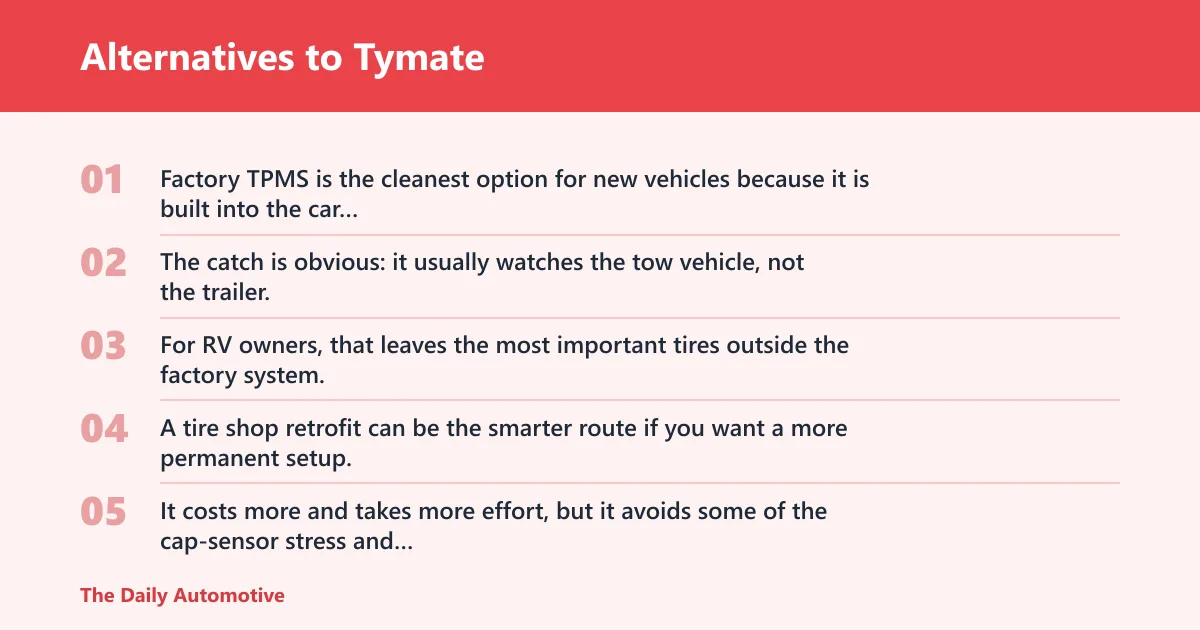
Factory TPMS
Factory TPMS is the cleanest option for new vehicles because it is built into the car and does not ask you to screw extra hardware onto valve stems. The catch is obvious: it usually watches the tow vehicle, not the trailer. For RV owners, that leaves the most important tires outside the factory system.
Tire shop retrofit systems
A tire shop retrofit can be the smarter route if you want a more permanent setup, internal sensors, or help matching parts to valve stems and wheel construction. It costs more and takes more effort, but it avoids some of the cap-sensor stress and pairing guesswork.
Higher-range RV TPMS options
If you are towing a long fifth wheel or a trailer where the signal path is the whole problem, a higher-range RV TPMS can be the better buy even if it costs more. That is where budget systems often lose the value argument: a cheaper monitor is not a bargain if it needs constant babysitting.
The Tymate TM7 is the better Tymate pick for RV and towing buyers who need broader pressure coverage and a more useful display package. Based on the spec sheet and owner feedback, it makes the most sense when you want a budget monitor for trailer tires, not just a car accessory that can tolerate occasional towing.
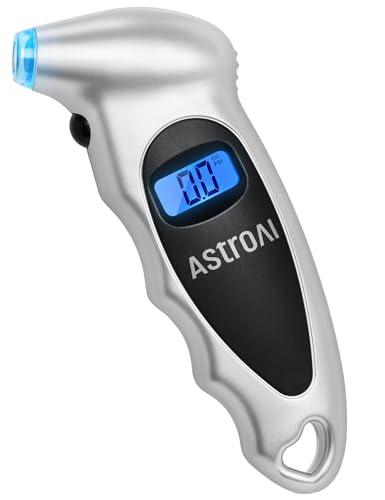
AstroAI’s digital gauge is not a TPMS, but it can serve as a smart companion or backup. It gives a manual check point with ±1 PSI accuracy and a bright backlit display, which helps when you want to confirm whether a TPMS reading is plausible. The downside is obvious: it cannot warn you while driving.

The OTAUPRS valve stem set is only relevant if you are replacing stems during a retrofit or repair. Its brass construction is a plus for corrosion resistance, but it is not a plug-in solution for a Tymate buyer who is trying to reduce valve-stem risk. It also raises the install burden because a stem swap is more work than a cap swap.
Should you buy Tymate TM2 or TM7?
For most buyers comparing Tymate models, the TM7 is the safer buy for RV and trailer use because its 0-144 PSI range and dual-USB charging fit heavier towing setups better. The TM2 is only the better choice if you are matching a simpler vehicle, want the cheapest workable monitor, and do not need the broader RV-oriented feature set.
TM2 vs TM7 decision guide
Choose TM7 if you tow, run a travel trailer, or want a monitor that looks more purpose-built for RV ownership. Choose TM2 only if your use is lighter, your rig is short, and you are comfortable living with more setup sensitivity. For longer combinations, the TM7 is the one with the more realistic fit.
When to skip both models
Skip both if you want factory integration, if your wheel-end hardware already worries you, or if your trailer layout makes range problems likely. That includes long fifth wheels, difficult-to-see monitor locations, and any setup where you do not want to think about repeaters, charging, or sensor theft concerns.
What to check before you order
Check the valve stem type, the total rig length, whether the monitor can sit where solar charging works, and whether you are willing to buy a repeater if the first signal test is weak. Those checks decide whether Tymate is a bargain or an expensive second attempt.
How much is a tire pressure monitoring system?
How much a TPMS costs depends on whether you buy a simple aftermarket kit, a higher-range RV monitor, or a shop-installed retrofit. Tymate sits in the budget category, with the TM7 listed at $39.99. Total cost can rise once you add a repeater, replacement sensors, or service work for stems.
Is a tire pressure monitoring system mandatory?
No, a TPMS is not generally mandatory for passenger use in the way seat belts or lights are, but rules vary by vehicle type and market. For towing, the practical question is not legal minimums. It is whether you are willing to drive blind to low pressure and heat on the tires that matter most.
What are the advantages of monitoring tire pressure?
The main advantage is earlier warning. A TPMS can alert you to a leak, heat build-up, or underinflation before the tire reaches failure territory. That matters most on trailers and RVs because the driver’s seat is far from the wheels, and a bad tire can go from fine to dangerous quickly.
Is the Tymate TM2 good for RVs and trailers?
The TM2 can work for RVs and trailers only when the rig is short enough, the sensor placement is friendly, and the monitor can stay linked without help. For long trailers, fifth wheels, or toad setups, the fit becomes much less certain and a booster or different system may be the smarter buy.
Do Tymate TPMS sensors need a repeater or booster?
Not every setup needs one, but longer rigs often do. The need is driven by distance, body shape, and signal obstruction more than by brand alone. If the display loses wheels, reconnects slowly, or acts inconsistent at towing length, a repeater is a practical fix to consider.
How accurate is a Tymate tire pressure monitoring system?
Accuracy is best treated as “good enough to warn you,” not as a replacement for a quality hand gauge. Owner feedback in the review bucketed perceived accuracy alongside alerts, and that is the right way to think about it. Use a gauge to confirm anything suspicious, especially after pairing or temperature swings.
How hard is it to install Tymate TPMS sensors?
Installation is simple in the sense that the sensors are external cap-style units, but that does not mean friction-free. You still have to screw them on, pair them, check for leaks, and make sure the stems tolerate the added hardware. The setup can be easy or annoying depending on the rig.
Will a Tymate TPMS work in bright sunlight?
It may work, but visibility is a known complaint. The review notes that the screen is often described as dim or small in bright sun, and the monitor depends on solar charging and dash placement. If your cab gets heavy glare, treat that as a real limitation, not a minor nitpick.
What tire pressure and temperature alerts does Tymate show?
Tymate displays tire pressure and temperature and uses audible alarms for out-of-range conditions. That combination covers the basics you need for towing and trailer safety. The catch is alert usefulness: if the screen is hard to read or the pairing is late, the warning arrives with less value.
Which Tymate model should I buy: TM2 or TM7?
Buy the TM7 if your priority is RV or trailer use, especially if you want the broader 0-144 PSI range and the more practical charging/display setup. Buy the TM2 only for simpler, shorter, lower-friction installs where you are trying to spend as little as possible and can accept tighter limits.
Products related to this article
Sponsored / affiliate links. As an Amazon Associate I earn from qualifying purchases. I may earn additional commission from eligible campaigns.