Tire Pressure Sensor Cost: What Drivers Actually Pay
A tire pressure sensor replacement often costs in the low hundreds per wheel, and OEM parts or dealer labor can push the total higher; if the valve stem is integrated or the battery is dead, replacement is often the practical fix. Ignore a bad TPMS sensor and you can lose pressure warnings, fail inspections in some states, and pay extra if the same wheel later needs valve-stem service. Here’s how the bill breaks down into parts, labor, relearn/reset work, diagnostics, and repair-versus-replace decisions.
This guide is part of our Car accessories guide series.
What a tire pressure sensor cost includes
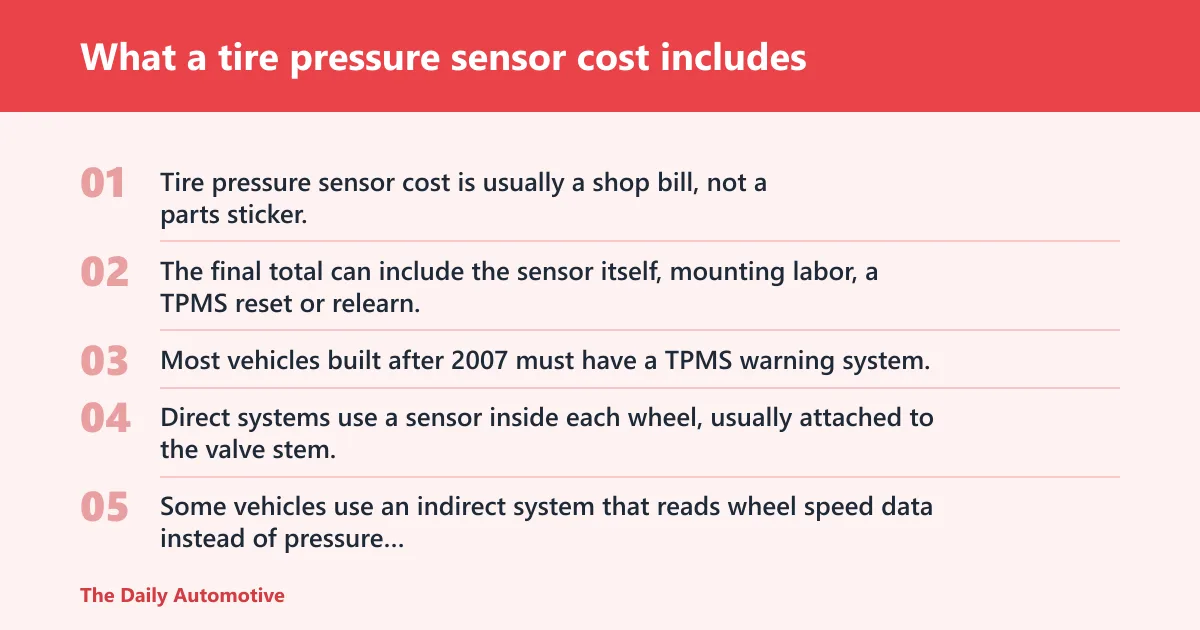
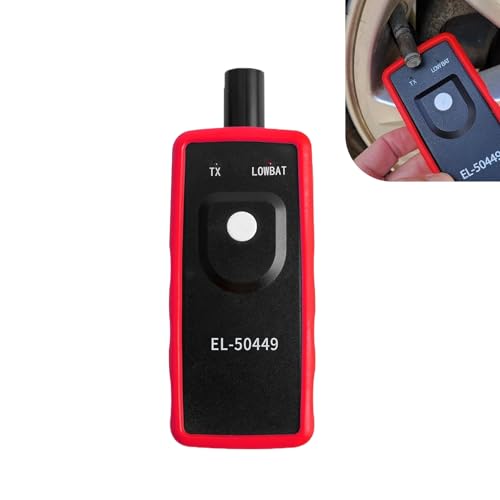


Tire pressure sensor cost is usually a shop bill, not a parts sticker. The final total can include the sensor itself, mounting labor, a TPMS reset or relearn, valve-stem hardware, and diagnosis if the warning light does not go away after air is added.
TPMS means tire pressure monitoring system. Most vehicles built after 2007 must have a TPMS warning system. Direct systems use a sensor inside each wheel, usually attached to the valve stem. Some vehicles use an indirect system that reads wheel speed data instead of pressure sensors inside the wheel. (en.wikipedia.org)
Sensor part price versus total installed price
The sensor part is only one piece of the bill. Aftermarket sensors often run lower than OEM parts, but the vehicle still needs labor, and many cars need a relearn or reset procedure after the new part is installed.
A quote that lists only the sensor price can look cheap. A quote that includes diagnosis, tire removal, mounting, balancing, and programming is usually clearer, even if the final number is higher.
Why labor, reset, and hardware change the bill
Wheel access matters. Some sensors come out with the tire removed from the wheel, which adds labor. If the valve stem, seal, or retaining hardware is worn, the shop may recommend replacing those pieces at the same time because TPMS service includes inspection of valve stems and tire condition.
That is why two quotes for the same warning light can differ by a lot. One may cover a quick reset. Another may include a damaged stem, a corroded sensor nut, and a diagnostic charge to find the fault.
How much does a tire pressure sensor cost to replace?
For one wheel, an installed price in the low hundreds is a common range. A dealer visit with an OEM sensor can run higher, especially when the vehicle needs specific programming or a more time-consuming relearn. A full set of four can often land somewhere in the hundreds to around a thousand, depending on part choice and labor.
Independent shops often sit in the middle because labor rates tend to be lower and aftermarket sensors may be available. DIY can cut labor, but it is not always the cheapest path once tire mounting, balancing, and a scan tool relearn are added.
Typical price ranges by shop type
- Independent tire shop: often the best middle-ground quote for parts, labor, and relearn.
- Dealer: usually higher, especially for OEM-fit sensors and vehicle-specific programming.
- DIY: parts may cost less, but you still need safe tire service tools, a tire gauge, and often a scan tool.
One-wheel and four-wheel example totals
| Line item | Typical one-wheel range | Typical four-wheel range |
|---|---|---|
| TPMS sensor part | $40–$120 | $160–$480 |
| Installation labor | $40–$90 | $160–$360 |
| Reset or relearn | $0–$60 | $0–$120 |
| Valve stem hardware | $10–$30 | $40–$120 |
| Diagnosis | $0–$100 | $0–$100 |
| Example total | $120–$350 | $360–$1,180 |
What affects TPMS replacement cost on your car?
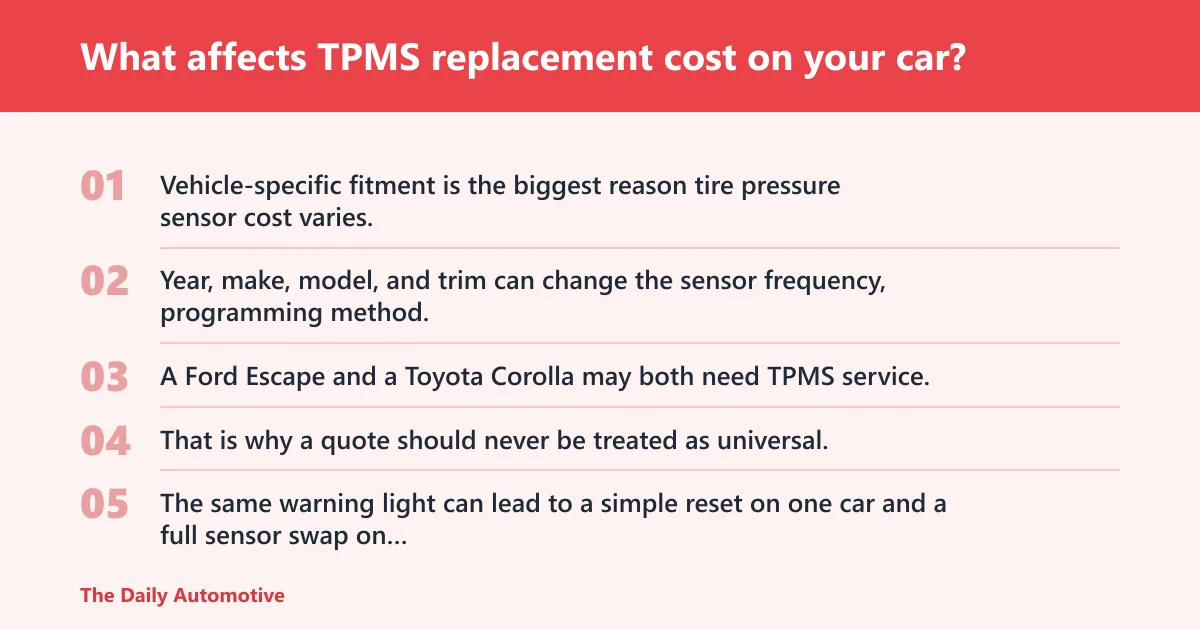
Vehicle-specific fitment is the biggest reason tire pressure sensor cost varies. Year, make, model, and trim can change the sensor frequency, programming method, wheel style, and labor time. A Ford Escape and a Toyota Corolla may both need TPMS service, but not the same parts or procedure.
That is why a quote should never be treated as universal. The same warning light can lead to a simple reset on one car and a full sensor swap on another.
Vehicle make, model, year, and trim
Year, make, model, and submodel differences matter because sensor IDs, wheel designs, and relearn steps can change from one version to the next. Even within the same model line, one trim may use a different wheel package or sensor part number.
For example, a base compact sedan may be cheaper to service than a higher-trim SUV with larger wheels and more involved tire mounting. The parts may look similar from the outside, but the quote can differ because the fitting steps are different.
Direct sensor versus indirect system
Direct TPMS systems use a sensor inside the wheel. Some of those sensors are mounted to the valve stem in direct systems. Indirect systems do not use a pressure sensor at each wheel; they read wheel speed data and infer pressure changes from rotation differences.
Indirect systems often cost less to service when the issue is only a reset. Direct systems cost more when a sensor, seal, or stem fails because the wheel has to come apart.
Valve-stem design and wheel access
Valve stem design changes labor. If the sensor is mounted to the valve stem or uses integrated hardware, a technician may need to replace the stem seal or retaining parts at the same time. Corrosion near the wheel opening can also slow the job.
A low-profile wheel, run-flat package, or stubborn bead can add time. That time becomes labor on the final invoice.
OEM versus aftermarket sensor pricing
OEM sensors usually cost more, but they may reduce fitment risk on vehicles that are sensitive to sensor ID or frequency. Aftermarket sensors can be a strong value when the part matches the car and the shop can program it correctly.
The cheaper part is not always the cheaper repair if it leads to a second visit for relearn or a sensor mismatch.
How to tell whether the TPMS light means low pressure or a fault
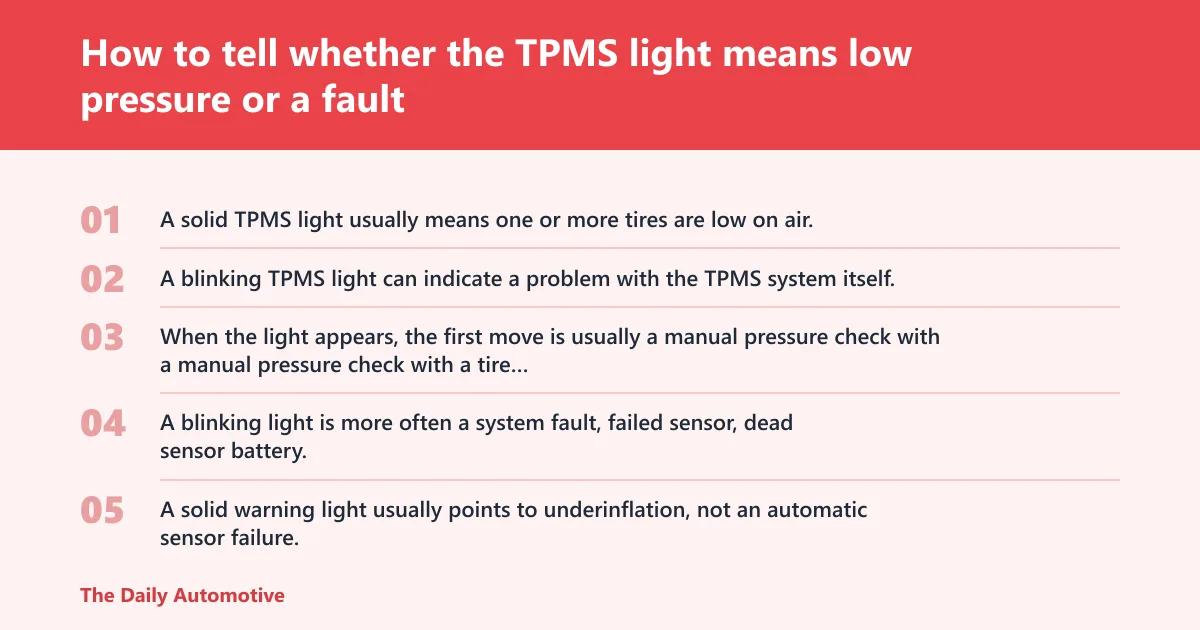
A solid TPMS light usually means one or more tires are low on air. A blinking TPMS light can indicate a problem with the TPMS system itself. When the light appears, the first move is usually a manual pressure check with a tire gauge at the valve stem.
That distinction matters. Low pressure is a tire issue first. A blinking light is more often a system fault, failed sensor, dead sensor battery, or communication problem.
Solid light meaning
A solid warning light usually points to underinflation, not an automatic sensor failure. Add air only after checking the tire pressure at the valve stem and comparing it to the placard on the driver-door jamb. Front and rear PSI can differ.
Blinking light meaning
A blinking light usually points to a TPMS system fault. That can mean a dead sensor battery, damaged sensor electronics, a wiring issue on some indirect systems, or a relearn that did not complete correctly.
When a manual tire-pressure check comes first
Before paying for TPMS service, check each tire with a gauge. A tire gauge is used manually at the valve stem to check pressure. If one tire is low, use an air compressor to refill it, but do not overfill. Then see whether the light clears after driving or a reset.
Say your compact SUV shows a solid TPMS light on a cold morning. The left front reads 27 PSI at the valve stem, while the placard lists 35 PSI for the front axle and 33 PSI for the rear. Filling the tire may solve the warning without replacing a sensor.
TPMS service cost breakdown
TPMS service can mean inspection only, a reset, or full replacement. A good quote separates the sensor, diagnostic labor, relearn or reset, valve-stem hardware, and any shop fee. That makes it easier to compare estimates and avoid paying for parts you do not need.
Sensor replacement
The sensor itself is the main parts cost. On many vehicles, it is a sealed unit with a battery that is not repaired separately. Once the battery dies, replacement is usually the fix.
Diagnostic labor
Diagnosis is useful when the light blinks, when one wheel will not relearn, or when the warning stays on after pressures are corrected. The shop may scan the system, check sensor IDs, and inspect the wheel end before replacing parts.
Relearn or reset
Some vehicles need a relearn after sensor replacement or after tire rotation. Tires Plus says it can inspect TPMS sensors and reset or restore the system. That kind of labor is often brief, but it still belongs on the estimate.
Valve stem and seal hardware
Valve stems are a common inspection point because the sensor may mount there in direct systems. A cracked stem, tired seal, or corroded nut can create a leak and trigger the warning light even when the sensor itself still works.
Example one-wheel and four-wheel totals
A one-wheel repair might include a single sensor, one stem kit, a tire mount and balance, and a relearn. A four-wheel job can raise the total sharply even if the labor per wheel is lower on a per-unit basis, because the parts count multiplies fast.
Suppose a driver has one failed sensor on a Toyota Corolla. The shop quotes $75 for the sensor, $55 for labor, $25 for a relearn, and $15 for stem hardware. The bill lands near $170 before tax. Replace all four sensors and the same car could move near $600 or more.
Can a TPMS sensor be repaired or does it need replacement?
Most failed TPMS sensors need replacement, not repair. The sealed sensor battery is not serviceable on typical road cars, and electronic faults are usually not worth opening up. The valve stem or seal can sometimes be repaired separately if the sensor electronics are still good.
If the whole unit has failed, replacement is the safer fix. If the leak is at the stem or seal, a hardware repair may solve the problem without buying four new sensors.
When the sensor itself is the problem
If the battery is dead or the sensor will not transmit, the sensor usually needs replacement. That is common on older vehicles or on systems with a long service interval on the original parts.
When the valve stem or seal is the failure point
A slow leak near the wheel opening may come from the stem, seal, or retaining hardware rather than the sensor body. In that case, the shop may replace the valve-stem parts and keep the sensor if it still reports correctly.
When the whole unit should be replaced
If the sensor does not transmit, fails to relearn, or is damaged during tire work, replacing the whole TPMS unit is usually the practical route. That is especially true when a low-cost hardware fix would still leave a weak battery behind.
How to check recommended tire pressure before you pay for service
Check the driver-door jamb placard before you approve TPMS service. Recommended tire pressure can be found there, and front and rear PSI may differ. A tire gauge at the valve stem tells you whether the tires are actually low or whether the warning points to a system problem.
If air is needed, use an air compressor and stop short of overfilling. Overinflation can create a new ride or wear problem while you are trying to fix an old warning light.
- Open the driver door and read the placard.
- Record the front and rear PSI values.
- Check each tire with a gauge at the valve stem.
- Inflate any low tire with an air compressor, but do not overfill.
- Recheck pressure and see whether the TPMS light clears after driving.
- If the light blinks or stays on, schedule TPMS service and diagnosis.
Frequently asked questions
How much does a tire pressure sensor cost to replace?
Most drivers pay $120 to $350 per wheel for a full replacement, including the sensor, labor, and a relearn or reset. Dealer pricing and OEM parts can push the bill above $400, especially when the vehicle needs extra diagnosis or valve-stem hardware.
How much do tire pressure sensors cost for my car?
Your exact cost depends on the year, make, model, trim, and TPMS design. A Ford Escape may need different parts or labor than a Toyota Corolla, and some trims use a different sensor or relearn method than the base model.
What affects TPMS sensor replacement cost?
Parts pricing, labor time, reset or relearn needs, valve-stem hardware, and diagnosis all affect the bill. OEM versus aftermarket parts also matters. A direct sensor system usually costs more to service than an indirect system when the wheel has to come apart.
Can a TPMS sensor be repaired or does it need replacement?
Most failed sensors need replacement because the battery and electronics are sealed. A valve stem or seal can sometimes be repaired separately, but a dead transmitter, damaged housing, or failed relearn usually means the full sensor unit should be replaced.
Do I need TPMS service if the warning light is blinking?
Yes. A blinking TPMS light usually points to a system fault, not just low air. Check tire pressure first, then have the system scanned if the light keeps blinking or will not clear after inflation and a reset.
How do I know if the TPMS light means low pressure or sensor failure?
A solid light usually means one or more tires are low on air. A blinking light usually means the TPMS system itself has a fault. The fastest first step is a manual check at the valve stem with a tire gauge.
Products related to this article
Sponsored / affiliate links. As an Amazon Associate I earn from qualifying purchases. I may earn additional commission from eligible campaigns.