Air Jack for Car: Tested & Reviewed (3 Picks)
The best air jack for most cars is the VEVOR 3 Ton Triple Bag Air Jack because its 6,600 lb rating, 5.5 to 17.7 inch lift range, and 3–5 second lift time match sedan and compact-car work well. Pick the wrong size and you can burn compressor air, run out of height, or get a lift that feels unstable. This guide compares three pneumatic air jacks by vehicle type, lift range, compressor demand, and safety fit.
Quick picks

| Use case | Best pick | Why it fits |
|---|---|---|
| Roadside tire changes | VEVOR 3 Ton Triple Bag Air Jack | Compact enough to carry, 6,600 lb capacity, and the 5.5-inch minimum suits many passenger cars. |
| Home garage use | VEVOR 3 Ton Triple Bag Air Jack | Fast lift, stable triple-bag layout, and a common 17.7-inch top end work well for routine brake and tire jobs. |
| SUVs and light trucks | VEVOR 5 Ton Triple Bag Air Jack | 11,000 lb capacity and 18.5-inch lift suit heavier vehicles better than a 3-ton unit. |
Top pick: VEVOR 3 Ton Triple Bag Air Jack
The VEVOR 3 Ton Triple Bag Air Jack is the best overall pick for most sedans because it balances capacity, lift height, and portability better than larger units. Its 6,600 lb rating and 5.5 to 17.7 inch range cover common passenger-car jobs without forcing you into a heavier, bulkier jack.
Why it wins for most sedans
This model fits the routine jobs: tire rotation, brake work, and roadside wheel changes on cars that do not need SUV-level lift. The triple-bag layout spreads load across more surface area than a simple two-bag design, and the steel support pipes add support against tilt and sticking.
Where its 5.5 to 17.7 inch range fits best
The 5.5-inch minimum matters on low cars. If your car sits close to the ground, a jack that starts too tall can fail before the bag fully inflates under the pinch weld or lift point. The 17.7-inch top end is enough for many sedans and coupes, but not every tall SUV or off-road truck.
What the 3 to 5 second lift claim depends
That speed depends on compressor output, hose flow, and the jack’s air path. A weak compressor can make a fast-rated jack feel slow, and a poor G1/4 connection can choke airflow. The jack is the tool; the compressor decides whether the lift feels quick or only looks quick on paper.
Quick picks by use case
- Best for roadside tire changes: VEVOR 3 Ton Triple Bag Air Jack
- Best for home garage use: VEVOR 3 Ton Triple Bag Air Jack
- Best for SUVs and light trucks: VEVOR 5 Ton Triple Bag Air Jack
Which air jack is best for roadside tire changes?
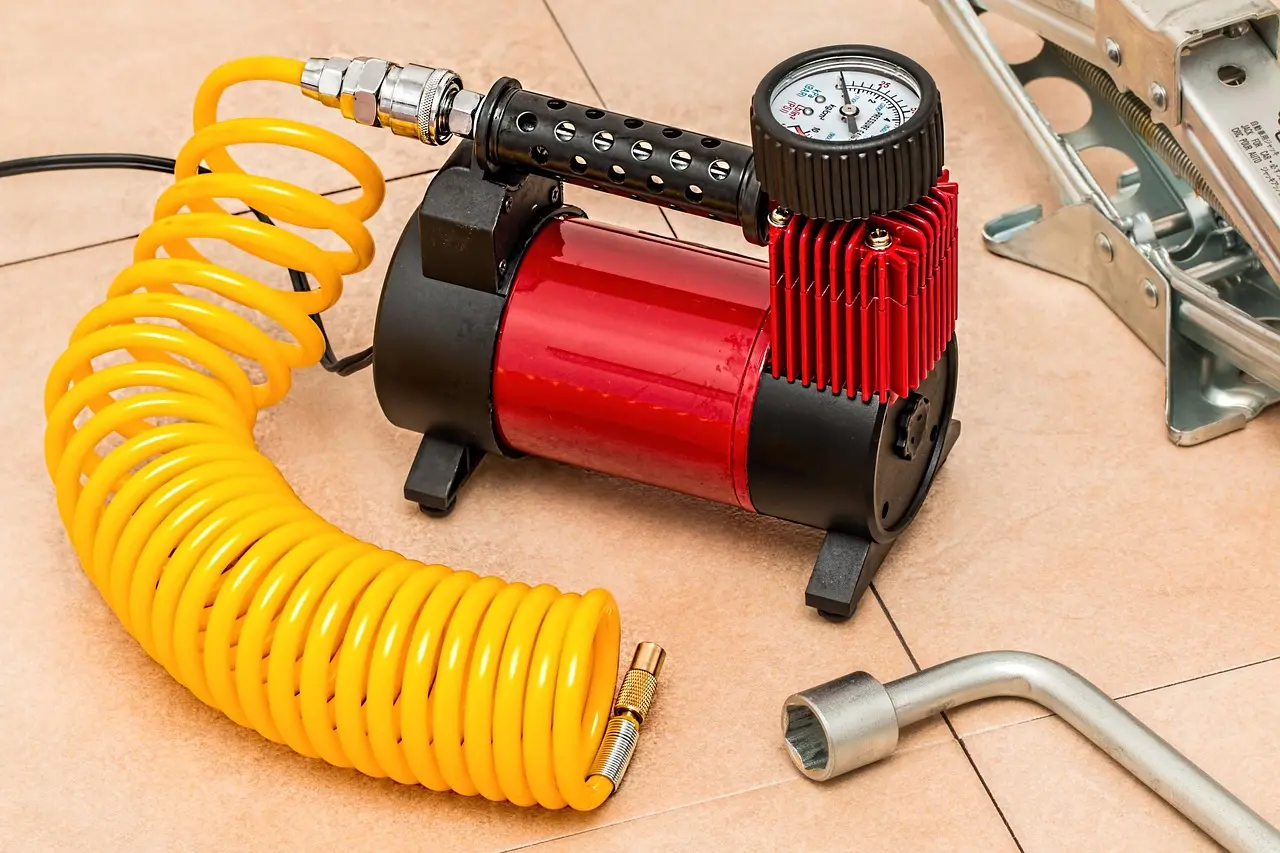
For roadside work, the best air jack is the one you can carry, place fast, and feed with a compressor you actually have with you or can reach. That usually points to a compact 3-ton triple-bag jack, because it fits more trunks and cargo areas than larger high-lift units.
Portability and trunk fit
Roadside use favors a small storage footprint over maximum lift. A 3-ton model is easier to stow in a sedan trunk, hatchback cargo floor, or SUV side well. A larger 5-ton or taller column-style jack may fit the vehicle better on paper, but it can be awkward to carry on a spare-tire run.
Say your sedan has a compact spare and a low trunk opening. A smaller jack is easier to store beside the tool kit, while a taller unit may eat too much cargo space and become annoying to move when you need it most.
Compressor access away from home
Roadside lifting is only as good as the air source. If you do not have a compressor in the vehicle, you need another plan, because most air jacks are not self-powered. A portable compressor with a G1/4 outlet connection is the practical standard to check before you buy.
Failure case: weak compressor or soft shoulder
A weak compressor can leave the jack half-inflated and slow to settle under load. On a soft shoulder, the base can sink or tilt, especially if the ground is uneven. That is where a stable jack stand and a firm pad under the base matter, even for a quick tire change.
Which air jack is best for a home garage?
For a home garage, stability and height range matter more than storage. The best choice is usually a triple-bag model with six steel pipes, because those features help the jack stay centered and move more cleanly under load during repeated lifting and lowering.
Why triple-bag and six steel pipe designs help
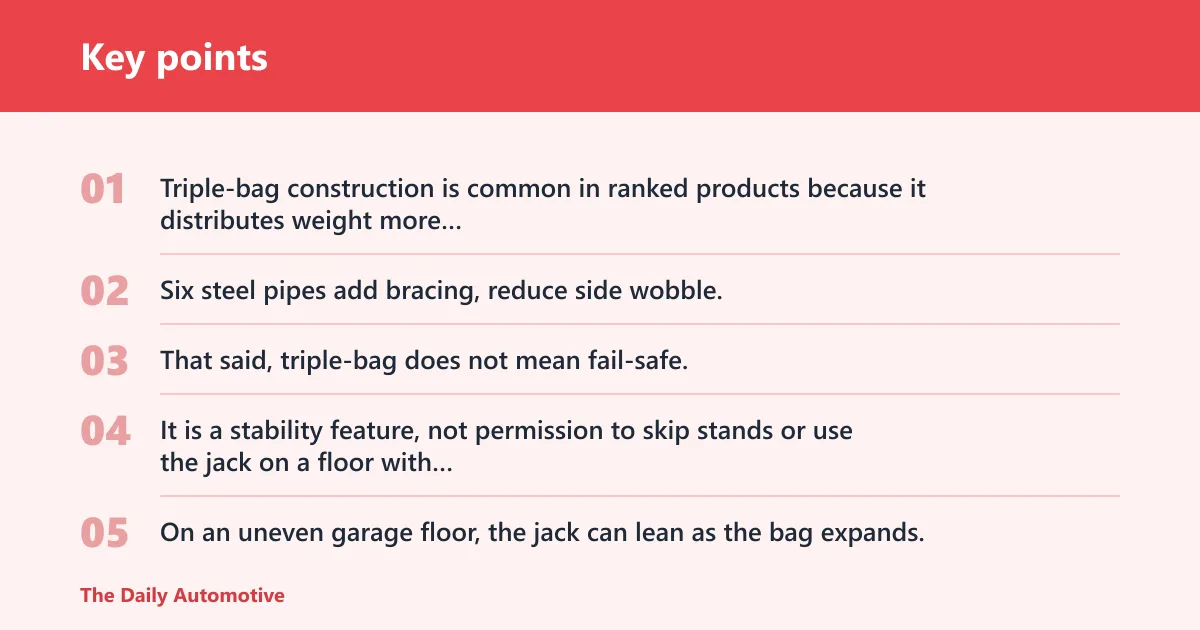
Triple-bag construction is common in ranked products because it distributes weight more evenly and can feel more stable under load than a simpler bag layout. Six steel pipes add bracing, reduce side wobble, and help resist jams when the jack is inflated on a proper flat surface.
That said, triple-bag does not mean fail-safe. It is a stability feature, not permission to skip stands or use the jack on a floor with slope, debris, or cracks.
Failure case: uneven floor or mis-centering
On an uneven garage floor, the jack can lean as the bag expands, which shifts the vehicle off center. If the lift point is not centered, the car can move on the saddle as pressure rises. That is when a jack that looked fine in the box starts feeling twitchy under load.
Simple ownership costs to expect
Air bags, seals, and hoses are wear items on pneumatic jacks. Replacement parts matter because a cheap jack with poor parts support can become expensive after a damaged bag or cracked hose. A buyer should treat consumables as part of the ownership cost, not an afterthought.
Which air jack is best for SUVs and light trucks?
For SUVs and light trucks, the VEVOR 5 Ton Triple Bag Air Jack is the better fit because its 11,000 lb capacity gives more margin, and its 18.5-inch lift reaches higher than the common 17.7-inch class. Heavy vehicles need capacity and height, not just speed.
When the 5.5 to 18.5 inch range is enough
The 5.5-inch minimum still works for many vehicles, but the real advantage is the top end. If your SUV has moderate ground clearance and you only need wheel changes, 18.5 inches may be enough. It is a better match than a 3-ton jack when curb weight and wheel travel leave little margin.
When a taller column-style jack makes more sense
A heightened column air jack variant makes more sense when you need extra clearance for taller vehicles or off-road suspension. These versions can reach 21.5 inches, and larger models go up to 26.5 inches. The better ones keep a low minimum height and use a thick rubber pad to meet the vehicle cleanly.
Picture a lifted SUV with larger tires and limited wheel well clearance. A standard 3-ton jack may stop short, while a taller column-style unit gives the extra rise needed to remove the wheel without stacking blocks or forcing the lift point.
Air jack decision matrix
| Vehicle type | Ground clearance | Compressor strength | Recommended jack | Failure case if the match is poor |
|---|---|---|---|---|
| Sedan or coupe | Low to moderate, around a 5.5-inch entry point | Small portable compressor with steady airflow | 3-ton triple-bag jack | Too-tall minimum height can prevent engagement; weak airflow slows the lift and may stall before full height. |
| SUV or light truck | Moderate to tall, needs more rise than a sedan | Medium compressor with decent output | 5-ton triple-bag jack | Undersized capacity can reduce margin and make the jack work too close to its limit. |
| Tall truck or lifted vehicle | High, with extra clearance needed | Strong compressor and reliable hose setup | Heightened column-style jack | A standard-height jack may run out of lift before the wheel clears, forcing unsafe improvisation. |
Choose by vehicle weight first, then by lift height, then by compressor and connection fit. A 3-ton jack suits many sedans and compact vehicles. A 5-ton jack makes more sense for SUVs and light trucks. A 6-ton class belongs with heavier vehicles or buyers who want extra margin.
3 ton versus 5 ton capacity
The 3-ton class, including the VEVOR 3 Ton Triple Bag Air Jack at 6,600 lbs, is the better default for cars. The 5-ton class, including the VEVOR 5 Ton Triple Bag Air Jack at 11,000 lbs, is the better match for SUVs and light trucks. Do not treat them as interchangeable.
How do you choose between a 3-ton and 5-ton air jack? Start with vehicle curb weight plus a margin for cargo, uneven load, and lift angle. If the vehicle is close to the 3-ton ceiling, move up to 5-ton. That margin costs less than a failed lift.
Lift height for low-profile cars and tall vehicles
Low-profile cars need a low minimum height, not just a big maximum. The common 5.5-inch minimum appears on many models and is a practical target for low cars. For taller vehicles, the 18.5-inch and 21.5-inch options matter more, and the larger 26.5-inch class exists for taller platforms.
G1/4 inlet valve and compressor compatibility
Check the G1/4 inlet valve before buying. That connection standard affects whether your hose and coupler fit cleanly. If the jack and compressor do not match, you can lose airflow, waste time, or end up buying adapters that defeat the point of a quick pneumatic setup.
Safety features that matter before price
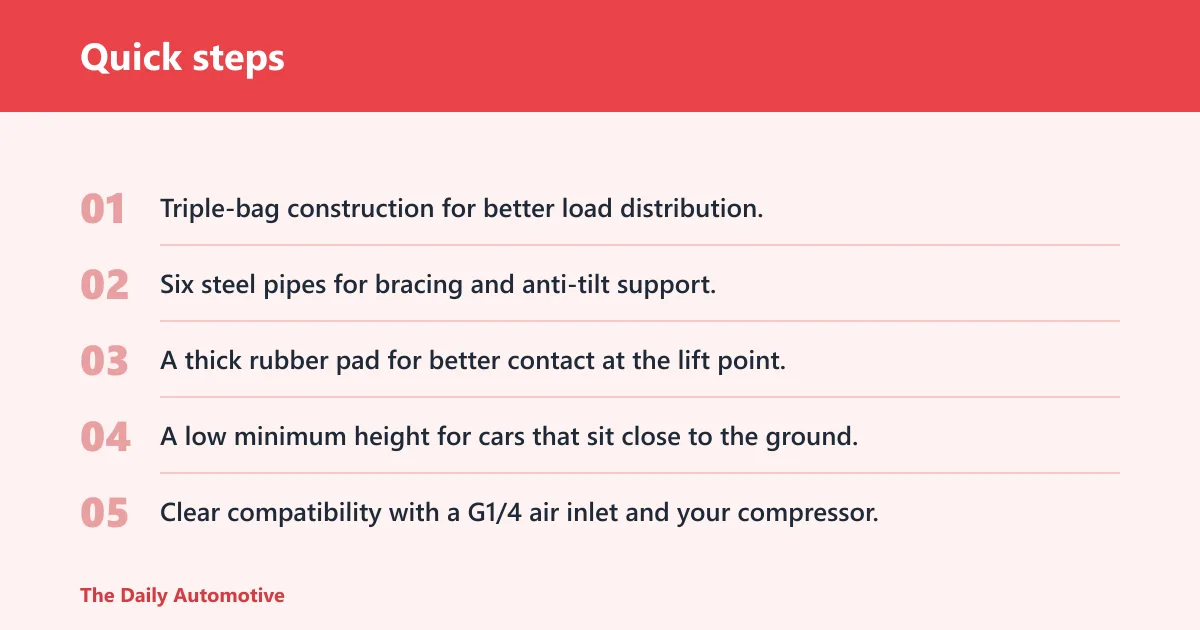
- Triple-bag construction for better load distribution.
- Six steel pipes for bracing and anti-tilt support.
- A thick rubber pad for better contact at the lift point.
- A low minimum height for cars that sit close to the ground.
- Clear compatibility with a G1/4 air inlet and your compressor.
Safety is also about setup. Use a level surface, center the jack under the lift point, and place jack stands before you work under the vehicle. A strong jack still fails the job if the ground is soft, the load is off-center, or the air supply is erratic.
Frequently asked questions
What is the best air jack for a car?
The best air jack for most cars is a 3-ton triple-bag model with a low minimum height and a compact footprint. The VEVOR 3 Ton Triple Bag Air Jack fits that job well because it combines 6,600 lb capacity with a 5.5 to 17.7 inch range and fast lift time.
How much lifting capacity do I need for my car or SUV?
For many sedans and coupes, 3 ton is the sensible floor. For SUVs and light trucks, 5 ton is the safer choice because it leaves more margin for curb weight and cargo. If the vehicle is heavy or lifted, a 6 ton class may be more appropriate.
Do air jacks require an air compressor?
Yes. Most air jacks require an air compressor, and most do not include one. Compressor output affects lift speed as much as the jack design does, so a low-flow unit can make even a fast-rated jack feel slow or incomplete.
What lift height should I choose for a low-profile car?
Choose a jack with a low minimum height, usually around 5.5 inches on common models, so it can fit under the car before inflation begins. If the car sits very low, a tall maximum lift is less important than getting the jack under the pinch weld cleanly.
Are triple-bag air jacks safer than two-bag models?
Triple-bag air jacks are generally better for load distribution and can feel more stable under pressure than two-bag models, but they are not automatically safer in every situation. Ground quality, centering, and proper jack stand use still decide whether the lift is actually safe.
Can I use an air jack for a truck or light SUV?
Yes, but match the jack to the vehicle. A 5-ton model is a better fit for many SUVs and light trucks than a 3-ton unit, and taller vehicles may need a heightened column-style jack with extra lift height. The wrong size can run out of travel too early.
Products related to this article
Sponsored / affiliate links. As an Amazon Associate I earn from qualifying purchases. I may earn additional commission from eligible campaigns.