Ancel AD310 OBD2 Scanner Review
The Ancel AD310 is a smart buy if you want a basic OBD2 code reader for check-engine lights on 1996-and-newer cars. Skip it if you need live data, ABS, SRS, or bidirectional functions. Buy the wrong scanner and you either miss the fault or pay for features you’ll never use. This review covers what the AD310 reads, what it cannot do, and who should buy it.
Verdict

That is enough for many driveway fixes. It is not enough for chassis, airbag, or deeper module diagnostics.
Specs at a glance
| Spec | AD310 detail |
|---|---|
| Product name | ANCEL AD310 Engine Code Reader |
| Type | Budget OBD2 code reader |
| Vehicle standard | OBD2 / OBD II for 1996+ U.S. vehicles |
| Supported regions | Most 1996 U.S.-based, 2000 EU-based, and Asian cars |
| Display | 128×64 LCD |
| Live data | Yes |
| I/M readiness | Yes |
| Freeze-frame data | Yes |
| Protocols | ISO9141, KWP2000, J1850 PWM, J1850 VPW, CAN |
| Operating voltage | 12 volts |
| Listed price | Tk 5,100.00 BDT |
Who it
The AD310 is for drivers who want a clear answer to a check engine light without opening an app or learning a full diagnostic menu. It also fits buyers who only need emissions readiness, a basic used-car precheck, or a quick read on generic engine codes.
It is not a good fit if you need ABS, airbag, body-module, or other deeper diagnostics. It also is not the right buy if you expect guided troubleshooting, service functions, or bidirectional controls. A beginner who only wants the MIL explained will get more value than a buyer chasing every warning lamp.
Say your car shows a check engine light after a loose gas cap. The AD310 can read the stored powertrain code, let you clear it after the cap is tightened, and show whether readiness monitors reset. It cannot confirm a bad wheel-speed sensor, because that is outside OBD2 engine diagnostics.
Pros and cons
- Pros: supports common OBD2 protocols and works on many 1996+ vehicles; compact format suits glove-box storage.
- Cons: no ABS, airbag, or bidirectional control support; it is engine-only by design.
- Cons: it gives limited help on intermittent or non-engine faults, where deeper data or a step-up scanner is more useful.
What works
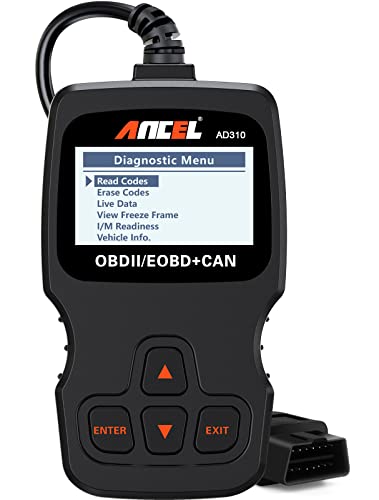
The AD310 does the core OBD2 jobs that most beginners actually need. That combination covers a surprising amount of driveway triage.
OBD2 means the 1996+ U.S. standard that uses a 16-pin DLC connection. On supported vehicles, that connector gives access to emissions-related engine faults, readiness monitors, and stored freeze-frame information. It does not open every module in the car. It opens the powertrain side first.
Live data matters when you want more than a code number. A reader that can show temperature, fuel trim, throttle position, or similar streams helps you judge whether a rough idle is consistent with a vacuum leak, a sensor reading, or a condition that comes and goes.
Freeze-frame data helps with intermittent faults because it stores a snapshot of conditions when the code set. That is useful when a misfire appears only at idle, on a cold start, or under light throttle. The AD310 can show that snapshot on supported vehicles.
Picture a used-car precheck before a weekend purchase. You plug in the scanner, confirm whether the MIL is on, check readiness monitors, and inspect the freeze-frame data for clues. That does not replace a full inspection, but it helps separate a simple emissions issue from a more questionable car.
How to use it
- Plug the scanner into the vehicle’s 16-pin OBD2 port with the ignition in the position the manual requires.
- Select the engine or diagnostics menu, then read the stored code and the pending code list if the vehicle supports it.
- Use live data only as a clue set, not a final diagnosis.
- Clear the code only after the repair is complete and you understand why it set.
What does not?
The main limitation is simple: the AD310 stops at basic OBD2 engine diagnostics. It does not read ABS, airbag, or other non-engine modules. If the warning light is for the brake system or supplemental restraint system, this tool will not diagnose that fault.
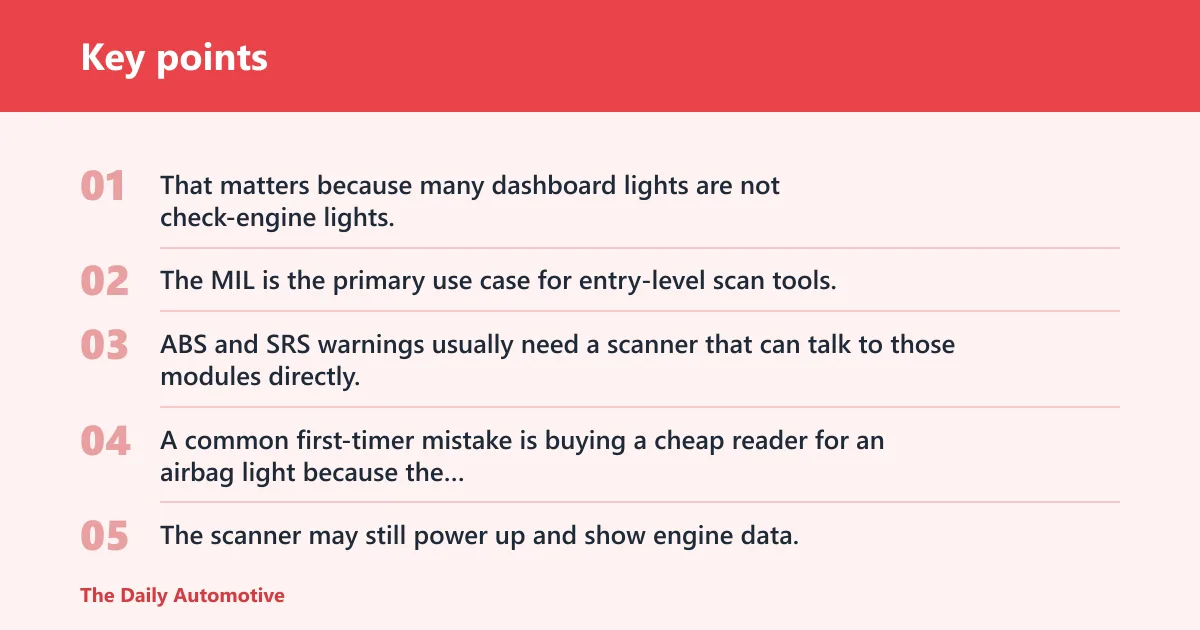
That matters because many dashboard lights are not check-engine lights. The MIL is the primary use case for entry-level scan tools. ABS and SRS warnings usually need a scanner that can talk to those modules directly, which is beyond the AD310’s scope.
A common first-timer mistake is buying a cheap reader for an airbag light because the price looks right. The scanner may still power up and show engine data, but the real problem will stay hidden. That is not a bad scanner. It is the wrong tool.
Another limit is interpretive depth. If a code comes back with a shaky idle and a noisy fuel trim trend, the AD310 can point you in the right direction, but it will not step through a guided test plan or run component commands. That is where a more capable scanner starts to earn its price.
AD310 decision table
| Scenario | Likely outcome | What the AD310 can confirm | What it cannot confirm | Step-up scanner worth it? |
|---|---|---|---|---|
| Check-engine light only | Usually a good fit for a quick diagnosis | Stored and pending engine codes, freeze-frame data, readiness status | Root cause if the fault needs deeper testing | No, unless the fault keeps returning |
| Emissions prep | Strong fit if you only need readiness checks | I/M monitor status and whether the car is ready or not ready | Why a monitor refuses to set | Maybe, if you need more guided diagnosis |
| Used-car precheck | Useful first filter before a purchase | Codes, readiness, and freeze-frame clues | Hidden chassis, body, or airbag faults | Yes, if you want broader module coverage |
| Intermittent misfire | Partly useful, but limited | Misfire-related powertrain codes and live data clues | The exact failing part without more diagnosis | Often yes |
| ABS light | Poor fit | Nothing useful for the ABS module on most vehicles | ABS fault codes and wheel-speed sensor detail | Yes |
| Airbag light | Poor fit | Usually nothing beyond basic engine information | SRS fault codes and restraint-system detail | Yes |
How it compares with the AD410
The AD410 is the step-up choice if you want a more capable ANCEL scanner and are willing to pay for it. In plain terms, the jump buys more diagnostic headroom. The AD310 is a basic reader. The AD410 is the model to consider when that basic level is no longer enough.
For a buyer who only wants engine codes and readiness, the AD310 is the cleaner buy. For a buyer who expects to diagnose beyond basic MIL work, the AD410 is the safer place to spend more. That difference is about user type, not badge prestige.
Here is the simple rule: buy the AD310 if your goal is light-duty engine diagnostics and emissions checks. Pay for the AD410 if you know you will be diagnosing problems often enough that deeper coverage will save time. If your use case is occasional, the cheaper reader is usually the smarter one.
Should you buy it?
Buy the AD310 if you want a low-cost OBD2 reader for a check engine light, readiness checks, or a quick used-car screen. It is especially sensible if you value simplicity and do not want to connect a phone or learn a long menu tree.
Skip it if you need ABS, airbag, or bidirectional functions, or if you regularly troubleshoot faults that require guided testing. A budget scanner is good value only when its limits match your job. If the job is broader, the wrong bargain becomes expensive.
The ownership math is straightforward. If the scanner prevents even one unnecessary shop visit, it can pay for itself quickly. At a typical diagnostic fee, a reader at this price is easy to justify after a single successful code check or readiness confirmation.
Follow the vehicle and product manual. For under-hood work, keep fuel, coolant, and electrical tasks ventilated, with no sparks, and disconnect the battery when the manual calls for it.
Frequently asked questions
Is the Ancel AD310 worth it for checking a check engine light?
Yes. For a basic MIL issue, the AD310 covers the main job: read the code, clear it after repair, and check readiness on supported vehicles. If your only goal is to identify why the light is on, it is one of the more practical entry-level buys.
What can the Ancel AD310 actually read and clear?
It reads and clears engine fault codes, including generic and manufacturer-specific powertrain codes on supported OBD2 vehicles. It does not extend into ABS or airbag modules.
Does the Ancel AD310 work on all 1996+ cars?
No. It works on many 1996 U.S.-based cars and is also listed for most 2000 EU-based and Asian cars, but not every vehicle or non-OBD2 system. Check the manufacturer’s listing for your model, especially if the car is region-specific or older than the standard applies to.
Can the Ancel AD310 read ABS or airbag codes?
No. ABS and airbag systems are outside the AD310’s basic OBD2 engine-only scope. If the warning lamp is for brakes or supplemental restraint systems, you need a scanner that supports those modules directly. The AD310 is the wrong tool for that job.
Is the AD310 good enough for emissions readiness checks?
Yes, for basic readiness screening. That is useful before a smog test. It will not explain every monitor failure, but it gives the key pass-fail snapshot.
What is a good OBD2 scanner to buy for a beginner?
If you want the simplest answer for check-engine lights, the AD310 is a solid beginner choice. If you already know you will need deeper module access or more advanced diagnostics, move up a level instead of buying twice. Start with the job you actually have.
Products related to this article
Sponsored / affiliate links. As an Amazon Associate I earn from qualifying purchases. I may earn additional commission from eligible campaigns.