Automatic Emergency Braking Review: Worth It?
Automatic emergency braking is worth paying for if you drive in traffic, around pedestrians, or in stop-and-go commuting. Treat it as a must-have on a daily driver, but as a lower priority on a highway-only car with weak calibration. Skip it, and you may pay more in rear-end damage, sensor calibration, and higher insurance claims after a low-speed hit. This guide weighs crash-avoidance evidence, repair and calibration costs, and the driving conditions where AEB pays for itself.
This guide is part of our Car safety features: types, functions and legal basics series.
What automatic emergency braking actually does
Automatic emergency braking, or AEB, is a collision-mitigation system that warns the driver and, if needed, applies the brakes automatically. It usually targets front-to-rear impacts, and in some vehicles it also supports pedestrian detection. The system can reduce speed before impact, but it cannot guarantee a stop. (Motortrend)
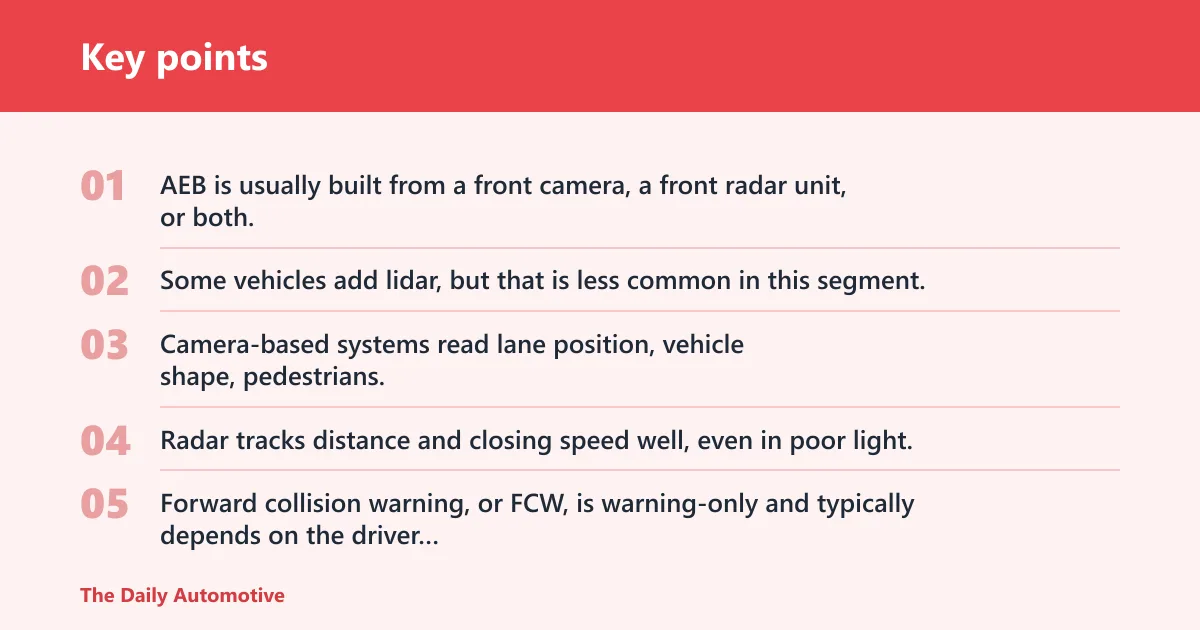
AEB is usually built from a front camera, a front radar unit, or both. Some vehicles add lidar, but that is less common in this segment. Camera-based systems read lane position, vehicle shape, pedestrians, and sign contrast better in good light. Radar tracks distance and closing speed well, even in poor light, but can still be limited by heavy dirt, snow, or unusual reflections.
How AEB differs from forward collision warning
Forward collision warning, or FCW, is warning-only and typically depends on the driver to brake. It depends on the driver to brake. AEB goes one step further and can intervene automatically if the driver does not react in time. Many vehicles bundle FCW and AEB together, but they are not the same feature.
That difference matters in real use. FCW can still be valuable if you want a timely alert and prefer full control of braking. AEB is the active layer that may reduce impact speed when a driver is distracted, late on the pedal, or caught by a sudden stop. If the warning is muted, ignored, or poorly calibrated, FCW alone does little.
Why false positives and false negatives matter
AEB is not perfect. A false positive is a brake event when no crash threat exists, such as braking for a shadow, a guardrail reflection, or a turning vehicle that is no longer in the path. A false negative is the opposite: the system misses a real hazard.
Those errors affect ownership value. Too many false positives make a system annoying and can reduce driver trust. Too many false negatives mean the feature may look good on a window sticker without doing enough in the situations that matter most. The best systems balance sensitivity with restraint.
Automatic emergency braking review matrix
| Use case | City commute | Highway driving | Winter weather | Used-car purchase | Insurance impact | Repair/calibration risk | Expected benefit level | Verdict |
|---|---|---|---|---|---|---|---|---|
| Bumper-to-bumper commuter | High | Low | Depends | Useful if verified | Possible discount | Moderate | High | Yes |
| Highway-heavy driver | Low | High | Depends | Less critical | Possible discount | Moderate to high | Medium | Depends |
| Snow belt owner | Medium | Medium | Low to medium | Verify sensor health | Possible discount | High | Medium | Depends |
| Used-car buyer | Medium | Medium | Depends | High | Possible discount | High if repaired poorly | Medium to high | Yes, if verified |
Picture a commuter sedan crawling through school-zone traffic. AEB can be useful there because closing speeds are modest, stops come often, and the most common claims are low-speed rear-end hits. Now picture a long-distance highway cruiser with a dirty front badge and a chipped windshield. The feature still helps, but only if the sensor suite is healthy and properly calibrated.
Does AEB work at highway speeds?
AEB can work at highway speeds, but its payoff is narrower than many buyers expect. It is best at reducing closing speed in front-to-rear scenarios, not at solving every fast-road hazard. It is not a substitute for following distance, mirror checks, or lane discipline.
Closing-speed limits in real traffic
At higher speeds, the energy involved rises quickly, so AEB has less room to erase the crash. Many systems are strongest in lower-speed urban use and become more limited as speed and time-to-impact shrink. On fast roads, the system may reduce severity instead of avoiding contact entirely.
Lane-change and cut-in scenarios
Cut-ins are a good example of where AEB can be uneven. If a car moves into your lane and then brakes hard, the system may react well if it tracks the lead vehicle cleanly. If the cut-in is abrupt, the sensor view is blocked, or the other driver changes lanes at the last moment, the response can be late or absent.
AEB also does not solve the judgment problem in lane changes. It cannot tell you whether the vehicle ahead is about to clear out of the lane, and it cannot read intent with certainty. On highways, it is a backstop, not a planning tool.
Does AEB work in rain, snow, or at night?
AEB can work in rain, snow, and darkness, but performance often drops as visibility falls or sensors get dirty. Radar tends to hold up better than camera-only systems in low light, while camera-based detection usually does better with lane and object classification when conditions are clear. Heavy precipitation changes both.
How dirt, glare, and heavy precipitation affect sensors
Front cameras can be blinded by glare, fogging, road spray, or a dirty windshield. Radar is less bothered by darkness, but snow buildup, mud, and bumper damage can still distort readings. Glare from low sun can also create false readings on some camera-heavy systems.
Suppose a crossover leaves a salted parking lot with slush packed around the front sensor cover. The warning may still appear, but braking intervention can become less reliable until the vehicle is cleaned. That is why winter owners should treat sensor cleanliness as part of daily driving, not an afterthought.
Pedestrian detection in crosswalks and turns
Pedestrian detection AEB is most useful in urban driving, especially at crosswalks, during turns, and when someone steps into the lane from between parked cars. Many systems are tested in both day and night scenarios, because performance can change sharply with lighting and contrast.
Its limits matter. Poor visibility, dark clothing, heavy rain, snow, and partial occlusion can all reduce detection quality. AEB can help, but it should not be treated as a pedestrian shield. The driver still has to scan intersections and turning paths carefully.
What are the costs and downsides of AEB?
The main downsides are false alarms, repair complexity, and cost after a front-end hit or windshield replacement. Many owners also overlook that the same tech that helps prevent crashes can make a small repair more expensive. That tradeoff matters most on cars with camera-and-radar systems or windshield-mounted sensors.
Windshield and bumper repair bills
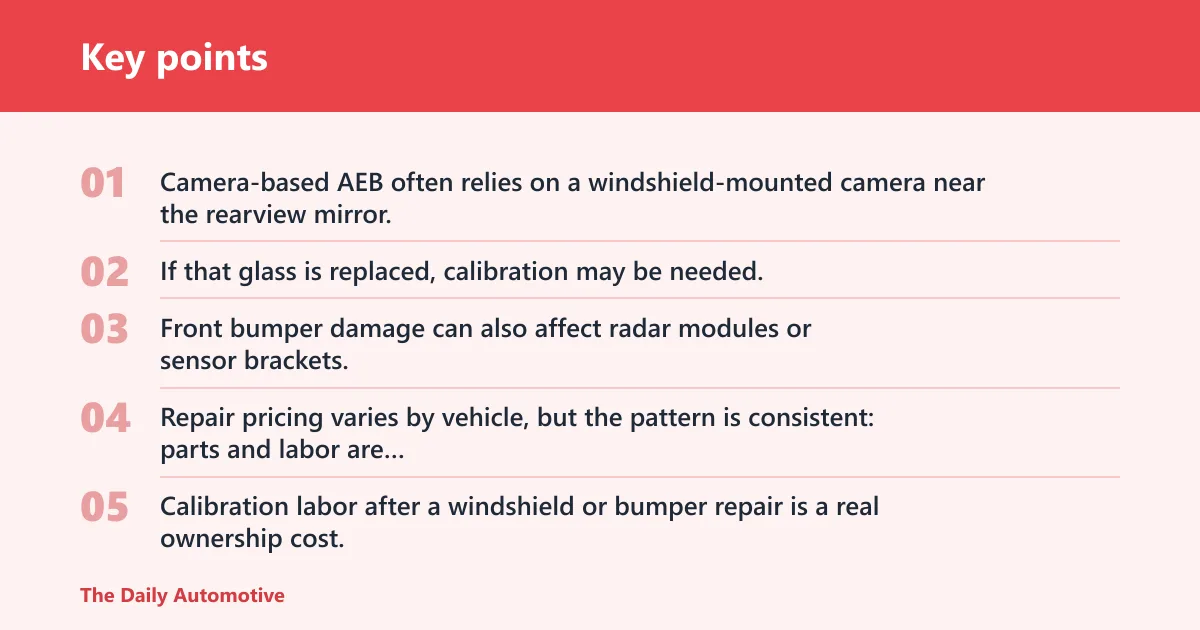
Camera-based AEB often relies on a windshield-mounted camera near the rearview mirror. If that glass is replaced, calibration may be needed. Front bumper damage can also affect radar modules or sensor brackets, and even a minor parking-lot hit can turn into a more involved repair than a basic bumper cover swap.
Repair pricing varies by vehicle, but the pattern is consistent: parts and labor are higher when sensors are involved. Calibration labor after a windshield or bumper repair is a real ownership cost, not a dealer upsell. If the system is not calibrated correctly, it may warn late, brake too early, or flag a fault light.
Insurance discounts versus ownership costs
Some insurers offer a premium discount for vehicles equipped with automatic braking, but the size of the discount is often modest. The value case depends on how often the system helps avoid claims versus how often sensor-related repairs occur. A low-speed urban driver may come out ahead more easily than a highway-only owner who rarely needs it.
The ownership math is simple enough: if AEB helps prevent even one rear-end claim, it can justify itself quickly. If the vehicle needs repeated calibration after windshield work, or if the sensor suite is fragile in your climate, the cost-benefit line moves closer to break-even.
Is AEB standard on new cars, and how do you verify it?
AEB is common on new cars, but standard equipment depends on model, trim, and package. Some brands include a strong system across the line; others reserve better sensors, pedestrian detection, or highway-speed coverage for higher trims. Do not assume the badge tells you what the car actually has.
Standard equipment versus optional packages
Two vehicles with the same nameplate can have very different AEB hardware. One trim may get camera-plus-radar coverage and pedestrian detection, while a lower trim may have only basic warning logic or a less capable system. Read the feature list for the exact trim, not just the brochure headline.
IIHS and NHTSA-style evaluation matters here because test results can change by trim or package. Safety ratings often separate vehicles by the presence of specific driver-assist equipment. Day and night tests, vehicle-to-vehicle scenarios, and pedestrian tests help show whether the system is more than a marketing line.
Used-car checklist for trim, repair history, and system operation
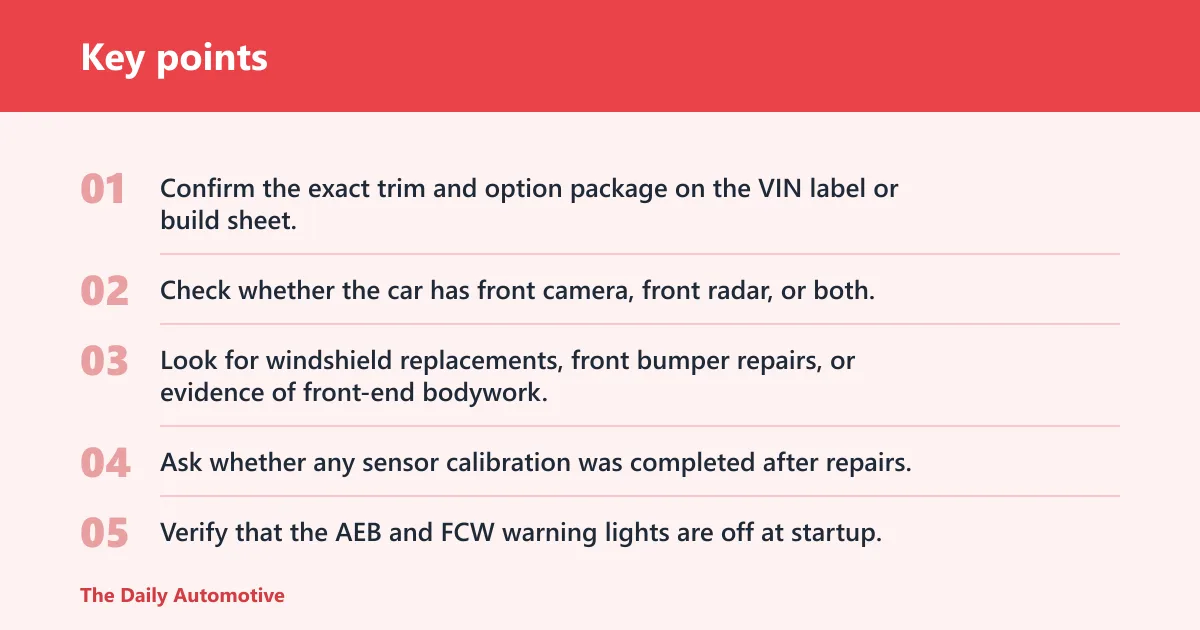
- Confirm the exact trim and option package on the VIN label or build sheet.
- Check whether the car has front camera, front radar, or both.
- Look for windshield replacements, front bumper repairs, or evidence of front-end bodywork.
- Ask whether any sensor calibration was completed after repairs.
- Verify that the AEB and FCW warning lights are off at startup.
- Test the system only in a safe, controlled environment described by the owner’s manual.
- Compare the vehicle’s safety rating notes for the exact trim, not the model name alone.
Used-car shoppers should be especially careful. A common first-timer mistake is assuming every trim of a popular crossover has the same braking tech, then learning after purchase that the car has FCW only, or that a previous windshield repair left the system uncalibrated.
Frequently asked questions
Is automatic emergency braking worth it?
Yes, for most daily drivers. AEB is most valuable in traffic, around pedestrians, and in stop-and-go commuting where closing speeds are lower and reaction time matters. It is less compelling on a highway-only vehicle if the system is basic, poorly rated, or expensive to repair.
How does automatic emergency braking work?
AEB uses a front camera, radar, or both to watch the road ahead and estimate collision risk. If the driver does not respond to a warning, the system can apply braking pressure automatically. The goal is impact reduction, not perfect crash prevention.
Can automatic emergency braking prevent rear-end crashes?
It can reduce or avoid many rear-end crashes, especially at city speeds and in stop-and-go traffic. It is not guaranteed, though. Sudden cut-ins, poor sensor visibility, and high closing speed can limit the system’s ability to stop in time.
What are the downsides of automatic emergency braking?
The main downsides are false alarms, higher repair costs, and calibration needs after windshield or bumper work. Some systems also become less reliable in rain, snow, dirt, or glare. AEB helps most when the sensors are clean and the hardware is correctly calibrated.
How is automatic emergency braking different from forward collision warning?
FCW warns the driver and depends on human braking. AEB can warn and then brake automatically if needed. In a traffic emergency, that difference matters. Warning-only systems still help attentive drivers, but they do not add automatic intervention.
Should I prioritize AEB on a used car?
Yes, if the car will be used for commuting, city driving, or family transport. Prioritize the feature only after checking the exact trim, repair history, and calibration status. A used car with intact sensors and verified operation is more valuable than one with unknown bodywork history.
Products related to this article
Sponsored / affiliate links. As an Amazon Associate I earn from qualifying purchases. I may earn additional commission from eligible campaigns.