Adaptive Cruise Control Review: Is It Worth It for You?
Adaptive cruise control is worth paying for if you drive mostly on highways or long, steady commutes. If most of your mileage is city traffic, tight parking, or snowy roads, skip it unless the option price is modest. Ignore that split and you may pay for a feature that adds little relief while still demanding attention. This guide weighs commute pattern, option cost, fatigue, family use, city driving, and winter behavior.
This guide is part of our Car safety features: types, functions and legal basics series.
Adaptive cruise control: the verdict


Buy it for highway-heavy driving, mixed commuting with real congestion, or long trips where small reductions in speed changes and pedal work matter. Skip it for short city hops, frequent winter slush, or stop-start routes with lots of cut-ins unless the package price is low and you also want the other driver aids bundled with it.
ACC holds a preset speed and adjusts for a vehicle ahead using radar, cameras, or both. Most systems let you change the following gap from close to far, and some add stop-and-go traffic support. The value is real, but it depends on where you drive.
When ACC is worth paying for
- You spend meaningful time on freeways, ring roads, or long suburban arterials.
- Your commute includes steady congestion where stop-and-go support can cut fatigue.
- The trim/package also includes lane centering or other aids you actually want.
- The option price is small relative to the car, not a large jump for one feature.
When you can skip it
- You mostly drive relatively short city trips with frequent merges and cut-ins.
- Your roads are often packed with snow, slush, ice, or road grime.
- You dislike brake pulses, low-speed creep, or constant gap adjustments.
- ACC is bundled only in an expensive package you do not otherwise need.
What adaptive cruise control does, and what it does not
ACC is cruise control with a lead-car sensor suite. It holds a set speed when the lane is open, then slows or speeds up to maintain a chosen gap when traffic is ahead. It does not remove the need to steer, check mirrors, or supervise the road.
How ACC uses radar and forward-looking cameras
Radar sensors measure distance to the vehicle ahead and help the system modulate throttle and braking. A forward-looking camera can help identify traffic, lane markings, and sometimes support curve-speed reduction or posted-limit changes on advanced systems. Snow, ice, mud, fog, rain spray, and road grime can block either sensor type.
Some systems react to traffic more smoothly than others. The best ones feel calm on a freeway. The worst ones hesitate in cut-in traffic or brake earlier than a human driver would like.
How it differs from conventional cruise control
Standard cruise control keeps a set speed and ignores traffic ahead. ACC automatically adjusts speed relative to the vehicle ahead, which matters most on multilane roads and in variable traffic. That difference is why ACC feels helpful in congestion and nearly irrelevant on empty roads.
Why the driver still has to steer and supervise
ACC is driver assistance, not autonomy. ACC alone is SAE Level 1. ACC paired with lane centering can rise to SAE Level 2, which still requires full supervision. Level 5 defines a self-driving car, and ACC is nowhere near that by itself. (motortrend.com)
Lane keep assist and lane centering can reduce workload further, but they do not replace the driver. Lane centering keeps the car positioned in the lane; ACC manages speed and following distance. They are separate functions.
Is adaptive cruise control worth it on your commute?
It is worth it when your commute repeatedly creates the same kind of fatigue: long highway stretches, slow freeway merges, or stop-and-go bottlenecks. It is less worth it when the drive is short, urban, and full of interruptions. Annual mileage matters because more miles mean more chances to benefit from reduced pedal work and steadier spacing.
Highway commuting
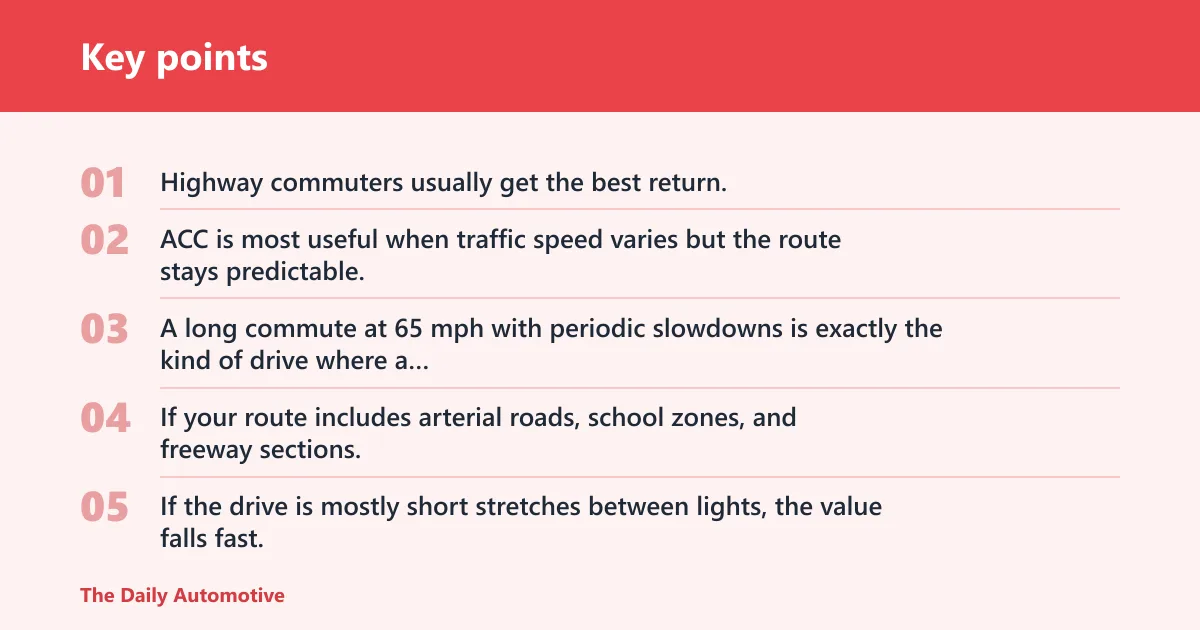
Highway commuters usually get the best return. ACC is most useful when traffic speed varies but the route stays predictable. A long commute at 65 mph with periodic slowdowns is exactly the kind of drive where a gap-setting cruise system can cut fatigue without becoming a nuisance.
Mixed suburban commuting
Mixed suburban use is a middle case. If your route includes arterial roads, school zones, and freeway sections, ACC can still help, especially if your package includes lane centering. If the drive is mostly short stretches between lights, the value falls fast.
City driving
City-first shoppers often get less from ACC than brochures suggest. Frequent cut-ins, pedestrians, cyclists, narrow gaps, and abrupt stops can make the system feel jumpy or overcautious. It can still help in traffic jams, but for short urban trips the annoyance risk often competes with the benefit.
Winter and poor-weather driving
Winter drivers should be careful. Snow, slush, salt spray, ice, and grime can interfere with radar and camera visibility. Even when the system stays active, the sensor may be more cautious or less consistent. If your winter commute regularly covers dirty roads, ACC may spend too much time limited or deactivated.
| Commute profile | Fatigue reduction | Traffic usefulness | Annoyance risk |
|---|---|---|---|
| Highway | High | High | Low |
| Mixed suburban | Medium | Medium-High | Medium |
| City | Low-Medium | Medium | High |
| Winter | Medium | Medium | Medium-High |
Pros and cons of adaptive cruise control
ACC can lower effort on long drives and reduce how often you chase speed changes with your right foot. The tradeoff is that the system can feel conservative, slow to react to sudden changes, or irritating in dense traffic. That split is why commute pattern matters more than brochure language.
Pros
- Maintains a set speed while adjusting for slower traffic ahead.
- Can reduce fatigue on highways and long commutes.
- Usually offers adjustable following-distance settings from close to far.
- Stop-and-go versions can help in traffic jams.
- Pairs well with lane centering for lower workload.
Cons
- May not react quickly enough to sudden braking ahead.
- Can feel jerky with frequent cut-ins or short gaps.
- Weather and debris can block sensors and limit function.
- Some systems need a manual resume after coming to a stop.
- It still requires attention, steering, and intervention.
How stop-and-go and traffic jam assist change the equation
Stop-and-go ACC matters because it extends the system into slow traffic, where ordinary cruise control shuts off. Some systems can brake to a complete stop, and some are marketed as traffic jam assist when they are tuned for crawling congestion. That makes them more useful in commuting than basic ACC.
Can ACC brake the car to a stop?
Yes, some stop-and-go ACC systems can come to a complete stop. That is especially useful in bumper-to-bumper traffic and freeway backups. But the feature does not mean hands-free driving, and it does not guarantee that the car will restart on its own.
When the car resumes for you, and when you must resume manually
Some systems require manual resume after stopping. That means you may need a tap on the accelerator, a resume button, or a driver prompt before traffic pulls away again. Always verify this on the trim you are shopping, because the behavior varies by manufacturer and system aggressiveness.
Why low-speed creep can feel helpful or irritating
Low-speed creep can take the edge off stop-and-go traffic, but it can also feel awkward in tight gaps. Suppose your lane keeps moving briefly and then stopping again. A system that creeps too eagerly may force extra brake use, while one that waits too long can make traffic feel laggy.
What to test on a drive before you buy
Test the system the way you actually drive. A smooth freeway demo is not enough if your daily route has merges, cut-ins, and slow traffic. You want to judge gap control, stop-restart behavior, and whether the sensors stay confident when the road gets dirty or the weather turns.
- Check following-gap behavior at the closest and farthest settings. The closest setting should feel usable without inviting constant cut-ins. The farthest setting should not leave you feeling like traffic is cutting into your lane every few seconds.
- Watch cut-in response and brake smoothness. The system should slow without harsh surges or late braking. A little firmness is normal; repeated jerkiness is a warning sign.
- Test stop-and-go resume behavior. Confirm whether the car resumes by itself after a full stop or whether you must prompt it manually. That detail matters in heavy traffic.
- Inspect sensor visibility and weather-debris exposure. Ask where the radar and camera are placed, then look for likely blockage points from slush, dirt, or heavy rain spray.
- Try it in the kind of traffic you live with. A system that is calm at 70 mph may still annoy you at 20 mph.
A common first-timer mistake is setting the gap too short, then blaming ACC when a cut-in forces abrupt slowing. Start with a longer gap, then shorten it only if the system still feels calm and predictable on your usual roads.
Who should buy adaptive cruise control?
High-mileage commuters, long-distance drivers, and families who take regular freeway trips are the strongest candidates. Seniors and new drivers can also benefit from lower workload, but only if they understand that ACC still needs supervision. City-first shoppers who spend most of their time in tight traffic often should not pay much for it.
High-mileage commuters
These drivers get the clearest return. If your work commute is fairly long and involves repeated speed changes, ACC can reduce the strain of constant pedal work. The benefit rises again if your route includes traffic jams or long highway stretches.
Families and long-distance drivers
Families who take regular road trips often appreciate the extra calm on interstates. ACC can reduce fatigue for the primary driver and make long segments less tiring. It is especially useful when paired with lane centering on newer vehicles.
Seniors and new drivers
ACC can help reduce workload, but it does not remove the need to monitor traffic and judge gaps. New drivers should learn what the system does and does not do before relying on it. Seniors may prefer it if the interface is simple and the gap settings are easy to understand.
City-first shoppers who may not need it
If most trips are short, low-speed, and filled with pedestrians or tight merges, ACC may be more of a nice-to-have than a must-have. That is especially true if the option price forces you to give up other useful equipment such as better headlights, winter tires, or parking aids.
Frequently asked questions
Is adaptive cruise control worth it on a daily commute?
Yes, if your commute includes highways, ring roads, or steady congestion. It is less compelling for short city trips or routes with constant stoplights and cut-ins. The best value comes from repeated use, so annual mileage and traffic pattern matter more than the feature name.
Does adaptive cruise control work in stop-and-go traffic?
Yes, if the vehicle has stop-and-go functionality or traffic jam assist. Some systems can crawl with traffic and even stop completely. Check whether the car resumes automatically or needs a manual prompt, because that detail changes how useful it feels in real traffic.
How does adaptive cruise control differ from standard cruise control?
Standard cruise control holds a fixed speed and ignores the vehicle ahead. ACC automatically adjusts speed relative to the vehicle ahead, which makes it far more useful in traffic and on multilane roads. That extra capability is also why the sensor system can be limited by weather or debris.
Can adaptive cruise control brake the car to a stop?
Yes, many stop-and-go ACC systems can bring the vehicle to a complete stop. Some will restart only after a manual input. That makes them useful in traffic jams, but it does not turn the car into a self-driving system or remove the need to supervise.
What are the limitations of adaptive cruise control in bad weather?
Snow, ice, rain spray, fog, mud, and road grime can block radar sensors and forward-looking cameras. When that happens, the system may deactivate or reduce function. Winter drivers should treat ACC as helpful when conditions are clean, but not something to count on when sensors are caked with slush.
Is adaptive cruise control self-driving?
No. ACC alone is SAE Level 1, and even ACC with lane centering is only SAE Level 2, which still requires supervision. Level 5 is the self-driving benchmark. ACC can reduce workload, but it does not replace an attentive driver.
Products related to this article
Sponsored / affiliate links. As an Amazon Associate I earn from qualifying purchases. I may earn additional commission from eligible campaigns.