Blind Spot Monitoring vs Rear Cross Traffic Alert Guide
Blind Spot Monitoring vs Rear Cross Traffic Alert comes down to direction: choose BSM for lane-change risk, and choose RCTA for reverse-angle risk. If you can only prioritize one, pick BSM for most highway driving and RCTA for frequent backing. Mixing them up can leave you exposed to sideswipes or backing collisions, the two crashes these systems are meant to reduce. This guide explains how each system works, where each matters most, and how trim availability can affect your choice.
This guide is part of our Car safety features: types, functions and legal basics series.
| Decision factor | Blind Spot Monitoring | Rear Cross Traffic Alert | Winner |
|---|---|---|---|
| Primary driving task | Lane changes and highway merging | Backing out of parking spaces and driveways | Tie |
| Sensor placement | Rear bumper or mirror-mounted sensors | Corner radar sensors in the rear bumper | Tie |
| Alert style | Mirror indicator light, chime, or vibration | Beep, visual cue, or seat rumble | Tie |
| Best help in tight parking lots | Limited | Strong | Rear Cross Traffic Alert |
| Best help on multilane roads | Strong | Limited | Blind Spot Monitoring |
| Reverse-only safety add-on | No | Yes, especially when paired with Rear Automatic Braking | Rear Cross Traffic Alert |
What’s the difference between blind spot monitoring and rear cross traffic alert?
Blind Spot Monitoring watches the blind spots to the sides and just behind the car, so it matters most when you change lanes or merge. Rear Cross Traffic Alert watches for vehicles crossing behind you while you reverse, so it matters most when you back out of a spot or driveway.
Plain-English definition of blind spot monitoring
BSM uses sensors in the rear bumper or mirror area to detect hard-to-see vehicles beside you. Many systems warn with a mirror indicator light, and some add a chime or vibration if you signal while something is there. That makes it a lane-change aid, not a reverse-driving system.
Plain-English definition of rear cross traffic alert
RCTA checks for vehicles approaching from the left or right as you reverse. It commonly uses corner radar sensors in the rear bumper and usually warns with beeps, a visual cue, or a seat rumble. Its job is to catch cross traffic you may not see through the rear glass.
Why people confuse these features
Both systems warn about traffic that is hard to see, both are often bundled in driver-assist packages, and both may use audio plus visual alerts. The key split is motion direction: BSM watches side and rear-adjacent traffic while moving forward, while RCTA watches side-crossing traffic while reversing.
How do the sensors and alerts work?
BSM and RCTA use similar hardware, but they watch different zones and issue warnings in different situations. BSM is built around lane-change awareness. RCTA is built around reverse-angle awareness, often with sensors in the rear corners.
Typical BSM sensor locations and warning types
Blind-spot monitoring uses sensors in rear bumpers or side mirrors to detect vehicles that are hard to see. Alerts often include a side-mirror light, and some vehicles add sound or vibration if you signal while something is there. That combination is why it is highly useful for highway lane changes.
Typical RCTA sensor locations and warning types
Rear cross traffic alert commonly uses corner radar sensors in the rear bumper. As you back up, it checks for vehicles coming from the left or right and warns with beeps, visual cues, or a seat rumble. It is aimed at tight spaces where sightlines are poor.
How Rear Automatic Braking fits in when paired with RCTA
Some vehicles combine RCTA with Rear Automatic Braking. That feature can apply the brakes if cross traffic appears not to be stopping, and it is generally used only when reversing. It is separate from RCTA, which warns first and does not itself brake the vehicle.
Why a backup camera is related but not the same thing
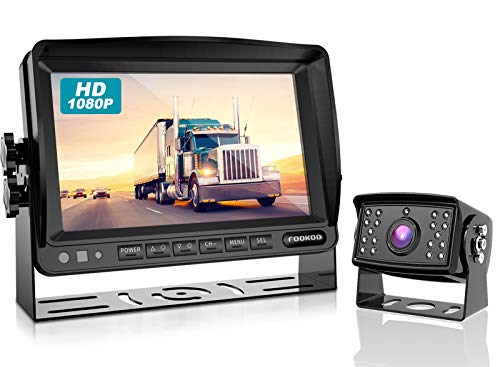
A backup camera shows the area behind the vehicle while reversing, but it does not by itself detect cross traffic. Parking-sensor systems are different again: they mainly detect stationary obstacles near the rear bumper and do not reliably detect moving cross traffic. That separation matters when you are comparing features on a spec sheet.
Which driving situations does each feature help with?
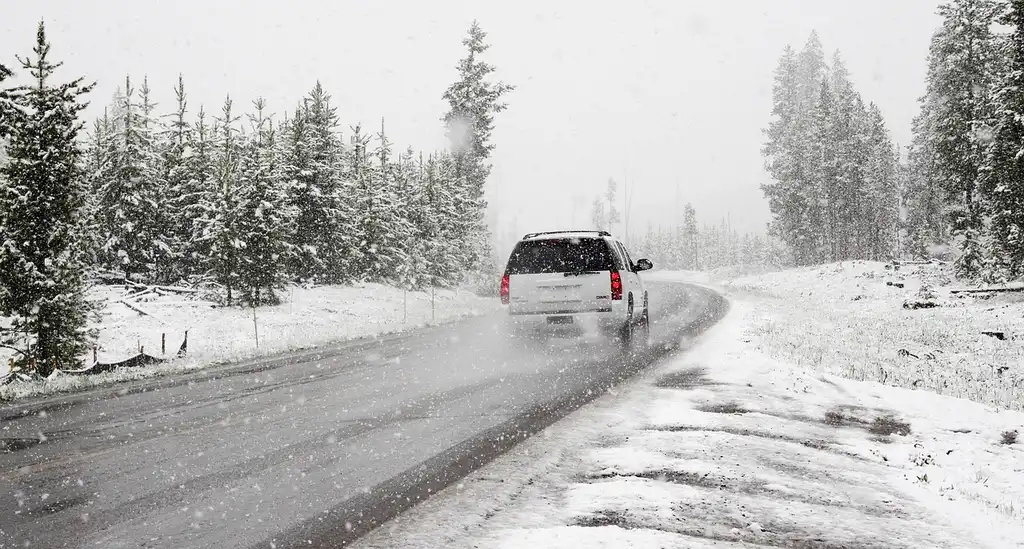
Use BSM for lane-change and merging risk. Use RCTA for reverse-angle risk. If your routine includes both highway lanes and tight backing maneuvers, the features solve different problems and do not substitute for each other.
Lane changes and highway merging
BSM is the clear fit here. It is highly useful for highway lane changes because it watches for vehicles sitting in the blind spot or closing from behind in the next lane. RCTA does not help in this forward-moving situation.
Backing out of angled parking spaces
RCTA is the clear fit here. Angled spaces can hide cross traffic until the last second, and corner radar sensors in the rear bumper are designed to catch that movement. BSM does not monitor this reverse path.
Driveway exits with blocked side view
RCTA helps when shrubs, walls, or parked vehicles block the view as you reverse out of a driveway. The system checks for vehicles approaching from the left or right, which is the exact risk at many neighborhood exits. BSM is not intended for this task.
City parking lots and crowded aisles
RCTA is more relevant in parking lots because vehicles can appear from between rows as you back out. BSM can still matter once you are driving through the lot and merging between lanes, but the reverse exit is where RCTA earns its place. Parking sensors may help with fixed obstacles, not moving cross traffic.
Reversing with limited rear visibility
RCTA is the feature built for this problem. A backup camera helps you see behind the vehicle, but it does not predict a car entering the lane behind you. If visibility is blocked, RCTA adds motion detection that the camera alone cannot provide.
Decision matrix: BSM vs RCTA by driving scenario
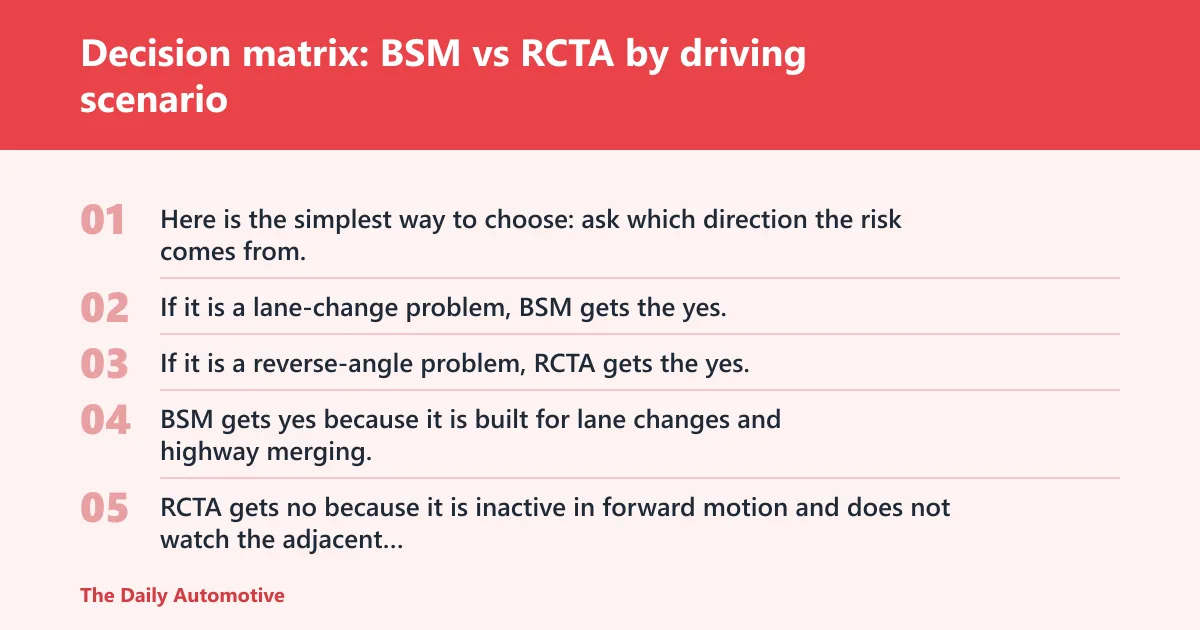
Here is the simplest way to choose: ask which direction the risk comes from. If it is a lane-change problem, BSM gets the yes. If it is a reverse-angle problem, RCTA gets the yes.
| Driving scenario | Blind Spot Monitoring | Rear Cross Traffic Alert | Winner |
|---|---|---|---|
| Highway merging | Yes | No | Blind Spot Monitoring |
| Backing out of angled parking | No | Yes | Rear Cross Traffic Alert |
| Driveway exits | No | Yes | Rear Cross Traffic Alert |
| City parking lots | Sometimes | Yes | Rear Cross Traffic Alert |
| Reversing with blocked visibility | No | Yes | Rear Cross Traffic Alert |
Highway merging: yes or no
BSM gets yes because it is built for lane changes and highway merging. RCTA gets no because it is inactive in forward motion and does not watch the adjacent lanes while you are driving ahead.
Backing out of angled parking: yes or no
RCTA gets yes because it monitors cross traffic while you reverse. BSM gets no because the risk is behind and to the sides, not in the lane-change zone BSM covers.
Driveway exits: yes or no
RCTA gets yes for the same reason. A driveway often creates a partial blind exit, and the system watches for vehicles crossing behind the rear corners. BSM does not replace that reverse check.
City parking lots: yes or no
RCTA gets the stronger yes because city lots create frequent reverse exits with traffic moving across your path. BSM may help later when you re-enter travel lanes, but the key hazard in the lot is the reverse crossing move.
Reversing with blocked visibility: yes or no
RCTA gets yes because it is designed for that exact pattern. Cameras show you the view, but RCTA adds motion detection from the left or right rear corners. BSM is not a backing aid.
Do you need both features?
Many drivers benefit from both because they solve different crash patterns. If you drive on highways and also back out of tight spaces, the combined coverage is practical. If you can only buy one, the better choice depends on where you spend more time.
When BSM matters more
BSM matters more if your miles are mostly on multi-lane roads, interstates, or dense traffic where lane changes happen often. It is also the stronger pick if your main worry is missing a fast vehicle in the blind spot during a merge.
When RCTA matters more
RCTA matters more if you regularly back out of angled parking spaces, long driveways, or crowded apartment lots. It is the more specific tool for reverse-angle risk, especially when side visibility is blocked by taller vehicles.
When both are worth paying for
Both are worth paying for when you split time between commuting and urban parking. A common first-timer mistake is treating a backup camera as enough. A camera helps you see; BSM and RCTA help you detect moving traffic outside the camera’s field of view.
When budget or trim limits force a choice
Choose the feature that matches your most repeated risk. For highway-heavy drivers, start with BSM. For drivers who back out of tight parking every day, start with RCTA. That is the cleanest trade when the trim sheet forces one or the other.
What can each system miss?

No driver-assist sensor is perfect, and the weak spots matter when you compare them. Fast-approaching motorcycles, angled traffic, dirty sensors, and add-on hardware can all interfere with detection. That is why you still check mirrors and look around.
Fast-approaching motorcycles and narrow vehicles
BSM may miss a motorcycle that approaches quickly or is positioned in a less typical part of the blind spot. Narrow vehicles can also be harder to classify than a full-size car. RCTA has similar limits when a vehicle enters the zone at speed from a sharp angle.
Angled or unusual traffic paths
Both systems work best when other vehicles move in predictable paths. An angled approach, a fast turn, or a vehicle cutting across a lot can reduce warning time. That is one reason why these systems support careful mirror checks rather than replace them.
Dirty, iced-over, or blocked sensors
Rear bumper sensors can fail to see well when dirty, iced over, or covered by road grime. If a sensor is blocked, warning coverage can degrade or stop. This matters for both BSM and RCTA because both rely on sensor line of sight.
Trailer hitches, bike racks, and add-on accessories
Trailer hitches, bike racks, and other add-ons can interfere with rear sensors. That can reduce RCTA performance in particular, since its sensors sit in the rear corners. Owners of pickup trucks and vehicles with frequent accessory use should pay close attention to the owner’s manual warnings.
Pedestrians and cyclists near the rear corners
RCTA can help spot moving cross traffic, but it should not be treated as a pedestrian detector in every case. It may be especially useful when cyclists or people move across the rear corners, yet it is still a warning system, not a guarantee. Always check around the vehicle before reversing.
Which cars and trims offer them, and how are they packaged?
Availability changes by brand, trim, and option package. Some automakers bundle BSM and RCTA under a Driver Confidence package or a similar driver-assist package, while others split them across trims. The names vary, but the buying rule is the same: verify the equipment list, not the brochure headline.
Common bundle names such as Driver Confidence packages
Packages may combine BSM, RCTA, and related alerts under a single name. That is common on compact SUVs and family crossovers, and it is one reason shoppers see the two features sold together instead of separately. The package label is not standardized across brands.
Why availability changes by brand and trim
Some trims get both systems standard, while others reserve them for higher trims or add-on safety groups. That is especially common when automakers use package ladders to separate convenience features from core safety equipment. Check the exact trim sheet before assuming the feature is present.
What to verify on a spec sheet before buying
- Look for the exact feature name: Blind Spot Monitoring, Rear Cross Traffic Alert, or both.
- Check whether it is standard equipment or part of an option package.
- Confirm whether Rear Automatic Braking is included or listed separately.
- Read the exclusions for trailers, racks, or sensor-blocking accessories.
- Verify that the system applies to the trim you plan to buy, not just the model line.
How to spot naming differences between automakers
Automakers do not always use identical labels. One brand may say blind spot warning, another may say blind spot monitoring, and another may fold it into a broader driver-assist suite. The function matters more than the label, so compare the description line by line.
Choose Blind Spot Monitoring if… / Choose Rear Cross Traffic Alert if…
Choose Blind Spot Monitoring if your driving is mostly lane changes, highway merges, and dense traffic where the danger comes from the side. Choose Rear Cross Traffic Alert if you back out of angled spaces, driveways, or crowded lots on a regular basis. If you do both every week, get both. If budget forces one pick, match the feature to the risk you face most often.
Choose Blind Spot Monitoring if…
Choose BSM if you spend more time on highways than in parking lots. Choose it if you worry about lane-change crashes, if you drive a sedan or compact SUV in commuter traffic, or if you want a clear mirror-based alert while moving forward.
Choose Rear Cross Traffic Alert if…
Choose RCTA if your parking routine includes frequent reverse exits, especially in apartments, schools, or crowded retail lots. Choose it if visibility is blocked by taller vehicles, walls, or landscaping, or if you want an alert that covers moving traffic behind the car while backing up.
Frequently asked questions
What is the difference between blind spot monitoring and rear cross traffic alert?
BSM watches the blind spots to the sides and just behind the vehicle, mainly for lane changes and merging. RCTA watches for traffic crossing behind you while reversing. The key difference is direction: BSM is for forward travel changes, and RCTA is for reverse-angle exits.
Which is better: blind spot monitoring or rear cross traffic alert?
Neither wins in every case because they solve different problems. BSM is usually the better single pick for highway drivers, while RCTA is the better single pick for drivers who back out of tight spaces often. The right answer depends on the risk you face more often.
Do I need both blind spot monitoring and rear cross traffic alert?
You need both if you split time between highway driving and frequent parking-lot reverses. Together they cover lane-change risk and reverse-angle risk. If your budget only allows one, pick the feature that matches your most common driving scenario.
Does blind spot monitoring help when backing out of a parking spot?
Not in the way RCTA does. BSM is designed for lane changes and merging, not for reversing out of a parking space. If the concern is cross traffic behind you while backing up, RCTA is the system built for that task.
Does rear cross traffic alert work when changing lanes?
No. RCTA is active when you reverse, not when you change lanes moving forward. Lane-change warning belongs to BSM, which watches the side and rear blind spots while you are driving ahead.
What is lane change assist vs blind spot monitor?
Lane change assist is a broad term some automakers use for a package of warnings or steering support tied to lane changes. Blind spot monitor is the specific feature that warns you when a vehicle is in the blind spot. Do not lump it together with lane keeping or lane centering; those are different systems.
Can rear cross traffic alert detect pedestrians or bikes?
It may detect some moving pedestrians or cyclists near the rear corners, but it is not a dedicated pedestrian-detection system. It is tuned for cross traffic while reversing, and it can miss people or bikes in unusual paths. Use it as a warning aid, not a final check.
What happens if blind spot monitor and rear cross traffic alert are unavailable?
You fall back on mirrors, shoulder checks, and a backup camera for reversing. If the vehicle lacks both features, a careful test drive and a close read of the trim sheet matter more, because you may need to prioritize a higher trim or a package that adds the systems you want.
Products related to this article
Sponsored / affiliate links. As an Amazon Associate I earn from qualifying purchases. I may earn additional commission from eligible campaigns.