Rear Cross Traffic Alert Review: Is It Worth It?
Rear Cross Traffic Alert can be worth paying for when it adds roughly $500 to $700 or less, especially if you often back out of crowded parking spaces. It is low priority if you already have a clear rear camera and good mirrors. Skip it, or pay less for it, if repairs, trailer hitches, or bike racks are likely, because radar sensors hidden in the bumper can be costly to recalibrate or replace. This guide explains what RCTA catches, which trims make sense, and where ownership quirks cut its value.
Verdict: when RCTA is worth it

Buy RCTA when you back out of blind parking spaces often, especially in shopping lots, apartment garages, or school pickup lines. It is a useful second set of eyes for vehicles approaching from either side behind you, but it does not replace mirrors, a shoulder check, or a rear camera.
Bottom-line take for daily drivers
For a daily driver, RCTA usually makes sense when it comes bundled with other useful safety items, or when the trim jump is small. The feature works only in Reverse, so it helps during backing maneuvers, not while the car is parked. That makes it a focused tool, not a general safety upgrade.
When the extra cost makes sense
Pay more when you regularly reverse from spaces where tall SUVs, vans, trucks, or landscaping block sightlines. RCTA is especially helpful in parking lots with blocked views from taller vehicles. It adds value when the camera view is too narrow to catch a car moving in from the side.
When a camera and sensors are enough
If the car already has a good backup camera plus parking sensors, and your backing is mostly in open driveways or small home lots, RCTA is less compelling. Backup cameras and parking sensors handle different jobs, and they already cover many buyers well enough. In that case, the extra radar may be a nice-to-have rather than a must-have.
Pros and cons of RCTA
Pros
- Catches vehicles approaching from either side behind the car while you are reversing.
- Uses rear-mounted radar sensors, not only a camera image, so it can detect movement outside the camera frame.
- Warns with an audible chime and a visual alert, such as a mirror indicator or backup-camera graphic.
- Can reduce slow-speed backing surprises in crowded lots and narrow driveways.
Cons
- It depends on clean, aligned rear radar sensors behind the bumper corners.
- Dirt, snow, rain, ice, trailers, bike racks, and walls can interfere with detection.
- False alerts can happen near shopping cart corrals or low walls.
- It does not replace looking around before moving.
Warning-only RCTA versus automatic braking
Basic RCTA generally warns and does not stop the car. It does not stop the car. Some vehicles add reverse automatic braking on higher trims or packages, and that is a different feature. If braking is included, the car can apply the brakes when a collision is imminent, which changes the value equation for newer drivers or dense garage use.
What RCTA actually detects
Rear cross traffic alert typically uses rear-mounted radar sensors to detect approaching vehicles while reversing. The system typically activates when you shift into Reverse, and the sensors sit behind the rear bumper corners. Most versions are tuned for low-speed backing maneuvers and short-range detection, not for parked use.
Rear-mounted radar sensors and Reverse activation
The radar units often sit behind plastic bumper covers and look across the path behind the car. That placement lets them detect motion from either side as you back up. They are not the backup camera, and they are not designed to watch the car while parked.
Alerts you may hear or see
Drivers usually get an audible chime plus a visual cue. Depending on the brand, that cue may be a mirror indicator, a screen warning, or a directional graphic in the backup-camera display. The output style varies by manufacturer, but the goal is the same: warn you fast enough to stop.
Why detection range varies by brand and model
Manufacturers tune these systems differently. Many systems are described as detecting traffic from roughly 20 meters away, but the usable alert window depends on vehicle speed, the angle of approach, and how the software filters moving objects. Some systems require the vehicle to be moving below a low speed such as under 7–9 mph.
That speed limit matters. A fast-moving car crossing behind you may trigger earlier than a slow one, but every setup behaves a little differently. Toyota lists an approaching-vehicle range of about 5–34 mph on some models, while Ford lists about 4–37 mph for some Cross Traffic Alert systems.
When does RCTA pay off?
RCTA pays off when your backing view is blocked and cross traffic can enter the path from the side. That includes crowded lots, angled parking spaces, long driveways with hedges or parked cars, and garages where a neighboring SUV hides an approaching vehicle until the last second.
Parking lots and driveway backing
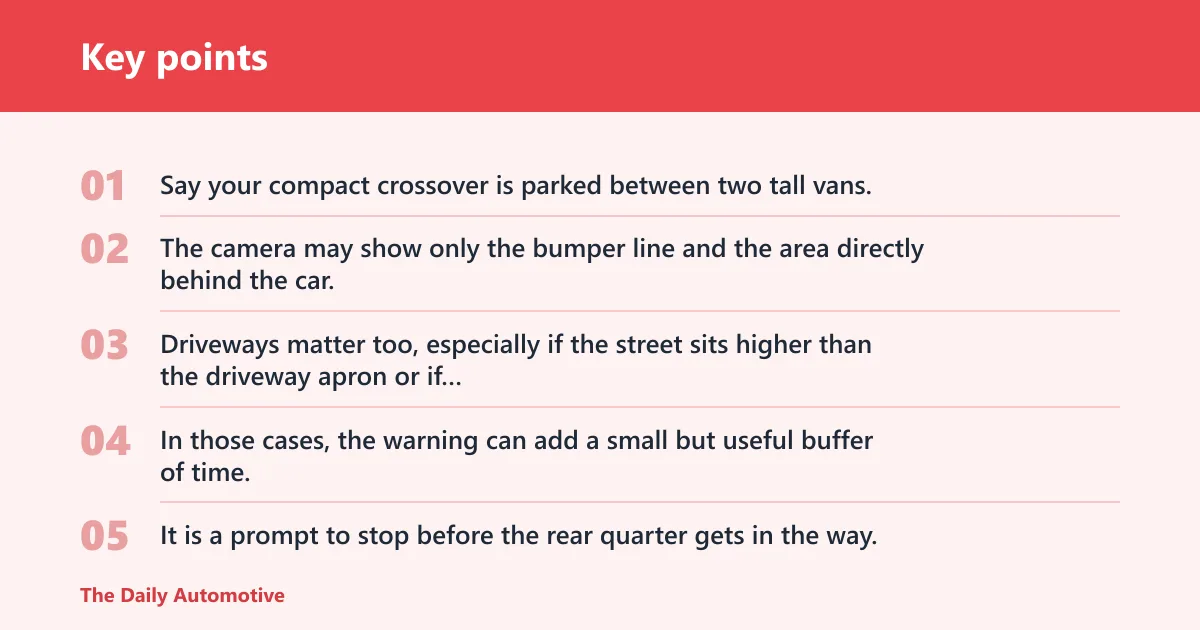
Parking lots are the clearest use case. Say your compact crossover is parked between two tall vans, and a sedan passes behind at low speed. The camera may show only the bumper line and the area directly behind the car, while RCTA adds an alert from the side before the sedan enters the rear path.
Driveways matter too, especially if the street sits higher than the driveway apron or if fences block the view. In those cases, the warning can add a small but useful buffer of time. It is not magic. It is a prompt to stop before the rear quarter gets in the way.
Older drivers, new drivers, and city parkers
Older drivers may value the extra cue when neck rotation is limited, but the feature still works best when used as a prompt rather than a substitute for checking. New drivers often benefit from the added warning discipline, especially in shared parking lots where timing gaps are hard to judge.
City parkers also get strong value because they back out into traffic more often and deal with tighter sightlines. If you parallel park, garage park, or use street parking with frequent pedestrian and bike movement behind the car, RCTA is easier to justify than it is for a suburban driveway.
Tall SUVs and minivans with blocked sightlines
Taller SUVs and minivans are frequent RCTA winners because they sit high enough to block a driver’s view of lower cross traffic. If you cannot see around adjacent vehicles, the radar adds coverage in a zone the camera cannot always clear. That is where the feature earns its keep.
Rear cross traffic alert decision table
The table below shows when RCTA is worth paying for and when another feature matters more. Read it as a trim-decision guide, not a universal ranking. A strong camera and parking sensors may be enough for some buyers, while reverse automatic braking can matter more for others.
| Driving scenario | Visibility problem | Added value | Common failure mode | Prioritize |
|---|---|---|---|---|
| Crowded grocery lot | Tall vehicles block the view of cars crossing behind | Early warning before a hidden vehicle reaches the rear path | False alerts near cart corrals or low walls | RCTA |
| Home driveway with hedges | Limited side view while backing into the street | Helpful if traffic can appear from either side | Snow, dirt, or ice covering the rear sensors | RCTA |
| Garage parking with tight walls | Little room to scan side-to-side | Useful only if cross traffic is possible near the exit | Wall reflections and short, odd approaches | Parking sensors |
| New-driver vehicle | Late reaction to cross traffic while backing | Extra cue can reduce hesitation and missed checks | Overreliance on alerts instead of mirrors and camera | Reverse automatic braking |
| Frequent trailer use | Hitch equipment can block radar coverage | Value drops if the rear area is altered often | Trailer, hitch, or bike rack interference | Parking sensors |
What can make RCTA less useful?
RCTA loses value when the rear bumper area is dirty, covered, damaged, or altered. That is because the feature depends on rear radar coverage around the bumper corners. If the sensing path is blocked or shifted, the car may miss traffic, warn late, or warn too often.
Dirt, snow, rain, and ice
Heavy dirt, snow, rain buildup, and ice can interfere with detection. In winter, this matters more than many buyers expect because the car may have been parked long enough for the rear bumper to collect grime or slush. A quick visual check of the bumper corners is worth doing before relying on the alert.
Trailers, bike racks, and hitch-mounted accessories
Trailers, bike racks, and some hitch-mounted accessories can block or distort rear radar coverage. That is a real ownership issue, not a rare edge case. If you plan to tow often or leave a rack installed most of the year, RCTA may be less useful than parking sensors or a stronger camera system.
Suppose a crossover gets a hitch-installed bike rack after purchase. The camera still works, but the radar field behind the bumper may no longer behave as designed. In that case, the owner should check the system with the rack removed, then again with the rack installed, before assuming the alerts are still trustworthy.
Bumper damage, repair work, and sensor alignment
Bumper repair can sometimes change radar alignment. Even a modest rear-end repair can shift a sensor, alter the bumper cover, or leave the module aimed slightly off-axis. After repairs, a calibration check matters because sensor alignment affects whether the system sees cross traffic correctly.
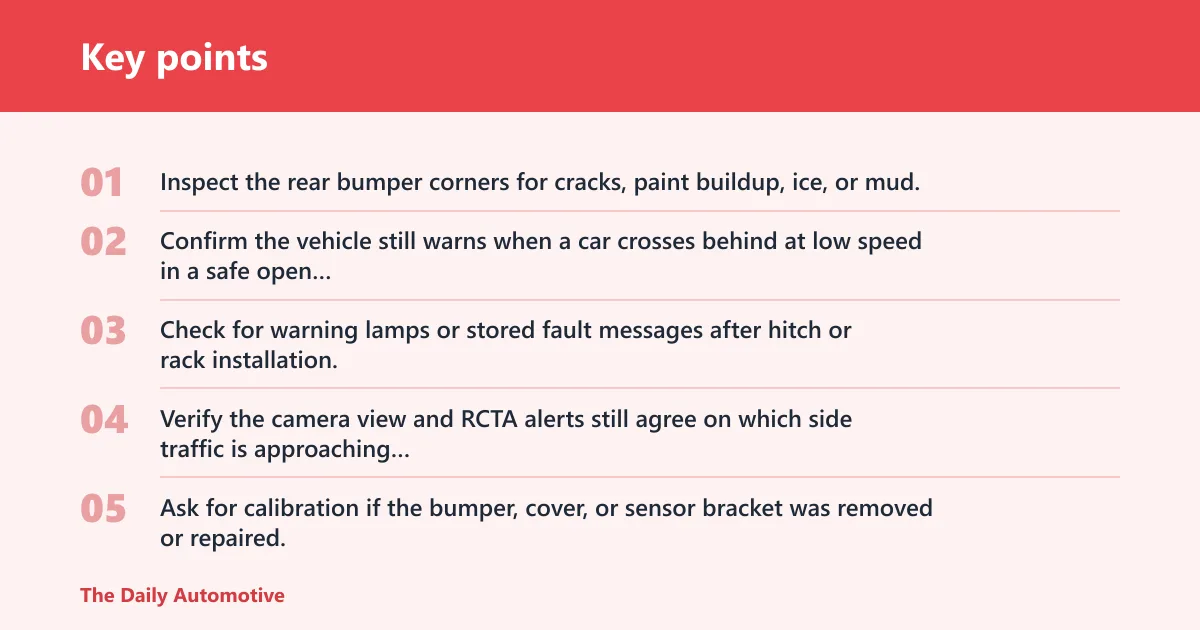
Use this quick ownership checklist after a repair or accessory change:
- Inspect the rear bumper corners for cracks, paint buildup, ice, or mud.
- Confirm the vehicle still warns when a car crosses behind at low speed in a safe open area.
- Check for warning lamps or stored fault messages after hitch or rack installation.
- Verify the camera view and RCTA alerts still agree on which side traffic is approaching from.
- Ask for calibration if the bumper, cover, or sensor bracket was removed or repaired.
How does RCTA compare with other safety features?
RCTA fills a narrower gap than many buyers think. It is useful when a vehicle crosses behind you while you are reversing, but it does not see everything. Parking sensors, a reversing camera, blind spot monitoring, and reverse automatic braking each cover different parts of the task.
RCTA versus blind spot monitoring
Blind spot monitoring typically watches adjacent lanes while you are driving forward or changing lanes. RCTA watches the space behind the car while reversing. They are related but not interchangeable. One helps with lane changes; the other helps with backing out of a space.
RCTA versus backup cameras and parking sensors
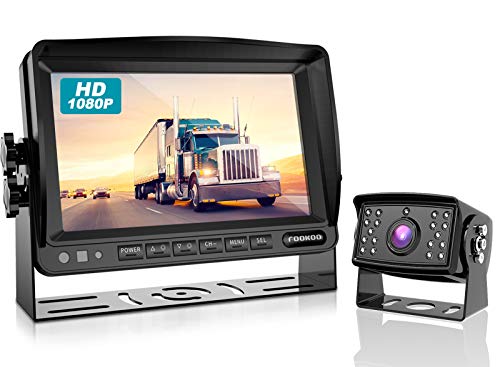
Backup cameras show the area behind the car. Parking sensors warn about nearby objects, usually by distance. RCTA detects moving cross traffic that may be outside the camera’s center view and outside the range of the park-assist sensors. That is why the three features work best as a set.
RCTA works alongside a reversing camera, and it does not replace it. It is the moving-object layer, not the visual overview. Parking sensors are still better for judging close object distance, while the camera helps you see lines, curbs, and fixed obstacles.
Where reverse automatic braking fits
Reverse automatic braking sits above warning-only RCTA. If a trim includes it, the car can apply the brakes when a collision is imminent. That can matter more than RCTA alone for drivers who want an active intervention, but it also depends on the exact brand and package.
Who should pay extra for RCTA?
Buyers who back out into traffic often, park in dense urban lots, or drive vehicles with poor rear sightlines are the clearest fit. The feature is less valuable for drivers who mostly park in open driveways, rarely reverse in traffic, or already have the full mix of camera, sensors, and automatic braking.
Best-fit buyers by driving pattern
City parkers should put it near the top of the list. Older drivers may appreciate the added alert, especially in crowded lots with poor side visibility. New drivers can benefit too, but only if they understand that the system is a warning, not a substitute for checking around the car.
Trim and package value checks
RCTA makes the most sense when it comes with blind spot monitoring, a good camera, and parking sensors for a modest upcharge. It is harder to justify if it adds a large trim jump or forces you into extras you do not want. The value is in the package math, not the feature alone.
When to skip the option
Skip it if you tow often, run a hitch rack often, or expect rear bumper repairs after minor parking bumps. Also skip it if the only reason to move up a trim is RCTA and the car already has a solid camera plus sensors. In those cases, the money often works harder elsewhere.
Frequently asked questions
Is rear cross traffic alert worth it on a daily driver?
Yes, if you regularly back out of crowded lots or apartment parking spaces. It is less compelling for a daily driver with open parking, strong rear visibility, and a good camera. The value comes from preventing low-speed surprises, not from making every drive safer in general.
Does rear cross traffic alert work in parking lots and driveways?
Yes, that is where it helps most. Parking lots with blocked sightlines are the classic use case, and driveways are useful too when hedges, walls, or parked vehicles hide cross traffic. The feature works only in Reverse, so it helps during backing maneuvers.
What is the difference between rear cross traffic alert and blind spot monitoring?
Blind spot monitoring watches the lanes beside you while driving forward. Rear cross traffic alert watches for vehicles approaching from either side behind the car while you reverse. They solve different problems, and one does not replace the other.
Does rear cross traffic alert brake automatically or just warn you?
Basic RCTA just warns with chimes and visual alerts. Some higher trims or packages add reverse automatic braking, which can apply the brakes if a collision is imminent. Buyers should check the exact trim sheet, because those two features are not the same.
Can dirt, snow, or a trailer disable rear cross traffic alert?
They can reduce it or interfere with it. Dirt, snow, rain, ice, trailers, bike racks, and wall reflections can all affect rear radar sensors. After bumper repair or accessory installation, it is smart to verify that the system still warns correctly before trusting it.
How far can rear cross traffic alert detect approaching vehicles?
Many systems are described as detecting traffic from roughly 20 meters away, but the real alert window varies by brand, model, speed, and approach angle. Some systems also have low-speed limits for the host vehicle, so the practical range is usually tuned for parking-lot use.
Which cars offer rear cross traffic alert and what other names does it use?
It appears on many mainstream vehicles and often comes bundled with driver-assistance packages. Automakers use different names, including Rear Cross-Traffic Alert, Cross Traffic Alert, Rear Traffic Alert, and Cross Traffic Monitor. The naming changes, but the job is similar.
Is rear cross traffic alert useful for older drivers or new drivers?
Yes, both groups can benefit. Older drivers may like the extra warning when backing visibility is limited, while new drivers may use it as an added cue during parking practice. It works best when paired with mirrors, head checks, and a rear camera.
Products related to this article
Sponsored / affiliate links. As an Amazon Associate I earn from qualifying purchases. I may earn additional commission from eligible campaigns.