Best Brake Rotors for Daily Driving (2026): We Compared
Pick brake rotors by job first. Commuting in salt calls for coated blanks, mountain towing needs thicker high-heat rotors, and performance builds do best with quality blank or slotted rotors matched to pad type. Choose poorly and you buy noise, corrosion, fade, warped feel, or short pad life. This guide sorts rotor types by climate, towing, mountain use, and performance, then points to the best picks in each class.
Quick comparison
| Product | Badge | Best for | Price | ||
|---|---|---|---|---|---|
 |
BOSCH 50011479 QuietCast Premium Disc Brake Rotor – Front,Bosch | Our pick | Front · 328mm · QuietCast premium disc rotor | $65.05
Price as of 23 Oct 2026
|
View |
 |
Power Stop AR85107EVC front Evolution Genuine Geomet®PowerStop | Upgrade pick | Front · Geomet coated · model-specific rotor | $103.78
Price as of 23 Oct 2026
|
View |
 |
Raybestos Element3 Automotive Replacement Front CoatedRaybestos | Also great | Front · coated · Element3 replacement rotor | $41.44
Price as of 23 Oct 2026
|
View |
 |
Brembo 09.7932.11 UV Coated vented Front Brake RotorBrembo | Pair with it | Front · UV coated · vented Brembo rotor | $54.30
Price as of 23 Oct 2026
|
View |
 |
ACDelco Advantage 18A2334AC (19327887) Coated Front DiscACDelco | Budget pick | Front · coated · Advantage disc rotor | $53.70
Price as of 23 Oct 2026
|
View |
This quick comparison helps you match rotor type to weather, load, and pad choice before you compare brands. It is the shortest route to the right part number, because fit and duty cycle matter more than marketing language.
How we chose
The picks below come from published product details, fitment notes, and buyer feedback. The filter was simple: corrosion protection, OE-style fit, heat control, and the use case the rotor is meant to serve.
We also weighed whether the rotor makes sense with common pad types, because a quiet ceramic pad and an aggressive slotted rotor can be a poor match for a commuter. Finally, keep the list to model-specific or clearly targeted options, since universal-fit guesses are a bad bet for ABS and OE-spec compatibility.
Bosch QuietCast: best for salty daily driving
This is the safest choice for a daily driver that sees winter road salt, wet streets, and ordinary stop-and-go use. Based on the manufacturer’s specs and buyer feedback, the coated surface and OEM-style vane design aim for quieter braking and better corrosion resistance than bare blanks.
The strength here is balance, not drama. Bosch lists it as factory-balanced, and CarAssists names QuietCast best overall for daily driving and rust resistance. Bosch also uses an aluminum-zinc coating, which matters most on hats, edges, and vanes where surface rust usually starts.
The drawback is that this is still a commuter rotor, not a track part. If your vehicle tows hard loads down long grades or you want sharper thermal headroom for repeated high-speed stops, a more aggressive rotor design is the better fit.
Power Stop Evolution Geomet: best for easy installation
This is a smart match for a truck owner who wants OE-spec fitment with extra corrosion protection and straightforward install work. Power Stop lists it as model-specific and sized for front left or right, and CarAssists calls it the easiest installation among the options it reviewed.
The Geomet coating is the draw. It helps resist rust while keeping the rotor close to factory fit and function, which matters for large trucks where ABS compatibility and exact application are not optional. CarAssists also points to it as a strong fit for Ford Super Duty applications.
The trade-off is price. It sits above budget replacements, and the coating does not remove the need for correct pad choice or proper bedding. For a heavy tow rig, that pairing still matters more than the logo on the box.
Raybestos Element3: best for rust-belt drivers
This is the best fit for drivers in harsh weather who want a coated rotor without moving into premium pricing territory. BestReviews names Raybestos Element3 best for rust-belt drivers, and the listed Grey Fusion coating is aimed at corrosion resistance in snow, slush, and salted roads.
Its strength is practical weather defense. The coated cooling vanes help airflow, which supports heat management, while the coating helps slow rust on the faces and exposed edges. That matters for commuters who leave the car outside and see constant moisture.
The drawback is that it is still an everyday replacement rotor, not a heavy-duty upgrade. If the vehicle tows regularly or spends time on mountain descents, you should look harder at pad selection and rotor thickness than at coated daily-driver parts alone.
Brembo UV Coated: best for premium OE fit
This is a strong pick when you want a premium OE-style replacement with corrosion protection and a focus on smooth feel. Brembo lists anti-corrosion coating, vented construction, and included installation hardware, which makes it attractive for fit-conscious owners who want a clean factory-style job.
Based on specs and reviews, the high-carbon content is meant to reduce vibration and keep the rotor calmer under heat. CarAssists lists it as best premium European fit, which makes sense for drivers who want OE-spec behavior rather than a louder, more aggressive setup.
The drawback is that premium fit does not mean universal fit. You still need the exact application, and this is not the rotor to buy for repeated towing abuse or for a build that wants the bite and debris-clearing behavior of slotted designs.
ACDelco Advantage: best budget coated rotor
This is the low-cost option for a basic replacement on a vehicle that just needs a correct, coated front rotor without paying for a premium badge. ACDelco lists multiple alloys for heat dissipation and a mill-balanced design, which supports ordinary street use at a lower entry price.
The upside is simple value. For a commuter or family vehicle that sees normal braking and no special duty cycle, this kind of rotor keeps the bill down while still offering better corrosion control than a bare rotor. It is the sort of part that fits the “replace it with the right OE-style piece” plan.
The drawback is that budget parts rarely shine in harsh use. If you live where winter salt attacks the hats and edges, or if you need fade resistance on long mountain descents, a higher-spec coated rotor or a slotted option is a better fit.
Which one should you buy?
If you want the quietest, simplest daily driver choice, start with Bosch QuietCast or ACDelco Advantage. If rust is the main enemy, Raybestos Element3 is the more climate-focused pick, and Brembo UV Coated makes sense when you want premium OE-style fit and finish.
For Ford Super Duty towing or other heavy-duty work, the Power Stop Evolution Geomet is the strongest model-specific fit in this group. If your brake job needs a budget cap, choose the ACDelco. If your vehicle runs salted roads for half the year, do not spend money on bare blanks just to save a little up front.
Say your SUV spends winter in a rust-belt garage and the old rotors have orange hats after one wet week. A coated rotor will still need proper hub cleaning and bedding, but the coating gives you a real chance of slowing the rust that starts on exposed steel first.
Coated rotors: best for snow and salt
Coated rotors are the right starting point for wet climates, winter road salt, and vehicles that sit outside. Zinc, Geomet, and phosphate-style coatings do not make a rotor rust-proof, but they can slow corrosion on the hats, vanes, and edges, which are the first places to show orange scale.
What the coating does
Coatings are there to resist surface rust before installation and during service. AllRotors says coated rotors may resist rust for up to 60,000 km in mild climates, while non-coated rotors can start rusting within 48 hours if exposed to moisture. That is the difference between a clean-looking brake job and one that flashes orange after one storm.
The best result depends on installation prep. Clean the hub face, remove shipping oil from the friction surface if the maker instructs you to do so, and make sure the mating surface sits flat. Coating helps, but it cannot compensate for a dirty hub or a warped installation stack.
Where coating helps most
Coating matters most on commuters, SUVs, and trucks that see winter roads, beach air, or frequent rain. It is especially useful when the vehicle is parked outside, because moisture sitting on bare iron is what starts the fast rust cycle.
It is less important on a weekend car stored indoors in a dry climate. In that case, a plain rotor may be fine if the owner wants to save money and values quiet, normal street behavior over long-term corrosion control.
Install prep and break-in
Most coated rotors need only light prep, but do not assume the friction surface is ready without checking the instructions. The hat, vanes, and outer edge are where the coating does its job, while the swept face must work with the pads, not against them.
Use the correct pad bedding procedure for the pad compound. That matters for noise, transfer layer, and fade resistance. A coated rotor with poor break-in can still feel rough or noisy, which is often blamed on the rotor when the pad surface is the real problem.
Blank rotors: best for everyday driving
Blank rotors are the quiet, lower-cost choice for normal street use. They work well on sedans, crossovers, and light-duty SUVs that do not see repeated hard stops, towing, or long downhill braking, and they usually pair best with ceramic pads for low dust and calm operation.
Why they stay quiet
With no slots or holes to sweep debris, blank rotors often produce the smoothest pad contact. That usually means less rotor-induced noise and a more ordinary pedal feel, which is exactly what many commuters want.
They are also easy to source and often cheaper than coated or performance designs. Cast iron is the common OE material, and AllRotors says cast iron rotors typically last 80,000 km to 120,000 km, which is why blanks remain a practical choice for ordinary service intervals.
Cost and service life
Blank rotors keep costs down because the design is simple. There are no slots to wear, no drilled holes to crack, and fewer features to pay for. That simplicity usually helps service life in normal driving, provided the pads and calipers are in good shape.
The shortcoming is heat control under abuse. On a mountain descent or with a loaded trailer, a blank rotor can be perfectly fine if it is thick enough and matched to the right pad, but it gives you less margin than a performance-focused design.
When blanks are the wrong pick
Do not default to blanks for serious towing, repeated canyon braking, or performance use. Those jobs create more heat than a plain commuter rotor is meant to manage, and that is where fade, vibration, and shorter pad life start to show up.
Picture a midsize SUV that hauls a trailer through a long descent with ceramic pads and basic blanks. The first warning is not always a dramatic failure; it is often a soft pedal, smell, and reduced bite that shows the system is running out of thermal headroom.
Slotted rotors: best for towing and heat
Slotted rotors are the middle ground for drivers who want more pad cleaning and fade resistance without moving to a drilled design. They are common on towing setups, spirited street cars, and some performance trucks because the slots can sweep gases, dust, and pad debris away from the contact patch.
How slots manage pad debris
The slot edge scrapes the pad surface lightly as the rotor turns. That helps refresh the pad face and keep the friction layer more consistent, which can improve initial bite when the brakes are hot or loaded with debris.
This does come with a wear trade-off. Slots can increase pad wear, and in some cases they can slightly raise rotor noise. That is acceptable on a tow rig or performance build, but it is often unnecessary on a quiet commuter.
Fade resistance on long descents
Slots help most when heat is repeating itself. On mountain descents and heavy towing, the rotor and pad are stressed again and again, and the slot pattern can help the system stay more consistent than a plain blank under the same load.
That does not mean a slotted rotor fixes bad pad choice. A soft economy pad can still overheat, glaze, or dust heavily. If the vehicle is loaded, pair the rotor with a pad compound that can tolerate heat without turning noisy or slippery.
Wear and noise trade-offs
Expect more pad wear than with a blank rotor. Some drivers also notice a slight hiss or scrape, especially at low speeds or during light braking. That is not always a defect; it is part of the design.
A slotted rotor makes the most sense when the brake system works hard. If the vehicle is a daily commuter with no special load, the extra wear is usually not worth the modest gain.
Drilled rotors: are they worth it?
Drilled rotors can help with heat evacuation and gas evacuation, but they are not the right answer for most drivers. They make the most sense for certain performance builds where repeated hard stops matter more than noise, durability, or long-term cost.
Heat and gas evacuation
The holes can help vent heat and remove gases from pad material under hard use. That is why drilled rotors show up in performance applications and some appearance-focused builds that still want a legitimate heat-management function.
Still, the benefit is situational. For normal commuting, the heat load is usually too low to justify the trade-offs, and for towing or rough road use, another design is often more sensible.
Noise and pebble pickup
Drilled rotors can be noisier than blanks, and the holes can pick up small stones. Pebble pickup is annoying on street-driven cars and can be a real drawback on roads with loose grit, winter debris, or gravel shoulders.
They also ask more of the rotor material itself. Holes create stress points, which is why drilled rotors can be a poor fit for heavy trucks or long downhill towing where heat and weight stack up fast.
When drilled rotors make sense
Choose drilled rotors only when the vehicle’s use case justifies them. That usually means performance builds, certain sporty sedans, or applications where looks and heat venting both matter and the owner accepts more noise and wear.
Do not treat drilled rotors as an automatic upgrade. For many drivers, a quality blank or slotted rotor with the right pad does a better job with fewer compromises.
Rotor decision matrix
This matrix turns the choice into a practical match between climate, duty, vehicle class, rotor type, coating, and pad pairing. It is not about brand prestige. It is about choosing a part that fits the way the vehicle actually stops.
| Climate | Driving style | Vehicle class | Best rotor type | Coating | Pad pairing |
|---|---|---|---|---|---|
| Dry | Daily | Sedan | Blank or coated blank | Optional, but helpful | Ceramic for low dust and quiet operation |
| Wet | Daily | SUV | Coated blank | Zinc, Geomet, or phosphate-style | Ceramic for calm street use |
| Rust belt | Daily | Sedan or SUV | Coated blank | Geomet or aluminum-zinc coating | Ceramic or quiet semi-metallic |
| Wet or mixed | Towing | Truck | Slotted, heavy-duty coated rotor | Strong corrosion coating preferred | Semi-metallic for heat and bite |
| Dry or mixed | Mountain | SUV or truck | Slotted or heavy blank | Helpful, but secondary to thickness | Semi-metallic for fade resistance |
| Dry | Performance | Sedan | Quality blank, slotted, or drilled if the build needs it | Secondary to thermal capacity | Semi-metallic or performance pad matched to rotor |
| Any | Race or supercar | Specialty build | Carbon-ceramic | Not the main issue | Carbon-ceramic pad requirement |
Pad pairing by rotor type
Ceramic pads are usually the quietest and cleanest choice for coated blanks and daily driving. Semi-metallic pads suit slotted rotors better when heat and bite matter more than dust, and they are often the better match for towing or mountain work.
Carbon-ceramic rotors need carbon-ceramic pads. Mixing them with the wrong pad material can ruin feel, create noise, and reduce the benefit of the rotor itself. That pairing rule is not optional.
For car brake rotors checklist
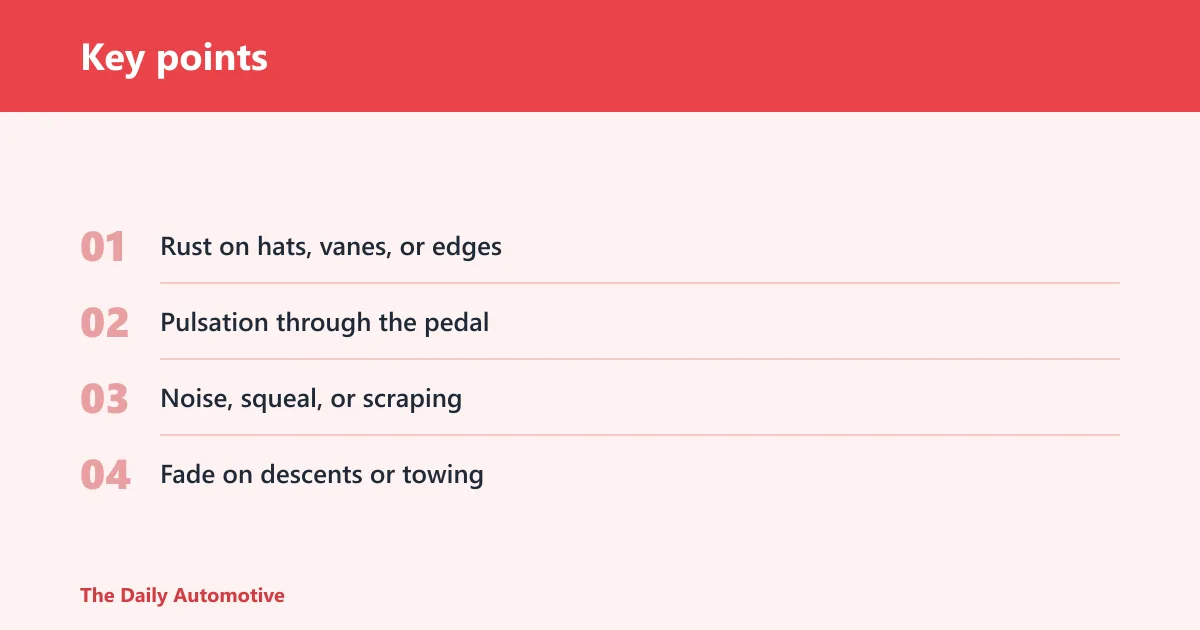
- Rust on hats, vanes, or edges: usually points to a bare rotor in wet or salty conditions, or a coating that has worn through.
- Pulsation through the pedal: often suggests thickness variation, pad transfer issues, or rotor runout, not automatic “warping.”
- Noise, squeal, or scraping: can mean pad mismatch, poor bedding, debris in drilled holes or slots, or hardware wear.
- Fade on descents or towing: points to too little thermal capacity, the wrong pad compound, or a rotor design that is too mild for the load.
A common first-timer mistake is replacing only the rotor when the pads are already glazed or uneven. That fixes the metal part but leaves the contact surface problem in place, so the new rotor can start feeling wrong almost immediately.
Carbon-ceramic rotors: best for race and supercar use
Carbon-ceramic rotors belong in extreme-performance applications, not ordinary commuter budgets. The same source says they can weigh 40–60% less than cast-iron equivalents, remain effective beyond 1000 °C, and last more than 300,000 km, which explains why they show up in race or supercar use rather than grocery-run vehicles.
The appeal is thermal stability and weight reduction. The same source says race rotor temperatures can exceed 1200 °C, so the material has to tolerate heat that would overwhelm ordinary cast iron. The downside is cost. Very high cost, in fact, and the pad requirement is specific.
They are not a sensible daily-driver upgrade for most owners. If you are not dealing with extreme heat and a specialty vehicle, the money belongs elsewhere, usually on better tires, more suitable pads, or a more suitable coated rotor.
Which rotor material is best for my car?
For most cars, the best rotor material is cast iron in a coated or blank form that matches the vehicle’s OE spec and duty cycle. Cast iron remains the common OE material because it offers thermal stability, predictable braking, and a typical lifespan of 80,000 km to 120,000 km at an affordable price.
If your car lives in salt and rain, prioritize coating before brand. If it tows or sees mountain descents, prioritize thermal capacity and pad match. If it is a race or supercar build, carbon-ceramic may be right, but only in the right application and budget.
Should I buy rotors as part of a brake kit or separately?
Buy as a kit when the pads, hardware, and rotor are all due at the same time, or when you want one part number that is built to work together. Buy separately when the pads are still healthy, the rotor choice needs to be specific to climate or duty, or the vehicle needs a model-specific OE-style rotor.
Kits can simplify the job, but they are not always the best value. Separate purchases give you more control over pad compound, coating, and rotor design, which matters when rust protection, towing, or noise are the real decision points.
Frequently asked questions
What brake rotors are best for daily driving?
For daily driving, coated blank rotors are usually the best fit. They stay quiet, cost less than performance designs, and handle normal commuting well. If you live where roads stay wet or salted, a coated rotor is the smarter long-term choice than a bare blank.
Are drilled and slotted rotors worth it?
Only when the vehicle actually needs more heat management or pad cleaning. Slotted rotors make more sense for towing and mountain driving. Drilled rotors are mainly for selected performance use, and they can add noise, pebble pickup, and extra wear without helping a normal commuter.
Which brake rotors resist rust the longest?
Coated rotors resist rust better than bare cast iron, especially on hats, vanes, and edges. The same source says coated rotors may resist rust for up to 60,000 km in mild climates, while non-coated rotors can start rusting within 48 hours if exposed to moisture.
What kind of rotors should I use for towing?
For towing, choose a rotor with more heat capacity, and slotted designs are often the better call. Pair them with semi-metallic pads when heat and fade resistance matter. A coated, OE-spec rotor can still be right, but only if it is built for the load.
How do I know if my brake rotors need replacing?
Replace them when you feel pulsation, hear grinding, or see deep rust, cracking, or heavy scoring. Fade under normal load is another warning sign. If the problem is pedal shake, the root cause may be runout, pad transfer, or hardware wear rather than simple surface rust.
Products related to this article
Sponsored / affiliate links. As an Amazon Associate I earn from qualifying purchases. I may earn additional commission from eligible campaigns.