Best Car A/C Coolant What You Need to Know
Figuring out the best car A/C coolant can feel a bit tricky, especially if you’re new to car care. Lots of different types and colors can make your head spin. But don’t worry, we’re here to make it super simple.
We’ll walk you through everything, step by step, so you can pick the right coolant for your car’s air conditioning. You’ll learn what works and what doesn’t, making your car cool and comfy again.
What Is Car A/C Coolant
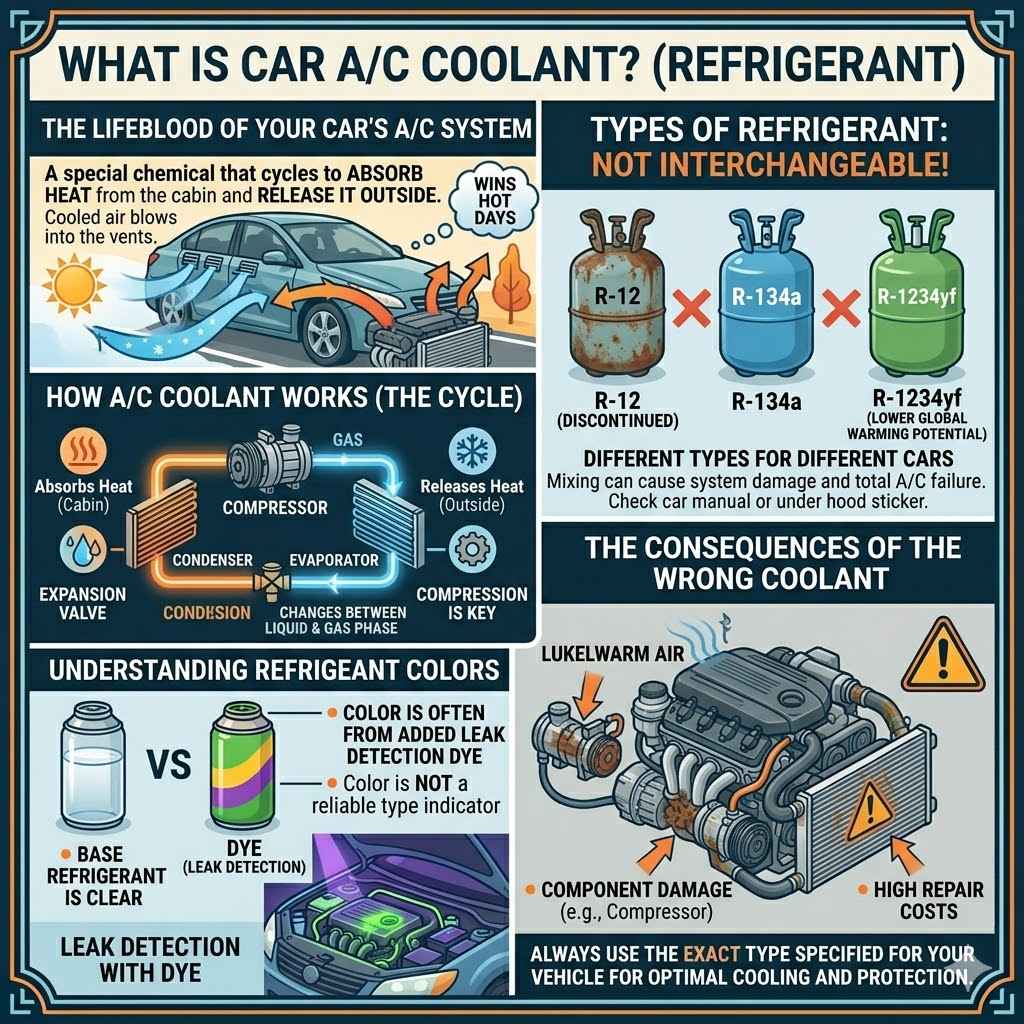
Car A/C coolant, often called refrigerant, is the magic stuff that makes your air conditioner cold. It’s a special chemical that cycles through your car’s A/C system. As it moves, it absorbs heat from the cabin and then releases that heat outside.
This process cools the air that blows out of your vents. Think of it as the lifeblood of your car’s cooling system. Without it, your A/C just wouldn’t work.
The type of refrigerant used in cars has changed over time. Older cars might use something different than newer ones. This is often due to environmental regulations and advancements in technology.
Using the wrong type of coolant can cause serious problems for your A/C system. It might not cool effectively, or worse, it could damage expensive components. Knowing which kind your car needs is key to keeping it running smoothly and efficiently.
Types of Refrigerant
There are a few main types of refrigerants you’ll hear about for car A/C systems. The most common one in modern cars is R-134a. This was a replacement for older refrigerants like R-12, which were phased out because they were bad for the ozone layer.
R-134a is still widely used, but newer vehicles are starting to use R-1234yf. This is an even newer refrigerant that has a lower global warming potential.
Some very old cars might still have R-12, but it’s rare and very expensive to find and service because it’s no longer produced. It’s important to know which refrigerant your car uses because they are not interchangeable. Mixing them can cause system damage and make your A/C not work at all.
Always check your car’s manual or a sticker under the hood to find out what kind of refrigerant it needs.
Understanding Refrigerant Colors
You might see refrigerants in different colors, but this is often misleading. The color of the refrigerant itself is not a reliable indicator of its type or quality. Sometimes, dye is added to refrigerants for leak detection, and this dye can be colored.
However, the base refrigerant is usually clear. Manufacturers might also package refrigerants in cans or cylinders of different colors, but this is just for branding or identification of the product itself, not the chemical inside.
Focusing on the refrigerant type (like R-134a or R-1234yf) is much more important than any color you might see. The critical thing is to use the exact type specified for your vehicle. If you see a colored substance coming from your A/C system, it might indicate a leak, especially if it’s accompanied by a visible oily residue.
In such cases, it’s best to have a professional check for leaks.
The Role of A/C Coolant in Your Car
The refrigerant is the core component that allows your car’s air conditioner to cool the air. It’s a chemical that changes from a liquid to a gas and back again as it cycles through the A/C system. This phase change is what makes the cooling happen.
The refrigerant absorbs heat from the air inside your car’s cabin, turning into a gas. Then, it’s compressed and sent to the condenser, where it releases the heat to the outside air and turns back into a liquid.
This constant cycle of absorption and release of heat is what keeps you cool on a hot day. If there isn’t enough refrigerant, or if the wrong type is used, this cycle is disrupted. This means your A/C won’t be able to cool effectively.
It might blow lukewarm air, or it might not blow cold air at all. It’s like trying to run an air conditioner without electricity; it just can’t do its job.

Why Best Car A/C Coolant What You Need to Know Is Important
Understanding the Best Car A/C Coolant: What You Need to Know is crucial for several reasons. Firstly, using the wrong type of refrigerant can lead to expensive repairs. Refrigerants are specific to the type of A/C system in your car.
Mixing them or using an incompatible type can damage seals, compressors, and other vital components. This means you could end up with a much bigger problem and a larger bill than you expected.
Secondly, the performance of your car’s A/C system directly impacts your comfort, especially during hot weather. Having a properly functioning system ensures a pleasant driving experience. If your A/C isn’t as cold as it used to be, it might be a sign that your refrigerant levels are low or that there’s an issue with the type of coolant being used.
Knowing what you need helps you maintain optimal cooling.
Consequences of Using the Wrong Refrigerant
Using the wrong refrigerant in your car’s A/C system can lead to a cascade of problems. The most immediate effect is usually poor cooling performance. The system simply won’t be able to achieve the desired temperature.
Beyond that, different refrigerants have different chemical properties, including pressure and lubrication requirements. An incompatible refrigerant might not lubricate the compressor properly, leading to premature wear and failure.
Furthermore, some refrigerants can degrade rubber and plastic components within the A/C system. This can cause leaks and further damage. If you mix different types of refrigerants, it can create a sludge that clogs the system.
This makes repairs incredibly difficult and costly. It’s also important to note that some refrigerants can be harmful if not handled correctly, so proper safety precautions are always necessary.
Maintaining Optimal A/C Performance
Keeping your car’s A/C system working at its best involves more than just adding refrigerant. Regular maintenance is key. This includes checking for leaks, ensuring the system is properly sealed, and having the refrigerant levels checked periodically.
A slight drop in cooling performance can be an early warning sign of a low refrigerant charge or a developing leak.
Simple checks can make a big difference. Listen for unusual noises from the A/C system. Make sure the air coming out of the vents is consistently cold, not just cool or warm.
If you notice any issues, it’s best to get them checked out by a qualified mechanic sooner rather than later. Proactive maintenance can prevent minor issues from becoming major, expensive repairs down the line.
Environmental Considerations of Refrigerants
The types of refrigerants used in cars have significant environmental implications. Older refrigerants like R-12 contained chlorofluorocarbons (CFCs) which severely damaged the Earth’s ozone layer. This led to their phase-out under international agreements like the Montreal Protocol.
The successor, R-134a, does not harm the ozone layer, but it is a greenhouse gas with a considerable global warming potential.
Newer refrigerants like R-1234yf are being introduced to address these concerns. R-1234yf has a much lower global warming potential compared to R-134a, making it a more environmentally friendly option. However, transitioning to new refrigerants also requires specialized equipment and training for technicians.
It’s important for car owners to be aware of the environmental impact of refrigerants and to support the use of more sustainable options when possible.
How to Choose the Best Car A/C Coolant
Choosing the right refrigerant for your car’s A/C system is essential. The most important factor is to identify the specific type your vehicle requires. This information is usually found in your car’s owner’s manual.
You can also often find a sticker under the hood, typically on the radiator support or the hood itself, that details the type of refrigerant and the correct amount to use.
Never guess what refrigerant your car uses. Using an incompatible type can cause severe damage to your A/C system. If you’re unsure, it’s always best to consult a professional mechanic.
They have the tools and knowledge to accurately identify your car’s refrigerant type and to perform any necessary A/C service safely and effectively.
Identifying Your Car’s Refrigerant Type
The first step in selecting the correct refrigerant is to determine what your car manufacturer recommends. As mentioned, your owner’s manual is the primary source for this information. It will clearly state the refrigerant type, such as R-134a or R-1234yf.
Look in the sections related to vehicle maintenance or the climate control system.
If you can’t find the information in your manual, or if the manual is missing, check for a label on your vehicle. These labels are usually placed in the engine bay. They are often white with black or colored text and provide key details about your car’s fluids and operating specifications.
Another option is to look up your car’s make, model, and year online on reputable automotive websites or forums.
R-134a vs. R-1234yf
R-134a has been the standard refrigerant in most cars for many years. It’s a hydrofluorocarbon (HFC) that is effective at cooling but has a significant global warming potential. If your car was manufactured roughly between the mid-1990s and the early 2010s, it most likely uses R-134a.
It’s readily available and relatively affordable.
R-1234yf is a newer hydrofluoroolefin (HFO) refrigerant that is becoming the new industry standard. It has a much lower global warming potential, making it more environmentally friendly. Cars manufactured from around 2015 onwards are more likely to be equipped with R-1234yf.
The key difference is environmental impact and cost. R-1234yf systems are also designed to be slightly more efficient.
Can You Mix Refrigerants?
Absolutely not. You should never mix refrigerants in your car’s A/C system. Refrigerants are chemically engineered to work with specific system components and other chemicals.
Mixing R-134a and R-1234yf, or any other combination of refrigerants, can cause severe damage. It can lead to chemical reactions that create corrosive acids, break down seals, and contaminate the system.
Mixing refrigerants can also make the system inefficient and difficult to repair. If your system has been contaminated with the wrong refrigerant, it often requires a complete flush and evacuation of the system, followed by refilling with the correct type. This is a complex procedure that should only be performed by trained professionals.
It’s always best to stick to the manufacturer’s specified refrigerant.
Buying Refrigerant Kits
When you decide to buy refrigerant, you might come across “recharge kits.” These kits often include a can of refrigerant and a simple gauge or hose. They are designed for DIY use. However, it’s crucial to ensure the kit contains the correct type of refrigerant for your car.
If you have an R-134a system, buy an R-134a kit. For an R-1234yf system, you would need a specific R-1234yf kit, which might be harder to find and more expensive.
Be cautious with DIY recharge kits. While they can be convenient for topping off a slightly low system, they don’t address underlying issues like leaks. Overcharging the system can also cause damage.
If your A/C is not cooling well, it’s often best to have a professional diagnose the problem. They can check for leaks, measure the exact amount of refrigerant needed, and ensure the system is functioning correctly.
Common Problems and Solutions
Your car’s A/C system can develop various issues that affect its cooling performance. One of the most common problems is a low refrigerant charge. This can happen over time due to tiny leaks in the system.
If your A/C is not blowing as cold as it used to, this is often the first thing to suspect.
Another frequent issue is a malfunctioning compressor. The compressor is like the heart of the A/C system; it circulates the refrigerant. If it fails or isn’t engaging properly, the system won’t cool.
Clogged cabin air filters can also restrict airflow, making your A/C feel weak, even if the refrigerant is fine.
Low Refrigerant Levels
Low refrigerant levels are the most common reason for a car’s A/C to stop cooling effectively. Refrigerant doesn’t get “used up” like gasoline. It circulates within a closed system.
If the level is low, it means there’s a leak somewhere in the system. This leak allows the refrigerant to escape into the atmosphere.
Topping off the refrigerant can provide temporary relief, but it’s not a permanent fix if there’s a leak. A proper repair involves finding the leak, fixing it, and then recharging the system with the correct amount of refrigerant. Some DIY recharge kits come with a gauge that helps you avoid overcharging, which is critical.
Statistics show that leaks are a major cause of A/C system failures. One study indicated that up to 70% of A/C system failures in vehicles are due to refrigerant leaks. This highlights the importance of addressing any suspected leaks promptly.
Leaky A/C Hoses and Seals
Over time, the rubber hoses and seals in your A/C system can degrade, crack, or become brittle. This allows refrigerant to escape. The high pressures and fluctuating temperatures within the system can accelerate this wear and tear.
Common culprits are the O-rings that seal connections between different A/C components.
Identifying leaks can be challenging. Mechanics often use special UV dyes that are added to the refrigerant. After the system runs for a while, they use a UV light to spot any glowing dye that has escaped through a leak.
Replacing faulty hoses and seals is a necessary step in repairing a leaky A/C system.
Diagnosing A/C System Issues
Diagnosing A/C problems requires a systematic approach. A mechanic will typically start by checking the refrigerant pressure using a manifold gauge set. This tells them if the system is overcharged, undercharged, or if there’s a blockage.
They will also check if the compressor clutch is engaging.
Visual inspections are also important. Looking for signs of oil leaks around A/C components can indicate where refrigerant might be escaping, as refrigerant carries lubricating oil. Listening for unusual noises from the compressor or other parts can also provide clues.
If the problem is complex, advanced diagnostic tools might be used.
Professional A/C Service
For most A/C issues, especially those involving refrigerant or complex system components, professional service is highly recommended. Auto technicians have specialized equipment for recovering refrigerant safely, evacuating the system (removing moisture and air), and recharging it with the precise amount of the correct refrigerant. They also have the expertise to diagnose leaks and repair or replace damaged parts.
Using a professional ensures that the job is done correctly and safely. It also helps maintain the longevity of your A/C system. While DIY kits can seem appealing, they often don’t address the root cause of a problem and can sometimes lead to more damage if used incorrectly.
Best Practices for A/C Coolant Maintenance
Proper maintenance of your car’s A/C system ensures it runs efficiently and lasts longer. This involves a combination of regular checks and proactive care. Following these best practices can help you avoid costly repairs and enjoy cool air all year round.
One of the simplest yet most effective maintenance steps is to run your A/C system for a few minutes every week, even during colder months. This circulates the refrigerant and oil, keeping seals lubricated and preventing them from drying out. It helps prevent leaks from developing in the first place.
Regularly Run Your A/C
It might seem counterintuitive to run your air conditioner when it’s cold outside, but it’s actually beneficial for the system. The refrigerant and oil that lubricate the A/C system need to be circulated regularly. If the system sits idle for long periods, seals can dry out and crack, leading to refrigerant leaks.
Running the A/C for 5-10 minutes once a week is enough to keep the components working properly. This simple habit can help prevent common problems like refrigerant loss and compressor seal failures, saving you money and hassle in the long run.
Keep Your Cabin Air Filter Clean
The cabin air filter is responsible for cleaning the air that enters your car’s interior. A dirty or clogged filter restricts airflow from your A/C system. This makes the system work harder, reducing its efficiency and potentially causing it to overheat.
It can also lead to less cold air being produced.
Checking and replacing your cabin air filter is a relatively easy DIY task. Consult your owner’s manual for its location and replacement instructions. Most filters need to be replaced every 12,000 to 15,000 miles or once a year.
A clean filter ensures that your A/C can circulate air effectively.
Inspect for Leaks
While pinpointing a small leak can be difficult without professional tools, you can still look for visual clues. If you notice a greasy residue around A/C system components, especially connections and hose ends, it might indicate a refrigerant leak. Refrigerant oil often escapes with the refrigerant.
If you suspect a leak, it’s best to have a professional inspect the system. They can use specialized leak detection equipment to find the exact source of the problem. Addressing leaks early is crucial to prevent further refrigerant loss and potential damage to other components.
Professional Check-ups
Consider having your car’s A/C system professionally checked as part of your regular vehicle maintenance schedule. Many mechanics offer A/C service checks, especially before the hot summer months. This can include checking refrigerant levels, testing system pressures, inspecting for leaks, and ensuring all components are functioning correctly.
These check-ups can catch potential problems before they become serious. A professional can also advise on any necessary maintenance, such as flushing the system or replacing older refrigerant with a newer, more efficient type if applicable to your vehicle. This proactive approach saves you from unexpected breakdowns and costly repairs.
Frequently Asked Questions
Question: What refrigerant do I need for my car
Answer: You need to check your car’s owner’s manual or look for a sticker under the hood. It will specify the exact type, like R-134a or R-1234yf.
Question: Can I buy refrigerant at any auto parts store
Answer: Yes, most auto parts stores sell refrigerant for car A/C systems, but make sure you buy the correct type for your vehicle.
Question: How do I know if my car needs more refrigerant
Answer: If your A/C is not blowing cold air, or not as cold as usual, it might need more refrigerant. However, this often means there’s a leak.
Question: Is it safe to add refrigerant myself
Answer: Adding refrigerant yourself can be done with a DIY kit, but it’s important to follow instructions carefully and not overcharge the system. It’s often best to let a professional handle it.
Question: How often should I service my car’s A/C
Answer: It’s a good idea to have your A/C system checked annually, especially before summer. Running the A/C weekly is also good maintenance.
Summary
Choosing the right car A/C coolant is vital for comfort and system health. Knowing your car’s specific refrigerant type, like R-134a or R-1234yf, is key. Never mix refrigerants, as this can cause costly damage.
Regular maintenance, including running your A/C weekly and checking cabin filters, keeps your system working well.