Why Change Your Cabin Air Filter? 5 Benefits + Warning Signs
A clogged cabin air filter can cut HVAC airflow by up to 50% and let pollen, mold spores, and diesel soot into your vents — most automakers recommend replacing it every 12,000 to 15,000 miles or once a year. Ignoring it strains the blower motor and can lead to a $300-plus repair bill. This guide covers the real health and HVAC benefits, the exact signs you’re overdue, and how to swap it yourself in under 15 minutes.
Quick Answer
Changing your cabin air filter every 12,000 to 15,000 miles (or once a year) keeps pollen, mold, and diesel soot out of the air you breathe, protects the blower motor and AC system from strain, and helps the defroster clear foggy windows faster. A new filter costs $15–45; skipping it risks a $300-plus blower motor repair.
The Key Benefits of Changing Your Cabin Air Filter
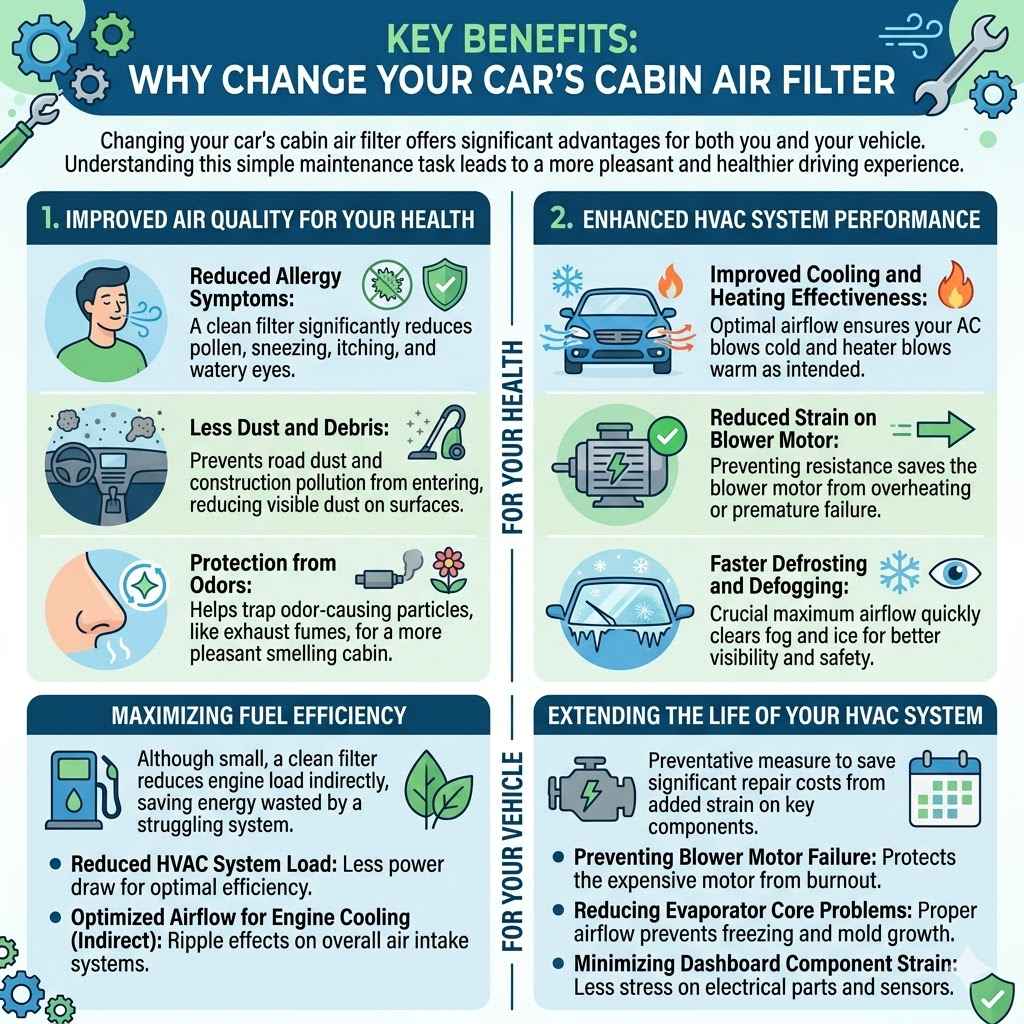
Changing your car’s cabin air filter offers real advantages for both you and your vehicle. This often-overlooked part controls the air quality inside your car, and when it clogs with dirt, dust, pollen, and other pollutants, it affects both the air you breathe and how efficiently your heating and cooling system runs.
Improved Air Quality for Your Health
The cabin air filter acts as a barrier, trapping airborne particles before they enter your car’s interior. Over time it becomes saturated with dust, pollen, mold spores, and exhaust particles — and once it’s dirty, those contaminants circulate freely inside the cabin, worsening allergies and respiratory irritation for sensitive drivers and passengers.
- Reduced Allergy Symptoms: Pollen and other allergens are a major concern for many drivers, especially during certain seasons. A clean cabin filter can significantly reduce the amount of pollen that gets into your car, meaning less sneezing, itching, and watery eyes on the road.
- Less Dust and Debris: Dust from roads, construction sites, and general pollution can quickly accumulate inside your car. A functioning cabin filter prevents most of this dust from entering, keeping your interior cleaner and reducing visible dust on your dashboard.
- Protection from Odors: While not its primary function, a cabin filter can help reduce some odors by trapping odor-causing particles, keeping exhaust fumes and other unpleasant smells at bay.
📊 A 2023 randomized cross-over study found that cabin air filtration cut in-vehicle ultrafine particles by 28%, PM2.5 by 30%, and black carbon by 32% compared to unfiltered outside air. — Source: Mallach et al., Environmental Science & Technology (2023)
“CAF [cabin air filtration] reduced in-vehicle/rooftop ratios of those pollutants by approximately one third.”
Enhanced HVAC System Performance
Your car’s heating, ventilation, and air conditioning (HVAC) system relies on the cabin air filter to function properly. A dirty filter restricts airflow, forcing the system to work harder — which reduces cooling and heating efficiency and adds wear on the system’s components. Want the full picture of how the parts connect? See our car A/C system diagram for a part-by-part breakdown.
- Faster Defrosting and Defogging: A clean cabin air filter allows maximum airflow to the windshield, clearing fog and ice faster and improving visibility in bad weather.
- Improved Cooling and Heating Effectiveness: With a clean filter, your AC and heater perform at their best in both summer and winter, without wasting energy fighting a restriction.
- Reduced Strain on the Blower Motor: A dirty filter creates significant resistance, making the blower motor work much harder — which can shorten its lifespan. Replacing the filter protects this component and saves you money in the long run.
Maximizing Fuel Efficiency
The impact here is small, but a dirty cabin air filter can indirectly affect fuel economy. When the HVAC system is struggling due to a clogged filter, the blower motor draws more electrical power, which places a slightly higher load on the engine’s charging system. It’s not a primary factor in fuel consumption, but it’s another small way a clean filter helps your car run the way it’s designed to.
- Reduced HVAC System Load: A dirty filter makes the HVAC system draw more power. Keeping the filter clean reduces this unnecessary draw.
- Consistent Airflow Design: A clean cabin filter ensures the ventilation system operates the way the manufacturer designed it, instead of compensating for a restriction.
Extending the Life of Your HVAC System
A clogged cabin air filter puts extra stress on key HVAC components, particularly the blower motor and the evaporator core. Over time, this added strain can lead to premature wear and eventual failure of these parts — and replacing the filter regularly is a simple, cheap way to prevent it.
- Preventing Blower Motor Failure: The blower motor has to work overtime to push air through a clogged filter, leading to overheating and premature burnout. Replacing the filter is a cheap way to protect this expensive component.
- Reducing Evaporator Core Problems: Poor airflow can cause the evaporator core to freeze up or become a breeding ground for mold and bacteria, reducing cooling efficiency and creating unpleasant smells.
- Minimizing Strain on Climate Control Electronics: When the filter is clogged, the system has to compensate, which can put unnecessary strain on the sensors and controls tied to your climate system.
When Should You Change Your Cabin Air Filter?
Most automakers set a mileage-based interval for cabin air filter replacement, but the right time to change yours also depends on how and where you drive. It’s a good habit to have the filter checked whenever you get your oil changed — most mechanics can inspect it in under a minute.
What Do Manufacturers Actually Recommend?
Intervals vary by brand and HVAC design, so your owner’s manual is the final word — but the general range across major automakers runs from 12,000 to 30,000 miles, or about once a year. According to Ford, most models call for a replacement every 15,000 to 20,000 miles, while Toyota’s maintenance schedule for the Corolla calls for an inspection at 15,000 miles/18 months and a full replacement by 30,000 miles/36 months.
Want the full mileage-by-model breakdown, including EV-specific guidance? Our companion guide, How Often to Change Your Cabin Air Filter, covers the interval schedule in depth — this article focuses on why the swap matters and what happens if you skip it.
Signs You’re Overdue, Regardless of Mileage
- Driving Conditions Matter: Dusty roads, heavy pollen, or driving behind diesel trucks clogs a filter much faster than average. In these conditions, plan to replace it every 6 months instead of yearly.
- Weak Airflow: A noticeable drop in airflow from the vents, even with the fan on high, is one of the clearest signs the filter is restricting air.
- A Musty Smell When the AC or Heat Runs: A dirty filter is a breeding ground for mold and bacteria, and running air through it carries that smell straight into the cabin.
- Windows Fog Up More Slowly: If the defroster is taking longer than usual to clear the windshield, restricted airflow is a likely cause.
How to Check and Replace Your Cabin Air Filter
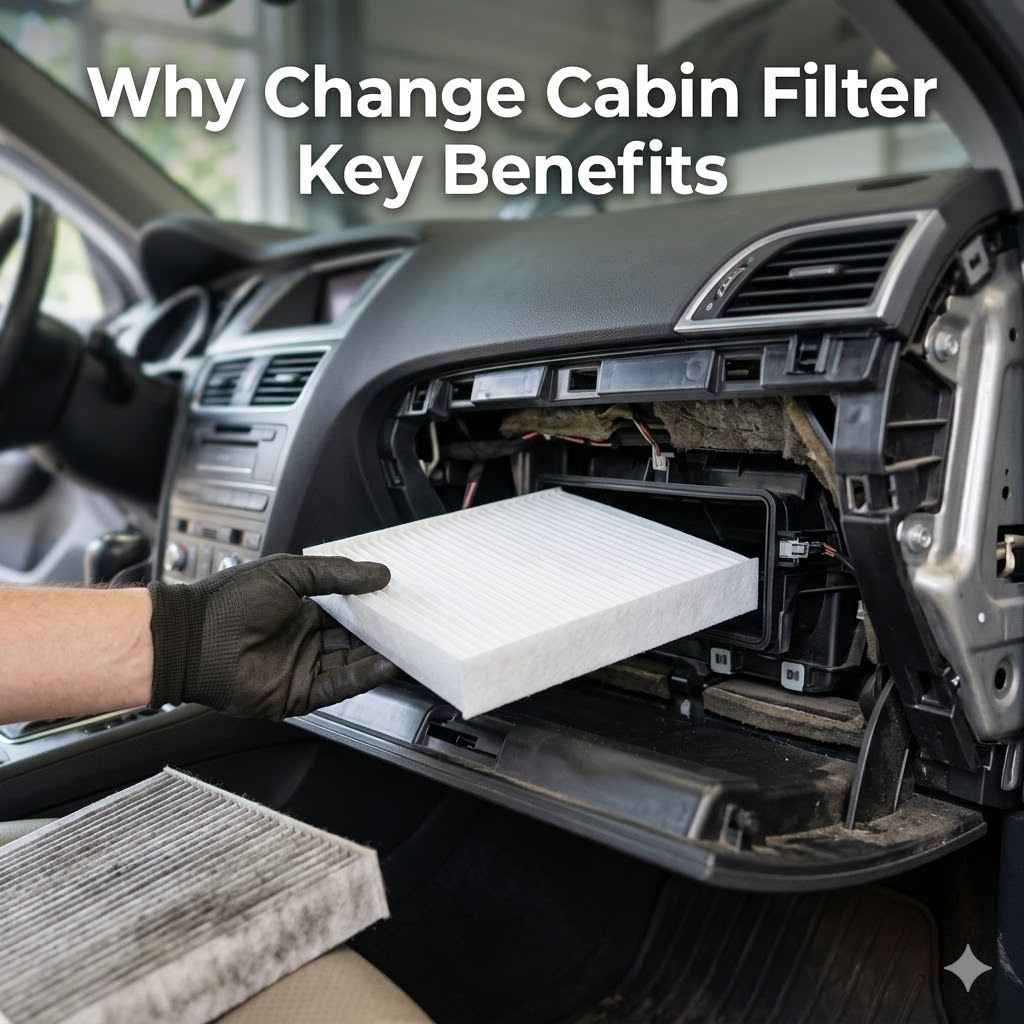
Replacing a cabin air filter is a straightforward DIY job that most car owners can do themselves. The filter is commonly found behind the glove box or under the dashboard, and on roughly 85% of vehicles built since 2005 it requires no tools at all — you just release a few clips and swap the filter, a job most drivers finish in 5 to 15 minutes.
- Locate the Filter Housing: The cabin air filter is typically found in the passenger compartment — commonly behind the glove box, under the dashboard, or near the firewall. Check your owner’s manual if you’re unsure.
- Remove the Old Filter: Release the housing’s clips or screws, then carefully pull out the old, dirty filter. Note the direction of the airflow arrow, since the new filter needs to go in the same way.
- Install the New Filter: Slide the new cabin air filter into the housing with the airflow arrow pointing the same direction as the old one, then close the housing securely.
- Test the Airflow: Start the car, run the AC or heater on high, and confirm strong, even airflow from every vent.
Which filter should you actually buy? A standard filter handles dust and pollen for a few dollars less; an activated carbon filter adds odor and gas protection for drivers in cities or behind heavy traffic.
Best Cabin Air Filter Pick
FRAM Fresh Breeze Cabin Air Filter with Arm & Hammer Baking Soda
A widely available, easy-install standard filter with a baking-soda layer for basic odor control.
- Best for: Drivers who want a reliable, budget-friendly replacement without a full carbon upgrade
- Why we picked it: Well-known brand, tool-free fit on most compatible models, and matches the DIY interval this guide covers
- Main drawback: Doesn’t filter gases or exhaust odor as well as a true activated carbon filter
Compare more cabin air filter options
 Option 1 K&N Lifetime Washable Cabin Air Filter
|
 Option 2 CARORY Activated Carbon Cabin Air Filter
|
 Option 3 Tresalto Auto Trim Removal Tool Kit
|
As an Amazon Associate we earn from qualifying purchases.
Cost-Effectiveness of Replacement
The part itself typically runs $15 to $45. Having a shop replace it adds roughly $20 to $100 in labor, so a dealership visit can total $60 to $150. Compare that to the cost of the repairs a neglected filter can cause — a replacement blower motor commonly runs several hundred dollars, and a new evaporator core can run over $1,000 — and the small investment in a filter pays for itself many times over.
- Low Part Cost: A quality cabin air filter generally costs between $15 and $45.
- Avoids Expensive Repairs: Neglecting the filter can lead to costly issues like a failed blower motor or a damaged evaporator core, far exceeding the cost of regular replacement.
- DIY Savings: Replacing the filter yourself skips the $20-100 labor charge entirely — a simple task that takes most drivers under 15 minutes.
Common Misconceptions About Cabin Air Filters
A few common ideas people have about cabin air filters aren’t quite right. Some assume that if their car’s AC still blows air, the filter must be fine. Others believe only very old cars need them replaced. The truth is even new cars benefit from regular changes, and a clogged filter can still blow air — just not effectively or cleanly.
Another misconception is that cabin air filters are the same as engine air filters. While both are filters, they serve different purposes — the engine air filter protects the engine from dirt, while the cabin air filter protects the people inside the car from airborne contaminants. They are not interchangeable, and both need their own maintenance schedule.
- Myth: If air blows, the filter is fine. A clogged filter restricts airflow, but it doesn’t stop it completely — air quality still suffers, and the HVAC system still works harder than it should.
- Myth: Cabin air filters are only for people with allergies. Everyone breathes the air inside their car; a clean filter benefits everyone by removing dust, soot, and other pollutants.
- Myth: Cabin air filters last forever. These filters are designed to trap particles and become saturated over time — they need regular replacement to stay effective.
Cabin Air Filter Types and Their Differences
There are generally three types of cabin air filters: standard, activated carbon, and HEPA. Standard filters, made of pleated paper or synthetic material, trap larger particles like dust and pollen. Activated carbon filters add a porous carbon layer that adsorbs gases and odors, making them a better fit for drivers who want to cut down on exhaust fumes, pet odors, or general air pollution.
📊 A real-world vehicle study found activated carbon filters cut in-cabin nitrogen dioxide (NO2) by an average of 87%, while standard pollen filters showed no significant reduction — but that carbon layer loses roughly 6.8% of its removal power every month, decaying fastest after 6 months of use. — Source: NO2 levels inside vehicle cabins study, PubMed (2022)
That decay rate is why activated carbon filters are usually replaced on the shorter end of the interval — around once a year or every 15,000 miles — even though a standard particulate filter can sometimes stretch longer. If you live in a heavily polluted area or drive in city traffic often, the upgrade is worth the slightly higher cost; if you drive mostly rural roads, a standard filter is fine.
- Standard Filters: The most common type. Effective at trapping larger particles like dust, pollen, and leaves — a basic level of filtration for your car’s interior.
- Activated Carbon Filters: Add a layer that absorbs odors, gases, and fumes — excellent for polluted environments or eliminating unpleasant smells, but they need replacing sooner.
- HEPA Filters: Some advanced filters offer HEPA (High-Efficiency Particulate Air) filtration, trapping even smaller particles including bacteria. More expensive, but the highest level of air purity available.
Statistics on Cabin Air Filter Impact
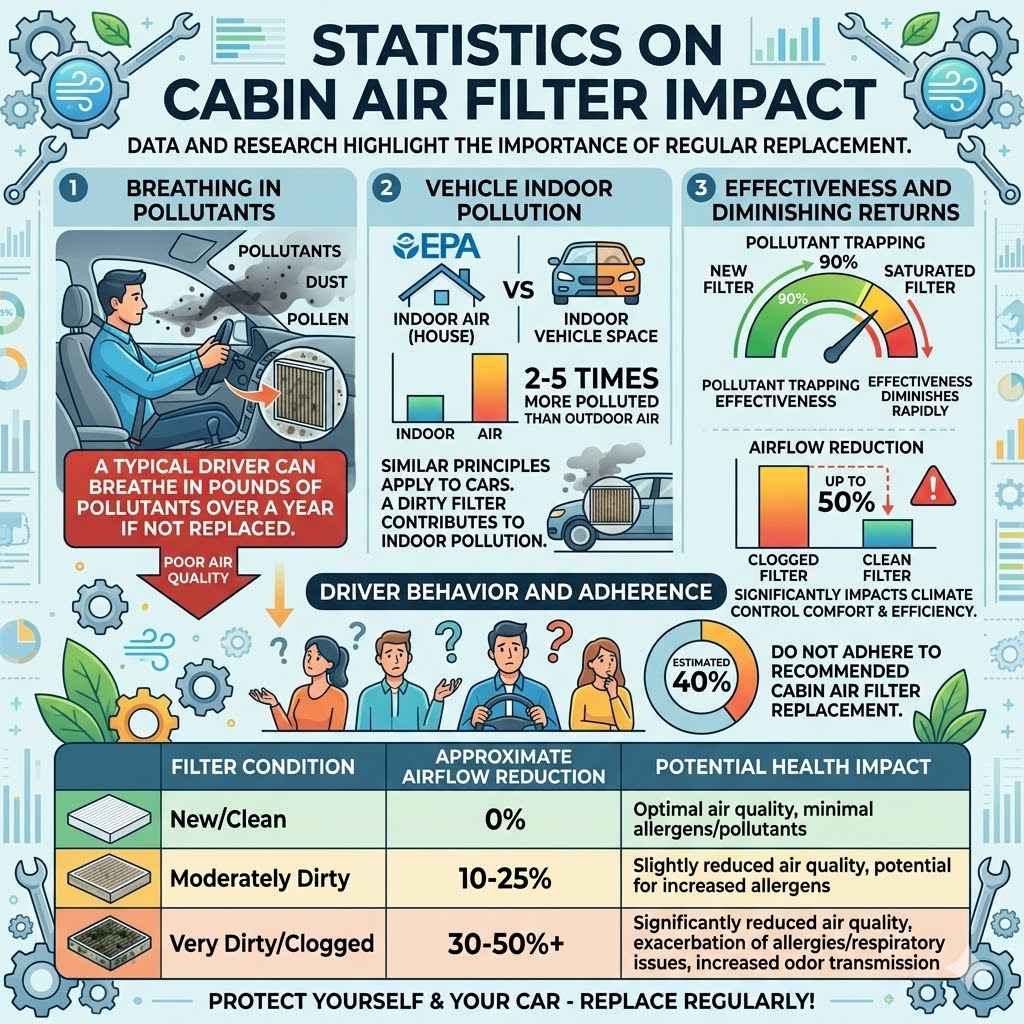
Real research backs up why cabin air filtration matters, not just inside the car but for how much traffic pollution you’re actually exposed to. One Los Angeles-based exposure study found that driving accounted for only about 6% of participants’ day, yet contributed 33 to 45% of their total ultrafine particle exposure — meaning the short time spent commuting can be a disproportionately large source of the pollution you breathe in.
That’s exactly the exposure a working cabin air filter is designed to cut down. As covered above, the 2023 Health Canada-linked study found cabin air filtration reduced in-vehicle ultrafine particles, PM2.5, and black carbon by roughly 28-32% compared to unfiltered air — and a clogged filter loses that protection as it saturates. Industry data on airflow restriction is summarized below.
| Filter Condition | Approximate Airflow Reduction | Potential Impact |
|---|---|---|
| New/Clean | 0% | Optimal air quality, minimal allergens/pollutants |
| Moderately Dirty | 10-25% | Slightly reduced air quality, some increase in allergens |
| Very Dirty/Clogged | 30-50%+ | Significantly reduced air quality, worsened allergy/respiratory symptoms, more odor transmission |
Frequently Asked Questions
How often should I change my cabin air filter?
Most automakers recommend replacing your cabin air filter every 12,000 to 15,000 miles or once a year, whichever comes first — check your owner’s manual for the exact interval. Drive in dusty, smoky, or heavy-pollen conditions and you should swap it every 6 months instead.
Can I replace my cabin air filter myself?
Yes. On roughly 85% of vehicles built since 2005, the filter sits behind the glove box or under the dash and needs no tools at all — just release a few clips, slide out the old filter, and insert the new one facing the same direction. Most drivers finish in 5 to 15 minutes.
What happens if I don’t change my cabin air filter?
A clogged filter lets pollen, mold spores, and exhaust particles circulate through your vents, restricts airflow to your AC and heater by as much as 50%, and forces the blower motor to work harder — which can shorten its lifespan and lead to a repair costing several hundred dollars.
How much does a cabin air filter replacement cost?
The filter itself typically runs $15 to $45. Having a shop do it adds roughly $20 to $100 in labor, so a dealership visit can run $60 to $150 total. Doing it yourself, since most cars need no tools, cuts the job down to just the cost of the part.
Are cabin air filters the same as engine air filters?
No. The cabin air filter cleans the air blown into the passenger compartment, while the engine air filter cleans the air the engine burns during combustion. They sit in different locations, use different materials, and are replaced on different schedules — neither one substitutes for the other.
What’s the difference between a standard and an activated carbon cabin air filter?
A standard filter traps dust, pollen, and debris but does nothing about gases or odors. An activated carbon filter adds a porous carbon layer that also adsorbs exhaust fumes, smog, and smells — research shows it cuts in-cabin NO2 levels by an average of 87%, versus almost no reduction from a standard filter.
Can a dirty cabin air filter make the AC blow warm or weak?
Yes. A severely clogged filter can restrict airflow enough that the AC seems weak even though the compressor and refrigerant are fine — replacing the filter often restores full airflow in minutes. If airflow stays weak after a fresh filter, the more likely cause is low refrigerant, which is worth checking separately.
Summary
Replacing your cabin air filter is a simple but genuinely worthwhile maintenance task. It directly improves the air quality inside your car, reduces allergens and pollutants, and keeps your heating and cooling system running efficiently for longer — all for a $15-45 part that most drivers can swap themselves in under 15 minutes.
Products related to this article
Sponsored / affiliate links. As an Amazon Associate I earn from qualifying purchases. I may earn additional commission from eligible campaigns.