3 Best Undercarriage Cleaners for Winter Salt (2026): We Compared
The best undercarriage cleaner matches your washer’s GPM and vehicle clearance; for most DIY owners, a bar-style attachment with 4-6 nozzles is the safest first pick, while a wand suits tight SUVs and trucks with winter-salt buildup. Choose wrong, and you waste rinse passes, miss salt packed around suspension parts, and risk rust that spreads through brake lines, fasteners, and seams. This guide compares three attachment types by fit, washer compatibility, spray pattern, and salt-removal use case.
Best undercarriage cleaners: our top pick
Best overall: the Westinghouse Universal 16-inch attachment is the strongest all-around pick for buyers with a higher-output washer, because it combines a 16-inch bar, four nozzles, a 1/4-inch connector, and dual-function flexibility. It is not the answer for every car, but it is the cleanest fit for owners who want one attachment that can handle routine road film and heavier winter residue.
Undercarriage cleaners remove road salt, mud, oil, and grime from the underside of a vehicle. That matters most after winter driving, muddy trails, or a jobsite week where spray rebounds into seams and around fasteners. The right spray head matters more than raw pressure alone.
If your vehicle sits low, a shorter frame may be a better buy even when the wider bar looks more capable on paper. If your washer is low-flow, a wide multi-nozzle bar can underperform because it does not get enough water to feed every nozzle evenly.
Quick comparison
| Product | Badge | Best for | Price | ||
|---|---|---|---|---|---|
 |
16 Inch Undercarriage Pressure Washer Attachment, PressureJavneo | Our pick | 16" · 4000 PSI · 3 Wands | $28.99
Price as of 23 Oct 2026
|
View |
 |
2-in-1 Undercarriage Pressure Washer Attachment – 4000 PSIKAKO | Budget pick | 2-in-1 · 4000 PSI · Rust Prev | $26.59
Price as of 23 Oct 2026
|
View |
 |
Salt Shift Magnetic Chassis Flusher with Hose – UnderbodySalt Shift | Also great | Magnetic · 6 Jets · Hose Kit | $64.99
Price as of 23 Oct 2026
|
View |
 |
Buyplus 18FT Reach Car Wash Brush with Long Handle – CarBuyplus | Also great | $48.18
Price as of 23 Oct 2026
|
View | |
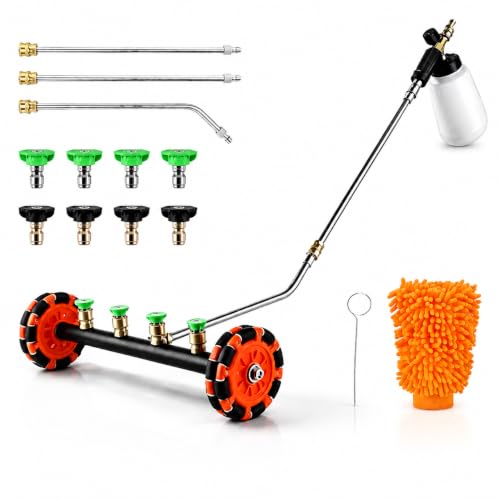 |
16" Undercarriage Pressure Washer Water Broom with FoamRyansunoro | Also great | $56.99
Price as of 23 Oct 2026
|
View |
The short version: wider bars suit larger footprints and repeated winter rinses, while compact frames are easier to fit under lower vehicles. Nozzle count and washer flow matter just as much as PSI, especially when you move from a small sedan to a truck or SUV.
How we chose
We compared each attachment on four things that actually affect results: clearance fit, washer compatibility, nozzle count and spray spread, and the type of winter-salt cleanup it suits best. Convenience features matter, but they do not replace fit or flow.
A 16-inch bar can be the right call for many SUVs and trucks. A 14-inch frame can be the safer choice when ground clearance is limited or when the chassis has low-hanging aero panels, cross braces, or battery shielding that leave less room for a wide head.
We also separated true cleaning performance from extras like foam cannons and water-broom conversion. Those features can be handy, but they should not be treated as the main reason to buy an undercarriage attachment.
Undercarriage cleaner decision matrix
This matrix is meant to be used before you buy. Measure ground clearance at the lowest point you need to clear, then compare it with your washer output and the attachment style that best matches the vehicle’s shape.
| Vehicle type | Ground clearance band | Washer output | Nozzle count | Recommended attachment style | When chemistry helps |
|---|---|---|---|---|---|
| Lowered car, sporty sedan | Low-profile clearance | Lower-flow electric washer | 4 nozzles | Compact 14-inch frame with wheels or a straight wand | After heavy winter brine, use a salt-neutralizing rinse after washing |
| Standard sedan or hatchback | Moderate clearance | Mid-range pressure washer | 4 nozzles | 14-inch or 16-inch bar, depending on lowest chassis points | Use chemistry when a rinse still leaves white film or crust in seams |
| Crossover or mid-size SUV | Moderate to taller clearance | Mid- to high-flow washer | 4 to 6 nozzles | 16-inch bar with stable wheels and extension wand setup | Salt treatment helps after repeated highway spray and slush exposure |
| Truck, van, trailer, road equipment | Taller clearance | Higher-output washer | 6 nozzles when flow supports it | 16-inch bar or larger-format attachment only if flow is sufficient | Use chemistry when the vehicle sees repeated salted-road duty |
Failure-mode checklist: weak spray usually points to a washer that cannot feed the bar, uneven output often means clogged or mismatched nozzles, wheel drag usually comes from low clearance or debris packed around the frame, and poor fit usually means the head is too wide for the vehicle’s lowest point.
Westinghouse Universal 16-inch: best for high-output washers
The Westinghouse Universal 16-inch attachment is the best fit for buyers with a stronger washer and a vehicle that can accept a full-width bar. Its 4400 PSI rating, 1/4-inch connector, four nozzles, and dual-function design make it the most flexible of the high-output options discussed here.
This is the right type if you want one attachment that can rinse the underside and also switch roles as a water broom for flat surfaces. Gas and electric compatibility makes it easier to pair with different washer setups, so long as your machine can deliver enough flow for the bar to spray evenly.
The drawback is simple: high-rated hardware does not guarantee better performance on a low-flow electric washer. A wide bar with multiple nozzles can feel weak if the washer cannot keep every stream fed with consistent volume.
Why the 4400 PSI and 1/4-inch setup matters
The 4400 PSI rating gives this model headroom for buyers who run stronger machines, but the better question is whether your washer can supply enough flow for the nozzle count. The 1/4-inch connector is useful because it matches common quick-connect setups and reduces friction at installation.
That said, PSI is only part of the story. A pressure washer with modest water delivery can still leave the spray bar underfed, especially when the head is wide and the nozzles are spread across the bar.
Dual-function cleaner and water broom use case
The dual-function layout adds versatility for driveway rinse-downs, wheel-well cleanup, and broad slurry removal. It is convenient, but it should be treated as a secondary benefit, not the reason the attachment cleans better under the car.
For winter salt, the real value is in repeated underside flushing. The broader rinse pattern helps, but it still depends on fit, flow, and getting the bar under the vehicle without contact.
How much ground clearance does an undercarriage cleaner need?
The cleaner needs enough clearance to pass under the lowest point of the chassis without striking splash shields, exhaust hangers, battery covers, or suspension parts. Measure before you buy. A 14-inch frame usually suits tighter cars better, while a 16-inch bar is often easier to use on SUVs and trucks with more room underneath.
Low-profile cars are the hardest fit case because the attachment must clear not just the body, but the lowest fixed part under the vehicle. Taller vehicles give you more room, though wheelbase shape and underbody bracing still matter.
Picture a sedan with low side skirts and a front splitter: a wide bar may fit in theory, but the lowest point can make the approach angle awkward. In that case, a compact frame or wand-style setup is less likely to snag.
Minimum clearance before you buy
The practical rule is to measure the lowest point under the car and compare it with the attachment’s overall height and wheel or caster layout. If the head has wheels, those wheels need room to roll; if it has a wider bar, the full width has to pass under the car without binding.
Low-profile cars versus taller trucks
Low-profile cars usually do better with compact or short-bar attachments. Trucks and larger SUVs can usually accept a 16-inch bar more easily, especially when the underbody is flatter and the approach path is more open.
When a 14-inch frame fits better than 16-inch
A 14-inch frame makes more sense when the vehicle has limited clearance, when the lowest chassis points sit close to the ground, or when the underbody includes extra protrusions that make a wider head awkward. The 16-inch format becomes more useful when the vehicle is taller and the underside is broad enough to benefit from the wider spray path.
RIDGE WASHER 16-inch: best for standard all-purpose use
The RIDGE WASHER 16-inch undercarriage cleaner is a straightforward all-purpose option for buyers who want a standard-width bar without extra complexity. Its 16-inch width and 4000 PSI rating make it a sensible match for many SUVs and trucks, especially when the washer has enough output to keep the spray pattern even.
This model is also a good fit when you want a simple straight extension wand setup and do not need a lot of extra features. The honest tradeoff is that a 16-inch bar can be too much for lower cars, and buyers with limited clearance may find a compact frame easier to live with.
Why a 16-inch bar fits many SUVs and trucks
A 16-inch bar spans more of the underside in one pass, which helps on broader chassis layouts and taller vehicles that leave more room under the body. That does not make it superior in every case, but it does make repeated rinse passes easier on larger vehicles.
Straight extension wand setup
Straight extension wand setups matter because they help keep the attachment aligned under the vehicle. They are especially useful when the underside is low enough that you need a flatter approach angle and less side-to-side wobble.
4-nozzle and dual-function variants
A 4-nozzle bar is the safer choice for many buyers because it is easier to feed consistently. Dual-function versions add convenience, but they do not change the core requirement: the washer still needs enough flow for all jets to spray evenly.
Tool Daily 16-inch: best for mixed cleaning jobs
The Tool Daily 16-inch attachment is the most flexible choice when you want undercarriage cleaning plus extra wash-tool utility. Its 1-liter foam cannon, 3 extension wands, 5 modes, and 3600 PSI rating make it a better all-around cleaning kit than a pure underbody bar for some buyers.
It is also listed as usable with a garden hose as well as a power washer, which broadens its appeal for owners who do not want a pressure washer setup every time. The drawback is that the mixed-use design can dilute the undercarriage focus; it is useful, but the extra pieces are not a substitute for fit or flow.
Foam cannon and extension wand bundle
The foam cannon and extra wands are best understood as workflow helpers. They can speed up pre-rinse, wheel cleaning, and general washing, but they are not what makes the undercarriage flush effective.
Five modes and what they add
The five modes are a convenience feature. They can help you shift from rinse to foam to broader wash tasks, but the undercarriage clean still depends on the head reaching the underside and the washer keeping pressure consistent.
Where 3600 PSI is enough
3600 PSI is enough for many homeowner setups, especially when the vehicle is a car or crossover and the washer output is not extreme. It is less compelling if you want to feed a wide, multi-nozzle bar on a large truck, where higher flow can matter more than headline pressure.
JOEJET 14-inch: best for tighter clearances
The JOEJET 14-inch undercarriage attachment is the best fit for tighter clearances because of its compact 14-inch frame and four 360° rotatable wheels. Rated for 4000 PSI, it is built for buyers who need maneuverability more than maximum span.
This type suits lower cars, smaller SUVs, and washer setups where a smaller footprint reduces the chance of contact. The tradeoff is coverage: a 14-inch head covers less ground per pass, so it can take more time on larger vehicles.
Four wheels and compact frame
Four rotatable wheels help the attachment track under the vehicle instead of scraping or hanging up. That matters more on cars with limited clearance or uneven underbody shapes, where wheel drag can stop a larger bar from moving cleanly.
4-nozzle spray coverage
A 4-nozzle pattern is the safer match for many small and mid-size washers because it is easier to keep balanced. It is a practical setup when you want cleaning consistency more than maximum width.
Best fit for lower cars and smaller washers
If your washer is not especially powerful, a 14-inch frame is often the better match because it asks less of the machine. Low-flow washers can struggle to keep a wide, multi-nozzle bar lively, while a compact setup is more forgiving.
Which one should you buy?
If you want the safest general recommendation, start with a 16-inch bar and four nozzles, then move up only if your vehicle is tall and your washer has enough flow for a wider spray pattern. The Westinghouse Universal 16-inch is the best high-output pick on paper, while the RIDGE WASHER 16-inch is the straightforward standard choice for many SUVs and trucks.
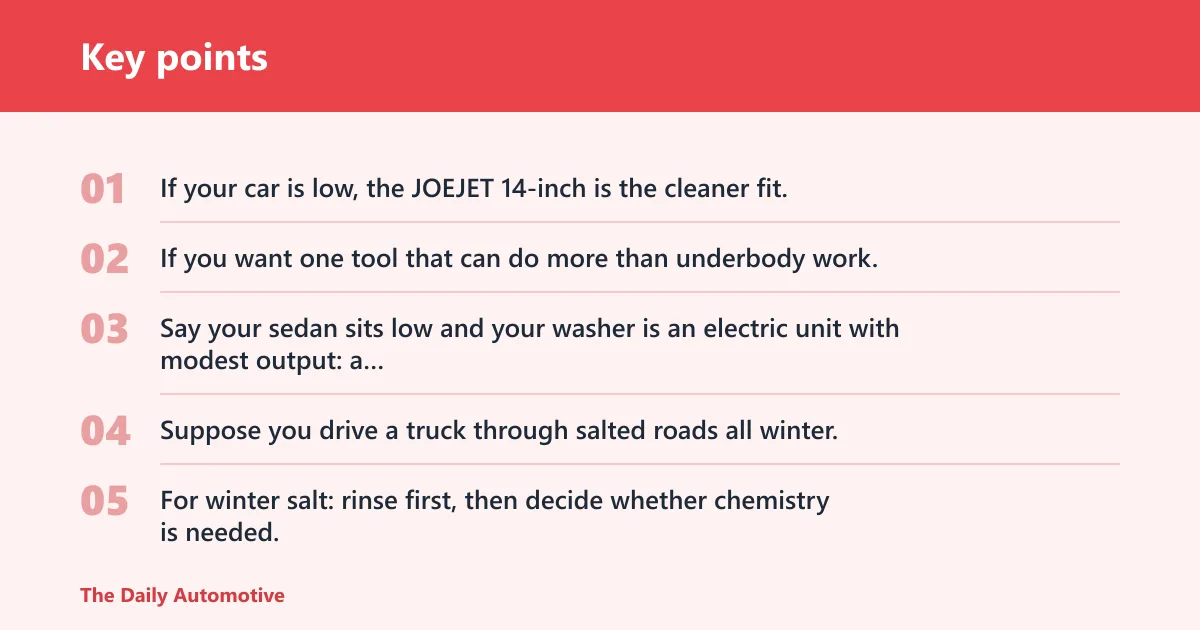
If your car is low, the JOEJET 14-inch is the cleaner fit. If you want one tool that can do more than underbody work, the Tool Daily bundle makes sense, but its extra pieces should be treated as convenience features, not the main reason it earns a spot in the garage.
Say your sedan sits low and your washer is an electric unit with modest output: a 14-inch attachment is usually the safer starting point because the bar is less likely to drag and less likely to outpace the washer’s flow. Suppose you drive a truck through salted roads all winter; a 16-inch bar with enough output, followed by a salt-neutralizing rinse, is the more practical path.
For winter salt: rinse first, then decide whether chemistry is needed. Water alone is often enough for light road film or fresh brine. If salt residue remains in seams, around fasteners, or on suspension parts, a product such as Salt-Away concentrate, sold in 32 fl oz size, adds a salt-neutralizing step for cars, trucks, trailers, and road equipment.
For corrosion protection after washing: Fluid Film Rust & Corrosion Protection aerosol, in the 11.75 oz aerosol format, is the kind of post-wash barrier buyers use when they want a wool-wax and refined-petroleum coating on exposed metal. It is a follow-up step, not a substitute for rinsing.
What to choose by washer output
Choose a compact 14-inch head if your washer is lower output or if you want the least chance of fit trouble. Choose a 16-inch bar when the washer can support it and the vehicle has enough clearance to let the bar move freely under the chassis.
When to step up to chemical rinse or corrosion protection
Step up when salt keeps returning after a plain rinse, when white crust remains after drying, or when the vehicle sees repeated winter exposure. Chemistry matters most when the rinse removes loose contamination but not the residue packed into seams and around brackets.
Frequently asked questions
What is the best undercarriage cleaner for my car or truck?
The best choice depends on clearance and washer output, not width alone. For most buyers, a 16-inch bar with four nozzles is the most practical starting point, but a 14-inch frame is better for low cars. Trucks and SUVs usually give you more room to work.
Is a 16-inch undercarriage cleaner better than a 13-inch one?
Not always. A 16-inch head covers more area per pass and suits many SUVs and trucks, but a smaller frame is often easier to fit under low cars. The better size is the one that clears the chassis and matches the washer’s flow.
How many nozzles should an undercarriage cleaner have?
Four nozzles are a practical baseline because they are easier to feed evenly. Six nozzles can spread water more broadly, but they ask more from the washer. On low-flow electric units, too many nozzles can thin the spray and reduce cleaning force.
Will an undercarriage cleaner work with my pressure washer?
Only if the connector and output match the attachment’s needs. A 1/4-inch connector is common, but compatibility is not only about fitting the hose. The washer must also supply enough pressure and flow for the nozzle count and bar width.
Can an undercarriage cleaner damage EV components or seals?
It can if you spray sensitive areas too closely or aim directly at exposed wiring, connectors, battery enclosures, or seals. Keep the spray moving, avoid concentrated blasts at one point, and follow the vehicle maker’s wash guidance. If a panel or connector looks fragile, do not target it.
Can an undercarriage cleaner remove road salt and winter brine?
Yes, but water alone is not always the full answer. The attachment can flush loose salt and brine, yet residue often remains in seams and around hardware. After heavy winter use, a salt-neutralizing rinse can help where plain water leaves deposits behind.
Do I need a pressure washer or can I use a garden hose?
Most undercarriage attachments are built around pressure washer use, but some kits add hose compatibility. A garden hose can be enough for light rinse duty, while a pressure washer is the better tool when you need stronger flushing power for salt, mud, and packed grime.
What PSI is safe for an undercarriage washer attachment?
Stay within the attachment’s listed range and match it to the washer’s flow, not PSI alone. One competitor lists 1500 to 4000 PSI, while another says performance is better at 2500 PSI or higher. The safe answer is the spec that fits both the washer and the vehicle.
Products related to this article
Sponsored / affiliate links. As an Amazon Associate I earn from qualifying purchases. I may earn additional commission from eligible campaigns.
 Automotive Windshield Oil Film Cleaner Brush, 2PCS 150ml Car Glass Cleaner with Refill Fluid & Microfiber Cloth, Repellent Windshield Cleaning Tool for Auto Windows, Mirrors & Home Glass
 2Pack Automotive Oil Film Cleaning Brush, Cars Clear Vision Glass Cleaner for Car Windows,Anti-Rain&Anti-Fog Windshield Cleaner Tool to Improve Clarity and Visibility,Car Glass Oil Film Remover