Car Audio Systems Guide
Most drivers get the best car audio upgrade by changing speakers first, adding a small amplifier second, and replacing the head unit only when they need CarPlay, better Bluetooth, or more tuning control. I have seen the reverse order waste roughly $1,000 on thin sound, broken factory features, or install work that had to be redone. This guide maps upgrade paths by budget, vehicle age, and listening goal, with the parts, compatibility checks, and typical install costs that matter first.
What components make up a complete car audio system?


A complete car audio system starts with a source unit, speakers, and some form of amplification, either inside the radio, in a factory amp, or in an aftermarket amp. A full build can also include a subwoofer, crossovers, wiring, and an equalizer. The right mix depends on whether the goal is better phone integration, cleaner vocals, stronger bass, or higher volume without harshness.
Head unit
The head unit is the source and control center. It handles radio, Bluetooth, USB playback, and often SD card support. Modern car audio systems can include Apple CarPlay and Android Auto, plus navigation, touchscreen controls, and built-in equalizer functions.
Sound quality depends less on the screen size than on source quality, preamp output, tuning control, and clean integration with the rest of the system. I have installed feature-packed radios that still sounded average through weak speakers and no amplifier.
Speakers
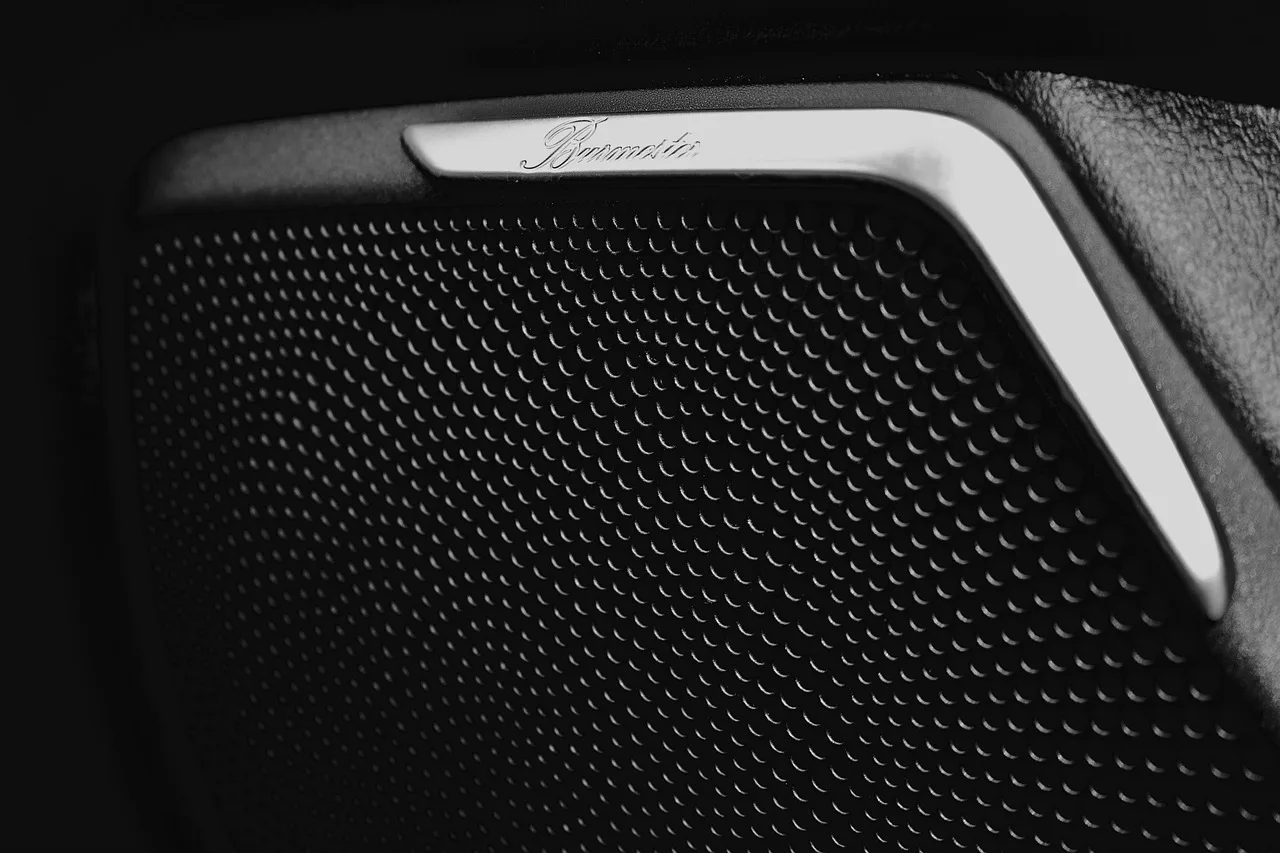
Speakers turn electrical signal into the sound heard in the cabin. Front speakers are described as creating a focused soundstage, so front doors and dash locations usually deserve attention before rear-fill speakers. Common fitment sizes include 6.5-inch and 6×9-inch, but depth and mounting pattern matter as much as diameter.
Amplifier
An amplifier takes the small audio signal from the radio or processor and gives the speakers steady power they can actually use. In practice, the real gain is cleaner playback when the volume goes up. Factory radios and small built-in amplifiers tend to clip early, which is why better speakers alone sometimes disappoint.
Subwoofer
A subwoofer handles the deep bass, roughly the 20-80 Hz range, that a typical door speaker often struggles to reproduce well in a car with road noise and thin factory doors. It adds weight to kick drums, bass guitar, and electronic tracks without forcing the front speakers to work outside their comfort zone. Powered subwoofers have a built-in amplifier, which keeps packaging simple for budget upgrades.
Crossovers, wiring, and equalizer
Component speaker systems consist of separate woofers, tweeters, and crossovers. Those crossovers split frequencies so bass goes to the woofer and highs go to the tweeter, which usually improves imaging and detail when installed well.
An adapter plug is recommended to avoid damaging factory wiring. Proper power wire routing, grounding, fuse placement near the battery, and secure signal connections also reduce signal loss and noise. Equalizers, either graphic or parametric, let the installer shape bass, midrange, and treble to match the car rather than the brochure.
Should you upgrade the head unit, speakers, amp, or subwoofer first?
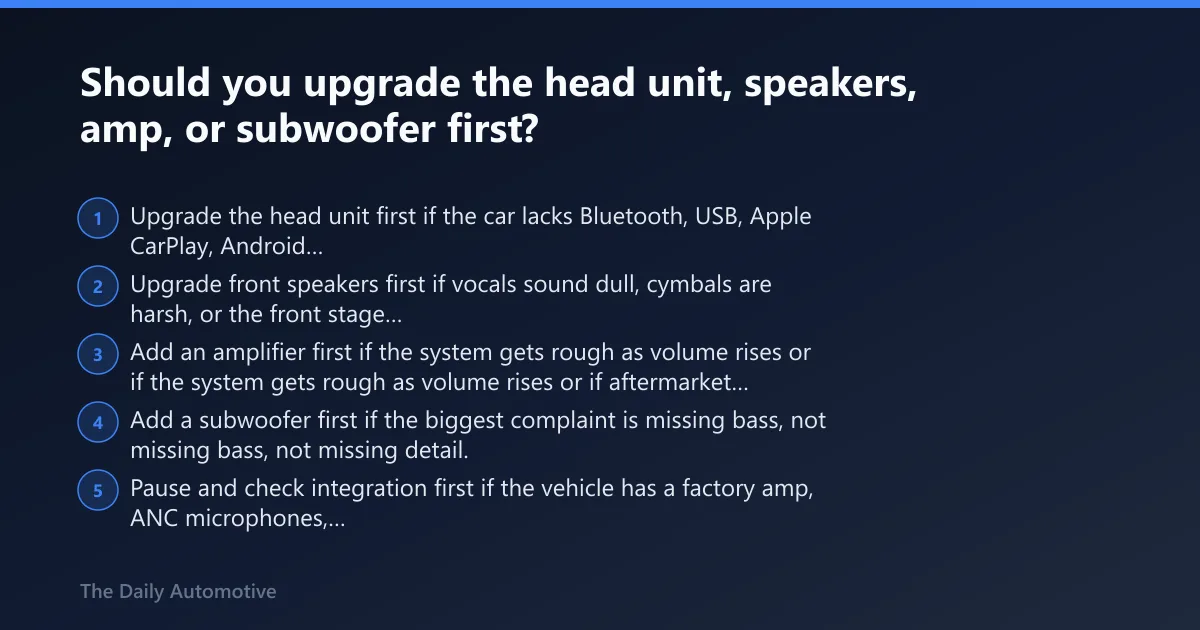
Start with the part that solves the actual complaint. If the problem is weak Bluetooth or no CarPlay, a head unit may be enough. If the complaint is harsh factory sound, speakers usually come first. If the system gets strained at volume, add an amplifier. If bass is missing, a subwoofer fixes that faster than replacing everything.
When a head unit alone is enough
A head unit-only upgrade makes sense when the existing speakers are acceptable but the source is outdated. Older cars often fall here. If the driver wants hands-free calling, USB charging, SD card playback, navigation, touchscreen controls, or phone mirroring, the radio can change daily use more than a speaker swap.
It also makes sense in basic vehicles where the factory radio has weak tuning control. A newer unit with better EQ, time alignment, and cleaner preamp output can tighten the sound enough to delay other upgrades.
When speakers should come first
Speakers are usually the best sound-per-dollar move when the car already has decent source features. Newer vehicles often already provide Bluetooth and decent media support. What they lack is tonal balance, detail, and composure from the factory speakers.
Coaxial speakers are presented as easier to install and budget-friendly. They fit well in commuter cars and family vehicles where cost, speed, and reliability matter more than chasing the last bit of imaging.
When an amplifier matters more
If the system sounds thin or sharp when the volume rises, amplification may matter more than a speaker swap. Better speakers still need clean power. A compact four-channel amp behind the dash or under a seat can bring more control than another round of speaker shopping.
This is also the right first move when the car already has decent aftermarket speakers but the radio cannot drive them well. Clean power reduces audible strain and keeps distortion down at higher volume.
When a subwoofer should be first
Many systems sound weak because the front speakers are trying to play bass they were never designed to handle. A small powered sub in the trunk or rear cargo area can fill in the low end and make the whole system sound more relaxed. That is especially true in SUVs and family vehicles.
Upgrade-first checklist
- Upgrade the head unit first if the car lacks Bluetooth, USB, Apple CarPlay, Android Auto, navigation, or useful EQ control.
- Upgrade front speakers first if vocals sound dull, cymbals are harsh, or the front stage feels flat.
- Add an amplifier first if the system gets rough as volume rises or if aftermarket speakers already exist.
- Add a subwoofer first if the biggest complaint is missing bass, not missing detail.
- Pause and check integration first if the vehicle has a factory amp, ANC microphones, warning chimes, steering-wheel controls, or a retained backup camera.
Upgrading Audio in Older Vehicles Without Ruining the Dash
Older cars need specific audio upgrades because standard modern head units often fit poorly, cause wiring issues, or introduce alternator whine. The safest approach is a single-DIN or classic-look Bluetooth receiver paired with new speakers and an amplifier, or a hidden Bluetooth amp if preserving the factory dash matters most.
Evaluating these options by fitment risk, wiring simplicity, and audible sound improvement prevents wasted money on incompatible parts. This breakdown of older car audio systems ranks the best upgrade paths, from shallow double-DIN CarPlay receivers to discreet amplifiers that deliver real performance gains without hacking your dashboard.
Optimizing Car Audio for Family Road Trips
Long drives with kids demand an audio setup that prioritizes vocal clarity over heavy bass. A front-stage speaker upgrade paired with a compact powered subwoofer and a DSP-capable head unit delivers clean sound without exhausting passengers or consuming cargo space. Allocating roughly 70 percent of your budget toward clarity components prevents the muddy, boomy output that causes ear fatigue during multi-hour journeys.
This approach matters because cheap systems distort speech and force you to raise the volume, which only worsens cabin noise. Choosing marine-rated receivers or mechless digital units also improves durability in minivans where spills happen frequently. For specific component recommendations that balance comfort, storage, and sound quality, explore family road trip audio before finalizing your build.
How do head units affect features, fitment, and sound?
Head units change convenience more than they change raw sound quality, unless the factory source is especially weak. They also drive fitment decisions because dash openings, adapters, and retained features can add cost fast. Choose the radio for the car’s dash, source needs, and tuning options, not for the screen alone.
Single DIN vs double DIN
Most vehicles manufactured after 1988 use Single DIN or Double DIN openings. Single DIN head units are more compact than double DIN units. Double DIN units offer more space for larger displays and features.
That matters because dash compatibility sets the whole project path. A car that takes double DIN may support a larger touchscreen with camera input and easier menu use. A single DIN dash may need a storage pocket, custom trim, or a flip-out screen if the owner wants modern features.
Features worth paying for
Bluetooth and USB are often the practical baseline. SD card support still matters for drivers who keep large local music libraries. Navigation is useful in older cars that lack any integrated phone screen option, though many drivers can save money by relying on phone-based maps through CarPlay or Android Auto.
Capacitive touchscreens are often considered better for brightness and color accuracy. That makes them easier to read in daylight, though screen quality does not guarantee better audio performance.
Sound and tuning limits
The better audio reason to change a head unit is tuning control. A useful unit offers a graphic or parametric equalizer, time alignment, adjustable crossover points, and clean preamp outputs for future amplifiers. Those tools matter more than animated menus.
There is a tradeoff here. A lower-cost receiver may offer CarPlay and a nice screen but limited preamp voltage and minimal tuning. A plainer unit with stronger audio settings can produce better sound once amplifiers and speakers enter the plan.
Factory radio retention vs replacement
In newer vehicles, replacing the radio is often the hardest move. Climate controls, vehicle settings, warning tones, and camera feeds may run through the factory screen. In those cases, a signal-integration processor, speaker upgrade, and amplifier may be the cleaner path.
Which head units perform best for daily driving?
A reliable commuter audio system needs fast startup times, clear call quality, and physical controls you can operate without taking your eyes off the road. Spending between $300 and $800 on a quality head unit and matching speakers typically delivers the most noticeable improvement over factory equipment in older vehicles.
Picking the wrong hardware introduces slow boot sequences, muddy Bluetooth calls, and distracting touchscreen menus that make traffic delays worse. Our detailed breakdown of commuter car audio systems compares specific models like the JVC KW-M690BW and budget options such as the Scosche BTFM9 based on one-hand usability, navigation reliability, and wireless smartphone integration.
Choosing a Sony Car Audio Head Unit
Sony car audio systems stand out for their seamless smartphone integration and straightforward installation, making them a strong choice for drivers who prioritize ease of use over complex DIY builds. Sony audio review breaks down which models fit specific dash chassis, helping you avoid buying a unit that misaligns with your vehicle’s interior geometry.
Matching the receiver to your existing speakers and upgrade path prevents the common mistake of installing a new head unit that sounds underwhelming due to impedance mismatches. This guide clarifies how Sony compares against Alpine and Pioneer, ensuring you select the right configuration based on your driving habits and desired CarPlay or Android Auto capabilities.
Boss Audio head units: budget value and tradeoffs
Boss Audio head units target buyers who need Bluetooth, Apple CarPlay, or Android Auto at the lowest price point, accepting rougher software and weaker sound tuning in exchange for savings. The supporting review outlines which specific models fit particular use cases and identifies where the budget cuts impact daily usability. It compares Boss against better-tuned competitors like Pioneer and Kenwood to help you determine if the price difference justifies the upgrade.
Before deciding, check the detailed breakdown of Boss Audio performance to understand the specific tradeoffs involved in choosing a budget-focused head unit.
JBL Car Speakers: Coaxial vs. Component Fitment and Output
When upgrading factory radios, JBL coaxial speakers often provide the easiest performance wins due to their higher sensitivity and simpler installation. Component sets offer a cleaner front stage but require precise tweeter placement and proper power handling. The JBL car speakers review breaks down the specific fitment, power needs, and sound characteristics of each configuration.
This guide helps you avoid common mistakes like selecting the wrong speaker size or impedance load, which can result in weak output or frequency imbalance. By comparing vehicle-specific options against your installation constraints, you can ensure the upgrade delivers improved clarity without sacrificing dashboard aesthetics or system stability.
Which Pioneer head units are worth buying?
If you want a practical aftermarket upgrade, this review breaks down which Pioneer stereos deliver the best mix of fitment, smartphone integration, and value. It highlights the DMH-130BT as a strong safe pick, then compares the other current options so you can match screen size, connectivity, and budget to your dash.
That matters because the wrong head unit can create extra install hassle or leave you paying for features you will not use. For a model-by-model look at the tradeoffs, see the Pioneer car stereo review.
Which speakers should you buy for better sound?
Choose speakers based on the car’s front-stage layout, fitment depth, and how serious the listening goal is. For many drivers, front coaxials are enough. For better imaging and detail, component sets are worth the extra install work. Rear speakers should usually wait unless the car needs rear-seat coverage.
Coaxial vs component speakers
Coaxial speakers place the tweeter and woofer together in one assembly. They are easier to fit, quicker to wire, and usually cost less. That makes them a solid choice for commuters, leased vehicles, and value-focused upgrades.
Component speaker systems consist of separate woofers, tweeters, and crossovers. They usually give better staging and high-frequency placement because the tweeter can be mounted higher in the door, sail panel, or dash. The downside is more wiring, more labor, and more chances to run into fitment trouble.
Front first, rear later
Front speakers are described as creating a focused soundstage. That is why a front-only speaker upgrade often beats replacing all four door speakers on the same budget. Rear speakers mostly add fill for back-seat passengers. They rarely fix a weak front stage.
Fitment: size, depth, and brackets
Do not buy by diameter alone. A 6.5-inch speaker may still hit the window track if mounting depth is wrong. A 6×9-inch factory opening may need an adapter bracket for a round speaker. Tweeter locations matter too, especially in vehicles with factory sail-panel pods.
Impedance checks matter when mixing factory amps with aftermarket speakers. Some factory systems expect unusual speaker loads. Ignore that, and volume or tonal balance can go sideways fast.
Crossovers, sensitivity, and realistic power
Crossovers keep each driver in its intended frequency band. Good component systems include passive crossovers that simplify installation, though active tuning through a DSP-style setup gives more control when the budget allows. Sensitivity affects how lively a speaker sounds on low power. Real-world power handling matters more than inflated packaging claims.
Do you need an amplifier or subwoofer for better sound?
An amplifier is the better first choice when the system gets strained at higher volume or when upgraded speakers sound underfed. A subwoofer is the better first choice when bass is thin. Many balanced systems need both, but the order depends on whether the missing piece is clean power or low-frequency output.
Choosing the right amplifier
Multi-channel amplifiers power door speakers. Mono amplifiers power subwoofers. The cleanest beginner path is often a small four-channel amp for the front stage, then a separate mono amp later if stronger bass becomes the next goal.
Power matching is less about chasing the biggest number and more about giving speakers enough clean output. Gain setting matters. Too much gain clips the signal early, and too little wastes the amplifier. Impedance has to match the amp’s safe operating range, especially when factory wiring or multiple speakers per channel are involved.
Why clean power matters
Amplifiers do more than make the system louder. They reduce distortion at higher volume because the speakers are getting cleaner signal headroom. That is why an amplified front stage can sound calmer and fuller even at moderate listening levels.
Powered vs component subwoofers
Powered subwoofers have a built-in amplifier, so they save space and install time. They are a smart move for hatchbacks, family vehicles, and people who want bass support without filling the whole trunk.
A component subwoofer setup uses a separate sub, box, and amplifier. It takes more planning and more wiring, but it gives better control over enclosure size, output, and future expansion. Trunk placement usually gives the best output options. Rear cargo placement is easier in SUVs but can eat useful storage.
What can go wrong with compatibility and installation?
The expensive mistakes in car audio usually come from integration, not from the speakers themselves. Factory amplifiers, active noise cancellation, dash adapters, odd speaker loads, and retained vehicle features can change the whole parts list. Good planning prevents rework, noise problems, and missing functions after the install.
Harnesses, dash kits, and retained controls
An adapter plug is recommended to avoid damaging factory wiring. In many vehicles, the project also needs a dash kit, antenna adapter, steering-wheel control interface, and sometimes a module to keep warning chimes or a factory backup camera working.
This is where a cheap head unit swap stops being cheap. The radio may fit the budget, but the adapters can add a surprising amount to the total.
Factory amps, speaker-level inputs, and ANC
Some factory amplified systems do not play nicely with aftermarket gear. The installer may need speaker-level inputs, load resistors, amp-bypass adapter plugs, or signal summing to get a clean result. Active noise cancellation can also fight a new subwoofer and create odd low-frequency behavior unless it is disabled correctly.
Signal loss, grounding, and fuse placement
Bad grounds cause more grief than flashy equipment choices. Ground the amplifier to clean bare metal, keep power wire fused near the battery, separate power and signal runs where possible, and avoid loose crimp connections. Those steps cut hiss, alternator whine, and intermittent shutdowns.
Always disconnect the battery before major wiring work. It is basic advice, but it matters.
DIY vs professional installation
DIY fits older cars with simple dashes, standard speaker openings, and no factory amp. Professional labor makes more sense when the vehicle has integrated screens, retained safety features, custom trim pieces, or tuning needs beyond a basic radio swap. Labor can save money when one wrong adapter choice would force buying parts twice.
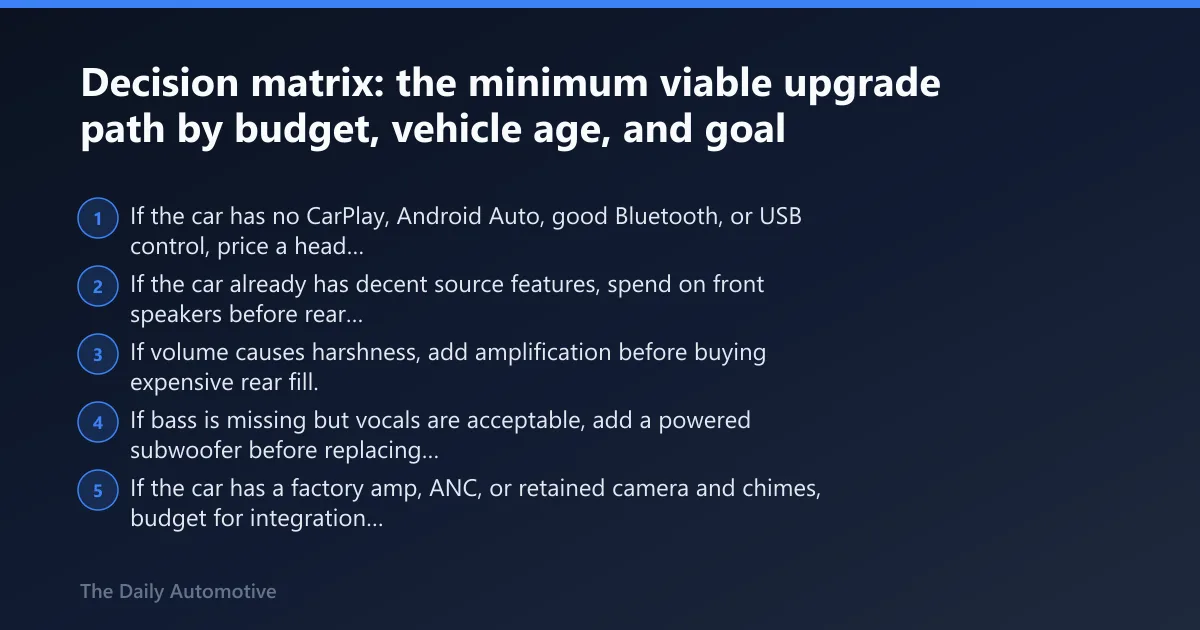
Decision matrix: the minimum viable upgrade path by budget, vehicle age, and goal
Minimum viable upgrade path
| Budget range | Vehicle age / factory complexity | Primary goal | Minimum viable upgrade path | Rough parts total | Rough install total |
|---|---|---|---|---|---|
| Entry | Older car, simple factory radio | Modern features | Single DIN or double DIN head unit, harness, dash kit, basic EQ setup | Roughly $250-$500 | Roughly $120-$300 |
| Entry | Newer car, usable factory screen | Better clarity | Front coaxial speakers, mounting brackets, plug-in adapters | Roughly $180-$350 | Roughly $100-$220 |
| Mid-range | Any vehicle with weak front stage | Sound quality per dollar | Front component speakers, small four-channel amp for fronts, tuning | Roughly $500-$950 | Roughly $300-$700 |
| Mid-range | Family vehicle or SUV | Fuller bass without losing cargo room | Front speaker upgrade plus compact powered subwoofer in rear | Roughly $450-$850 | Roughly $220-$500 |
| Full-system | Older car, easy integration | Clarity, bass, volume | Double DIN head unit, front components, rear coaxials, four-channel amp, mono amp, component subwoofer | Roughly $1,300-$2,400 | Roughly $600-$1,400 |
| Full-system | Newer car, factory amp and retained features | Keep tech, improve sound | Factory radio retention, integration processor, front components, multi-channel amp, subwoofer, tuning | Roughly $1,500-$2,800 | Roughly $800-$1,800 |
How vehicle age changes the plan
Older cars usually reward a head unit swap because the source is often the weakest link and integration is simpler. Newer cars often reward speaker and amplifier upgrades first because the factory screen may control too many vehicle functions to replace cheaply.
Use cases competitors usually skip
A commuter car usually needs front speakers and Bluetooth before it needs a subwoofer. A family vehicle often benefits from a compact powered sub and reliable hands-free calling. An older weekend car can justify a full radio replacement because there is less factory tech to preserve.
Checklist: choose the first upgrade
- If the car has no CarPlay, Android Auto, good Bluetooth, or USB control, price a head unit path first.
- If the car already has decent source features, spend on front speakers before rear speakers.
- If volume causes harshness, add amplification before buying expensive rear fill.
- If bass is missing but vocals are acceptable, add a powered subwoofer before replacing all door speakers.
- If the car has a factory amp, ANC, or retained camera and chimes, budget for integration modules before any other purchase.
- If the budget is tight, avoid splitting it across too many parts. One strong front-stage move beats four weak upgrades.
How much does a good car audio system cost?
A good car audio system usually starts with a rough parts budget of $300 to $600 for a meaningful improvement and lands around $900 to $1,800 for the sweet spot most drivers actually enjoy. The total depends less on brand names than on vehicle integration, amp needs, and whether bass is part of the plan.
Practical cost tiers
At roughly $300 to $600 in parts, the best value is usually either a head unit upgrade for an older car or front speakers plus install accessories for a newer one. At roughly $700 to $1,200, a front-stage upgrade with a small amplifier becomes realistic. At roughly $1,300 to $2,400, a balanced full system is possible in a straightforward vehicle.
What drives the bill up
The expensive items are often the boring ones: integration modules, amp-bypass harnesses, custom mounting rings, sound treatment, and tuning time. A newer factory-amplified vehicle can cost more to improve than an older car with a blank dash and simple speaker wiring.
Premium Factory Audio Systems Ranked for Audiophiles
The guide evaluates factory‑installed car audio packages on imaging, tonal balance, and tuning flexibility, highlighting why a well‑tuned system beats sheer volume. It compares four to five top contenders, explains the testing criteria, and helps you decide if a premium upgrade justifies the cost. Readers learn which system delivers the clearest stage, the most neutral sound, and the best value, with the ELS Studio 3D emerging as the overall winner.
For a detailed ranking and buying advice, see the best car audio systems guide.
How much does it cost to install a full car audio system?
Professional installation for a full car audio system often runs roughly $600 to $1,800, depending on whether the vehicle needs a simple radio-and-amp install or deeper factory integration. Labor rises with dash disassembly, custom subwoofer mounting, amp rack work, retained-feature modules, and tuning or troubleshooting time.
Where labor increases
Labor climbs fast when the radio controls climate functions, when door panels are difficult, or when factory amplifiers need to stay in the loop. Tuning also matters. A system with component speakers, crossovers, and multiple amplifiers should not leave the shop with gains guessed and EQ untouched.
How much does a full car audio system cost?
A full car audio system, including parts and installation, often lands roughly between $1,900 and $4,200 for a clean, balanced build. Simple older cars can come in lower. Newer factory-amplified vehicles with retained cameras, steering-wheel controls, and integration processors usually land higher, even before custom fabrication enters the picture.
What a full system usually includes
In practical terms, that budget covers a head unit or factory-source retention plan, front speakers, optional rear speakers, at least one amplifier, a subwoofer, wiring, adapters, and setup time. Spending more without addressing tuning and integration rarely gives proportional gains.
Frequently asked questions
What is the best audio system for a car?
The best audio system for a car matches the cabin, source needs, and listening goal. For most drivers, that means front-speaker upgrades, a small amplifier, and a subwoofer only if bass is missing. A touchscreen radio matters most when modern connectivity is the problem, not when speaker quality is the weak point.
Should I choose a single DIN or double DIN head unit?
Choose based on dash fitment first, then features. Single DIN head units are more compact than double DIN units. Double DIN units offer more space for larger displays and features. If the vehicle supports either format, double DIN usually makes more sense for touchscreen use, camera input, and easier menu navigation.
Do I need an amplifier for better sound?
An amplifier is needed when the system sounds strained as volume rises or when upgraded speakers are not coming alive. It helps by delivering cleaner power and reducing distortion at higher volume. If the main issue is bass only, a powered subwoofer may fix the system faster than a full speaker-and-amp upgrade.
What is the difference between coaxial and component speakers?
Coaxial speakers combine drivers in one unit and are easier to install and budget-friendly. Component speaker systems consist of separate woofers, tweeters, and crossovers, which usually improves imaging and detail. Coaxials suit quick upgrades. Components suit drivers who care more about front-stage precision and are willing to pay for labor.
what is the best audio system for car
The best audio system for car use is the one that fixes the weakest link first. Older cars often benefit from a new head unit. Newer cars often benefit more from front speakers and a compact amplifier. Bass-heavy listeners should budget for a subwoofer, while commuters may care more about Bluetooth and phone integration.
Products related to this article
Sponsored / affiliate links. As an Amazon Associate I earn from qualifying purchases. I may earn additional commission from eligible campaigns.