Best Dash Cams for Night Vision (2026): We Compared
The best car dash cam with night vision depends on use case: pick a STARVIS-based road cam for license plates, an IR cabin cam for passenger video, or a model with buffered parking mode if you need overnight coverage. Choose wrong and nighttime footage turns into unusable glare, dark faces, or missed parking-lot incidents. This guide compares the best options by sensor, IR lighting, and parking-mode performance so you can match the camera to your driving.
The best car dash cam with night vision depends on what you need to record: pick a STARVIS-based road cam for license plates, an IR cabin cam for passenger video, or a model with buffered parking mode if you need overnight coverage. Pick the wrong tool and night footage turns into glare, dark faces, or missed parking-lot incidents. This guide matches the camera to the driving.
Quick comparison
| Product | Badge | Best for | Price | ||
|---|---|---|---|---|---|
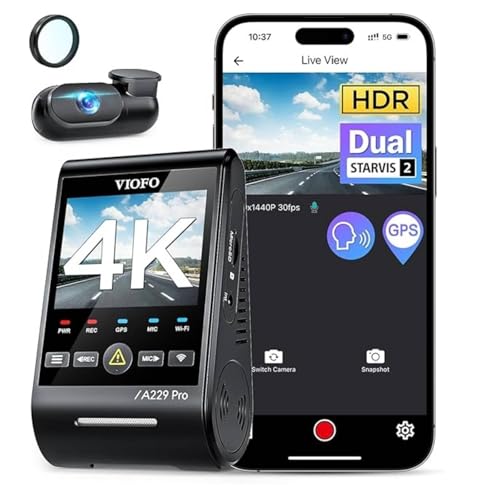 |
VIOFO A229 Pro 4K HDR Dash Cam Front and Rear, Dual STARVISVIOFO | Our pick | 4K front · 2K rear · dual STARVIS 2 · GPS | $279.99
Price as of 22 Oct 2026
|
View |
 |
Vantrue N4 Pro S 4K 3 Channel Dash Cam, Triple STARVIS 2VANTRUE | Also great | 4K front · 2.5K rear · 1080P cabin · IR night vision | $299.99
Price as of 22 Oct 2026
|
View |
 |
4K+4K+1080P 3 Channel Dash Cam, Free 128GB Card, AProX HDTERUNSOUl | Budget pick | 4K+4K+1080P · AProX night vision · WiFi 6 · 128GB card included | $116.99
Price as of 22 Oct 2026
|
View |
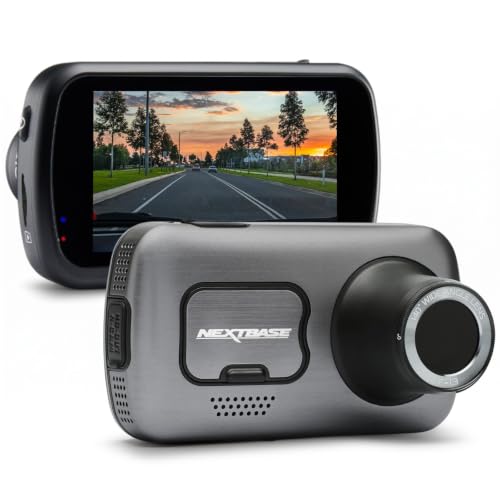 |
Nextbase 622GW Dash Cam Full 4K/30fps UHD Recording in CarNextbase | Upgrade pick | 4K/30fps front · 140° view · Alexa · image stabilization | $199.99
Price as of 22 Oct 2026
|
View |
Use this section to split road-facing low-light capture from cabin IR lighting before you buy. That split matters more than the marketing label on the box.
How we chose
Each model was compared on four night-driving points: low-light sensor type, channel count, glare control, and parking-mode power needs. Also check whether the camera is built for road footage, cabin footage, or both. Finally, we weighed installation complexity, because night-focused setups often fail on wiring and storage before they fail on image quality.
One more filter matters. A camera with strong sensor specs can still disappoint if it cannot handle headlights, windshield reflection, or a dark rear seat. That is why WDR, HDR, and channel layout appear throughout this guide.
What does night vision mean on a dash cam?
On dash cams, “night vision” usually means one of two different things: sensor-based low-light recording for the road, or infrared illumination for a dark cabin. Those are not interchangeable. If you need plate detail on an unlit road, you want a strong image sensor and glare control. If you need faces inside a blacked-out cabin, you want IR-lit interior capture.
Sensor-based low-light recording for the road
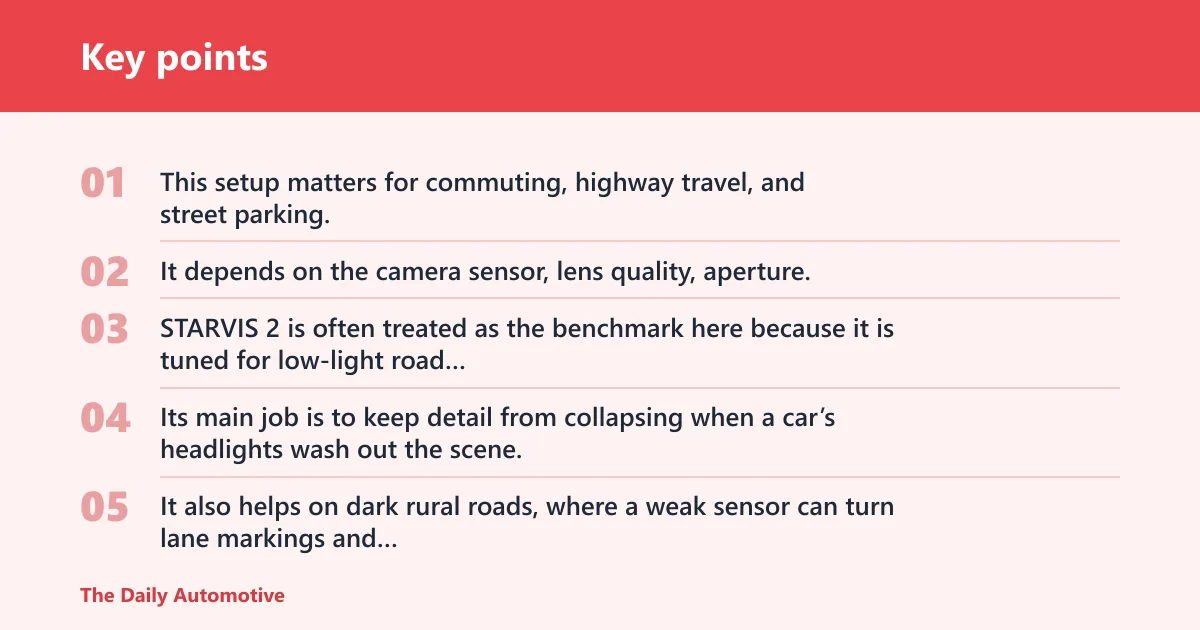
This setup matters for commuting, highway travel, and street parking. It depends on the camera sensor, lens quality, aperture, and image processing such as HDR or WDR. STARVIS 2 is often treated as the benchmark here because it is tuned for low-light road footage and can appear across multiple channels in some premium models.
Its main job is to keep detail from collapsing when a car’s headlights wash out the scene. It also helps on dark rural roads, where a weak sensor can turn lane markings and license plates into noise.
Infrared illumination for dark interiors
Infrared illumination is purpose-built for interior cameras in true darkness. The LEDs are invisible to the human eye, but they light the cabin for the camera. That is why this approach is common in rideshare, taxi, and fleet cabins where the interior may be dark or dim at night.
It does not help much for the road. IR can even be the wrong tool there, because it does not solve headlight bloom or windshield glare. It solves pitch-black cabin footage.
Where marketing claims blur the difference
Many listings treat all night footage as one feature. That creates bad buying decisions. A driver shopping for parking surveillance in an apartment lot does not need IR in the cabin; a rideshare driver usually does.
Another problem is that some brands use “night vision” to describe a broad set of features without saying which scene they improve. Ask a simple question: does the camera need to see the road, the cabin, or both?
Night vision decision matrix
| Night-driving scenario | Recommended sensor type | Channel count | IR needed? | Hardwire kit required? | Main failure mode avoided |
|---|---|---|---|---|---|
| Road-only low-light commute | STARVIS 2 or similar low-light road sensor | 1 or 2 | No | No for driving only | Headlight bloom and plate loss |
| Front/rear night driving | Dual STARVIS 2 or strong HDR front and rear sensors | 2 | No | Usually yes for parking mode | Rear impact gaps and glare from following traffic |
| Rideshare cabin monitoring | Interior IR camera plus road-facing sensors | 3 or 4 | Yes | Usually yes for all-night monitoring | Pitch-black cabin footage |
| Parking surveillance in dark lots | Low-light road sensor with buffered parking mode | 2 or 3 | No unless cabin evidence matters | Yes | Missed hit-and-run clips and dead-battery shutdown |
| Fleet and multi-camera use | STARVIS 2 across multiple channels | 4 | Only for interior duty | Yes | Blind spots and unusable low-light side footage |
A common first-timer mistake is buying a 4-channel camera for a simple commute and then discovering the extra wiring, storage use, and setup time add more friction than value. Suppose you park in a street spot every night, but only need front and rear evidence. A strong 2-channel setup is easier to live with and still covers the likely claims.
Rove R2-4K Dual: best overall for night driving
The Rove R2-4K Dual is the best overall choice in this group because it combines 4K front recording, dual recording, wide-angle coverage, and a night-vision focus in one direct package. Digitech Bytes also lists it as a dual dash cam, which fits its role for everyday drivers who want one camera that covers most night-driving cases.
It works best for commuters who want a road-first setup without moving to a heavier multi-camera system. The main strength is balance: enough coverage for front and rear incidents, plus a clearer path to usable night footage than a basic budget model.
The drawback is the same one that affects many dual cams: it still has to divide attention between two views. If your real need is interior video in a dark cabin, this is not the right tool. If your real need is multi-angle fleet monitoring, it can run out of coverage fast.
VIOFO A229 Pro 4K HDR: best for front/rear clarity
The VIOFO A229 Pro is the strongest front/rear pick when you care about image quality at night. Its published details call out exceptional 4K front and 2K rear video, dual STARVIS 2 sensors, and HDR Night Vision 2.0. That combination is built for mixed lighting, not just darkness.
This is the better choice when headlights, streetlamps, and rear traffic all appear in one drive. HDR matters here because it helps balance bright and dark areas instead of letting headlights blow out the frame.
The tradeoff is cost and complexity. You are paying for stronger imaging and parking features, but you are also buying into a more involved install than a simple single-channel camera. If you never use the rear view, the value drops quickly.
WOLFBOX G900 Tripro: best for multi-channel coverage
The WOLFBOX G900 Tripro is the right fit when you need multi-channel coverage and want 4K front recording with 2.5K rear recording. That makes it a practical choice for drivers who split time between city traffic, curbside stops, and rear-impact risk. It is also described as a smooth-operation option, which matters when you do not want the system to feel busy every time you start the car.
This model makes more sense for drivers who want broader evidence than a dual cam can provide, but who still want a road-first setup rather than a cabin-first setup. It is the kind of camera to look at for larger vehicles, work use, or shared family cars where more than one view can matter.
The drawback is predictable: more channels mean more installation effort and more storage demand. If you do not need the extra views, the additional complexity may not pay off.
Vantrue N5S: best for four-channel monitoring
The Vantrue N5S is the most serious multi-angle option here. It is a 4-channel dash cam with 2.7K front recording, dual 1080P side cameras, 1440P interior recording, and STARVIS 2 sensors across all four channels. That is the most direct answer for fleet, rideshare, or high-risk parking use where one camera has to cover many directions at once.
It stands out because it does not treat the interior as an afterthought. The front, sides, and cabin all get imaging support, which is exactly what you want when the event could happen beside the car or inside it.
The drawback is installation load. Four channels mean more cable routing, more planning, and more storage pressure than most drivers need. For a normal commute, this is more camera than you need.
Vantrue N4S: best value for three-channel coverage
The Vantrue N4S is the value-oriented choice for drivers who want more than front/rear without paying for a full four-channel system. It is positioned in competitor roundups as a best-value 3-channel dash cam, and it uses STARVIS 2 sensor tech for strong night performance.
This is a smart middle ground for commuters who sometimes want cabin coverage, or for drivers who park in darker areas and want one more angle than a basic dual cam provides. The added channel can help when an incident does not happen directly in front or behind the car.
The compromise is obvious: three channels still create more wiring and storage needs than a dual cam, but without the full flexibility of four channels. If cabin video is not part of your problem, a dual setup is usually simpler.
IIWEY N5: best for true-dark cabin monitoring
The IIWEY N5 is the clearest fit when the cabin is the priority and darkness is absolute. It uses dedicated IR illumination for interior monitoring, which makes it the right tool for true-dark cabin use cases such as late-night passenger rides or parked-car monitoring where faces inside the vehicle matter.
This is the model to look at when sensor-based road night vision is not enough. IR is invisible to the human eye and purpose-built for interior cameras, so it can show a cabin that would otherwise appear black.
The drawback is that this strength is specialized. IR helps the cabin, not the road. If your main problem is plate capture on dark roads, this is not the camera to lead with.
FAIMEE F9: best budget 3-channel setup
The FAIMEE F9 is the budget 3-channel option in this group. It is aimed at drivers who want balanced resolution and night vision without stepping into the higher price and complexity of flagship systems. For light-duty rideshare work or family use, that can be enough.
Its value is coverage. A three-channel layout gives you more evidence than a basic dual cam, which can matter if a side impact or cabin dispute is more likely than a simple rear-end claim.
The drawback is that budget cameras can be more sensitive to sensor and lens limits at night. That means the footage may be fine for general evidence, but not as dependable as a higher-end STARVIS 2 setup when headlights and darkness mix.
Which one should you buy?
If you commute mostly on lit roads and want the least hassle, start with the Rove R2-4K Dual. If your night driving includes a lot of headlights, merges, and rear traffic, the VIOFO A229 Pro is the stronger front/rear choice because it pairs dual STARVIS 2 sensors with HDR.
For rideshare or taxi work, pick the IIWEY N5 if interior darkness is the main issue, or the Vantrue N5S if you need full coverage of front, sides, and cabin. For fleets, parking-heavy routes, or vehicles that face more than one risk angle, the Vantrue N5S earns its keep faster than a dual cam.
Picture an apartment garage with dim lighting and a rear camera that only records a blur after a tap-and-run. A buffered parking-mode setup with a hardwire kit is the fix, not a higher resolution number. The camera has to stay awake when the car is off.
2-channel is enough when your real risk is front and rear traffic, or when you want easier installation and lower storage use. 4-channel becomes worth it when side impacts, cabin disputes, or fleet accountability are part of the job. Extra channels are valuable only if you will actually review them.
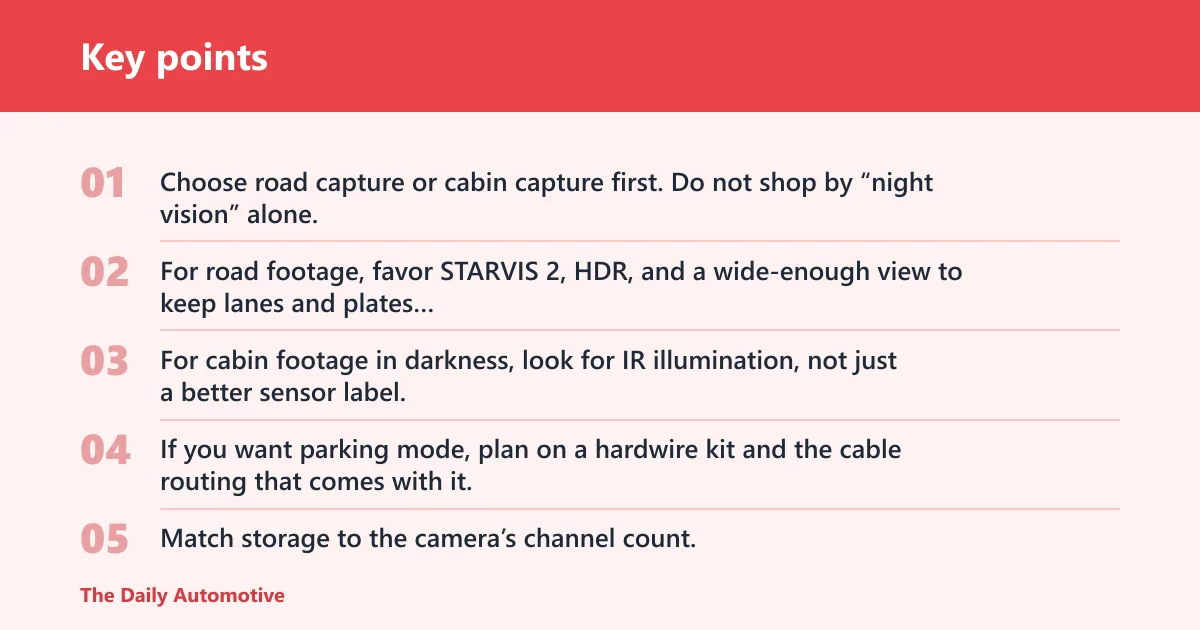
- Choose road capture or cabin capture first. Do not shop by “night vision” alone.
- For road footage, favor STARVIS 2, HDR, and a wide-enough view to keep lanes and plates in frame.
- For cabin footage in darkness, look for IR illumination, not just a better sensor label.
- If you want parking mode, plan on a hardwire kit and the cable routing that comes with it.
- Match storage to the camera’s channel count. More channels mean more data and faster card wear.
What is the best dash cam for night vision?
The best dash cam for night vision depends on whether you need road footage or cabin footage. For most drivers, the VIOFO A229 Pro is the strongest front/rear option because its dual STARVIS 2 setup and HDR are built for mixed night lighting. For interior darkness, an IR-equipped model is the better answer.
Frequently asked questions
Do dash cams with night vision actually work in the dark?
Yes, but only when the right kind of night vision matches the scene. Sensor-based systems can improve road footage in low light, while IR lighting can make a dark cabin visible. Neither one can fully defeat glare from headlights or a dirty windshield, so setup still matters.
Is STARVIS 2 better than regular night vision on a dash cam?
For road footage, STARVIS 2 is the better benchmark because it is designed for low-light capture rather than a vague “night vision” label. It tends to matter more than headline resolution when the scene is dark, noisy, or hit by oncoming headlights. It is not the answer for interior darkness, though.
Should I buy a 2-channel or 4-channel dash cam for night driving?
Buy 2-channel if you mainly need front and rear evidence and want a simpler install. Buy 4-channel if you need side views, cabin coverage, or fleet accountability at night. Extra channels help only when the added angles solve a real incident risk.
What is the difference between infrared and sensor-based night vision?
Infrared lights the cabin for the camera and is meant for true darkness inside the vehicle. Sensor-based night vision depends on the camera sensor, lens, and image processing to keep the road visible in low light. One is for interiors; the other is for roads.
Which dash cam is best for parking mode at night?
For parking mode, the best choice is usually a buffered system with a hardwire kit, such as the VIOFO A229 Pro or any comparable model built for overnight recording. The key is not just image quality; it is whether the camera can keep recording while the car is off.
What resolution is best for clear night footage on a dash cam?
4K helps, but it is not the whole answer. At night, sensor quality, HDR or WDR, and lens performance often matter more than resolution alone. A strong 2K or 4K sensor can beat a weaker high-resolution camera when headlights and darkness collide.
Products related to this article
Sponsored / affiliate links. As an Amazon Associate I earn from qualifying purchases. I may earn additional commission from eligible campaigns.