3 Best Rearview Dash Cams for Night Vision (2026): We Compared
Pick the WOLFBOX G840S, Pelsee S12, and Vlokda dual dash cam if you want the three best rearview dash cams with night vision in 2026, ranked by plate capture, cabin visibility, and parked-car protection. Low-light footage gets hard to trust fast when glare, tint, or a dark cabin cuts detail. This guide compares rear-facing image quality, infrared or HDR performance, parking modes, and rear coverage tradeoffs.
Quick comparison
| Product | Badge | Best for | Price | ||
|---|---|---|---|---|---|
 |
WOLFBOX G840S 12" 4K Mirror Dash Cam Backup Camera withWOLFBOX | Our pick | 4K mirror dash cam with 32GB card and GPS | $169.99
Price as of 21 Oct 2026
|
View |
 |
Dual Dash Cam Front and Inside with 64GB Card | 1080P DashVlokda | Budget pick | 1080P dual dash cam with 64GB card | $46.99
Price as of 21 Oct 2026
|
View |
 |
Pelsee S12 Native 4K + 2.5K Mirror Dash Cam, 64GB Cardpelsee | Also great | Native 4K and 2.5K mirror dash cam with GPS | $139.99
Price as of 21 Oct 2026
|
View |
This quick view separates the three picks by night-use case, not by headline resolution alone. The best choice depends on whether you need a readable rear plate, an interior-facing cabin feed, or a parked-car watch mode that can keep recording after dark.
How we chose
The ranking puts night performance first. Sensor quality, aperture, WDR, and usable rear footage matter more than a big spec number on the box.
Installation cost and storage needs also count. A rearview mirror unit can keep the install cleaner, but a 3-channel setup usually needs more wiring, more setup time, and more storage planning.
Finally, the picks had to cover different real use cases. One has to fit plate capture, one has to fit cabin visibility, and one has to stay affordable without pretending it can do everything.
WOLFBOX G840S: best for plate capture
The WOLFBOX G840S is the strongest all-around pick here if your priority is a rearview mirror dash cam that can handle night driving, rear coverage, and parking use without moving into full hardwired fleet-style complexity. Based on the published product details, it is reported to include 4K front recording, a 1080p rear camera, GPS, 5.8GHz Wi-Fi, a 32GB card, and a 24-hour parking monitor.
That setup fits drivers who want better odds of catching a front plate and a usable rear view for backing, lane changes, and after-dark parking checks. The 140-degree wide view and F2.0 aperture listed on similar rearview models matter because low light often fails first at the edges of the frame, not the center.
The drawback is simple: this is still a mirror-style system, so a bright screen, a dirty rear lens, or heavily tinted glass can limit what the rear camera gives you at night. The included 32GB card is useful out of the box, but longer parked monitoring usually pushes you toward a larger card and a hardwire kit for better endurance.
Pelsee S12: best for parked-car protection
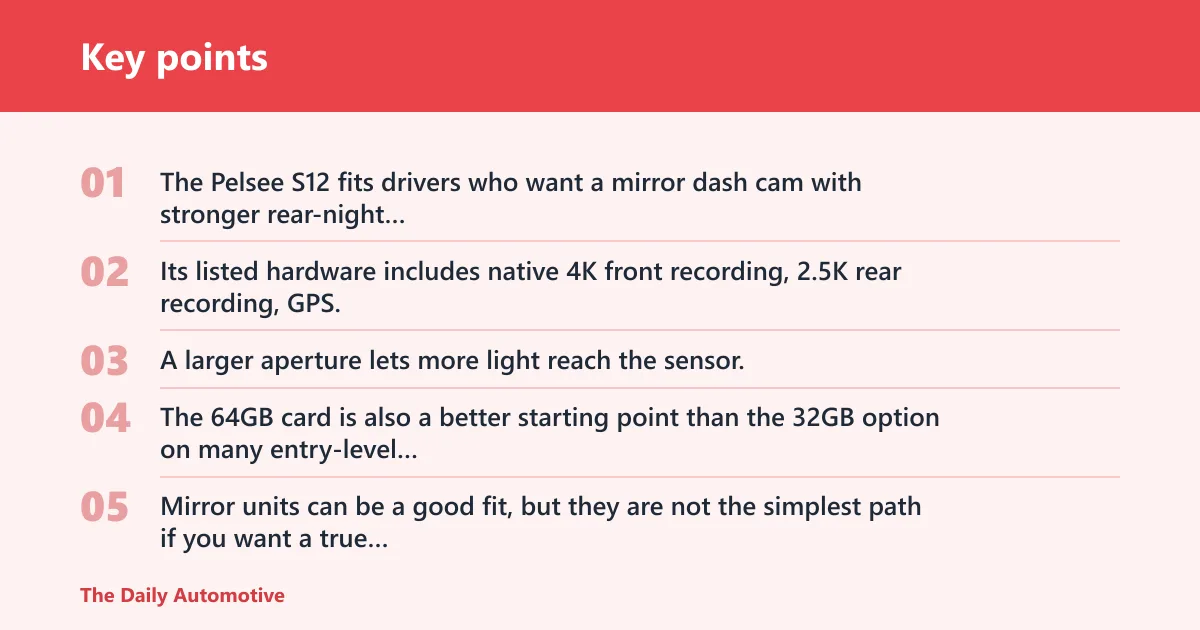
The Pelsee S12 fits drivers who want a mirror dash cam with stronger rear-night usability than a basic budget model and who value parked-car coverage as much as driving footage. Its listed hardware includes native 4K front recording, 2.5K rear recording, GPS, Wi-Fi 6, a 64GB card, and a starlit color night vision design with an F/1.5 aperture.
That F/1.5 aperture is the key spec. A larger aperture lets more light reach the sensor, which helps when you are trying to read a plate on a dim street or capture a moving car in a darker lot. The 64GB card is also a better starting point than the 32GB option on many entry-level kits, especially if parking mode is part of the plan.
The trade-off is install and cost. Mirror units can be a good fit, but they are not the simplest path if you want a true rear-road camera plus a separate cabin view. Also, a bright interior reflection or rear-window rain can still reduce rear detail enough that the rear feed shows motion clearly without always delivering plate-level certainty.
Vlokda dual dash cam: best budget rearview-style option
The Vlokda dual dash cam is the lowest-cost choice here for drivers who want front-and-inside coverage with infrared night vision, loop recording, a G-sensor, and a 64GB card included. It is the most practical buy if cabin visibility matters more than a premium mirror display or a rear-road camera with sharper plate capture.
Its real value is in interior use. Infrared night vision is mainly useful for low-light cabin recording, rideshare passenger monitoring, and seeing faces inside a dark car. It is not the same thing as strong exterior low-light capture, so it should not be judged like a sensor-based night-road camera.
The drawback is the trade-off that budget buyers often miss: this setup is built around cabin coverage, not rear-road excellence. If your main need is reading a rear plate at speed on an unlit street, a front-and-inside unit with IR is the wrong tool for that job.
Night-vision fit matrix
This matrix compares the three picks against the situations that decide real night use. A camera can look good on paper and still fall short when the street is dark, the rear glass is tinted, or the cabin is blacked out.
| Model | Sensor type | Aperture | IR support | Parking mode type | Included card size | Unlit suburban roads | Streetlit urban roads | Reverse-gear rear visibility | Rideshare cabin use | Parked-night surveillance | Failure note |
|---|---|---|---|---|---|---|---|---|---|---|---|
| WOLFBOX G840S | Rearview mirror camera system; front 4K, rear 1080p | F2.0 | No stated IR | 24-hour parking monitor | 32GB | Good for general motion and lane context; plate capture depends on lighting | Strongest use case; streetlights help the rear and front feeds stay readable | Useful for backing and bumper awareness | Limited; not built around cabin IR recording | Good if hardwired and paired with enough storage | Rear detail drops fast with tint, glare, or a smeared rear lens |
| Pelsee S12 | Mirror dash cam with native 4K front and 2.5K rear | F/1.5 | No stated IR | Parking mode supported; collision-triggered use implied by parking functions | 64GB | Best here for dark-road detail thanks to the larger aperture | Very strong for readable motion and better plate odds than a basic 1080p unit | Good, especially with the wider rear feed and stronger sensor package | Poor fit for true cabin monitoring without IR illumination | Strong starting point for parked coverage, but hardwiring still matters | Color night footage still weakens if the rear window is dirty or heavily tinted |
| Vlokda dual dash cam | Front and inside cabin camera | Not listed | Yes | Loop recording with G-sensor | 64GB | Weak for plate capture outside the car | Adequate for general driving records, not a plate-first pick | Not the main strength | Best of the three for dark-cabin visibility | Usable for incident clips, but not the strongest parked-outside solution | IR helps the cabin, not the road; outside detail remains the compromise |
What matters most for night vision?
The biggest night-vision gains usually come from a larger aperture, a better low-light sensor, and sensible glare control. WDR helps balance bright headlights and dark shadows, while Sony STARVIS or STARVIS 2 sensors usually outperform generic sensors when the road gets darker.
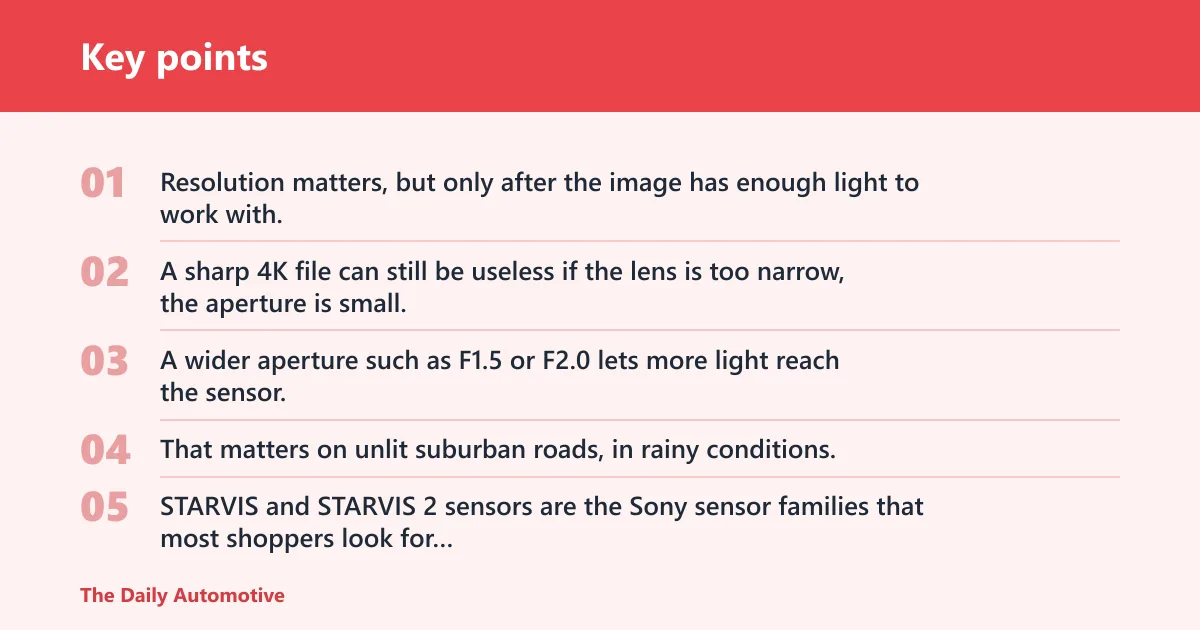
Resolution matters, but only after the image has enough light to work with. A sharp 4K file can still be useless if the lens is too narrow, the aperture is small, or the rear glass is tinted enough to swallow detail.
Aperture and low-light sensors
A wider aperture such as F1.5 or F2.0 lets more light reach the sensor. That matters on unlit suburban roads, in rainy conditions, and when the only illumination comes from headlights behind you.
STARVIS and STARVIS 2 sensors are the Sony sensor families that most shoppers look for in premium night-vision dash cams. They are not magic, but they are a clearer signal of low-light competence than marketing phrases like “super night vision.”
WDR and glare handling
WDR helps a dash cam balance bright and dark areas in the same frame. That matters when a rear plate sits under a headlight beam or when a car’s taillights blow out the exposure.
It also helps in mixed lighting, such as streetlit roads with dark shoulders. Still, WDR cannot fix everything. Rain on the lens, dirty glass, or heavy cabin reflections can flatten the image before the software has a chance to help.
When 1080p is enough
1080p can still be enough for general evidence, backing, and parking incidents where you mainly need to know that a car moved, stopped, or made contact. It is less convincing for rear plate capture at speed, especially in poor light or through tinted glass.
Suppose your commute is mostly city driving under streetlights. A good 1080p rear camera with strong WDR may still give usable footage. Move that same camera to an unlit road at 10 p.m., and the plate-reading margin shrinks fast.
Do you need IR night vision?
IR night vision is most useful for cabin or interior recording, not for exterior road detail. It can light up a dark passenger area, a rear seat, or a rideshare cabin without relying on streetlights or dashboard reflections.
For rear-road footage, sensor quality, aperture, and WDR matter more than infrared LEDs. IR does not turn a dark road into a readable plate scene, and in some setups it is not even aimed at the rear glass.
Cabin use versus rear-road use
A rideshare driver, family shuttle, or delivery driver who wants passenger visibility should care about IR. A commuter who mainly wants a rear plate in the event of a hit-and-run should care more about a strong rear sensor and a wider aperture.
Picture a blacked-out cabin with no dome light. IR makes the faces visible. Now picture a car following you on a dark road. IR will not fix the rear-road exposure problem the way a better sensor package can.
Should you buy a mirror dash cam or a front-and-rear setup?
Choose a mirror dash cam if you want a cleaner install, a larger screen, and an easier path to rear coverage in one unit. Choose a separate front-and-rear setup if you want more flexibility, better placement options, or a future upgrade to a 3-channel system.
The deciding factor is whether you care more about convenience or coverage depth. Mirror-style units are tidy, but a separate system is usually better when you want the best rear angle or when cabin recording matters too.
When mirror-style units make sense
Mirror units fit drivers who want a backup camera feel, parking help, and one visible screen. They are often a good match for commuters and family cars that need rear visibility more than a complex camera network.
They also make sense when you want quick access to front and rear footage without juggling multiple mounts and apps. The compromise is that the rear camera may still be the weakest link at night if the glass is tinted or the road is very dark.
When a separate 2-channel or 3-channel system is the better buy
A 2-channel system is front and rear. A 3-channel dash cam adds a cabin camera, which is the better fit for rideshare drivers, teen drivers, and anyone who wants interior context after dark.
That extra channel comes with more wiring, more storage use, and more setup effort. It is worth it only when the cabin feed will actually solve a problem, such as passenger disputes or rear-seat incidents.
Which one should you buy?
Pick the WOLFBOX G840S if you want the best overall balance of rearview convenience, parking coverage, GPS, and a strong 4K front camera. It is the most practical fit for commuters who want a mirror-style system with a useful rear feed and day-to-night flexibility.
Pick the Pelsee S12 if you want stronger night-road optics and better parking-minded hardware. The F/1.5 aperture and 64GB card make it the best bet here for drivers who spend real time in darker streets or who want more headroom from the outset.
Pick the Vlokda dual dash cam if your budget is tight and your real need is cabin monitoring with IR. It is the right answer for rideshare-style interior visibility, not the best answer for rear plate capture.
Common hidden costs matter. If you plan to use parking mode, you may need a hardwire kit. If you want longer event retention, you may need a larger microSD card than the one in the box. If your car has a steep rear window or heavy tint, installation position can matter almost as much as spec sheet size.
- Start with the job: rear plate capture, cabin visibility, or parked-car monitoring.
- Check the low-light hardware: aperture, sensor family, and WDR before resolution.
- Confirm the coverage type: front/rear, mirror-style, or 3-channel with cabin recording.
- Match storage to use: 32GB is a starter card, while 64GB or more is safer for parking mode.
- Budget for hardwiring if parking surveillance matters after the engine is off.
Frequently asked questions
What is the best rearview dash cam with night vision for cars?
If your priority is stronger low-light optics over mirror convenience, the Pelsee S12 is the better night-first alternative.
Do rearview dash cams record well at night?
Some do, but not all of them do it equally well. Rear footage is most readable at night when the camera has a larger aperture, strong WDR, and a good low-light sensor. A rear camera can still struggle if the window is tinted, wet, dirty, or hit by headlights.
What specs matter most for night vision in a dash cam?
Start with aperture, sensor quality, and WDR. Sony STARVIS or STARVIS 2 sensors are a stronger sign of low-light performance than a big resolution number alone. A 4K badge helps only when the camera can actually gather enough light to make that detail usable.
Is 1080p enough for a rearview dash cam in 2026?
1080p is enough for general evidence, backing assistance, and some parking incidents. It is less reliable for rear plate capture at night, especially on dark roads. If your main goal is readable low-light plates, a stronger sensor and wider aperture matter more than 1080p alone.
Which dash cams include parking mode and parking monitoring?
The WOLFBOX G840S lists a 24-hour parking monitor, and the Pelsee S12 is built around parking-capable use. The Vlokda model focuses more on loop recording and G-sensor protection than on premium parked-car monitoring. For best results, parking mode usually needs a hardwire kit.
Do I need IR night vision for cabin or rear recording?
You need IR if your goal is cabin visibility in low light, such as rideshare or passenger monitoring. You do not need IR for rear-road footage, and it will not replace a strong sensor, aperture, or WDR package for plate capture outside the car.
Products related to this article
Sponsored / affiliate links. As an Amazon Associate I earn from qualifying purchases. I may earn additional commission from eligible campaigns.