Best Car Detailing Products for Small Businesses: 12 Picks
For small businesses, a practical detailing product set is usually built around a core group of items that help you wash, decontaminate, correct, protect, and finish paid jobs efficiently, with the basics coming before any extras. Buy the wrong sequence, and cash sits in bottles that rarely leave the shelf while customers keep asking for paint cleanup or interior protection. This guide breaks those 12 products into first purchase, second purchase, and scale-up essentials so a one-person detailer can spend in the right order.
A practical top pick for a first-time buy list is an all-in-one kit, because it can cover a wide range of starter jobs while the business learns what runs out fastest.
Best car detailing products for small businesses


For a small operator, the best list covers the most paid work with the fewest dead-shelf items. Begin with wash, towels, wheel cleaner, and glass cleaner, then add decontamination, correction, and coating tools only when those services are actually sold. That order keeps cash moving.
What this guide prioritizes for small operators
Consumer kits often look complete but miss the products that get used every day. Small businesses need items that handle repeated wash cycles, quick handoff cleanups, and the occasional upsell into paint prep or protection. Consumables matter more than shiny one-time tools, because towels, soap, wheel cleaner, and detail sprays disappear first.
How the buying sequence differs from a consumer kit
A consumer kit usually bundles a little of everything. A small business should buy around job flow instead: wash first, then interior and wheels, then decontamination and correction, then protection and final wipe-down. That order also lowers the risk of buying a ceramic coating before the business has the clay, compound, and towels needed to prep paint properly.
Quick picks by budget and job type
The fastest path is to match the basket to the jobs being sold, not to the size of the catalog. A bare-bones mobile setup needs wash, towels, glass, wheels, and interior basics. A growth basket adds decontamination and better finish products. A pro basket adds machine correction and paint protection.
- Starter basket: wash, towels, wheel cleaner, glass cleaner, and a basic interior cleaner for paid maintenance details.
- Growth basket: starter items plus clay bar and lubricant, better drying towels, and spray sealant for higher-value handoffs.
- Pro basket: growth items plus a dual-action polisher, cutting compound, and a ceramic coating for correction and protection packages.
Starter basket: bare minimum to take paid jobs
This is the first money-making basket. It should cover weekly maintenance work, dealer-style resets, and customer handoff details without forcing a second trip to the store for soap, glass, or wheel care.
Growth basket: better speed and finish quality
This basket improves finish quality and cuts rework. It is where a small business starts charging more for paint prep, cleaner-looking glass, and protection that lasts longer than a quick wash and wipe.
Pro basket: correction and protection work
This basket supports swirl removal, light scratch reduction, and coating jobs. It is useful once the business can schedule paint correction time, control dust, and protect the vehicle while the coating cures.
What to buy first if you are starting small
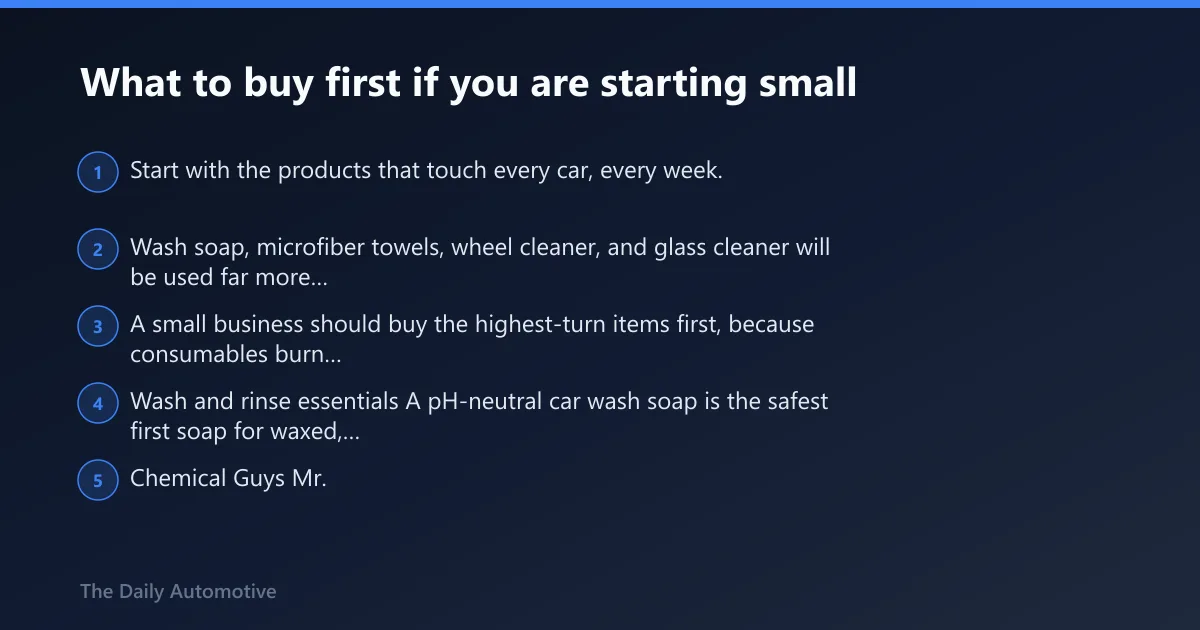
Start with the products that touch every car, every week. Wash soap, microfiber towels, wheel cleaner, and glass cleaner will be used far more often than a coating or a polisher. A small business should buy the highest-turn items first, because consumables burn through faster than tools.
Wash and rinse essentials
A pH-neutral car wash soap is the safest first soap for waxed, sealed, and coated paint, and it rinses clean while staying gentle enough for weekly use. Chemical Guys Mr. Pink Super Suds is presented as a pH-neutral wash soap, which makes it a practical starting point for maintenance and regular hand wash jobs.
A foam cannon belongs early in the stack too. Chemical Guys TORQ Foam Cannon is framed for pre-wash decontamination, meaning it lays down suds before contact washing, helps loosen dirt, and lowers swirl-mark risk when used correctly.
Towel and glass basics
Microfiber towels should be bought in more than one style. Plush drying towels handle water removal, while edgeless towels are safer for final wipe-downs and sensitive paint. The Rag Company Eagle Edgeless 500 is included as microfiber towels, and that type of towel fits drying, detail spray leveling, and interior wipe work.
Glass cleaner matters earlier than many new operators expect. It is one of the easiest ways to make a handoff look complete, and it has to leave streak-free glass inside and out. A bad glass wipe can make an otherwise solid detail look rushed.
Wheel and interior basics
Wheel cleaner or wheel gel should be treated as a separate process, not an afterthought. It removes brake dust and works on coated or finished wheels when matched to the surface. That separation keeps dirty wheel work away from clean paint towels and lowers cross-contamination.
For interiors, a basic leather cleaner and conditioner belongs on the list if the business sees leather seats often. Chemical Guys Leather Cleaner and Conditioner is included for interior leather care, and it gives a simple path for cleaning and conditioning without mixing dedicated products too early.
Which products should you buy after the basics?
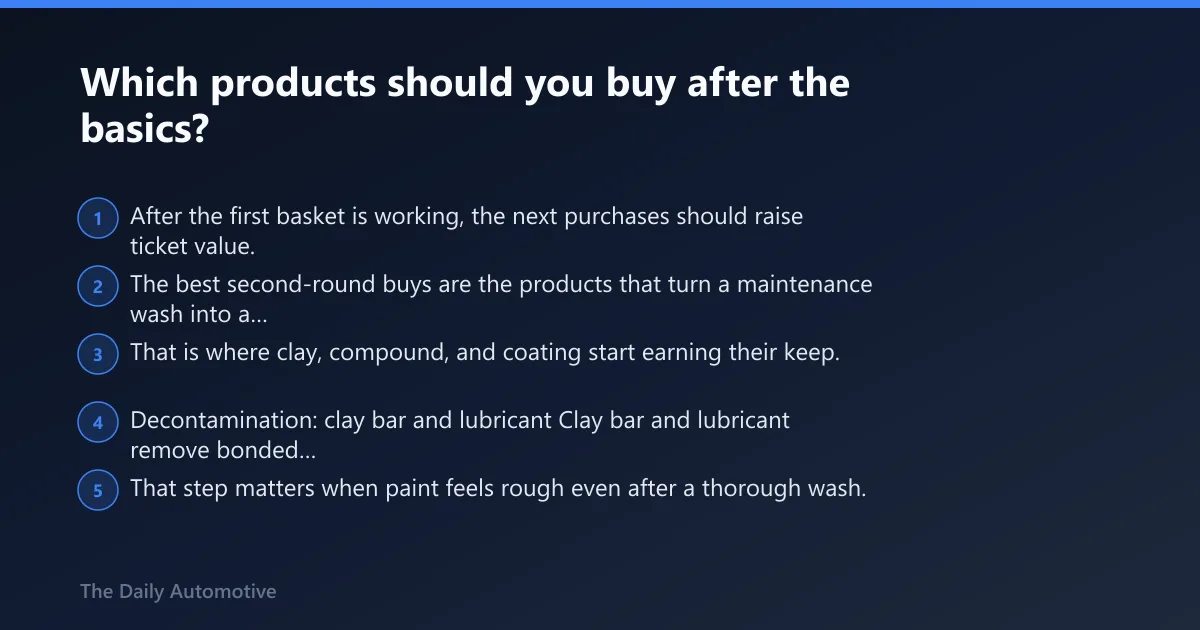
After the first basket is working, the next purchases should raise ticket value. The best second-round buys are the products that turn a maintenance wash into a paint-prep service, a quick shine into a correction package, or a basic handoff into a longer-lasting finish. That is where clay, compound, and coating start earning their keep.
Decontamination: clay bar and lubricant
Clay bar and lubricant remove bonded contamination after washing and before correction or protection. That step matters when paint feels rough even after a thorough wash. It is the bridge between cleaning and actual surface prep, and skipping it leaves grit and bonded fallout under the next layer.
CarPro IronX is listed as an iron fallout remover, which fits the same prep stage. It helps strip embedded brake dust and metallic contamination before claying or polishing. Used in sequence, these products make correction and protection work more predictable.
Correction: dual-action polisher and cutting compound
A dual-action or random orbital polisher is the safer correction machine for many small businesses, especially when the operator is still building speed and pad control. Chemical Guys TORQX Random Orbital Polisher is categorized as a dual-action polisher, and that type is paired with pads and compound for swirl removal and light correction.
Cutting compound removes light scratches and defects before polishing or protection. Meguiar’s Ultimate Compound is identified as a cutting compound, which makes it a useful step when a car needs visible improvement before sealant or coating. It is a technique-driven product, not a wipe-on miracle.
Protection: quick detailer, spray sealant, and ceramic coating
Quick detailer and spray sealant work between washes and on fast turnaround jobs. Adam’s Detail Spray is described as a spray sealant or quick detailer, which makes it useful for gloss, light dust removal, and hydrophobic maintenance when a full correction is not part of the ticket.
Ceramic coating is the long-game product. Gtechniq Crystal Serum Light is listed as a ceramic coating, and that matters because coatings bond to clear coat, last months instead of days, and need prep plus controlled application. They are not a beginner shortcut, and they should not be sold before the business can prep paint correctly.
Starter-basket table by budget tier
This table shows what a small business should buy first, what each basket covers on real jobs, and which items are consumables versus durable tools. Consumables should drive the order, because soap, towels, detail spray, and wheel cleaner will be replaced far sooner than a polisher or foam cannon.
| Budget tier | What to buy first | Expected job coverage | Consumables or durable tools | When to move up |
|---|---|---|---|---|
| Starter | pH-neutral soap, foam cannon, microfiber towels, glass cleaner, wheel cleaner, interior cleaner | Maintenance washes, basic interior resets, wheel cleaning, glass handoffs | Mostly consumables, with the foam cannon as the main durable tool | When paint requests start including roughness, swirls, or protection upsells |
| Growth | Starter items plus clay bar and lubricant, better drying towels, spray sealant | Paint prep, higher-end maintenance details, quicker gloss and better handoff quality | Mixed, with towels and applicators wearing out fastest | When customers ask for visible defect removal or longer-lasting protection |
| Pro | Growth items plus dual-action polisher, cutting compound, pads, ceramic coating | Swirl removal, light correction, coating prep, premium paint-protection jobs | Mostly durable tools with recurring consumables in pads, towels, soap, and coating prep chemicals | When the business can schedule correction time and control dust, power, and curing space |
How to choose products for your service menu
Choose products based on the jobs you sell, the space you work in, and how much time you have between vehicles. A mobile detailer needs compact storage, lower water demand, and faster handoff products. A shop-based team can keep more tools on hand, but it also needs better staging and tighter process control.
Mobile detailer buying criteria
A mobile setup should favor compact bottles, simple dilution, and tools that pack well. One-person operators need fewer specialty products and more products that can move from maintenance wash to quick interior reset without changing the whole setup. Towels, spray sealant, glass cleaner, and wheel cleaner should be easy to replace.
Shop-based buying criteria
A shop can justify more tooling because storage, power, and water are easier to manage. That means a dual-action polisher, extra pad sets, clay supplies, and coating prep products can be staged without slowing the day. Shop teams also benefit from dedicated wheel towels, glass towels, and interior towels to cut cross-use mistakes.
Storage, power, water, and turnaround constraints
Products fail small businesses when they do not fit the workflow. A low-power mobile setup may not support a big correction package. A busy shop may have the power and water, but no space for coatings to cure cleanly. The right order is the one that matches the slowest part of the operation, not the longest product label.
Do you need a detailing kit or separate products?
A detailing kit is worth it when the business needs a fast, low-risk start and has not yet learned which products will be used daily. Separate products make more sense once service mix is clear, because they let the buyer stop paying for filler items and buy more of the items that actually move.
When a kit makes sense
A kit makes sense for a new one-person operator that needs multiple categories at once: soap, towels, dressings, glass, and some interior supplies. Chemical Guys Arsenal Builder Kit is positioned as an all-in-one detailing kit, so it works as a broad starter base before the business knows which products deserve repeat purchase.
When separate products are smarter
Separate products are smarter when a business already knows its order flow. If wheels are the dirtiest, buy more wheel cleaner. If glass is the biggest complaint, buy better glass towels and a stronger glass cleaner. If correction sells, buy machine, pads, and compound before more general-purpose bottles.
How to avoid paying twice for filler items
Avoid the trap of buying a large kit and then replacing half of it in a month. Watch what is used first: towels, soap, glass cleaner, wheel cleaner, and detail spray usually move fastest. Those are the products that deserve repeat purchase. The slow movers can wait.
Frequently asked questions
What are the best car detailing products for a small business?
The best products are the ones that cover paid jobs in the right order: wash soap, foam cannon, microfiber towels, wheel cleaner, glass cleaner, interior cleaner, clay and lubricant, a dual-action polisher, cutting compound, quick detailer, spray sealant, and a ceramic coating. That sequence covers the widest range of work.
Which detailing products should a mobile detailer buy first?
A mobile detailer should buy pH-neutral soap, microfiber towels, wheel cleaner, glass cleaner, and a quick detailer before moving into correction or coating. Those items solve the most common customer complaints and travel well. They also keep the setup light, which matters when water, power, and storage are limited.
What products do professional detailers use every day?
Everyday products are the consumables: wash soap, microfiber towels, wheel cleaner, glass cleaner, interior cleaner, and sometimes spray sealant or quick detailer. Those are used on nearly every vehicle. More advanced items such as compound, clay, and coating products appear less often but raise the ticket when needed.
What is the best car wash soap for coated cars?
The best wash soap for coated cars is a pH-neutral car wash soap, because it is safer for waxed, sealed, and coated paint, rinses clean, and is gentle enough for weekly use. Chemical Guys Mr. Pink Super Suds is presented as a pH-neutral wash soap and fits that role well.
Is a detailing kit worth it for a small business?
A detailing kit is worth it when a business is starting from zero and needs a quick way to cover basic wash, wipe, and interior work. It is less useful once the service menu is set, because separate products let the business buy more of what moves fastest and skip filler items.
How much should a small detailing business spend on products?
Spend first on the products that get replaced most often: soap, towels, wheel cleaner, glass cleaner, and interior cleaners. Then add clay, spray sealant, polishing supplies, and coating products only when those jobs are sold. Consumables should absorb more budget than durable tools in the beginning.
Which products are best for interiors, wheels, and paint protection?
For interiors, use an interior cleaner and leather cleaner and conditioner when leather is present. For wheels, use a dedicated wheel cleaner or wheel gel. For paint protection, use spray sealant for fast work and a ceramic coating when the business can prep properly and control application and cure time.
Products related to this article
Sponsored / affiliate links. As an Amazon Associate I earn from qualifying purchases. I may earn additional commission from eligible campaigns.