Best Engine Cleaners for Carbon Buildup (2026): we compared
For carbon buildup, match the cleaner to the symptom: spray intake cleaners for rough idle, fuel additives for injector and chamber deposits, and walnut blasting when intake-valve or turbo soot is heavy. Pick the wrong path, and money gets wasted, the fault stays, or a marginal engine gets worse. I sort the job by where the soot lives, then I choose the chemistry or the tool that can reach it.
This guide is part of our Car engine troubleshooting guide series.
Best car engine cleaner for carbon buildup: the short answer
The best car engine cleaner for carbon buildup depends on where the deposits live. For oil-borne sludge and dirty oil passages, an oil-system cleaner is the right tool. For intake valves and combustion chamber deposits, a fuel-system cleaner or intake cleaner fits better. For heavy direct-injection valve buildup, walnut blasting is usually the real fix.
If one product has to be named first, the safest top pick is the cleaner that matches the fault, not the loudest bottle on the shelf. That is why symptom-to-cleaner matching matters more than brand hype.
According to Best Carbon Removers for Engines: Top Picks for Carbon Deposit Cleaning … — Quest CARBON-OFF! can be left on for 15 minutes up to overnight.
Quick comparison
| Product | Badge | Best for | Price | ||
|---|---|---|---|---|---|
 |
LIQUI Moly Pro-Line Diesel Intake System Cleaner | 400 ml |Liqui Moly | Budget pick | Liqui Moly 400 ml diesel cleaner | $25.02
Price as of 25 Sep 2026
|
View |
 |
CRC 05319 GDI IVD Intake Valve and Turbo Cleaner – 11 oz,CRC | Upgrade pick | CRC GDI/Turbo cleaner, 11 oz pack of 12 | $179.24
Price as of 25 Sep 2026
|
View |
Use this comparison as a filter, not a ranking. The right cleaner changes with deposit location, fuel type, and how far the buildup has progressed.
When a rough idle comes from intake dirt, the chemistry choice is different than when oil consumption points to sticky rings. That split is where most shoppers go wrong.
How we chose
Selection came down to five things: deposit location, engine and fuel compatibility, service interval, whether the product is a real fix or a stopgap, and whether the job can be done safely at home. The list also favors products with clear use cases instead of broad claims that do not hold up on modern engines.
Carbon cleaners are not interchangeable. An oil-system cleaner can help sludge and ring deposits, but it will not reliably clear baked-on direct-injection intake-valve buildup. A fuel additive can help injectors and chambers, but it will not scrub a heavily coated intake port.
Which cleaner fits your symptom?
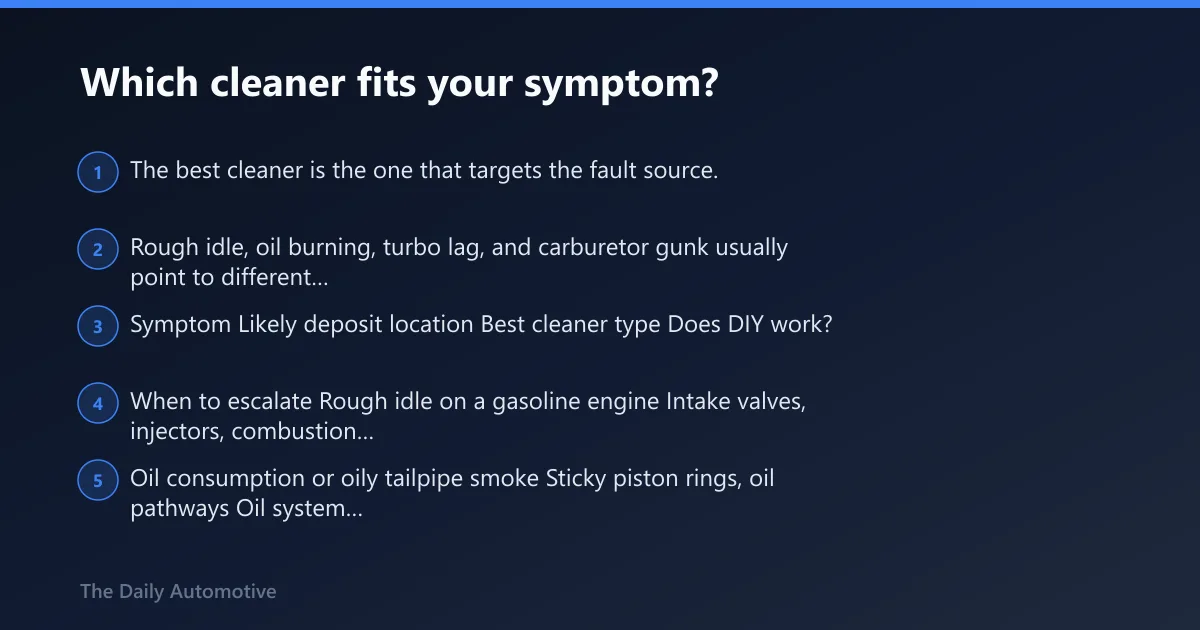
The best cleaner is the one that targets the fault source. Rough idle, oil burning, turbo lag, and carburetor gunk usually point to different deposit locations, and the fix changes with each one.
| Symptom | Likely deposit location | Best cleaner type | Does DIY work? | When to escalate |
|---|---|---|---|---|
| Rough idle on a gasoline engine | Intake valves, injectors, combustion chambers | Fuel system cleaner or intake spray cleaner | Yes, if deposits are light to moderate | If a direct-injection engine still misfires after cleaning, walnut blasting may be the next step. |
| Oil consumption or oily tailpipe smoke | Sticky piston rings, oil pathways | Oil system cleaner | Sometimes, if the issue is sludge-related | Shop visit if compression is poor or ring sticking persists |
| Turbo lag or whistle with dirty oil history | Turbocharger, oil passages | Oil system cleaner with turbo compatibility | Yes, for cleaning maintenance | Professional inspection if the turbo has shaft play or oil coking damage |
| Knock under load or hard starting | Combustion chambers, injectors | Fuel additive | Yes, if the engine is otherwise healthy | Escalate if knock stays after cleaning or if the check engine light returns |
| Carburetor sticking or choke problems | Carburetor throat, choke plates | Carb/choke spray cleaner | Yes | Rebuild the carb if passages are still clogged |
| Heavy direct-injection valve deposits | Intake valves | Walnut blasting | No, not for deep deposits | Book a shop if misfires, airflow loss, or valve coating is severe |
When DIY is enough
DIY works when the engine still runs normally, the deposits are early, and the fault points to a path that the cleaner can actually reach. That usually means light injector varnish, mild chamber carbon, carburetor gum, or sludge that has not turned into a mechanical wear issue.
When to book walnut blasting or a shop visit
Escalate when the engine is direct injection with hard intake-valve buildup, when sticky rings keep driving oil consumption after treatment, or when a turbo, EGR, or aftertreatment issue is involved. Chemical cleaners cannot remove every type of deposit, and they do not repair damaged parts.
XADO Engine Oil System Cleaner with Anti-Carbon Effect: best for oil-borne sludge and turbo-safe cleaning
This oil-system cleaner fits engines that show dirty oil pathways, sludge, or deposit buildup tied to poor lubrication. Based on the spec sheet, it is described as suitable for all engines and compatible with turbochargers or superchargers, which matters when the oil circuit runs through boosted hardware.
The standout here is its focus on oil-borne contamination rather than fuel-side deposits. XADO also advertises revitalizant protection, so it is framed as a cleaner-plus-protection product instead of a one-time flush. The drawback is simple: it will not directly solve heavy intake-valve carbon on a direct-injection engine.
Use this when rough running appears after neglected oil changes, when the valvetrain sounds dirty, or when a turbo engine needs cleaner oil passages. It is the right first move only if the problem lives in the oil system, not the intake tract.
XADO AntiCarbon Anti-Carbon Engine Cleaner: best for sticky rings and oil consumption
This cleaner is aimed at piston-ring mobility, which is why it belongs in the conversation when oil consumption is the main complaint. It cleans cylinders, pistons, combustion chambers, and valves, so it targets places where carbon can cause rings to stick and sealing to suffer.
That matters when an engine burns oil but still runs smoothly enough that a tear-down would be premature. The honest limitation is that a cleaner cannot fix broken rings, worn valve seals, or scored cylinders. If compression is low, the problem may be mechanical rather than deposit-related.
As a maintenance tool, it makes sense before major repair. As a rescue for severe oil burning, it is only a chance, not a promise.
Quicksilver 8M0047921 Quickleen Engine & Fuel System Cleaner: best for gasoline and ethanol fuel deposits
This is the best fit when the engine is gasoline-powered and the deposit problem sits in the fuel path, combustion chamber, or intake side. Quicksilver Quickleen is described as working with gasoline, including ethanol blends, and it targets carburetors, injectors, intake valves, spark plugs, piston crowns, and cylinder heads.
That wide target list makes it useful for rough idle, hesitation, knock under load, and dirty chamber buildup on gasoline engines. The drawback is that “fuel system cleaner” does not mean it will solve heavy direct-injection intake-valve deposits by itself; if the valves are caked, chemistry often falls short.
The preventive claim is practical too: it is said to help prevent knocking and piston seize-up. That makes it a better routine treatment than a miracle cure.
Gumout Carb/Choke Carburetor Cleaner Spray: best for carburetor gum and choke problems
This spray format is the right tool for carburetor chambers and choke valves, where gum, varnish, and dirt can create sticking or poor throttle response. It works because the cleaner is delivered directly to the part that needs it, instead of hoping fuel circulation reaches the problem.
Use it on carbureted engines, lawn equipment style setups, or older vehicles with choke issues. The limitation is obvious: it is not the answer for oil-borne sludge, and it will not clear hard carbon on intake valves inside a modern direct-injection engine.
For a carburetor that gums up after storage, this is often the quickest DIY fix. For a modern GDI engine, it is the wrong bottle.
zMAX Engine & Fuel Formula Kit: best for routine maintenance intervals
This kit combines an engine formula and a fuel formula, so it is aimed at routine maintenance rather than severe deposits. The micro-lubrication claim is part of the pitch, but the more practical point is using it on a regular schedule, such as at oil changes or around every 6,000 miles.
That makes it a maintenance product for drivers who want a recurring treatment plan instead of a one-time cleanup. The drawback is the same one that applies to most preventive additives: it is not a deep-clean solution for a heavily carboned intake valve or a sticky-ring engine that already consumes oil.
If the engine is healthy and the goal is prevention, this kind of kit has a place. If the engine is already misfiring from heavy buildup, the job is past routine maintenance.
Walnut blasting: when chemistry stops being enough
Walnut blasting is a common mechanical fix for direct-injection intake-valve deposits. It uses walnut sand as the cleaning media, and machines with closed-loop recovery keep the abrasive contained while adapters fit multiple vehicle models. Some units may need an air pump or similar hardware to work correctly.
The value of the closed-loop design is practical: it collects spent media instead of scattering abrasive through the engine bay. Models such as the QPKING walnut blaster list 23 adapters, while the AUTOOL unit is described as a closed-loop system with a built-in dust filter and as eco-friendly using walnut sand.
Use walnut blasting when intake valves are coated so heavily that fuel additives cannot reach the deposit, or when a GDI engine keeps misfiring after chemical cleaning. That is the point where chemistry becomes a stopgap and mechanical cleaning becomes the real repair.
When walnut blasting beats chemicals
- The engine is direct injection and the intake valves are visibly coated.
- Misfires, rough idle, or airflow loss remain after a fuel additive treatment.
- The engine has high mileage and repeated short-trip use.
- The shop can confirm heavy buildup with a borescope or intake inspection.
What is the best car engine cleaner for carbon buildup?

The best car engine cleaner for carbon buildup is the one that matches the deposit location. Oil-system cleaners suit sludge and dirty oil passages, fuel additives suit injectors and combustion chambers, carb sprays suit carburetors, and walnut blasting is the answer for heavy direct-injection intake-valve buildup.
If forced to choose a single approach, start with the fault path, not the label. That keeps buyers from using a fuel additive on oil-borne sludge or expecting a spray cleaner to clean valves that fuel never reaches.
Do engine carbon cleaners actually work?
Yes, but only when the cleaner reaches the deposit and the buildup is within the product’s range. They work best on light to moderate varnish, chamber carbon, injector deposits, carburetor gum, and some sludge-related issues. They do not fix worn parts, broken rings, or severe baked-on valve carbon.
Results depend on deposit type, severity, and delivery path. That is why one bottle can help rough idle on one engine and do almost nothing on another.
Which cleaner is best for intake valve carbon buildup?
For intake-valve carbon buildup on a direct-injection engine, walnut blasting is usually best when the buildup is heavy. Chemical fuel additives may help with light deposits, but they are unlikely to remove thick carbon on valves that are not bathed in fuel.
For a mild case or a port-injected engine, a fuel system cleaner can still help. The key is knowing whether the valves are actually reachable by the cleaner.
Can I use a fuel system cleaner for carbon buildup?
Yes, if the carbon is in injectors, combustion chambers, or other fuel-wetted areas. A fuel system cleaner can help rough idle, hesitation, knock, and some power loss. It is a poor fit for severe intake-valve buildup on direct-injection engines.
That split is the whole decision. Fuel cleaners are useful, but they are not universal carbon removers.
What cleaner is safe for gasoline and diesel engines?
Safety depends on the exact product, not the cleaning category. XADO Engine Oil System Cleaner is described as suitable for all engines and compatible with turbochargers or superchargers, while CarAwareness notes MotorPower Care as compatible with gasoline and diesel engines. Quicksilver Quickleen, by contrast, is for gasoline, including ethanol blends.
Diesel users should be careful not to assume a gasoline-focused cleaner will be safe or effective. The label has to match the fuel system and the deposits.
How do I clean carbon buildup without taking the engine apart?
Use the delivery path that reaches the deposit: fuel additive for injectors and chambers, intake spray for accessible throttle-body or carburetor dirt, and oil-system cleaner for sludge and sticky oil passages. That approach avoids teardown when the buildup is still manageable.
If the engine is direct injection with heavy intake-valve carbon, though, the answer may still be no. At that point, walnut blasting or a shop service is the realistic route.
Should I use an oil system cleaner or fuel system cleaner?
Use an oil system cleaner when the symptom points to sludge, dirty oil pathways, sticky rings, or turbo lubrication concerns. Use a fuel system cleaner when the issue sounds like injector varnish, chamber carbon, rough idle, or light power loss tied to fuel delivery.
If the engine burns oil, oil-system cleaning comes first. If the engine misfires on the fuel side, start there instead.
Which product helps with rough idling and power loss?
For rough idling and power loss, the best choice depends on the source. Quicksilver Quickleen is a strong gasoline option for injectors, chambers, and intake deposits, while CRC’s GDI IVD Intake Valve and Turbo Cleaner is aimed at baked-on valve and turbo carbon in modern GDI engines.
If the rough idle comes from sludge or poor oil circulation, an oil-system cleaner is the better fit. If it is a direct-injection valve issue, chemical help may be limited and walnut blasting may be needed.
How often should I use an engine carbon cleaner?
Frequency should follow the product directions and the engine’s condition. For routine maintenance, a product like zMAX is positioned for use at oil changes or every 6,000 miles. That is maintenance, not rescue work.
If the engine has a known deposit problem, treat once, reevaluate, and do not keep dosing a failing part forever. Repeated cleaner use is not a substitute for a clogged EGR, a damaged turbo, or a ring issue that needs repair.
Are walnut blasting cleaners better than chemical cleaners?
For heavy direct-injection intake-valve deposits, yes. Walnut blasting is usually better because it physically removes the carbon from the valve face and port, while chemical cleaners often cannot reach the deposit or break it loose fully.
Chemicals still win for maintenance, injector cleaning, carburetor gum, and sludge control. The smart choice is to use chemistry early and mechanical cleaning when the buildup is already hard and deep.
Products related to this article
Sponsored / affiliate links. As an Amazon Associate I earn from qualifying purchases. I may earn additional commission from eligible campaigns.