Best Car Seats for Small Cars
Best overall for compact back seats: the Graco SlimFit3 LX is a strong starting point because Graco lists it at 16.7 inches wide. That puts it in the narrow category for compact cars, though you still need to verify rear-facing depth and buckle access in your vehicle. [Graco SlimFit3 LX product specifications/manual]
Best infant seat for tight back seats: choose a compact infant carrier with a narrow base and verify front-to-back depth first, because the base footprint usually determines fit in a small car. [Manufacturer infant seat manual/spec sheet; NHTSA child restraint guidance]
Quick picks for small cars

Best convertible seat for compact cars: look for a narrow shell under about 17 inches wide and compare rear-facing depth separately, especially if front seats already sit close to the rear bench. [Manufacturer manual/spec sheet; vehicle owner’s manual]
Best option for three-across setups: prioritize flat sides, narrow base width, and clear buckle access. Overlap is not acceptable, so the shell and buckle zone both have to fit cleanly. [NHTSA child restraint installation guidance; AAP/CPST resources]
Best rotating seat when door space is tight: consider rotation only if the base and door opening allow it. Swivel convenience can disappear fast in a two-door compact or narrow hatchback, so confirm the vehicle opening and seat footprint first. [Manufacturer manual/spec sheet; vehicle owner’s manual]
What matters most in a small car?
Width is only part of the answer. In compact vehicles, a seat can be narrow and still fail if its rear-facing footprint pushes the front seat too far forward or blocks the center buckle. Fit is a geometry problem, so width, depth, and access need to work together. [AAP/CPST child restraint guidance; vehicle owner’s manual]
Why width is only half the answer
Car seat width is the widest-point measurement, and anything at or under about 17 inches is genuinely narrow in small-car comparisons. Base width matters too, especially in three-across setups where the lower shell may touch a neighbor before the top does. [Manufacturer spec sheets/manuals; vehicle owner’s manual]
For a back seat with limited shoulder room, a narrow shell helps, but buckle access can still fail if the base is too broad or the armrests flare outward. A seat that looks slim on paper may still be awkward if its widest point sits exactly where the adjacent buckle needs to live. [Manufacturer manual/spec sheet; vehicle owner’s manual]
When rear-facing depth becomes the dealbreaker
Rear-facing front-to-back footprint is a separate measurement from width. A slim seat can still consume too much legroom when reclined for infant or rear-facing use. [Vehicle owner’s manual; manufacturer manual/spec sheet]
The Clek Fllo shows why this matters. Clek lists it at 16.9 inches wide, but the seat measures 32.5 inches front to back rear-facing with the anti-rebound bar fitted. Without the anti-rebound bar, Clek lists it at 29 inches front to back rear-facing. [Clek Fllo manufacturer specifications/manual]
Why center access changes the choice
The center position can be the best place for a narrow seat, but only if the buckle is reachable and the install method works there. In tight rows, a vehicle-seat-belt install may fit better than lower anchors, especially when the center position does not have usable lower anchors. [Vehicle owner’s manual; NHTSA LATCH guidance]
Lower anchors are an install method, not a guarantee of center fit. They also come with weight-limit considerations, and they are not always usable from outboard positions for center installs. In a narrow sedan or hatchback, the vehicle manual matters more than the label on the seat box. [NHTSA LATCH guidance; vehicle owner’s manual]
Best infant seat for small cars
For newborn use, the best infant seat for a small car is usually the one with the smallest carrier-base footprint, not simply the narrowest shell. Infant seats are removed from the base, so front-to-back depth and door clearance often matter more than the carrier itself once the base is installed. [Manufacturer infant seat manual/spec sheet; NHTSA child restraint guidance]
Compact carrier bases and front-to-back space
An infant carrier can be easy to carry and click in, but the base still has to fit the bench without forcing the front passenger seat into an awkward position. That is why compact front-to-back design matters more than a slim top shell in many small cars. [Manufacturer infant seat manual/spec sheet; vehicle owner’s manual]
If the rear cushion depth is short, a long base can crowd the front seatback even when the carrier looks compact from the outside. In a hatchback or two-door coupe, that can turn daily loading into a constant compromise. [Vehicle owner’s manual; manufacturer manual/spec sheet]
When a slim base matters more than shell width
For infant seats, the carrier usually comes out of the car, so the base footprint is the real fit test. A narrow base helps more than an ultra-slim carry handle if the seat must sit beside another restraint or near the center buckle. [Manufacturer infant seat manual/spec sheet; vehicle owner’s manual]
Suppose a compact sedan has a short rear cushion and the front passenger seat already sits close to the dashboard. In that case, a seat with a long rear-facing base can be a poor match even if it is narrow enough on paper. [Vehicle owner’s manual; manufacturer manual/spec sheet]
Which convertible car seat is best for a compact car?
The best convertible car seat for a compact car is the one that stays narrow enough for the bench and short enough rear-facing for the front seats to remain usable. A narrow shell helps three-across, but rear-facing recline and accessory choices can change the result quickly. [Manufacturer manual/spec sheet; AAP/CPST resources]
Rear-facing geometry and recline range
Convertible seats can vary more than many shoppers expect in width. Some use more front-to-back space at a deeper recline, and that footprint can change again as the child grows and the seat is adjusted. A seat can be a good compact-car choice at one angle and a bad one at another. [Manufacturer manual/spec sheet; vehicle owner’s manual]
That is why rear-facing depth is often the deciding factor. It is not a universal pass, but it gives you a practical benchmark before you move on to vehicle-specific checks. [Vehicle owner’s manual; manufacturer manual/spec sheet]
When to favor a narrow shell over extra features
In a tight row, a plain narrow shell often beats extra convenience features if the goal is to save room. The Diono Radian 3RXT is listed at 17 inches wide, and the Clek Fllo is listed at 16.9 inches wide. [Diono Radian 3RXT manual/specs; Clek Fllo manual/specs]
Those numbers do not tell the whole story. The same seat can still fail a compact car if its recline, headrest position, or base shape steals the front seat’s knee room. [Manufacturer manual/spec sheet; vehicle owner’s manual]
How accessory choices can change fit
Anti-rebound bars and load legs can improve stability, but they also change how much space the seat occupies. An anti-rebound bar can add front-to-back depth. A load leg can add base footprint and may complicate fit in a short rear footwell. [Manufacturer manual/spec sheet; vehicle owner’s manual]
That matters because small-car fit is geometry, not brand loyalty. A seat with an accessory installed may fit one vehicle and miss another by a small but decisive margin. [Manufacturer manual/spec sheet; vehicle owner’s manual]
Can you fit three car seats in a small car?
Yes, sometimes. Three-across works when all three seats have flat, narrow shells, the buckle access stays open, and the install method avoids overlap. If one seat spills into another seating position or blocks the buckle, it is not a real three-across fit. [NHTSA child restraint guidance; vehicle owner’s manual]
What makes a true three-across shell
Three-across setups usually start with seats that are roughly under 17 inches wide. Under about 17 inches wide is the right starting point, but the shape matters as much as the number. [Manufacturer spec sheets/manuals; vehicle owner’s manual]
Base width matters because adjacent seats need to sit flush enough for buckles to remain usable. Overlapping is not acceptable. If the shell rests on top of another restraint or hides the buckle, the setup is not working correctly. [NHTSA child restraint installation guidance; vehicle owner’s manual]
Why buckle access and base width matter
Three-across often fails at the buckle, not the shell. A seat may slide in physically, but if the buckle stalk is buried under the neighboring base, you lose the ability to secure it cleanly. That is a geometry problem, not a strength problem. [Vehicle owner’s manual; NHTSA child restraint installation guidance]
A common first-timer mistake is measuring the widest outer shell and ignoring the buckle zone. In a narrow bench, the buckle can be the part that breaks the setup. [Vehicle owner’s manual; NHTSA child restraint guidance]
When seat-belt installs beat lower anchors
In the center position, a vehicle-seat-belt install is often the better choice in tight rows. Lower anchors can be limited to outboard positions, and even where they exist, the hardware may take up more room than a belt path would. [Vehicle owner’s manual; NHTSA LATCH guidance]
Use the car-seat manual and vehicle manual together. Some seats also include lock-off features that help hold the belt tight, which can make a center install more practical when lower anchors are not the best fit. [Manufacturer manual/spec sheet; vehicle owner’s manual]
Small-car fit matrix
This matrix turns fit into a quick decision tool. Use it with your own measurements, because the same seat type can work in one compact sedan and fail in a narrow hatchback or two-door coupe. [Manufacturer manuals/spec sheets; vehicle owner’s manual]
| Seat type | Likely width range | Likely rear-facing depth risk | Three-across suitability | Center-seat install difficulty | Rotation/access convenience | Best for / avoid if |
|---|---|---|---|---|---|---|
| Infant seat | Often narrow at the carrier; base width varies | Medium to high if the base sits long in the rear seat | Good if the base is slim and buckle access stays clear | Moderate, because base placement matters | High convenience for in-and-out carrier use | Best for: newborn portability. Avoid if: the base crowds the front seatback. |
| Convertible seat | About 16.7 to 17 inches is the target zone | Medium to high depending on recline and accessories | Often the strongest choice if the shell is flat and narrow | Moderate to high in tight center positions | Lower convenience than infant carriers, but usually stable | Best for: long-term use. Avoid if: the rear-facing angle steals front legroom. |
| Rotating seat | Often wider at the base than a simple convertible | Often medium to high because the base adds structure | Fair to poor in very tight rows | Often high, especially in narrow back seats | High when doors open wide enough | Best for: easier loading. Avoid if: the door opening or adjacent seat blocks the swivel path. |
| All-in-one seat | Varies widely; some are narrow, some are not | Variable, often tied to extended use features | Can work, but fit depends on shell shape and base width | Usually moderate | Moderate; less portable than an infant seat | Best for: one-seat long horizon. Avoid if: you need the shortest possible rear-facing footprint. |
Methodology note: width is taken from manufacturer published specs at the widest stated point; rear-facing depth is the manufacturer’s published front-to-back footprint, or a vehicle fit check when a published depth is not available; buckle access is judged by whether the vehicle buckle can be reached without moving the installed seat; three-across suitability requires clean side-by-side installs without overlap, buckle burial, or interference with adjacent restraints. [Manufacturer manuals/spec sheets; vehicle owner’s manual]
How do you check fit before buying?
Measure the car first, then match the seat to the measurements. The four points that matter most are rear cushion depth, front seatback clearance, center buckle reach, and door-opening width. If one of those is short, the wrong seat type can fail even when the width looks fine. [Vehicle owner’s manual; vehicle fit-check guidance]
- Measure rear cushion depth from the seatback to the front edge of the rear cushion.
- Measure front seatback clearance with the front seat set where it actually needs to be for a passenger or driver.
- Measure center buckle reach from the seat bight to the buckle stalk in the center position.
- Measure door-opening width so you know whether a rotating seat or wide carrier can actually pass through the opening.
- Compare those numbers with the car-seat manual and the vehicle manual before you buy.
Match the seat manual to the vehicle manual, especially for LATCH, center installs, and aftermarket accessories. Child restraints and accessories have to be allowed by both manuals, not just one of them. [NHTSA LATCH guidance; vehicle owner’s manual; manufacturer manual]
Say your hatchback has a short rear cushion and a small center buckle gap. A seat that is 16.7 inches wide may still be a bad choice if its rear-facing base pushes the front passenger seat forward enough to make that seat unusable. [Vehicle owner’s manual; manufacturer manual/spec sheet]
Suppose your compact sedan has a usable center belt path but the lower anchors are only outboard. In that case, a vehicle-seat-belt install in the center may be more realistic than trying to force a lower-anchor setup that the vehicle does not support there. [Vehicle owner’s manual; NHTSA LATCH guidance]
What are the best car seats for small cars?
The best car seats for small cars are the ones that stay genuinely narrow, keep rear-facing depth under control, and fit the vehicle’s buckle and center position without overlap. For many shoppers, that means a compact convertible or infant seat first, then a rotating seat only if the door opening and base footprint cooperate. [Manufacturer manuals/spec sheets; vehicle owner’s manual]
Best overall for compact back seats: the Graco SlimFit3 LX is a strong fit-oriented pick because Graco lists it at 16.7 inches wide. [Graco SlimFit3 LX product specifications/manual]
Best narrow convertible for compact cars: the Clek Fllo and Diono Radian 3RXT are the strongest named narrow-seat references in this guide, with Clek listing the Fllo at 16.9 inches wide and Diono listing the Radian 3RXT at 17 inches wide. [Clek Fllo manual/specs; Diono Radian 3RXT manual/specs]
Frequently asked questions
How wide should a car seat be for a small back seat?
Anything at or under about 17 inches is genuinely narrow in small-car comparisons. That is the starting point, not the finish line. Base width, buckle access, and side shape still matter, especially if you need three-across or a center install in a compact sedan or hatchback. [Manufacturer spec sheets/manuals; vehicle owner’s manual]
Do rotating car seats work in small cars?
Sometimes, but only when the base, door opening, and adjacent seats leave enough room for the swivel path. Rotating seats can be convenient, yet they are often bulkier than fixed seats. In a tight back seat, rotation can solve loading while creating a fit problem elsewhere. [Manufacturer manual/spec sheet; vehicle owner’s manual]
What is the best rear-facing car seat for a small car?
The best rear-facing seat for a small car is usually the one with the shortest workable rear-facing footprint in your vehicle, not the narrowest label alone. Check the front seatback clearance in your car. [Manufacturer manual/spec sheet; vehicle owner’s manual]
How do I fit three car seats in a small car?
Choose seats with flat, narrow shells and make sure the buckles remain reachable. Use the center position carefully, and do not assume lower anchors will solve the layout. A seat-belt install is often the more realistic option in the middle when space is tight. [NHTSA child restraint guidance; NHTSA LATCH guidance; vehicle owner’s manual]
What is the best infant car seat for small cars?
The best infant seat for a small car is the one with the smallest base footprint and the easiest carrier removal, because the base is what usually consumes space in the car. Check front-to-back depth first, then confirm that the carrier can still click in and out without hitting nearby seats. [Manufacturer infant seat manual/spec sheet; vehicle owner’s manual]
Sources
- Manufacturer manuals and specification pages for Graco SlimFit3 LX, Diono Radian 3RXT, and Clek Fllo.
- NHTSA child restraint installation and LATCH guidance.
- Vehicle owner’s manuals for center-seat and lower-anchor use, seat-belt installation, and child restraint placement guidance.
Products related to this article
Sponsored / affiliate links. As an Amazon Associate I earn from qualifying purchases. I may earn additional commission from eligible campaigns.
 Coverado Car Seat Covers, Car Seat Covers Front Seats, 2-Pack Front Seat Cover, Nappa Leather Waterproof Seat Covers, Car Seat Protectors, Automotive Seat Covers Universal Fit for Most Vehicles
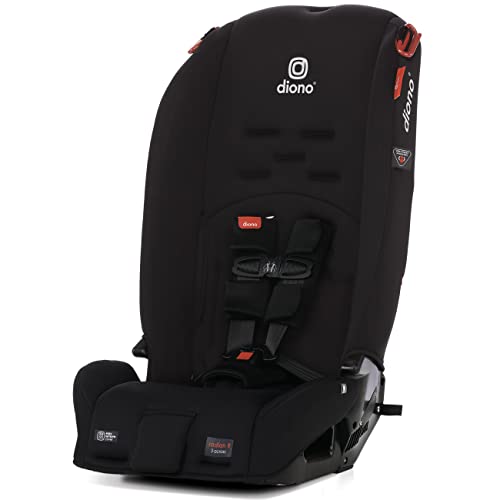 Diono Radian 3R, 3-in-1 Convertible Car Seat, Rear Facing & Forward Facing, 10 Years 1 Car Seat, Slim Fit 3 Across, Jet Black