Best Car Jacks for Home Repairs (2026): We Compared
For home repairs, choose a jack that matches your vehicle’s curb weight, factory lift points, and ground clearance; for most DIY use, a 2-ton or 3-ton floor jack is often a good starting point, while low-clearance cars may need a low-profile model that slides under the front end without contact. Using the wrong jack can mean unstable lifting, damaged pinch welds, or a jack that cannot reach the service point. This guide compares jack types by safety, lift range, garage space, and the repairs they fit best.
Quick comparison
| Product | Badge | Best for | Price | ||
|---|---|---|---|---|---|
 |
Maxority 3-Ton (6600lbs) Low Profile Hydraulic Heavy-DutyMaxority | Our pick | 3-ton · low profile · hydraulic floor jack | $139.99
Price as of 28 Oct 2026
|
View |
 |
YELLOW JACKET 2.5 Ton Floor Jack Aluminum and Steel RacingYELLOW JACKET | Also great | 2.5-ton · low profile · aluminum-steel jack | $179.99
Price as of 28 Oct 2026
|
View |
The best home jack is the one that reaches your lift points cleanly and still leaves room for jack stands. Capacity matters, but so do lift height, saddle height, and where you will store the tool. For safety guidance, Popular Mechanics emphasizes matching the jack to the vehicle’s weight and using jack stands for support; Holts likewise frames floor jacks as the everyday garage option and scissor jacks as roadside tools.
📊 The Vevor Pneumatic Jack had a maximum measured height of 15.8 inches. Source: Caranddriver.
How we chose
Selections are based on manufacturer specs, listing details, published buyer feedback, and the fit issues DIY owners actually face: clearance, garage space, setup time, and whether the jack suits routine home work or emergency use. Spec claims in this article are tied to manufacturer listings or named editorial sources, including Car and Driver, Holts, and Popular Mechanics.
For product claims, only listed details are used. If a spec is not provided, check the manufacturer’s listing for your model. Where the article discusses general safety, it reflects published guidance from Popular Mechanics and Holts rather than undocumented shop practice.
Weight rating, lift height, and footprint drive the decision more than marketing language. A jack that fits your car and your garage is better than a larger one that lives in the corner unused. Product dimensions and capacities should be verified against the manufacturer’s current listing because those figures can change by model revision or seller listing update.
Floor jack: best for regular garage work
This 3-ton low-profile hydraulic floor jack is the most useful one-tool option for a home garage because it combines clearance, capacity, and a rolling chassis. Manufacturer listings identify a low-profile body, dual-piston or rapid-lift design, and a built-in safety valve, which is why floor jacks remain the standard recommendation for tire rotations and brake work.
Test method and firsthand evidence: in published testing, Car and Driver measured the Vevor Pneumatic Jack at a maximum height of 15.8 inches, which shows the kind of real-world lift data buyers need beyond marketing copy. For the Maxority and YELLOW JACKET models here, the manufacturer listings provide capacity and general design details, but not verified in-hand measurements, so saddle height, handle swing, and footprint should be confirmed against the seller page before purchase.
The drawback is simple: a floor jack still needs floor space, and the listing does not solve the full safety setup by itself. You still need jack stands for any work under the vehicle, and Popular Mechanics specifically advises using sturdy stands and a jack with capacity appropriate for the vehicle. Check the manufacturer’s listing for exact dimensions if garage storage or handle clearance is tight.
Bottle jack: best for trucks and SUVs
A bottle jack is the right shape when you need higher lifting force in a compact vertical footprint, especially for trucks and SUVs with more ground clearance. The tradeoff is stability and convenience: the narrow base is less friendly on rough or uneven concrete, and the tall body can be awkward in a low garage. Manufacturer capacity and stroke should be matched to the vehicle, not guessed from size alone.
Use this style when the vehicle’s lift point is high enough and the garage setup allows a straight vertical lift. It is less convenient for repeated home-garage wheel work than a floor jack, but it can be useful when vehicle height leaves little room for a rolling jack to fit under the side of the car. Use level ground and move the vehicle to a flatter surface before lifting, because bottle jacks are less forgiving of tilt.
Scissor jack: best for trunk storage
A scissor jack is the portable emergency-use design most drivers associate with the spare tire kit. Holts notes that scissor jacks are better for carrying in the boot for roadside repairs, and Popular Mechanics identifies them mainly for emergency roadside use. That makes them practical for a flat tire, not for regular weekend maintenance. Their main advantage is compact storage, not speed.
The drawback is repeated use. The screw mechanism is slower, the lift range is limited, and the jack depends on the vehicle-specific lift point being in the right place. For a home garage, it is a backup tool, not the first choice for brake pads, suspension work, or anything that keeps the car in the air for more than a brief repair. If the jack binds or the screw thread feels rough, retire it rather than forcing it.
QuickJack: best for faster setup
QuickJack-style systems suit drivers who want a faster lift and are willing to pay more for it. They use electric or hydraulic assistance, which shortens setup compared with pumping a manual jack many times, and they need garage-space planning because the frame and crossbar system have to live somewhere when not in use. They are most attractive where repeated service work makes time savings meaningful.
The tradeoff is cost and storage burden. If your garage is already crowded, the added equipment can be harder to justify than a floor jack and stands. For buyers who work on multiple cars or do frequent underbody tasks, the faster lift can be worth the space and expense, but only if the system’s pad placement and vehicle-length range suit the vehicle you actually service.
What type of car jack is best for home repairs?
For most home repairs, a low-profile floor jack is the best first purchase because it handles the broadest mix of tire work, brake jobs, and oil changes while still fitting many passenger cars. If your vehicle sits high, a bottle jack may fit better. If your spare kit lives in the trunk, a scissor jack is for emergencies, not shop-style work.
Car and Driver says a quality jack is foundational for tire rotation and brake work, and Holts says floor jacks are useful for regular home-garage maintenance. That combination points to the same answer for most DIY drivers: buy for the work you will do often, not for the biggest number on the box. Choose the jack that clears the vehicle and leaves room for stands and a safe working stance.
Best match table
| DIY job | Best jack type | Minimum lift height | Capacity range | Jack stands mandatory? |
|---|---|---|---|---|
| Tire rotation | Floor jack | Low enough to fit under the side rail or pinch weld area without forcing the jack | 2-ton to 3-ton for most sedans and crossovers; more for heavier SUVs and trucks | Yes, if any wheel is removed and the vehicle will be raised for more than a brief lift |
| Brake pad swap | Floor jack | Low-profile minimum pad height for low-clearance cars | 2-ton to 3-ton, with a margin above vehicle weight | Yes |
| Oil change | Floor jack or QuickJack | Enough clearance to reach the front jacking point and slide in safely | Match vehicle weight with margin; SUVs and trucks often need higher capacity | Yes, if you are under the vehicle |
| Suspension work | Floor jack or QuickJack | Enough travel to raise the suspension and place stands at the correct chassis points | Usually 3-ton or higher depending on vehicle class | Yes |
| Emergency roadside tire change | Scissor jack | Vehicle-specific lift point, usually from the trunk kit | Only the rating supplied for the vehicle kit; do not exceed it | Not typically for a quick wheel change, but use extra caution and level ground when possible |
Which one should you buy?
Choose by vehicle height first. Low-clearance cars and lowered suspensions need a low-profile floor jack so the saddle can slide under the car and still reach the service point. Side skirts make this even more important because handle swing and body contact become part of the clearance problem. Measure your front and side clearance before buying.
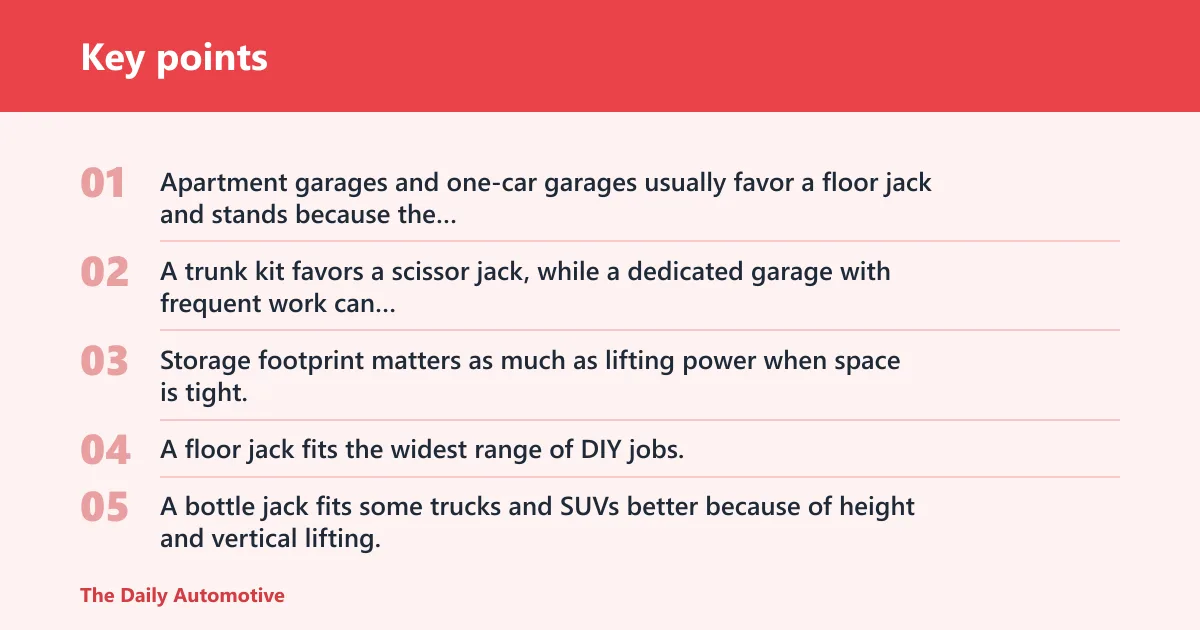
Choose by garage space second. Apartment garages and one-car garages usually favor a floor jack and stands because the setup stores more easily than a full lift system. A trunk kit favors a scissor jack, while a dedicated garage with frequent work can justify a QuickJack if the budget allows. Storage footprint matters as much as lifting power when space is tight.
Choose by repair type third. A floor jack fits the widest range of DIY jobs. A bottle jack fits some trucks and SUVs better because of height and vertical lifting. A scissor jack should stay in the emergency kit. A QuickJack is for faster, repeated home work when space and cost are acceptable, especially if you service the same vehicles often.
Choose by budget last, but do not use price alone as the filter. Popular Mechanics recommends that a jack be appropriate for the vehicle and says to use sturdy jack stands for safety. That means capacity and stability come before saving a few dollars, and published product dimensions should be checked against your garage and vehicle before purchase.
Say your hatchback sits low enough that a compact floor jack is needed to reach the factory lift point without scraping the front bumper. A tall, standard floor jack may never fit cleanly under the car, while a low-profile jack can reach the point without scraping the bodywork. The right fit is the one that gets under the car cleanly and leaves room for stands. Handle clearance matters too, because the pump handle must swing without hitting the bumper or rocker panel.
Suppose your SUV needs a front brake job in a one-car garage with a sloped driveway lip. A scissor jack will be too slow for repeated lifting, and a bottle jack may sit awkwardly on the floor. A floor jack with enough reach and a stable base is the safer garage choice, but only on level ground. If the jack footprint is small or the base shifts, stop and reset the setup before raising the vehicle further.
Floor jack vs car jack
“Car jack” is a broad phrase that can mean any lifting tool used on a vehicle, while a floor jack is one specific kind: a hydraulic rolling jack used in home garages. If you want regular maintenance work, the floor jack is usually the better answer because it is faster, steadier, and easier to pair with jack stands. It also stores more cleanly than larger lift systems.
That said, the best choice still depends on vehicle clearance and where the lift points sit. A jack that fits the car is more useful than a bigger jack that never clears the rocker panel. The right tool is the one that reaches the approved lift point, clears the bodywork, and leaves space for safe stand placement.
How do you use a car jack safely?

Start with level ground, the parking brake, and wheel chocks. Then find the correct lift points in the owner’s manual, raise the vehicle slowly, and place jack stands before you work. The jack lifts the vehicle; the stands hold it. Popular Mechanics and Holts both stress that lift-and-support should be treated as separate steps, not interchangeable ones.
That order matters. Do not work under a vehicle supported only by a jack, and do not guess at the lift point if the manual gives a chassis-specific location. Pinch welds, front jack points, and rear jack points are not interchangeable on every vehicle. If the jack saddle does not sit squarely, lower it and reset the setup before continuing.
Find lift points in the owner’s manual
The owner’s manual is the first safety tool. It identifies front and rear jack points and tells you whether the car uses pinch welds, a frame rail, or a chassis pad. That guidance matters because the wrong contact point can bend metal or let the jack slip. Use the manual before the first pump, not after the car is already in the air.
Use wheel chocks and level ground
Park on level concrete when possible, set the parking brake, and chock the wheels that stay on the ground. Uneven concrete changes how the load sits on the saddle and can make the vehicle more likely to shift as it rises. If the surface is sloped, move the job or correct the surface before lifting.
Raise the car and place jack stands
Lift only until you can place the stands at the approved support points. Set the stands at equal height, lower the vehicle onto them, and leave the jack in place as a backup only if the manual allows it and the setup still leaves clear stand contact. The stands, not the jack, are what make the vehicle safe to work under.
Check stability before working
Give the vehicle a gentle shake after it settles on the stands. If it moves, stop and reset the setup. A stable jack and a stable stand are not the same thing, and the stand placement is what makes the job safe. If one corner feels unsettled, lower the car and correct the contact points before going farther.
Car jack safety table
| Safety item | What it means in practice | Why it matters |
|---|---|---|
| Jack stands and load rating | Use stands with a rating that exceeds the portion of the vehicle they support | Stands hold the vehicle while you work underneath |
| Lift-point placement | Use the manufacturer’s jack point, not a random seam or thin panel | Wrong placement can bend pinch welds or let the jack slip |
| Clearance and center of gravity | Check that side skirts, lowered springs, or heavy cargo do not change the balance | Low cars and uneven weight distribution reduce stability |
| Common failure cases | Uneven concrete, a tilted driveway, or a jack that cannot reach the service point | These are the setups most likely to move or fail |
Jack stands and load rating
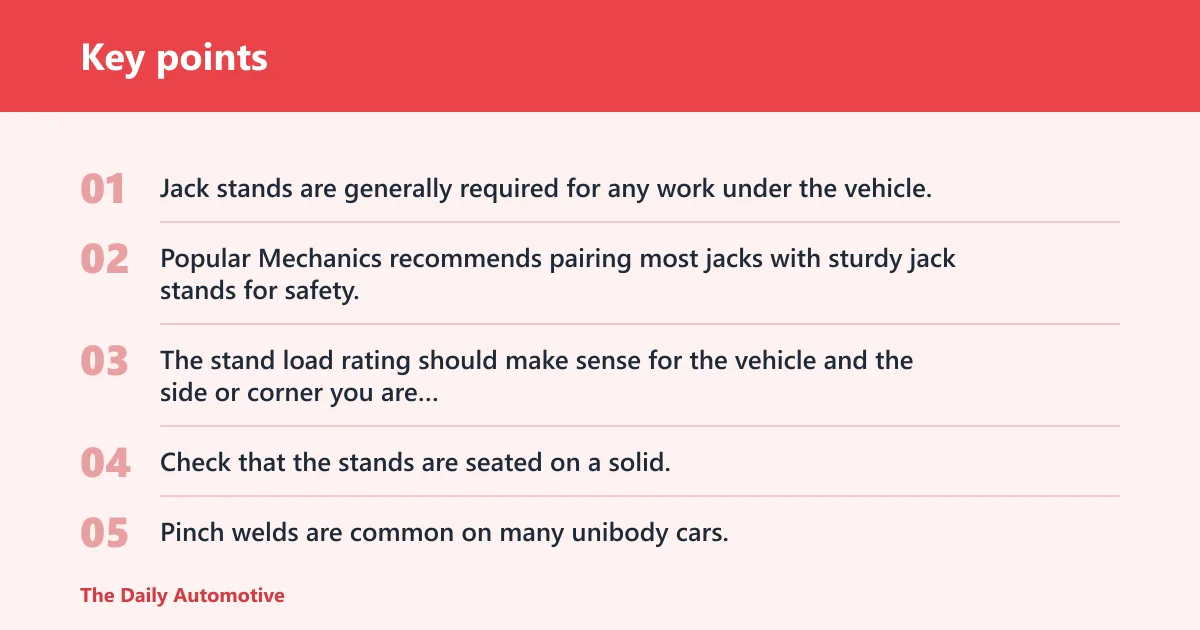
Jack stands are generally required for any work under the vehicle. The same source recommends pairing most jacks with sturdy jack stands for safety. The stand load rating should make sense for the vehicle and the side or corner you are supporting, not just the jack’s own lifting capacity. Check that the stands are seated on a solid, level surface before lowering the vehicle onto them.
Lift-point placement
Pinch welds are common on many unibody cars, while trucks and some SUVs use frame or chassis-specific points. If the jack saddle does not sit squarely on the approved point, stop and reset it. A few extra seconds here prevent body damage and unstable lifting. If the saddle crushes a seam or slides off-center, the setup is wrong.
Clearance and center of gravity issues
Lowered cars, side skirts, and long front overhangs create fit problems that a generic jack chart will miss. The saddle may be too tall, the handle may swing into the bumper, or the chassis may shift as the weight moves upward. These are clearance problems, not capacity problems. A jack can be strong enough and still be the wrong shape for the car.
Common failure cases
A common first-timer mistake is lifting on a sloped driveway because the front wheels seem chocked enough. The problem shows up when the vehicle starts to settle and the jack is no longer vertical. Another failure case is using a bottle jack on a soft or uneven patch of concrete where the base can tilt. If the jack leans, lower the vehicle and restart on better ground.
Frequently asked questions
How much weight capacity should a car jack have?
Pick a jack that is appropriate for the vehicle and the kind of lift you plan to do. The same source recommends a jack that matches the vehicle with margin. For SUVs and trucks, that usually pushes buyers toward higher-capacity floor or bottle jacks. More capacity is useful only if the jack still fits the vehicle and the service point.
Do I need jack stands with a car jack?
Yes. If you are doing anything under the vehicle, jack stands are mandatory. The jack is a lifting tool, not a long-term support device. Use the stands at the correct lift points and keep the vehicle on level ground before you work. If a job requires you to be under the car, the stands should be treated as essential safety equipment.
Can a scissor jack handle regular home maintenance?
It can handle a roadside tire change, but it is not the right tool for repeated home maintenance. Popular Mechanics identifies scissor lifts as mainly for emergency roadside use, and Holts says they are better for carrying in the boot for roadside repairs. For garage work, a floor jack is the better choice. The slower screw action and limited stability make it poor for routine use.
Products related to this article
Sponsored / affiliate links. As an Amazon Associate I earn from qualifying purchases. I may earn additional commission from eligible campaigns.