Car Seat Snack Tray Cost / Price / How Much
The best value for most families is a mid-range travel tray with cup holders and wipe-clean sides. It gives you snack containment without paying for tablet pockets or bulky storage you may never use.
Quick picks
| Best for | What to look for | Typical price | Why it fits |
|---|---|---|---|
| Short errands | Basic molded plastic, one-piece construction, raised edges | $10 to $15 | Simple containment and easy sanitizing without extra features |
| Daycare runs | Fabric tray, single or dual cup holders, light storage pockets | $15 to $25 | Holds snacks and a cup while staying portable |
| Road trips | Tablet pocket, reinforced edges, spill control, storage pockets | $25 to $35 | Better fit for long rides and in-seat entertainment |
Car seat snack tray price bands
Car seat snack trays are often grouped into three general price bands: about $10 to $15 for basic molded plastic, about $15 to $25 for fabric trays with simple storage, and about $25 to $35 for premium travel trays with tablet pockets and sturdier edging. Higher prices usually buy more structure, more compartments, or better compatibility.
Budget trays: basic molded plastic
At the low end, molded plastic snack trays are made for quick cleanup and simple use. They usually have one-piece construction, raised edges, and little or no storage. That can be enough for crackers, sippy cups, and a short commute, especially if you want something you can wipe clean fast.
Molded plastic models are often the easiest to sanitize, and some are dishwasher safe. The trade-off is limited organization. If you need a place for crayons, snack bags, or a tablet, a basic tray usually will not do much beyond holding food in place.
Mid-range trays: fabric and simple storage
Mid-range fabric car seat trays usually use polyester or Oxford fabric and add more structure than a bare plastic tray. They often include a strap system, sidewalls, and at least one or two pockets. This is the band where convenience starts to matter more than plain simplicity.
A good example is the Kenley Kids Travel Tray, which uses 900D Oxford Polyester, has a 10-inch width, includes two cup holders, two storage pockets, and comes with a lifetime warranty. That mix points to a tray aimed at regular use, not just one short trip.
Premium trays: tablet pockets and reinforced edges
Premium trays usually cost more because they add tablet storage, larger viewing windows, reinforced edges, and more pocket space. That extra structure helps on longer rides, but it is too much for many local trips. If you do not need a tablet slot or storage pockets, you are paying for features, not necessity.
These trays also tend to use stronger straps and more rigid sidewalls, which can help with wobble. The cost increase makes the most sense when the tray will be used often and needs to survive repeated setup, teardown, and cleaning.
Price to feature matrix
This matrix maps what each price band usually buys. It separates basic snack containment from features that add cost, so you can decide whether a tray is worth the extra money for your route and your child’s age.
| Price band | Material | Cup holders and cleanup | Storage, tablet fit, portability | Best use case |
|---|---|---|---|---|
| $10 to $15 | Molded plastic, one-piece construction | Often no cup holder or one basic cup holder; easiest to sanitize; some are dishwasher safe | Little or no storage; rarely includes a tablet slot; light and simple | Short commutes, quick errands, occasional use |
| $15 to $25 | Polyester or Oxford fabric with basic structure | Single or dual cup holders; spill resistance depends on fit and sidewall height | Small pockets for snacks or crayons; fold-flat portability is common | Daycare runs, repeated local trips, mixed snack and toy use |
| $25 to $35 | Heavier fabric with reinforced sidewalls and trim | Dual cup holders are more common; better stability helps reduce spills | Tablet pouch, clear-front viewing, zippered or mesh pockets, better organization | Road trips, older toddlers, families who need entertainment storage |
A common first-timer mistake is buying for the tablet slot first and the car seat fit second. If the tray wobbles or the straps do not stay tight, the extra pocket does not help much. Fit comes before features.
How much is a car seat snack tray?
Most car seat snack trays cost $10 to $35. The average buyer will see the strongest value in the middle of that range, where you get more structure than a bare plastic tray without paying for road-trip features you may not use. The right price depends on how often the tray will be installed and how much mess it needs to handle.
Typical retail range
Basic trays near $10 to $15 usually focus on containment and simple cleanup. Mid-range trays around $15 to $25 typically add fabric construction, cup holders, and a few pockets. Premium models at $25 to $35 often include tablet storage, more rigid edges, and more durable strap systems.
Average price by feature set
For a family that wants only snacks and a stable surface, the practical average is usually in the lower half of the range. For a family that wants both snack storage and a tablet pocket, the average climbs because the material, stitching, and closure details usually become more complex.
Hoovy’s listing on Target shows a snack tray accessory that is sold for car seats, booster seats, and strollers, and it includes a cup holder. The listing is black, shows a 4.4-star rating, 15 reviews, 6 questions, and it was bought 100+ times in the last month. Those details suggest broad use, but they do not tell you whether the extra price is necessary for your routine.
When a higher price is justified
Pay more when the tray must do more than hold crackers. A higher price makes sense if you need stronger straps, spill control, a tablet pocket, or storage for crayons and toys. If the tray will mainly hold one snack and a drink on short drives, the cheapest stable option is often enough.
Which features make a snack tray cost more?
Features raise price when they add material, stitching, or fit complexity. Cup holders, tablet pockets, storage pockets, and reinforced edges all cost more because they need extra structure and better layout. If you do not need those functions, the added price is often hard to justify.
Cup holder count and spill control
Single cup holders are common on budget trays. Dual cup holders usually cost more because they need more width and a sturdier base. They also help with toddler cup compatibility, especially when a cup has a wider bottom or a spill-resistant lid that needs a stable seat.
Fit stability matters as much as the number of holders. A tray with a loose cup opening can wobble when a child reaches across it. If the holder is too deep or too narrow, the cup can tip, even on a pricier tray.
Tablet holder size and viewing window
A tablet slot raises cost because it needs a pouch or window that fits a device securely while still allowing the screen to be seen. Clear-front viewing is useful on road trips, but the pouch has to match the tablet size. If the opening is too tight or too loose, the device is harder to use safely and consistently.
Tablet support should be treated as a road-trip feature, not a default feature. For errands and daycare runs, it is often unnecessary. For longer drives, it can be worth paying for if your child actually uses the screen space.
Pockets, sidewalls, and strap systems
Storage pockets add price because they add stitching, material, and organization space. Zippered pockets and mesh pockets are helpful for crayons, snack packs, or small toys. Reinforced sidewalls also push the price up because they improve tray shape and reduce collapsing at the edges.
Strap systems matter too. Adjustable straps and more secure anchors usually cost more, but they can reduce slipping. That matters if the tray will be used often or moved between seats.
How to choose the right tray
Choose by use pattern first, then by features. Short trips call for a basic tray with easy cleaning. Longer rides call for more structure, better fit, and storage. The wrong tray is usually not the one with fewer features; it is the one whose fit or construction does not match the trip.
Short commutes and daycare runs
For short commutes, a molded plastic snack tray is often the better buy. You get easy sanitizing, one-piece construction, and less cleanup after sticky snacks. If the tray only needs to hold a snack cup and a small toy, do not pay for a tablet pocket.
Suppose your child rides about 12 minutes to daycare and mostly snacks on dry cereal. A $12 molded plastic tray with raised edges is likely enough. A $30 tray with a tablet sleeve, by contrast, adds cost without changing the ride much.
Road trips and longer rides
For longer rides, a fabric travel tray usually earns its higher price. The strap system, raised edges, tablet slot, and pockets all matter more when the tray has to do more than hold food. The extra structure helps keep crayons, snacks, and a device in one place.
Picture a three-hour drive with a toddler who wants a cup, crackers, and a show on a tablet. In that case, dual cup holders, a clear-front tablet pocket, and a few storage pockets are worth paying for. A bare plastic tray would be a poor fit.
Car seat, booster seat, and stroller fit
Compatibility is not the same across all setups. Some trays are made for car seats, booster seats, and strollers, like the Hoovy listing. Others fit only one type of seat. Before you buy, check the strap path, seat width, and whether the tray interferes with the harness or buckle.
Do not assume a tray that works in a booster seat will work on a stroller. Front-seat use is a separate issue and should be treated with caution, because placement can interfere with airbag zones or driver access. If the listing does not clearly state the intended setup, skip it.
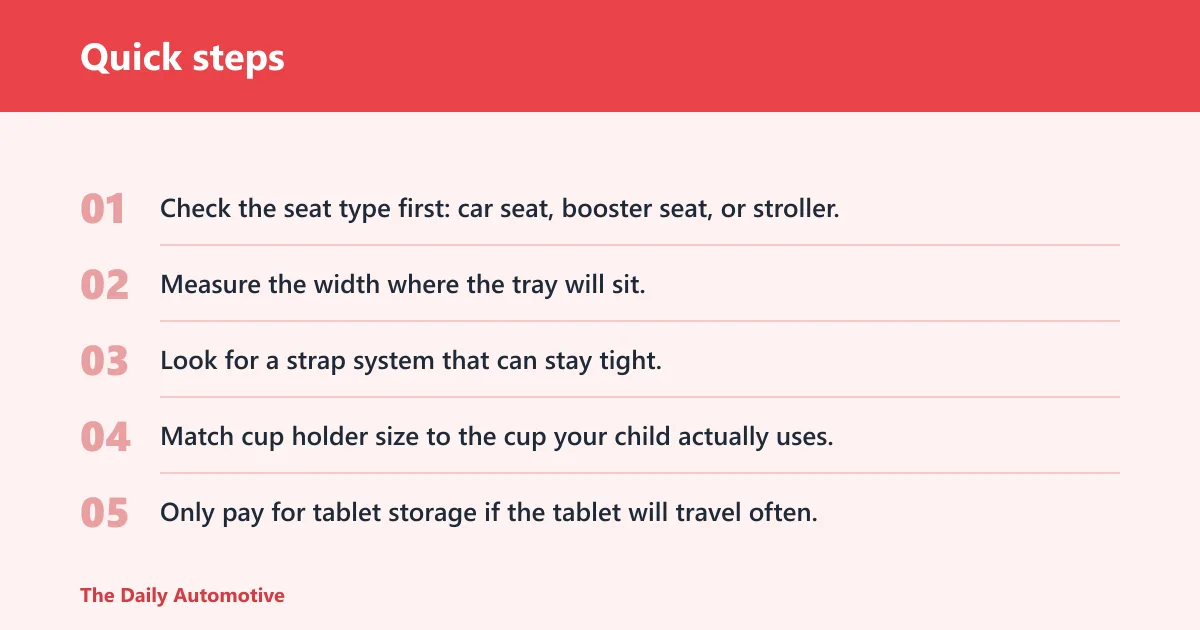
- Check the seat type first: car seat, booster seat, or stroller.
- Measure the width where the tray will sit.
- Look for a strap system that can stay tight.
- Match cup holder size to the cup your child actually uses.
- Only pay for tablet storage if the tablet will travel often.
Are car seat snack trays worth it for toddlers?
They are worth it when the tray solves a real problem: snack spillage, toy clutter, or the need to keep a cup within reach. For toddlers who eat in the car often, a tray can cut mess and keep items from sliding under the seat. For rare trips, a basic tray is usually enough.
What a basic tray solves
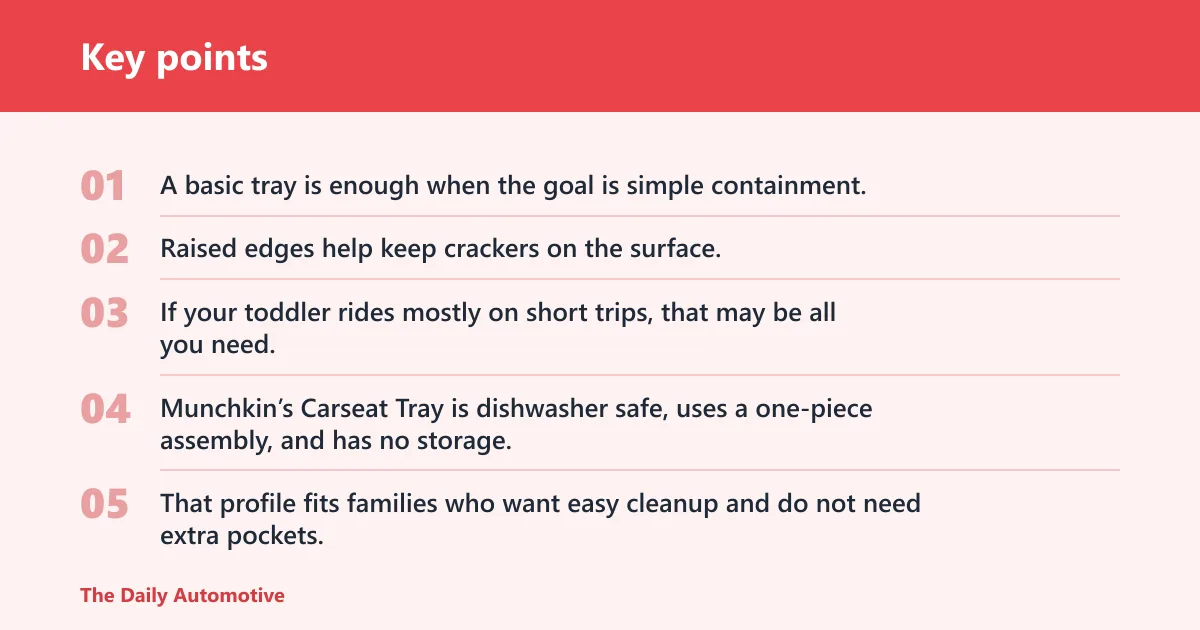
A basic tray is enough when the goal is simple containment. Raised edges help keep crackers on the surface, and a cup holder can stop a drink from rolling away. If your toddler rides mostly on short trips, that may be all you need.
Munchkin’s Carseat Tray is dishwasher safe, uses a one-piece assembly, and has no storage. That profile fits families who want easy cleanup and do not need extra pockets. It is a better match for pure convenience than for organized road-trip use.
When storage and tablet features matter
Storage pockets matter when you want crayons, small books, or extra snacks to stay in one place. Tablet features matter when the ride is long enough that entertainment becomes part of the plan. Once the trip length increases, the value of pockets and a viewing window goes up.
The Kenley tray’s two cup holders and two storage pockets are useful for children who need both a drink and a place for small items. That kind of setup makes more sense for longer rides than for a five-minute school drop-off.
When you should skip the upgrade
Skip the upgrade if the tray will mainly hold a snack for a short ride and the child already has a stable cup elsewhere. A premium tray is not a better buy just because it has more pockets. If those pockets stay empty, you paid for unused features.
Worth it if: the tray will be used several times a week; snacks are often eaten in the car; the child uses a cup that tips easily; or the ride is long enough to need tablet storage. Not worth it if the tray will mostly sit in the car and only see occasional use.
Frequently asked questions
What is the average price of a car seat snack tray?
The practical average lands around the middle of the market, where fabric trays with one or two cup holders are common. That usually means about $15 to $25. You pay more when you add tablet pockets, more storage, or heavier construction meant for regular road trips.
What features make a snack tray more expensive?
Cup holders, tablet pockets, storage pockets, reinforced edges, and better strap systems are the main price drivers. Dual cup holders and larger tablet pouches usually cost more than a plain molded tray because they need more material and more structure. Extra compartments also add stitching and layout complexity.
Do car seat trays fit booster seats and strollers too?
Some do, but not all. The Hoovy tray is sold for car seats, booster seats, and strollers, which shows that compatibility can vary by product. Always check the listing for fit notes, because a tray designed for one seat type may sit too loose or interfere with another.
How do I choose between a plastic tray and a fabric travel tray?
Choose plastic if cleanup and low cost matter most. Choose fabric if you want cup holders, pockets, and better use on longer rides. Plastic is usually better for short errands. Fabric is usually better when you need storage, a tablet slot, or a more structured setup for road trips.
Products related to this article
Sponsored / affiliate links. As an Amazon Associate I earn from qualifying purchases. I may earn additional commission from eligible campaigns.