How Much Does Negative Equity Cost When Trading in a Car?
Negative equity adds the old loan shortfall to the next car loan, then charges interest on that carried balance. If that added interest costs more than waiting, delaying the trade is cheaper. Skip the math and you can end up paying for two cars at once, with a larger payment, more interest, and little or no cash toward the next purchase. This guide shows how to calculate rolled debt, estimate the interest hit, and find the break-even point before you trade.
What negative equity means
Negative equity means the loan payoff is higher than the car’s current value. It is also called underwater or upside-down. The number that matters is the gap between the 10-day payoff amount and what the vehicle would fetch now, not what you originally paid.
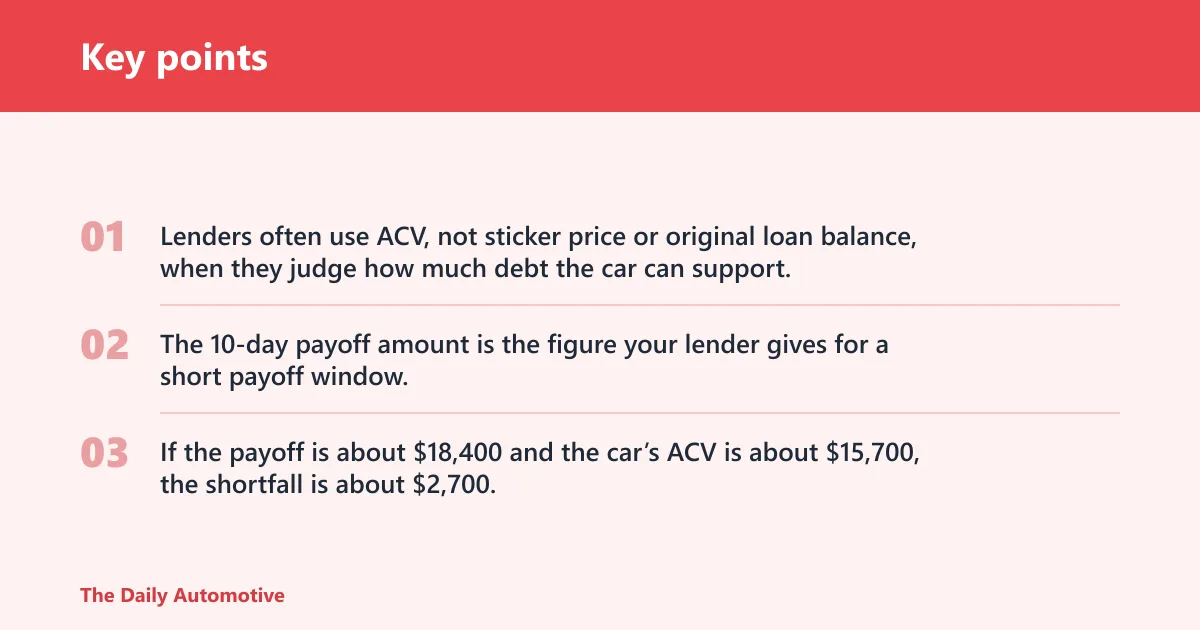
Trade-in value matters because a dealer’s offer is usually lower than a private-party sale price, and both can be lower than the vehicle’s actual cash value. Lenders often use ACV, not sticker price or original loan balance, when they judge how much debt the car can support.
Payoff, trade-in value, and ACV
The 10-day payoff amount is the figure your lender gives for a short payoff window. It can differ from the monthly statement balance because interest keeps accruing. If the payoff is about $18,400 and the car’s ACV is about $15,700, the shortfall is about $2,700.
That same car may bring a lower trade-in offer than a private sale. A dealer can use the trade-in as part of the next purchase, but the lower offer can widen the shortfall even when the car still looks decent and runs well.
How to calculate your trade-in shortfall
Start with the 10-day payoff amount, then subtract the car’s current value. Use ACV if you want a lender-style estimate, and use a real dealer offer if you want a trade-in estimate. The result is your negative equity.
For example, NerdWallet says a $10,000 car with a $12,000 loan leaves you $2,000 upside-down. Carwow gives the same basic setup in pounds: a vehicle worth £4,000 against £5,000 owed creates £1,000 negative equity. OMVIC also shows a $9,192 shortfall in a trade-in example.
Do the calculation in order
-
Get the 10-day payoff. Ask the lender for the exact payoff figure and the expiration date. That number is the baseline, because the statement balance may be stale by the time you trade.
-
Estimate current value. Compare ACV, private-sale value, and the dealer’s trade-in offer. ACV is the figure lenders tend to use for LTV, while the trade-in offer is what actually offsets the next purchase.
-
Subtract value from payoff. If the payoff is higher, that difference is negative equity. If the value is higher, you have positive equity and can use the surplus as a down payment.
-
Check the next loan size. Add any shortfall to the new vehicle price. That total is the amount you may finance before taxes, fees, and any down payment are applied.
Suppose your payoff is $22,000 and a dealer offers $18,500. The shortfall is $3,500. If you roll it forward, the next lender is financing the new car plus that extra $3,500, so the cost shows up immediately in the payment and over the term.
Can you trade in a car with negative equity?
Yes, you can trade in an underwater car if the lender approves the new loan and the numbers still fit the lender’s rules. The unpaid difference is usually rolled into the next contract, which raises the amount financed and can stretch the payment well beyond what the new car alone would cost.
F1 lenders typically cap loan-to-value ratios around 125%, so the car, the rolled balance, and the rest of the deal still have to fit that limit. F2 shows the structure clearly: rolling $2,000 negative equity into a $15,000 purchase creates a $17,000 loan balance.
What lenders check
- LTV. The new loan amount compared with the vehicle’s ACV.
- Income and debt load. The monthly payment must still fit the borrower’s budget and debt-to-income profile.
- Term length. Longer terms can make approval easier on paper, but they usually increase total interest.
- Down payment. More cash up front can offset some or all of the rolled debt.
What negative equity adds to your loan
Rolling negative equity adds principal first, then interest on top of that principal. The size of the payment increase depends on term length and APR. A longer term lowers the monthly hit, but it also keeps the rolled debt alive longer and usually costs more overall.
OMVIC’s example shows how this works in practice: $9,192 of negative equity turns a $35,000 new car into a $44,192 loan amount, with a monthly payment of $538. That is the same rolled-debt logic buyers face in smaller and larger deals alike.
| Negative equity rolled in | Added amount financed | Estimated payment change at 60 months | Estimated payment change at 72 months | Estimated payment change at 84 months | Extra interest paid vs. waiting 12 months |
|---|---|---|---|---|---|
| $1,000 | $1,000 | About $19 per month | About $16 per month | About $14 per month | About $55 |
| $3,000 | $3,000 | About $56 per month | About $50 per month | About $43 per month | About $165 |
| $5,000 | $5,000 | About $94 per month | About $83 per month | About $71 per month | About $275 |
| $8,000 | $8,000 | About $150 per month | About $133 per month | About $114 per month | About $440 |
The table above uses a simple 7% APR assumption so the payment effect stays comparable across terms. The payment increase gets smaller as the term gets longer, but the total interest picture worsens because the debt stays on the books longer. That is why a 84-month loan can look easier and still cost more.
Negative equity cost
Here is the real decision point: compare the payment relief from a longer term with the interest you will pay on the rolled balance. F4 notes that 72, 84, or even 96 months are common long auto loan terms. That can keep the payment tolerable, but it does not erase the debt.
To keep the comparison concrete, the examples below assume you could wait 12 months instead of trading now, and that waiting lets you avoid the rolled balance entirely. The “extra interest” column shows the extra cost of acting now rather than sitting tight and saving the equity gap.
- $1,000 gap. This is often absorbable if the rest of the deal is clean. The payment bump is modest, and the interest penalty is usually small enough that other deal terms matter more.
- $3,000 gap. This is where the deal starts to deserve scrutiny. A longer term may keep the payment manageable, but the interest cost becomes noticeable.
- $5,000 gap. This usually needs caution. The monthly increase can be hard to justify unless the current car has high repair risk or the next car sharply reduces running costs.
- $8,000 gap. This often argues for waiting. The rolled balance can distort the next loan enough to leave little room for a fair trade.
Should you wait or trade now?
If your negative equity is under about $2,000, trading can be workable when the new car price, APR, and term all stay reasonable. Between $2,000 and $5,000, the decision gets more sensitive to payment size, and above $5,000 the case for waiting usually gets stronger unless you have a real need to change cars now.
The break-even point is simple: if waiting 12 months will reduce your payoff gap by more than the extra interest you would pay by rolling the debt today, waiting is cheaper. F12 says new cars lose about 30% over the first 2 years, so depreciation can both create the problem and make waiting painful if the car keeps dropping fast.
A common first-timer mistake is trading early because the monthly payment on the new car looks close to the old one. That can hide the fact that the new contract is carrying old debt, so the total cost of ownership rises even if the payment barely moves.
What can make negative equity worse?
Fast depreciation, low down payments, high mileage, and long loan terms all push a car underwater faster. The same source says negative equity can happen with long loan terms and low deposits, and F5 matches that point. A long term can keep the monthly bill low while the loan balance falls too slowly.
Higher mileage lowers the vehicle’s value, which can widen the gap between payoff and ACV. Longer terms do the same by keeping the loan balance ahead of the car’s value for more months. In practical terms, 72, 84, or 96 months can delay equity recovery even when the payment looks easier.
Four common patterns
- Large first-year depreciation. New cars often drop quickly in value, so early trading tends to be expensive.
- Small down payment. Little cash up front leaves less cushion against depreciation.
- Long term. The balance shrinks slowly, so equity takes longer to catch up.
- High mileage. More miles lower ACV and can widen the shortfall at trade-in.
How GAP insurance fits
GAP insurance may cover the difference between an insurance payout and the loan balance if the car is totaled. It does not erase rolled negative equity as a habit, and it does not lower the loan amount you already took on. It is a backstop for a total loss, not a fix for an overpriced trade.
If the vehicle is stolen or declared a total loss, GAP can help prevent a shortfall from becoming a cash bill in some cases. But if the loan was already inflated by old debt, GAP only helps if the policy terms and loss timing line up. It also costs extra.
What happens if you trade in a car with negative equity?
The dealer usually applies the trade-in value to the old loan, then carries any remaining balance into the new loan if the lender allows it. That raises the amount financed on the new car, which can increase the monthly payment and the total interest cost over the full term.
If the old car is sold before the loan is fully covered, the borrower still owes the shortfall. A voluntary surrender can be worse, because the lender may sell the car at auction for less than a dealer trade-in would have brought, which can leave a bigger balance to pay after the sale.
Failure cases to watch
- Total loss. Insurance pays actual cash value, not the full loan balance, so the gap can still matter.
- Voluntary surrender. The vehicle is returned, sold, and the remaining balance can follow you.
- Private sale before payoff. If the sale price is below the payoff, you must cover the difference at closing.
Frequently asked questions
How much negative equity can I roll into a new car loan?
There is no universal dollar cap, but lenders usually care about the final loan-to-value ratio and your ability to repay. F1 says LTV ratios are typically capped around 125%. If the rolled balance pushes the deal too far above ACV, approval can get harder or require more cash down.
Will rolling negative equity raise my monthly payment?
Yes. Rolling old debt into the new loan raises the amount financed, so the payment goes up unless a longer term or lower APR offsets part of it. A longer term can soften the monthly change, but it usually raises total interest over the life of the loan.
What loan-to-value limit do lenders use for negative equity?
Many lenders cap LTV around 125%, though the exact limit varies. That means the new loan, including any rolled negative equity, should not run too far above the vehicle’s ACV. Once the deal exceeds that range, the lender may ask for a larger down payment or decline the application.
Is it better to keep my current car until I have positive equity?
Often yes, especially if the gap is above $5,000 and the current car is still dependable. Waiting gives depreciation time to slow the shortfall and may let your existing loan balance catch up. If the current car needs major repairs soon, compare that repair cost to the cost of carrying the debt forward.
Does GAP insurance cover negative equity if my car is totaled?
Sometimes it covers part of the shortfall between the insurance payout and the loan balance, depending on the policy terms. It does not erase the rolled debt itself, and it does not pay down a loan that is underwater unless a total loss triggers the claim. Read the policy before assuming it will solve the problem.
How do I calculate negative equity on my trade-in?
Get the 10-day payoff amount from the lender, estimate the car’s current value using ACV or a dealer offer, and subtract value from payoff. If the payoff is higher, that difference is negative equity. If you want a trade-in answer, use the dealer offer instead of the private-sale number.
Can I trade in a car if I’m underwater on the loan?
Yes, if the lender approves the next loan and the deal fits the vehicle’s value and your income. The shortfall is usually rolled forward. The risk is not the trade itself; it is the extra principal and interest the next loan must carry.
Products related to this article
Sponsored / affiliate links. As an Amazon Associate I earn from qualifying purchases. I may earn additional commission from eligible campaigns.