Best Jump Cables for Emergencies (2026): We Compared
The best jump cables for emergencies are the shortest set that reaches both batteries cleanly, with 4- to 6-gauge copper-clad cables for most cars and 2-gauge or thicker for SUVs and trucks with side-post, rear, or awkward battery placement. Pick the wrong set, and you waste time, lose voltage through long thin leads, or cannot make the connection at all. This guide covers the cable lengths, gauge choices, clamp quality, and vehicle layouts that matter most on real roadside jobs.
Quick comparison
For most drivers, the right set is the one that fits the car you actually drive and the parking spaces you actually use. Cable length, clamp grip, and trunk storage matter as much as gauge.
How we chose
The picks below are based on published product details, buyer feedback, and the fit questions that matter most on the roadside. Gauge, length, clamp grip, battery-terminal compatibility, and storage practicality carried the most weight.
Also use the practical limits that show up in this category: Popular Mechanics says most vehicles can use 4- to 8-gauge jumper cables and recommends at least 10 feet of length. Longer cables help reach awkward battery locations, but they are harder to stow and can be less convenient in a trunk kit.
Clamp quality matters too. Popular Mechanics says the clamps need to be secure for effective power transfer, and that means strong spring tension and teeth that actually bite into the terminal, not just look heavy-duty.
Choose the right jumper cables in 30 seconds
| Vehicle type | Battery location | Minimum gauge | Recommended length | Clamp priority | Storage trade-off |
|---|---|---|---|---|---|
| Compact car | Front, easy access | 6- to 8-gauge | 10 to 12 feet | Secure spring and clean tooth grip | Easier to store; less reach margin |
| Midsize sedan | Front or under a cover | 6-gauge | 12 to 16 feet | Top-post fit plus firm contact | Balanced size for trunk kits |
| Large SUV | Front, rear, or offset | 4- to 6-gauge | 20 feet | Wide jaws and strong spring pressure | Bulkier coil and harder trunk storage |
| Truck | Side-terminal or deep bay | 2- to 4-gauge | 20 to 30 feet | Side-terminal compatibility matters most | Longest sets are hardest to pack neatly |
| Any vehicle with tight parking | Hard to line up nose-to-nose | 4- to 6-gauge | 20 feet | Clamps that stay put at an angle | Worth the extra bulk for reach |
Failure-case checklist:
- Tight parking: If the donor car cannot park close and nose-to-nose, a 10-foot set may be too short even if the gauge is strong.
- Trunk-mounted batteries: Rear battery placement often needs 20 feet or more, because the lead has to route around bodywork and parked cars.
- Cold-weather brittleness: If the jacket stiffens in low temperatures, clamps can slip and the cable can be harder to route without forcing it.
TOPDC 4 Gauge 20 Feet Heavy Duty Jumper Cables: best overall jumper cables

This is the best fit for most drivers who want one set that can cover a sedan, SUV, or truck without guessing at reach. Based on the manufacturer’s specs and published product details, the 4 gauge, 20-foot layout gives more margin than short budget sets, and the included carry bag helps keep it ready in the trunk.
The strong point is roadside flexibility. Coast 2 Coast lists TOPDC as 4 gauge and 20 feet long, says it works with top-post and side-terminal batteries, and says it stays flexible in cold weather down to -40°F. That combination matters when the battery sits in a rear compartment, behind a fender, or in a parking spot where the cars cannot line up neatly.
The drawback is simple: longer, thicker cables take more space. A 20-foot set is easier to use in difficult layouts, but it is not as compact as a short sedan-only kit, and the higher bulk can make storage less tidy in a small emergency bag.
TOPDC also says its jumper cables come with a 600D Oxford fabric carry bag, and it gives the product a multi-year quality guarantee. For buyers comparing materials, this is a common budget-heavy-duty pattern: copper-clad aluminum construction for easier handling and lower cost, with claims of flexibility and durability that should still be checked against the rest of the product details.
Which one should you buy?
If you drive a compact car and park in open spaces, a 6- to 8-gauge set around 10 to 12 feet can be enough. If you drive an SUV, a truck, or anything with a battery that sits away from the grille, 20 feet is the safer starting point.
Choose the TOPDC set if you want one cable pair that can handle awkward parking, side-terminal batteries, and colder weather without forcing the donor car to sit perfectly close. Skip the longer format only if storage space is so tight that you would leave it behind; an unused cable is worse than a shorter one that actually stays in the car.
Say your truck is parked nose-in beside another vehicle in a crowded lot. A short set may never reach cleanly, even if the gauge looks strong on paper. In that case, the extra length is not a luxury; it is the difference between a quick jump and a dead end.
Best jumper cables for SUVs and trucks
For SUVs and trucks, the longer choice usually makes more sense because the battery often sits farther from the front bumper or in a position that makes direct donor-car alignment awkward. A 20-foot set starts to solve those reach problems without pushing all the way to the largest, hardest-to-store cables.
Coast 2 Coast lists a 30-foot heavy-duty option at 0 gauge, which shows where the category goes when size and reach matter most. That length is useful for large vehicles and awkward roadside angles, but it also takes up more space in the cargo area and is less pleasant to coil neatly after each use.
Clamp strength matters more here than in a small sedan. Bigger batteries and more awkward terminal access reward clamps with strong spring tension and teeth that hold position instead of slipping off the terminal edge.
When 20 feet starts to make sense
Twenty feet is the practical midpoint for drivers who need help reaching batteries that are not directly at the front of the vehicle. It also helps when the donor car has to stop at a shallow angle, when one lane is blocked, or when snow and curb space make perfect alignment impossible.
Longer cables are not automatically better. They add reach, but they also add bulk, and every extra foot must be stored somewhere. That trade-off matters if the set has to live behind a third-row seat or in a small trunk organizer.
Best compact jumper cables for small cars
Small cars usually do best with a lighter, shorter set that still meets the minimum length needed for a clean connection. For compact vehicles with front-mounted batteries and easy access, 10 to 12 feet is often enough, and a 6- to 8-gauge cable can be a sensible match.
The main upside is storage. Shorter cables fit more easily in the trunk, stay tidier in a carry bag, and are more likely to remain part of the emergency kit instead of getting removed for space. The downside is obvious: if parking is tight, the donor car may not be able to get close enough for a short set to work.
Where compact sets can fall short
A compact set can fail even on a small car if the battery sits under a cover, the hood opens only partway, or the donor vehicle has to stop one space away. In those cases, gauge alone will not save the job. You need enough cable to make the geometry work.
That is why the shortest workable set is the right target, not the shortest set available.
How do you choose the right gauge and length?
Start with the vehicle, not the brand name. The same source says most vehicles can use 4- to 8-gauge jumper cables, and lower numbers mean thicker cable. Thicker cables carry more amperage, which helps when you are dealing with larger engines, longer cable runs, or batteries that sit in awkward places.
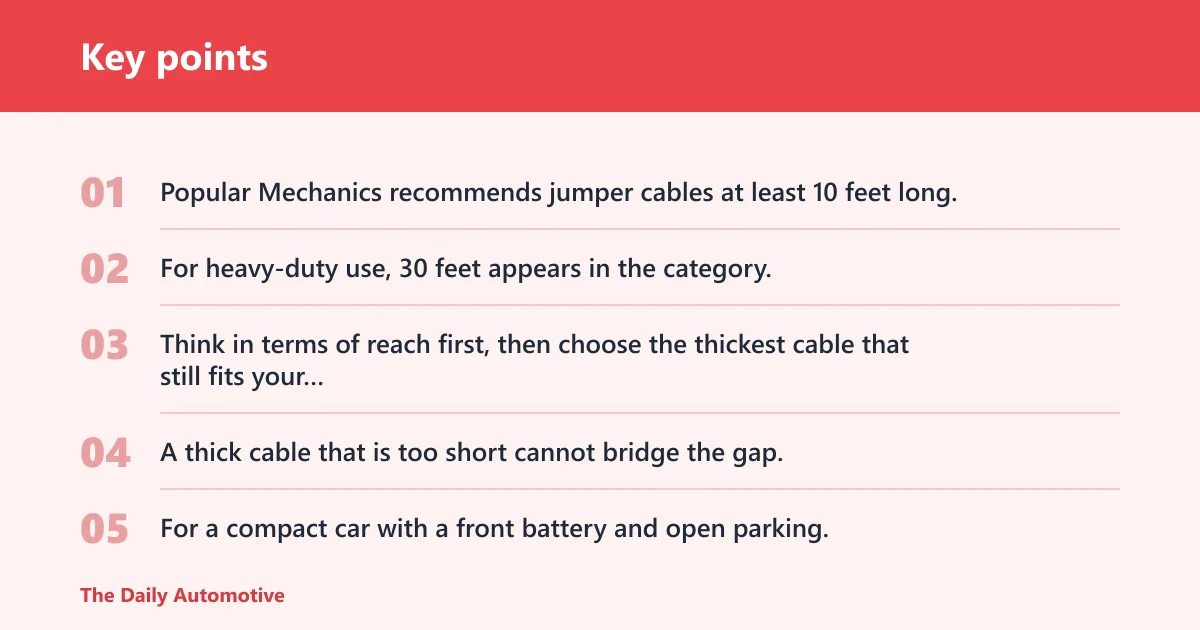
Length and gauge work together. The same source recommends jumper cables at least 10 feet long, but 20 feet helps when the donor car cannot sit directly in front of the disabled vehicle. For heavy-duty use, 30 feet appears in the category, though the extra length is harder to store and can be more cumbersome in a roadside kit.
Think in terms of reach first, then choose the thickest cable that still fits your vehicle type and storage space. A thick cable that is too short cannot bridge the gap, and a long cable that is too thin can waste time when voltage drops over the run.
Minimum length by vehicle type
For a compact car with a front battery and open parking, 10 to 12 feet is a workable floor. For most midsize sedans and many crossovers, 12 to 16 feet gives useful flexibility. For SUVs and trucks, 20 feet is the safer everyday choice, while 30 feet belongs to heavy-duty situations where reach is the first concern.
Suppose the battery is in the trunk and the only donor spot is two spaces away. A 10-foot set may not bridge that distance cleanly, even if the cable itself is a good gauge. In that case, the longer set earns its keep.
What clamp size and grip should I look for in jumper cables?
Look for clamps that close hard, grip cleanly, and stay in contact on top-post or side-terminal batteries. The same source says the clamps need to be secure for effective power transfer, and that means strong spring tension and teeth that can bite through light corrosion or uneven terminal surfaces.
Top-post clamps need to sit squarely without rocking. Side-terminal compatibility matters because many trucks and some SUVs use terminals that do not accept a loose, oversized clamp well. If the clamp cannot stay aligned, the jump becomes harder and less reliable.
Clamp design is not cosmetic. The cable can be thick, but if the clamp slips or sits half-open, the connection weakens and the job becomes slower. Secure grip matters as much as gauge.
Top-post and side-terminal fit
Some sets are built for one style of battery and struggle with the other. That is why compatibility should be checked before purchase, especially if your family vehicles use different terminal layouts. A clamp that can handle both types saves you from buying a second set later.
For emergency use, a clamp that is easy to place with one hand is worth more than one that looks oversized but is awkward to hold at an angle.
Should you buy jumper cables or a portable jump starter?
Jumper cables make more sense if you want a simpler, lower-maintenance tool that can stay in the car for years without a recharge cycle. A portable jump starter is better if you often drive alone, park in places where another car may not be available, or want a one-car solution that does not depend on a donor vehicle.
The trade-off is readiness. Jumper cables are always ready if they are in the trunk. Portable jump starters need charging, and a dead battery in the jump pack itself leaves you with no backup. For drivers who already keep a charger in the garage, the jump starter is attractive; for drivers who want a set-it-and-forget-it emergency tool, cables are still hard to beat.
For many owners, the best answer is to keep both over time, but start with the tool that fits the driving pattern you actually have. Urban drivers with tight parking may value a jump starter more. Owners of trucks or SUVs often benefit from longer cables first.
Can jumper cables work in cold weather?
Yes, but cold weather changes the job. Cables can stiffen, clamps can be harder to position, and brittle jackets are more likely to crack if they are forced too sharply. That is why flexible insulation and cold-weather claims matter more than they do in mild climates.
Coast 2 Coast says TOPDC cables are flexible in cold weather down to -40°F, and some listings also advertise a temperature range up to 140°F. Those claims are useful as a buyer cue, but they should still be verified against the exact product page and packaging before purchase.
Cold also raises the cost of a bad connection. If the clamp barely grips and the cable jacket is stiff, the whole setup becomes harder to route around snow banks, frozen hoods, and cramped parking spots. A set that stays flexible is easier to place correctly.
Cold-weather failure modes to watch
- Stiff insulation that resists bending around the battery tray.
- Clamps that lose bite when gloves make placement less precise.
- Frozen or corroded terminals that reduce contact quality.
- Short cables that cannot reach because the donor car must park farther away in snow or ice.
Are UL-listed jumper cables worth buying?
Yes, UL certification is worth using as a trust cue, especially when the product will live in a trunk for years and may be used under stress. It does not replace the need to check gauge, length, clamp design, and battery compatibility, but it can help separate better-documented products from vague listings.
Read the listing carefully, because UL mentions are not all the same. Verify the exact product you are buying, not just the brand family. If the listing does not clearly identify the certification, treat that as a reason to keep looking.
What is the safest way to use jumper cables?
The safest sequence is the one that keeps the clamps from touching each other and keeps the final connection order under control. Park the donor car close enough for the cables to reach without strain, but do not let the vehicles touch. Then confirm that both ignitions are off before attaching the clamps.
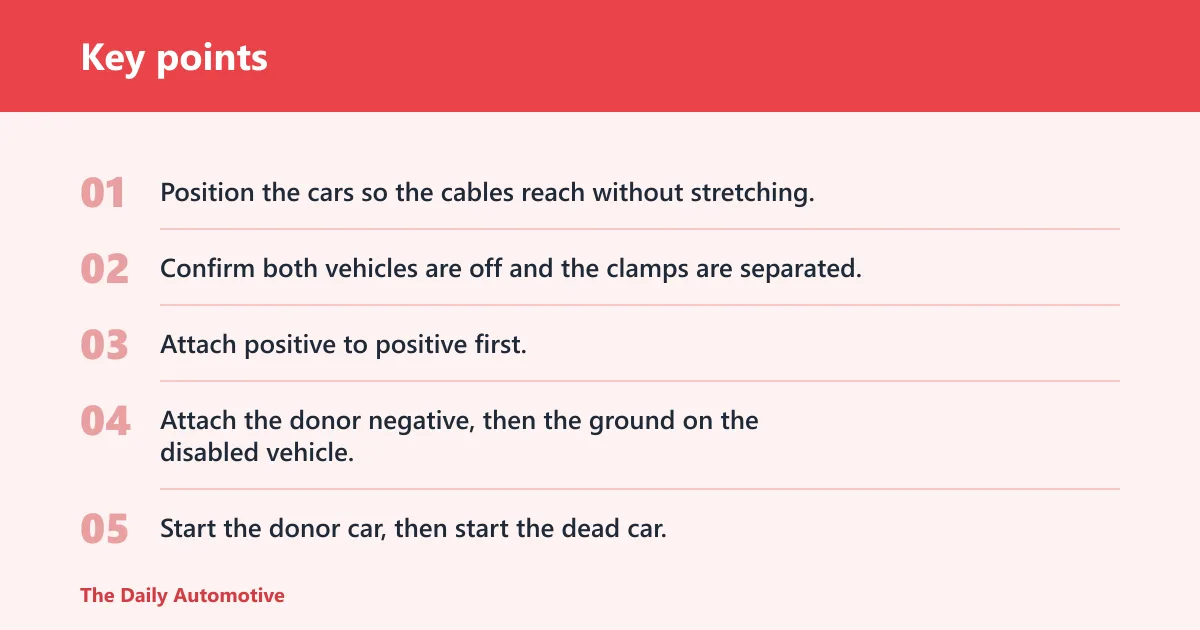
Connect one red clamp to the dead battery’s positive terminal, then the other red clamp to the donor battery’s positive terminal. Attach one black clamp to the donor battery’s negative terminal, then place the final black clamp on a clean, unpainted metal ground on the disabled vehicle away from the battery if possible. Start the donor car, then the dead vehicle. Remove the clamps in the reverse order after the disabled vehicle is running.
- Position the cars so the cables reach without stretching.
- Confirm both vehicles are off and the clamps are separated.
- Attach positive to positive first.
- Attach the donor negative, then the ground on the disabled vehicle.
- Start the donor car, then start the dead car.
- Remove the clamps in reverse order.
A common first-timer mistake is trying to use a short cable while the donor car sits too far away. That forces the clamps to pull sideways, which makes a secure grip harder and increases the chance of a poor connection.
Frequently asked questions
What gauge jumper cables are best for a car emergency?
For most cars, 4- to 8-gauge jumper cables cover the typical emergency range, with thicker cables helping when the battery is harder to reach or the vehicle is larger. The same source says most vehicles can use that range, but the best choice still depends on where the battery sits and how far the donor car must park away.
How long should jumper cables be for an SUV or truck?
For an SUV or truck, 20 feet is usually the safer everyday choice because it gives you room to deal with offset battery placement and awkward parking. If the battery is in a rear compartment or the vehicle is especially large, 30 feet may be useful, but the extra bulk is harder to store neatly.
Are 4-gauge jumper cables better than 6-gauge?
Usually yes for bigger vehicles or longer reaches, because lower gauge means thicker cable and thicker cable carries more amperage. But 4-gauge is not automatically better for every driver. If the vehicle is small and the battery is easy to reach, a shorter, easier-to-store 6-gauge or 8-gauge set may fit better.
Do I need jumper cables or a portable jump starter?
Choose jumper cables if you want a low-maintenance emergency tool that can stay in the car and work whenever another vehicle is available. Choose a portable jump starter if you often drive alone or want a one-car backup. The jump starter needs charging, while cables depend on a donor vehicle.
Products related to this article
Sponsored / affiliate links. As an Amazon Associate I earn from qualifying purchases. I may earn additional commission from eligible campaigns.