Best Car Throttle Bodies for Performance: We Compared
The best throttle body matches your engine, ECU, and airflow needs: stock-size for drivability and simple replacements, mildly larger for bolt-on intake and exhaust builds, and drive-by-wire compatible units only when the calibration can support them. Pick wrong and you can get idle problems, lazy throttle response, check-engine lights, or a part that adds cost without adding power. This guide compares throttle bodies by use case, fitment, electronic compatibility, and upgrade value so you can buy the right one the first time.
Quick comparison
| Product | Badge | Best for | Price | ||
|---|---|---|---|---|---|
 |
GM Genuine Parts 12670834 Fuel Injection Throttle BodyGM GENUINE PARTS | Our pick | OEM replacement · sensor included · GM setup required | $90.51
Price as of 23 Oct 2026
|
View |
 |
BBK Performance 1709 80mm Throttle Body – High Flow PowerBBK Performance | Upgrade pick | 80mm · high-flow · LS1/GM fitment | $444.21
Price as of 23 Oct 2026
|
View |
 |
Holley Sniper EFI 860001-1 Throttle Body 92mm SilverHolley | Pair with it | 92mm · EFI · silver billet | $259.95
Price as of 23 Oct 2026
|
View |
The safest default for most shoppers is a direct-fit OEM replacement with the correct sensors already installed. Move to a larger bore only when the engine, intake, and tune can use it.
How we chose
We compared each option by fitment certainty, sensor inclusion, and whether the part restores drivability or actually moves more air. We also weighed tuning risk, connector compatibility, and how much benefit each throttle body can deliver on the stated platform.
That matters because bore size does not decide the result by itself. A 90 mm unit on the wrong setup can be a poor trade, while a correct OEM replacement can solve rough idle, hesitation, or stalling with far less risk.
Quick picks
- Best daily-driver replacement: GM Genuine Parts 12670834 Fuel Injection Throttle Body Assembly with Sensor.
- Best airflow upgrade for a GM LS-based setup: BBK Performance 1709 80mm Throttle Body.
- Best large-bore EFI option: Holley Sniper EFI 860001-1 92mm Throttle Body.
GM Genuine Parts 12670834 fuel injection throttle body assembly with sensor: best for direct replacement
This is the best fit for a stock or near-stock GM vehicle that needs a repair-first solution. It makes sense when the goal is to restore clean idle, normal throttle response, and reliable cold starts rather than chase extra horsepower.
Based on the manufacturer details, the sensor is included, which cuts down on the guesswork that comes with reusing a worn TPS or swapping over an old unit with questionable readings. The strongest value here is simple: a direct GM Genuine Parts replacement that supports proper airflow and keeps the installation close to factory intent.
The drawback is just as clear. If your engine already has supporting intake, exhaust, and calibration changes, this part is a repair part first, not a performance jump.
BBK Performance 1709 80mm throttle body: best for LS1 and GM full-size bolt-on builds
This is the better choice when the engine already has mild airflow mods and you want a more responsive throttle body without jumping to an oversized setup. It fits the LS1 Camaro, Firebird, GTO, and GM full-size 4.8L, 5.3L, and 6.0L applications listed with the part.
What stands out is the 80mm high-flow design and the included adapter plate, which makes the part more usable on the intended GM platforms than a generic “bigger is better” pick. For a modified street truck or muscle car, that can be the right middle ground between stock drivability and a larger airflow path.
The trade-off is cost and complexity. At this level, the price only makes sense if the engine can use the added flow; otherwise, the gain may be modest compared with a direct replacement.
Holley Sniper EFI 860001-1 92mm throttle body: best for larger EFI setups
This is the strongest pick here for a build that actually needs a larger bore and already has the supporting hardware to justify it. A 92mm throttle body is aimed at higher-airflow EFI combinations where a smaller unit becomes a bottleneck.
Based on the published product details, the billet aluminum construction and Sniper EFI layout make it a serious airflow component rather than a simple replacement part. It is a better fit for builders who want to size the throttle body around the engine’s demand, not around the factory casting.
The drawback is that a larger bore can outpace the setup. On a mild engine with limited intake capacity or conservative calibration, a 92mm unit can be more throttle than the combination can use well.
What is the best throttle body for your car?
The best throttle body depends on whether you are replacing a failed part or trying to improve airflow on a modified engine. For most daily drivers, the best answer is the correct OEM-style replacement with the right sensor package. For bolt-on builds, a modest bore increase can help. For serious airflow demands, choose a platform-specific performance unit only when tuning and intake capacity are ready for it.
Best daily driver replacement
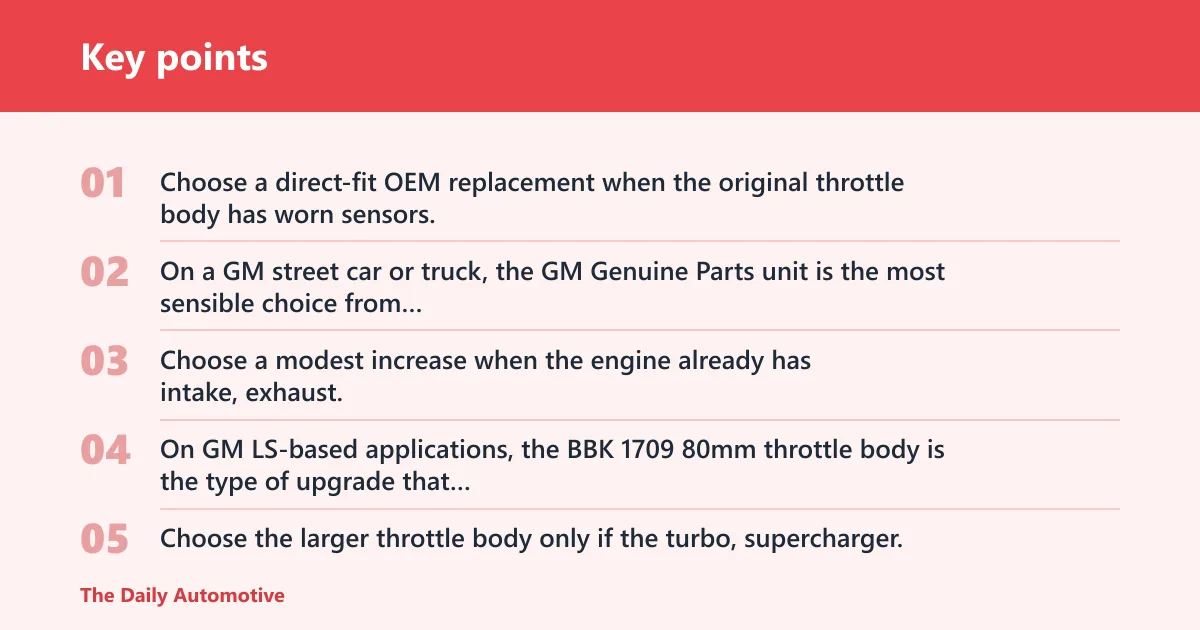
Choose a direct-fit OEM replacement when the original throttle body has worn sensors, contamination, or an idle problem that starts after the housing itself. On a GM street car or truck, the GM Genuine Parts unit is the most sensible choice from a repair-cost standpoint because it includes the sensor and stays close to factory behavior.
Best mild bolt-on upgrade
Choose a modest increase when the engine already has intake, exhaust, or calibration changes and you want sharper response. On GM LS-based applications, the BBK 1709 80mm throttle body is the type of upgrade that can make sense when the rest of the setup can use the extra airflow.
Best forced-induction choice
Choose the larger throttle body only if the turbo, supercharger, or high-output EFI setup can actually move enough air to justify it. On a build that needs a 92mm bore, the Holley Sniper EFI unit fits the “size it for demand” approach better than a small stock replacement.
Best classic TBI restoration
Pick a direct-replacement throttle-body injection assembly when the goal is to restore idle quality and drivability on an older truck. Classic TBI systems often need the correct injectors, gasket sealing, and sensor behavior more than they need extra bore size.
Mopar Gen III Hemi throttle body
For Mopar Gen III Hemi applications, the best throttle body is the one that matches the engine management strategy and the intake layout, not just the largest bore you can find. The strongest upgrade case is a 90 mm single-blade unit on 5.7L and 6.4L applications where the calibration and airflow path can support it.
Best for 5.7L and 6.4L applications
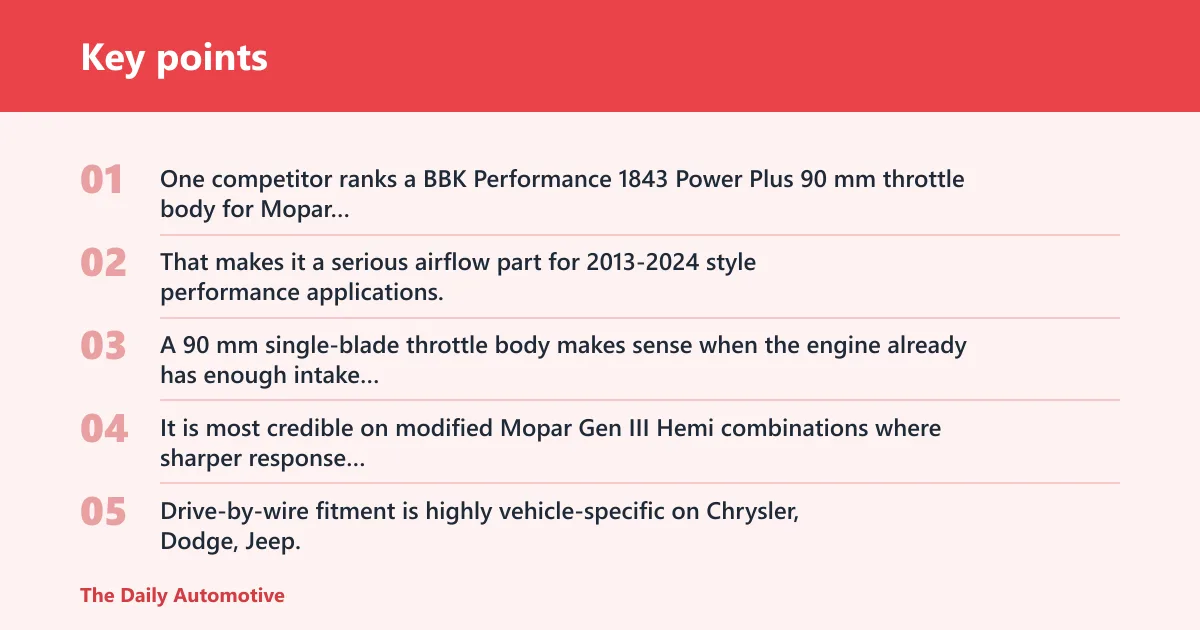
One competitor ranks a BBK Performance 1843 Power Plus 90 mm throttle body for Mopar Hemi fitments, and the same unit is described as a 90 mm single-blade upgrade. That makes it a serious airflow part for 2013-2024 style performance applications, not a casual bolt-on for every Hemi in the yard.
When a 90 mm single-blade makes sense
A 90 mm single-blade throttle body makes sense when the engine already has enough intake and exhaust flow to benefit from it. It is most credible on modified Mopar Gen III Hemi combinations where sharper response and higher airflow matter more than factory-like moderation.
Fitment and tuning cautions
Drive-by-wire fitment is highly vehicle-specific on Chrysler, Dodge, Jeep, and Ram applications. You need the right electronic connector, the correct terminal count, and a calibration that can accept the new throttle mapping. Without that, you can get idle instability, warning lights, or poor tip-in behavior.
Suppose a 5.7L Ram owner swaps in a larger electronic throttle body but keeps the stock calibration and a restrictive intake tube. The result may be little more than extra cost, because the engine cannot fully use the added bore and the ECU may need relearn time or a tune.
Ford 4.6L and 5.4L throttle body
Ford truck and SUV owners usually want a throttle body that improves response without turning the vehicle into a tuning project. The best fit is a platform-specific unit for Ford 4.6L and 5.4L applications, where a 75 mm bore is a common upgrade size and the part is aimed at airflow and pedal response.
Best for trucks and SUVs
The Ford performance pick in competitor rankings uses a 75 mm bore and is tailored to Ford 4.6L and 5.4L truck and SUV engines. That makes it a realistic option for F-150, Expedition, and related platforms where you want a bit more airflow without overreaching the setup.
Why 75 mm is common here
A 75 mm throttle body often lands in the middle of the road: larger than many stock units, but not so large that it instantly becomes mismatched to a mostly stock engine. On the right Ford package, that can translate to cleaner response and a more direct pedal feel.
What to verify before ordering
Verify the year, engine, throttle-actuator style, and connector details before you buy. Electronic throttle bodies on Ford applications are not interchangeable by bore alone. If the connector type or terminal count is wrong, the truck may stall, surge, or fail to start.
- Confirm year, make, model, and engine code.
- Match cable-operated or electronic throttle type.
- Check connector shape and terminal count.
- Verify whether TPS and IAC are included or reused.
- Confirm whether the calibration supports a larger bore.
GM 2.4L and classic TBI throttle body
For GM 2.4L applications and classic TBI trucks, the best throttle body is usually the one that restores factory behavior. These platforms reward correct replacement parts far more than oversized airflow parts, especially when the goal is steady idle quality, clean starting, and predictable drivability.
Best for direct replacement
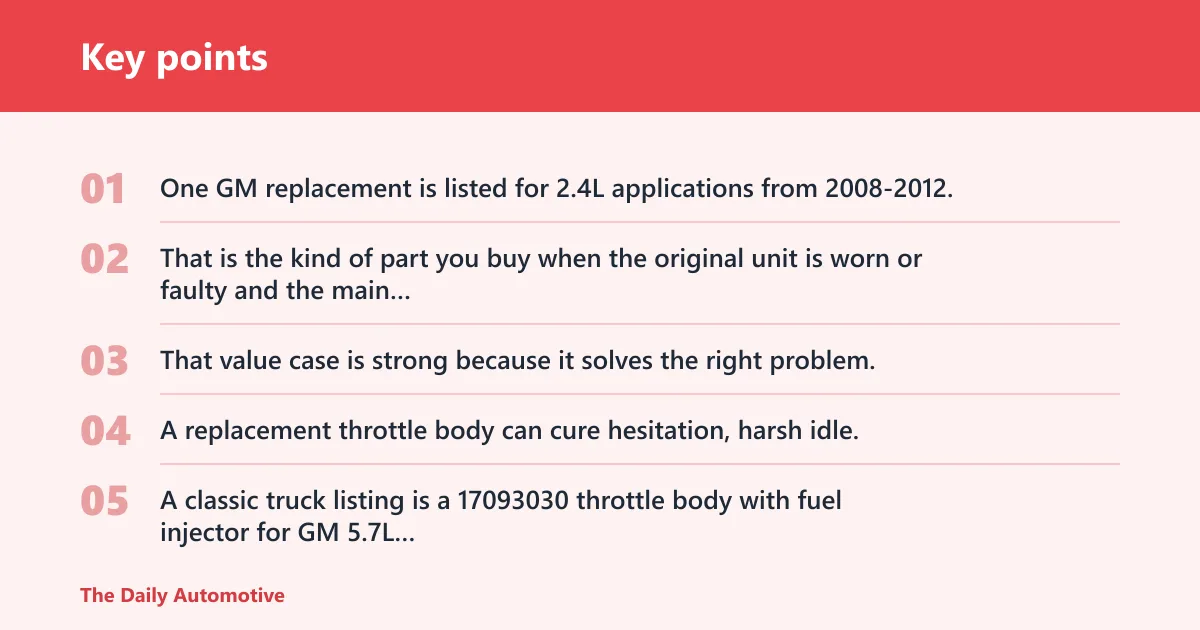
One GM replacement is listed for 2.4L applications from 2008-2012, and it replaces multiple interchange numbers including 12616668 and TB1033. That is the kind of part you buy when the original unit is worn or faulty and the main target is to get the engine back to normal behavior.
That value case is strong because it solves the right problem. A replacement throttle body can cure hesitation, harsh idle, or throttle lag caused by wear, contamination, or sensor failure, but it is not automatically a power upgrade.
Best for older TBI 5.7L systems
A classic truck listing is a 17093030 throttle body with fuel injector for GM 5.7L 1993-1995 applications. Older TBI setups are different from modern cable or electronic throttle bodies because the assembly can include fuel delivery hardware as part of the unit.
Sensor and idle quality notes
On older or high-mileage units, worn TPS readings or idle-control issues can show up as rough idle, hesitation, or surging at stoplights. If the platform uses IAC hardware, that part matters for idle quality. Replacing the throttle body without checking the sensors can leave the real problem in place.
A common first-timer mistake is buying a performance-looking throttle body for a 2.4L commuter car that only needs a clean replacement. The new part may fit the opening, but the payoff is poor if the old unit’s problem was contamination, a failing sensor, or a bad connector.
Throttle body decision matrix
This matrix separates repair jobs from airflow upgrades. That matters because the right part for a broken daily driver is not the same part for a built engine with a tune.
| Use case | Recommended bore range | Sensor needs | Tuning risk | Fitment risk | Expected benefit | Red-flag incompatibilities |
|---|---|---|---|---|---|---|
| Daily driver replacement | Stock size or near-stock | TPS included or correctly reused; IAC if the platform uses one | Low | Medium if connector or terminal count is wrong | Restores idle quality, starts, and throttle consistency | Wrong year/make/model/engine, mismatched connector, missing sensors |
| Mild bolt-on street build | About 70 mm to 75 mm, sometimes 80 mm on the right platform | Drive-by-wire units must match ECU expectations; TPS may be integrated | Medium | Medium | Sharper response, modest airflow gain, possible small power increase | Restrictive intake tube, stock calibration limits, oversized bore with no supporting mods |
| Forced-induction setup | 80 mm to 92 mm, depending on airflow demand | Electronic compatibility is critical; relearn or calibration may be needed | Medium to high | High if the throttle type or connector is wrong | Supports higher airflow demand and better top-end breathing | Stock tune, undersized intake manifold, poor DBW match, unstable idle after install |
| Classic TBI restoration | Factory-equivalent replacement size | Injectors, TPS, and IAC behavior must match the system | Low to medium | Medium | Restores drivability more than peak power | Modern EFI part substituted for a TBI assembly, fuel-injection mismatch, wiring mismatch |
Which one should you buy?
Choose the GM Genuine Parts throttle body if your priority is the least risky repair and the highest chance of getting the vehicle back to normal quickly. Choose the BBK 1709 if you have a GM LS-based street build and want a real airflow upgrade with adapter support. Choose the Holley 92 mm only if the engine setup is already built around greater airflow demand.
Budget should point you toward the repair-only part when the old throttle body is simply worn out. Platform should come first on everything electronic; Mopar, Ford, and GM drive-by-wire units are not interchangeable by bore size alone. Mod level should decide whether you stay near stock or move up to 75 mm, 80 mm, 90 mm, or 92 mm.
Do not buy a larger throttle body to fix a dirty intake tract, a bad connector, or a worn TPS. Fix the underlying issue first. If the engine still has a restrictive intake, stock tune, and no other airflow changes, a bigger bore may do very little.
By contrast, if the vehicle has rough idle, hesitation, or a throttle that feels inconsistent after years of use, a correct direct replacement can be the smarter buy than a performance part. That is especially true on GM 2.4L daily drivers and classic TBI 5.7L trucks.
Frequently asked questions
What is the best throttle body for my car?
The best throttle body is the one that matches your engine, throttle type, and calibration. For a stock or mildly used daily driver, a direct OEM-style replacement is usually the best buy. For a modified engine with supporting airflow parts, a larger platform-specific unit can make more sense.
Does a larger throttle body actually improve performance?
It can, but only when the engine can use the extra airflow. A larger bore such as 75 mm, 80 mm, 90 mm, or 92 mm may help response and top-end flow. On a stock setup, oversizing can do little or even soften low-speed response.
How do I know if a throttle body will fit my engine?
Check year, make, model, engine, throttle type, connector shape, and terminal count. Electronic throttle bodies are especially platform-specific. If the listing does not match those details, do not assume it will work because the bore looks right.
What size throttle body should I choose for my car?
Choose stock size for repair work, a modest increase for light bolt-ons, and a larger bore only when the intake and tune support it. A common range for mild upgrades is 70 mm to 75 mm, while more aggressive setups may use 80 mm or larger.
Should I buy an OEM replacement or performance throttle body?
Buy OEM replacement when the goal is to fix a drivability problem, rough idle, or a failed sensor. Buy performance only when the engine already has supporting mods and you want more airflow. If the old unit is simply worn, replacement usually gives better value per dollar.
Do I need a new gasket or sensors with a throttle body replacement?
Usually yes, if the original gasket is flattened or the sensor is worn. Some throttle bodies include the TPS, and some also include IAC hardware. Reusing old sensors can trigger idle problems or check-engine lights if the readings are off.
Will a throttle body upgrade fix rough idle or hesitation?
Sometimes, but only if the throttle body is the source of the problem. Dirty bores, failed TPS units, and bad idle-control parts can cause rough idle or hesitation. If the issue comes from vacuum leaks, fuel delivery, or a tuning problem, a new throttle body will not fix it.
Which throttle bodies work best for Mopar, Ford, GM, or Honda engines?
Mopar Gen III Hemi setups often point toward a 90 mm single-blade performance unit when the calibration supports it. Ford 4.6L and 5.4L trucks often use a 75 mm upgrade. GM 2.4L and classic TBI 5.7L applications usually benefit most from direct-fit restoration parts. Honda fitment still needs exact year and engine verification before purchase.
Products related to this article
Sponsored / affiliate links. As an Amazon Associate I earn from qualifying purchases. I may earn additional commission from eligible campaigns.