Best Car Rental Reviews for Budget Travelers
For budget travelers, a common 5-point filter for car rental reviews includes total trip cost, fee transparency, pickup speed, fuel policy, and claim reputation. Skip that filter and a cheap daily rate can turn into airport surcharges, insurance add-ons, and long counter delays. This guide ranks rental companies by real value and shows what to check before you book.
How to read rental reviews for value
Use rental reviews to estimate the full trip cost, not the headline rate. The most useful reviews mention unexpected charges, pickup friction, vehicle condition, and whether the final bill matched the quote. Fresh patterns matter more than old praise or one angry complaint.
Separate sticker price from total trip cost
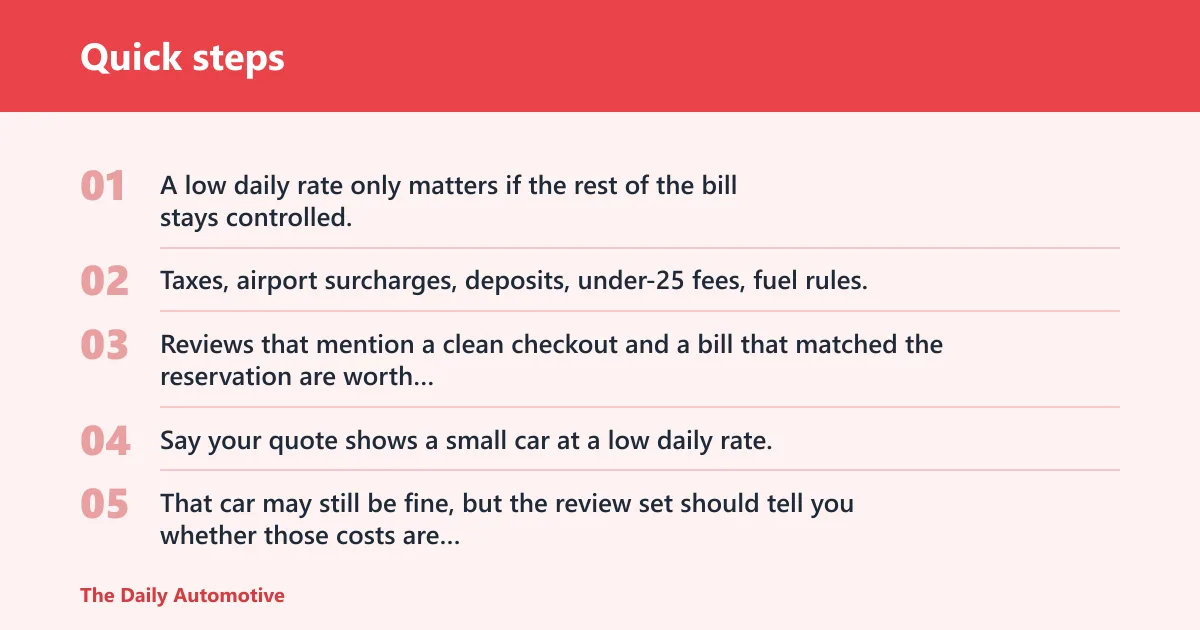
A low daily rate only matters if the rest of the bill stays controlled. Taxes, airport surcharges, deposits, under-25 fees, fuel rules, and counter add-ons can erase a bargain fast. Reviews that mention a clean checkout and a bill that matched the reservation are worth more than star averages.
Say your quote shows a small car at a low daily rate, but the airport counter adds a surcharge, a fuel prepay option, and a young-driver fee. That car may still be fine, but the review set should tell you whether those costs are common or rare at that location.
Spot the review patterns that matter most
Look for the same problem showing up again and again across many reviews. One complaint about a dirty interior or a slow desk may be noise. Ten reviews mentioning long lines, surprise insurance pressure, or deposit holds point to a process issue, not bad luck.
Focus on vehicle condition, customer service, pickup and drop-off process, and unexpected charges. Those review themes most often separate cheap-looking offers from actual value.
Use recent reviews over old star averages
Recent reviews tell you whether the current operation is stable. Booking.com says to focus on reviews from the last few months, because a company can change staff, policies, or fleet condition without changing its average rating quickly. Volume matters too; a larger set makes patterns easier to trust.
That matters most at airport locations, where staffing and line length can change by season and by day of week. Old praise from last year can miss a new upsell push or a slower pickup process.
Budget traveler rental review scorecard
This scorecard can turn review reading into a budget filter. Score each item from 1 to 5, then total the points. Higher totals point to better value for budget trips, especially when the reviews are current and consistent.
| Criterion | 1 | 3 | 5 | Best for | Avoid if |
|---|---|---|---|---|---|
| Base rate | High versus peers | Middle of the pack | Below the local average | Short trips where the quote stays simple | The rate rises after the first screen |
| Taxes and fees | Many added charges | Some added charges | Clear and limited extras | Travelers who want a realistic quote | The reviews mention bill shock |
| Deposit risk | Large hold or unclear hold | Moderate hold | Low or clearly explained hold | Debit-card users and lean budgets | You need every dollar available right away |
| Under-25 penalty | Frequent added daily surcharge | Sometimes added | Little or no age penalty in reviews | Renters under 25 | Recent reviews flag extra age charges |
| Airport surcharge | Common at the counter | Sometimes present | Rare or clearly disclosed | Airport pickups with tight budgets | The airport location is known for add-ons |
| Pickup speed | Long waits and slow lines | Mixed wait times | Fast, organized handoff | Late arrivals and one-stop trips | You arrive during peak hours |
| Upsell pressure | Strong insurance or upgrade push | Some pressure | Light or no pressure | Travelers who want the quoted rate only | Reviews mention hard sells at the counter |
| Fuel policy clarity | Confusing or disputed | Explained but not always honored | Clear and consistent | Anyone trying to avoid fuel surprises | Reviews mention prepay confusion |
| Vehicle-condition consistency | Dirty, damaged, or mismatched cars | Mixed condition | Consistently clean and road-ready | Trips where reliability matters | Many reviews mention worn tires or damage |
| Review recency | Mostly old feedback | Some recent feedback | Many reviews from the last few months | Choosing among similar low-cost offers | The latest reviews conflict with the old average |
How to use the scorecard before booking
Start with the quote, then cross-check the reviews against the ten criteria. If a company looks cheap but scores low on deposit risk, pickup speed, and upsell pressure, the total trip cost can climb fast. A good budget option usually scores well on the money items first.
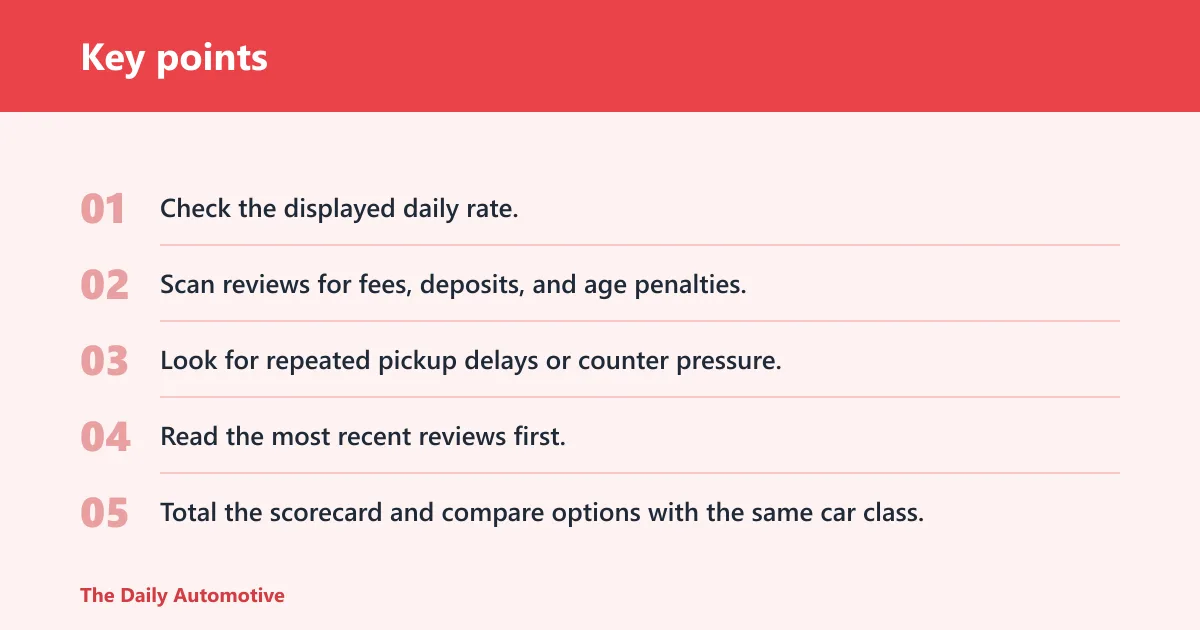
- Check the displayed daily rate.
- Scan reviews for fees, deposits, and age penalties.
- Look for repeated pickup delays or counter pressure.
- Read the most recent reviews first.
- Total the scorecard and compare options with the same car class.
Best for and avoid if notes
Use the scorecard to match the rental to the trip. For a weekend city trip, pickup speed and fee clarity may matter more than vehicle size. For a longer road trip, vehicle-condition consistency and fuel policy clarity deserve more weight because a roadside issue gets expensive quickly.
A common first-timer mistake is booking the cheapest compact car for a weekend trip and overlooking repeated reviews about surprise fees at pickup. The car may be fine. The bill may not be.
Which car rental company is best for budget travelers?
Budget Car Rental can be a strong starting point for budget travelers if the reservation fits its rules and the reviews at your pickup point look clean. Budget says members can get its best rate by signing in, but login is not required to complete a reservation. That matters if you want to compare first and decide later.
Budget Car Rental pricing hooks and limits
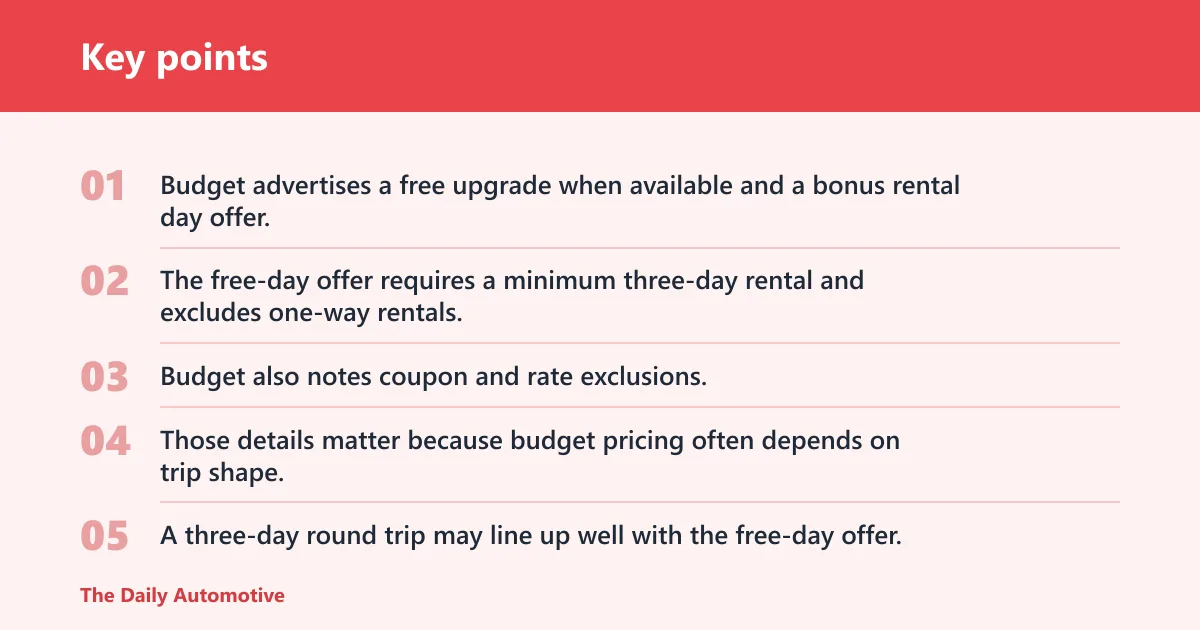
Budget advertises a free upgrade when available and a bonus rental day offer. The free-day offer requires a minimum three-day rental and excludes one-way rentals, so the headline deal does not apply to every trip. Budget also notes coupon and rate exclusions, plus age and credit requirements that can affect who qualifies.
Those details matter because budget pricing often depends on trip shape. A three-day round trip may line up well with the free-day offer. A one-way airport-to-city move may not.
What KAYAK can tell you before you book
KAYAK’s car rental price comparison is useful because it shows daily price listings, price tracking tools, booking insights, advance-booking guidance, vehicle-type comparisons, and good-deal benchmarks. That gives you a way to compare a low quote against the local market instead of guessing whether the rate is actually weak or strong.
KAYAK also says to book Ios rental cars around 77 days before the trip. It says the cheapest month to rent a car in Ios is October at an average cost of $23/day. It also says small rental cars in Ios are around 72% cheaper than other car types on average, while Mazury small car rentals are typically about $36 per day.
When a low rate is actually a poor value
A low rate is poor value when the review trail shows high deposit risk, aggressive upsells, or slow pickup at the counter. A quote can still look cheap after taxes, but the review signals may predict a frustrating handoff or surprise fees that erase the saving.
If two companies are close in total price, choose the one with better recent reviews on pickup speed and fee transparency. That is where budget trips usually win or lose time.
What hidden fees should you watch for?
Watch for fees that change the final bill more than the base rate does. Taxes, airport surcharges, deposit holds, under-25 penalties, fuel rules, and counter add-ons are the most common ways a budget rental becomes expensive. Reviews are useful when they describe those charges clearly.
Taxes, fees, and airport surcharges
Airport counters often carry extra charges that are easy to miss when you sort by daily rate. Reviews that mention an airport surcharge after the booking screen are especially valuable, because they reveal the real pickup cost, not the teaser price.
If the review set keeps mentioning a jump at checkout, treat the quote as incomplete. That is a value warning, not a minor detail.
Deposits, age penalties, and credit checks
Deposits can block a budget trip even when the daily rate looks fine. Under-25 penalties matter too; Budget notes an additional daily surcharge may apply for renters under 25. Credit requirements can also affect whether the booking is usable, especially for travelers trying to keep the payment simple.
Ask one question before you book: can the renter actually meet the pickup rules without paying more than expected? If not, the quote is misleading.
Add-ons, fuel policy traps, and upsells
Insurance pressure, fuel prepay pushes, and upgrade offers can change the final price fast. Reviews help because they show whether the staff explains options clearly or pushes extras at the counter. Booking.com specifically says to watch for unexpected charges in reviews.
Fuel policy clarity deserves special attention. If reviewers repeatedly describe confusion about refueling, the cheap rate is doing too much of the selling.
How far ahead should you book?
Book far enough ahead to catch the below-average part of the market, but not so early that you ignore rate tracking. The best window depends on location, season, and vehicle type. KAYAK’s Ios example shows that timing can matter a lot.
What the booking window usually signals
A booking made too late often costs more because inventory thins out. A booking made at the right interval can land below the destination’s average. KAYAK says to book Ios rental cars around 77 days before the trip, which shows how far ahead a target window can sit.
The exact timing varies, but the signal is consistent: if rates start moving up quickly, you are late; if a market still shows strong choice and a decent benchmark, you may have room to wait while tracking prices.
Why season and destination change pricing
Seasonality matters because peak travel dates reduce choice and push rates up. Destination-specific pricing matters because the same car class can cost very different amounts in different places. KAYAK’s October figure for Ios shows that some locations have clear low-cost months.
That is why a quote should be compared with both the calendar and the city. A cheap car in one market may be normal there and overpriced somewhere else.
When to compare small cars and SUVs
Compare small cars and SUVs before you lock in the booking window. Small cars are typically cheaper than larger vehicle types and are a strong fit for solo travelers or couples with light luggage. SUVs cost more, but the extra space can justify the jump for group travel or road trips.
Suppose a family of four has two suitcases and a stroller. A small car may win on price, but an SUV may avoid a cramped back seat and a forced second bag. The better value depends on the trip, not the class name.
Small cars are usually the budget-friendly choice because they carry a lower daily rate and often a lower fuel bill. SUVs can still make sense when the trip has more people, more luggage, or rougher roads. Review expectations change with the class, too.
Why small cars are often cheapest
Small cars are usually the first class to watch when you want the cheapest practical quote. They are typically cheaper than larger vehicle types and work well for solo travelers or couples with light luggage. KAYAK’s Ios data also points to strong savings for small rentals there.
When an SUV can still make sense
An SUV may be the better budget choice if the smaller car forces a second rental, extra baggage fees, or an upgrade at pickup. Higher daily cost can still be rational when the trip needs cargo room, family seating, or less risk of a cramped drive.
How car class changes review expectations
For small cars, pay more attention to fuel policy and pickup speed, because the saving is smaller and the trip is usually simpler. For SUVs, look harder at vehicle-condition consistency, tire and cabin comments, and whether the listed class matches what travelers actually received.
Overall star ratings are useful, but not enough on their own. The better move is to match review themes to the car class and the trip type before you book.
Frequently asked questions
How do I compare car rental reviews without getting fooled by the price?
Compare the review themes that affect the final bill: unexpected charges, pickup speed, fuel policy, and vehicle condition. Then check how recent the reviews are. A low daily rate means little if the latest feedback keeps mentioning airport surcharges or counter upsells.
What hidden fees should I watch for in budget car rental reviews?
Watch for taxes, airport surcharges, deposits, under-25 penalties, fuel prepay pressure, and insurance add-ons. Reviews that mention a smooth reservation but a larger checkout total are especially useful, because they show where the quote stopped being accurate.
Is the cheapest rental car actually the best value?
Not always. The cheapest car is the best value only when the fees stay low, the deposit is manageable, the pickup is quick, and the fuel policy is clear. If reviews show repeated add-ons or long counter waits, a slightly higher quote can cost less in practice.
How far in advance should I book a rental car to save money?
The right booking window depends on the destination and season. The same source says to book Ios rental cars around 77 days before the trip, which shows how far ahead a good window can be. Track rates early, then compare the quote with the local benchmark and car class.
What do recent car rental reviews usually reveal that star ratings miss?
Recent reviews often reveal current pickup speed, new fee behavior, and whether the fleet condition has slipped. Star averages can lag behind those changes. Reviews from the last few months are more useful when you are deciding between similar prices and similar car classes.
Products related to this article
Sponsored / affiliate links. As an Amazon Associate I earn from qualifying purchases. I may earn additional commission from eligible campaigns.