How to Use Car Rental Reviews to Avoid Hidden Fees
Use car rental reviews to flag hidden fees by reading for repeated complaints, not star ratings; treat three or more mentions of the same charge as a warning to verify that fee in the contract before you book. Miss this, and a low daily rate can turn into a much higher bill at pickup or return. This guide shows which review patterns matter, how to match them to contract line items, and what to check before you reserve.
Why reviews matter before you book
Reviews matter because the biggest cost surprises usually show up in plain language: a quote that changes at the counter, a fuel charge after return, or an insurance add-on sold as mandatory. Hidden fees can add 20%–60% to the headline rate, so recent review text often matters more than the overall star score.
What repeated charge complaints reveal
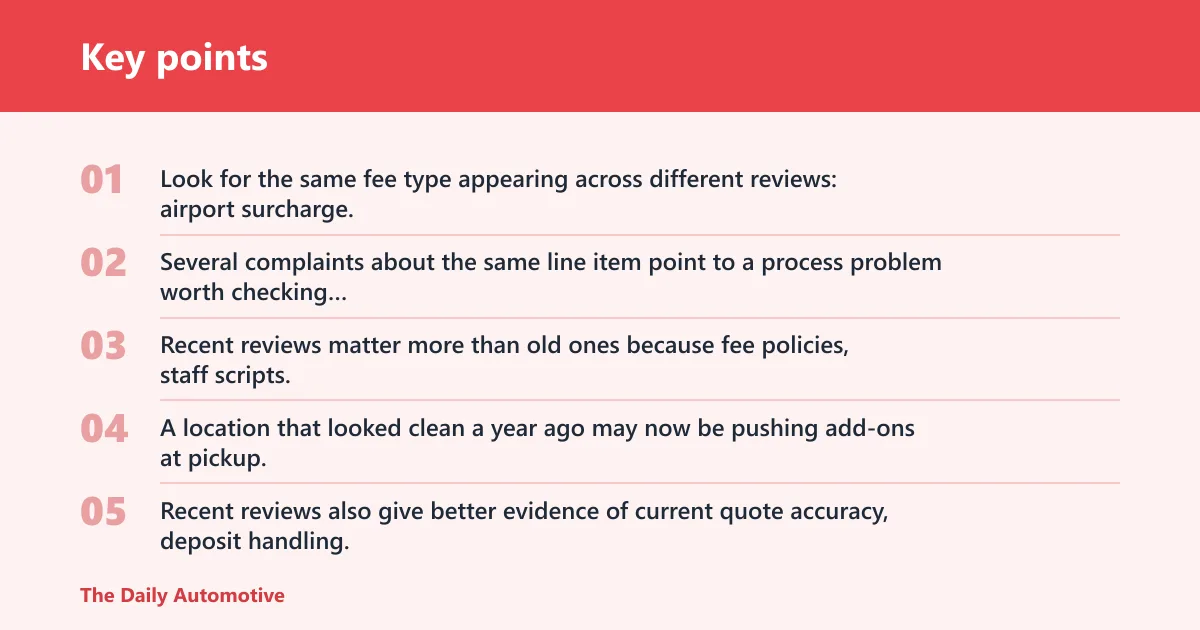
Look for the same fee type appearing across different reviews: airport surcharge, fuel service fee, cleaning fee, young driver surcharge, or an unexpected insurance charge. One complaint can be a one-off dispute. Several complaints about the same line item point to a process problem worth checking before you reserve.
Why recent reviews matter more than overall ratings
Recent reviews matter more than old ones because fee policies, staff scripts, and branch practices can change fast. A location that looked clean a year ago may now be pushing add-ons at pickup. Recent reviews also give better evidence of current quote accuracy, deposit handling, and return-desk behavior.
How to separate one-off frustration from a pattern
Separate emotion from signal. A review that only says “terrible service” is less useful than one that says “the final bill was substantially higher than the quote because of a facility charge and prepaid fuel.” A pattern usually includes the same charge name, the same stage of the rental, and the same surprise on the final invoice.
Suppose five recent reviews mention that the advertised rate was lower than the final bill because of airport taxes and a fuel service fee. That is a pricing pattern, not just a bad mood. A different branch with mostly praise and one vague complaint is a weaker signal.
Car rental reviews as a fee filter
Read reviews as a fee filter by mapping each complaint to a contract line item. The goal is not to judge whether the company is “good” overall. The goal is to learn which charges are likely to appear after you book and which questions you need answered before you pay.
Look for the final bill versus quote
The most useful review language compares the reservation quote with the final bill. Terms like “price doubled,” “extra charges at pickup,” or “more on return than online” often point to mandatory extras, airport surcharges, deposit adjustments, or protection plans. Those are the reviews that tell you whether the rate is really final.
Scan for pickup upsells and add-on pressure
Watch for mentions of being told a reservation was incomplete without CDW, LDW, roadside help, or a higher-class vehicle. CDW is commonly offered at the counter, and LDW is another common protection add-on. Reviews that describe pressure, urgency, or refusal to honor the reservation deserve attention.
Check drop-off disputes and post-return charges
Drop-off complaints often point to fuel disputes, cleaning charges, smoking fees, or damage claims. Cleaning and smoking fees can be charged after return, and they can be large relative to the base rate. Reviews that describe a dispute after keys were returned are especially useful because the problem may not have been visible at pickup.
What to look for in car rental reviews before booking
Focus on recent reviews from similar travelers: same airport, same branch type, same age band, and same rental length. A short rental at an airport branch can attract different fee rules than a weeklong off-airport booking. The most helpful reviews often mention pickup experience, vehicle condition, customer service, and the exact charge name.
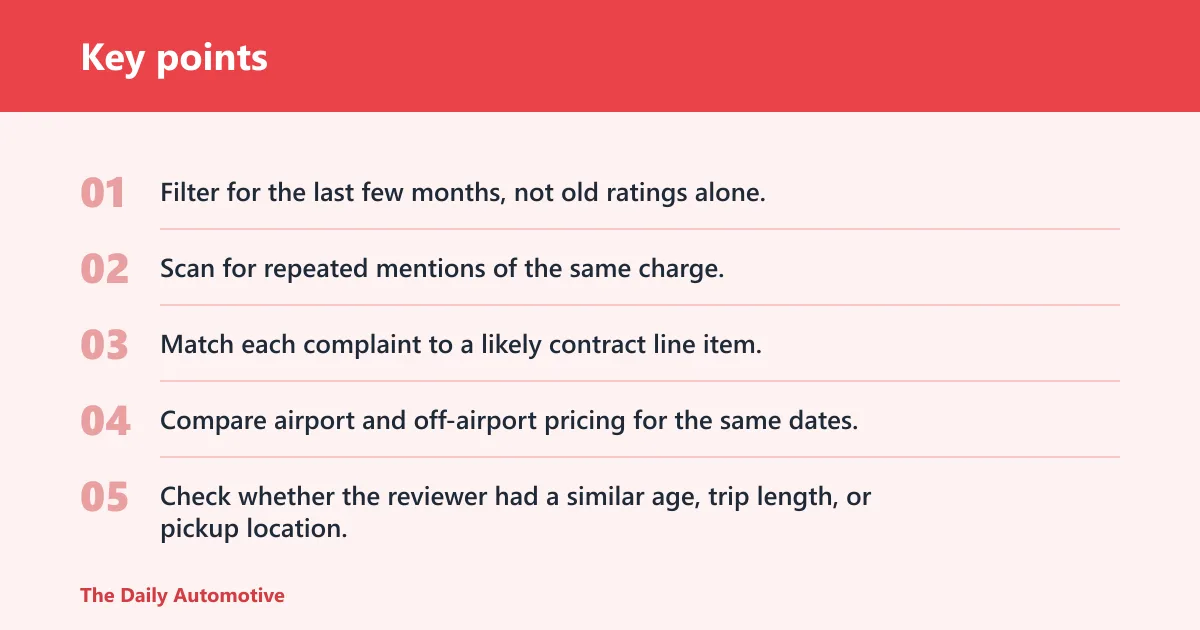
- Filter for the last few months, not old ratings alone.
- Scan for repeated mentions of the same charge.
- Match each complaint to a likely contract line item.
- Compare airport and off-airport pricing for the same dates.
- Check whether the reviewer had a similar age, trip length, or pickup location.
- Ask the company to confirm the fee in writing before you pay.
Which review patterns usually signal extra charges at pickup?
Pickup-time extra charges usually appear as counter upsells, deposit hold complaints, or mandatory add-on language. If several reviews say the agent would not release the car without buying insurance, paying a young driver surcharge, or accepting a higher rate, treat that branch as fee-sensitive and verify the rules first.
Counter upsell language
Reviews that mention “pressure,” “forced,” “required,” or “would not honor the booking” often describe a counter upsell. The likely issue may be CDW, LDW, an extra driver fee, or an upgraded class tied to availability. Ask whether the reservation already includes every mandatory fee for your driver profile.
Deposit hold complaints
Deposit hold complaints do not always mean a hidden fee, but they do matter if the hold is larger than expected or tied to extra products. Some reviewers describe a higher card hold after declining insurance or after booking a lower-cost rate. That can signal strict counter rules, even if the base fare looks good.
Mandatory add-on complaints
When several reviews say an add-on was presented as mandatory, read the complaint carefully. It may be a true fee, such as an age-based surcharge, or it may be a sales tactic around protection coverage. Either way, the contract should state whether the charge is required or optional.
Airport surcharges and location fees
Airport surcharges are a common source of surprise because they can appear as flat daily fees or percentage-based charges. Reviews that compare airport pickup with off-airport pickup are useful because they can show whether the company prices the same class of car differently by location, even before fuel or insurance is added.
Airport concession and facility charges
Airport fees often come from concession recovery fees, facility charges, and other location-based costs. These can be embedded in the total or added after the base rate is shown. When reviews mention “airport tax,” “facility fee,” or “location fee,” check whether the complaint is about the branch itself rather than the car model.
Airport versus off-airport pickup comparisons
Off-airport locations can sometimes be cheaper, but that is not automatic. Reviews should tell you whether the lower headline rate survives taxes, shuttle time, and mandatory extras. Compare like for like: same rental days, similar car class, and the same driver profile.
How reviews describe location-based pricing
Look for reviewers who mention that an airport branch had a much higher final bill than a downtown or off-airport branch. If the same company gets repeated complaints only at airport counters, the fee may be tied to location rules rather than the brand everywhere.
Insurance and protection plans in reviews
Reviews can reveal aggressive insurance selling when multiple renters say the agent pushed CDW or LDW as if it were required. That matters because both are common protection add-ons and can materially increase daily cost. Reviews are most useful when they name the product and describe whether the renter already had other coverage.
CDW and LDW upsell pressure
CDW and LDW often appear in review text as counter pressure, not as optional protections. If reviewers say the agent insisted on one of these before releasing the car, check whether your card benefit or auto policy already applies. Do not assume the sales pitch matches the contract.
Duplicate coverage warnings
Reviews that mention “they tried to sell me coverage I already had” are especially useful. That language suggests duplicate protection pressure, not necessarily a fraud claim. Ask whether your card benefit, travel policy, or auto policy will satisfy the company’s proof-of-coverage rule.
What to confirm with your card or policy provider
Before you book, confirm whether the card or policy covers damage, theft, and deductible exposure, and whether that coverage applies in the country you are visiting. The rental contract can still require proof of coverage, and some companies sell a waiver if you cannot document it on the spot.
Fuel policy and refueling charges
Fuel complaints often point to a full-to-full rule, prepaid fuel, or a refueling fee. Fuel service fees can be charged if the tank is not returned full. Reviews that mention a photo of the fuel gauge, an argument over the level, or a surprise refueling charge are among the most actionable.
Full-to-full versus prepaid fuel
Full-to-full is usually the cleanest rule, but the branch should state it clearly. Prepaid fuel can be convenient, yet it can cost more if you return the car with fuel left in the tank. Reviews often reveal whether the company explains the policy well or uses it as a post-return charge source.
Refueling fee complaints
Reviews that mention “fuel charge,” “refueling fee,” or “returned full but still billed” should be read closely. These complaints can stem from a weak handoff at pickup, a contested gauge reading, or a return-lane dispute. The fee type matters more than the anger in the review.
Why to photograph the fuel gauge
Photograph the fuel gauge at pickup and return, along with the dashboard mileage. That simple record helps if a review pattern suggests fuel disputes. A common first-timer mistake is returning the car quickly and skipping the photo, then losing the proof needed to challenge a refueling fee.
Hidden fee review decoder
This table turns review language into a booking decision. Match the phrase to the likely fee, judge whether the signal is minor or serious, and ask the exact question before you reserve. If the same phrase shows up in several recent reviews, treat it as a contract-check item.
| Review phrase | Likely fee | How serious it is | Exact question to ask |
|---|---|---|---|
| “Final bill was way higher than the quote” | Unexpected charges; taxes, surcharges, or add-ons | High | “Please list every mandatory fee that will appear on the final bill for this booking.” |
| “Airport fee” or “location fee” | Airport surcharge; concession recovery fee; facility charge | Medium to high | “Which airport-related fees are included in this quote, and are any charged separately at pickup?” |
| “They pushed insurance at the counter” | CDW or LDW upsell | High | “Is CDW or LDW optional here, and what proof do you need if I decline it?” |
| “Would not release the car without coverage” | Mandatory protection add-on or proof-of-coverage issue | High | “What coverage is required for this rental, and what documents count as proof?” |
| “Charged for fuel even though I refilled” | Fuel service fee; refueling fee | High | “What fuel level do you require at return, and how do you measure it?” |
| “Young driver fee was not mentioned online” | Young driver surcharge | High | “Is there an under-25 surcharge for my age, and does it change the vehicle class I can book?” |
| “Extra driver cost was added later” | Additional driver fee | Medium | “Is the additional driver fee waived for any membership or card benefit, and can both drivers be added at pickup?” |
| “They billed me after return for smoke or dirt” | Cleaning or smoking fee | Medium to high | “What condition triggers a cleaning or smoking fee, and how is that charge documented?” |
How should you read a company with good ratings but fee complaints?
Good ratings do not cancel fee complaints. If the same charge appears often, recently, and in reviews from similar travelers, treat it as a live risk even when the overall score is high. The score can reflect car availability or service speed while still hiding a pricing problem.
Count how often the fee appears
Count mentions of the exact issue, not just praise or general complaints. Three or more recent mentions of the same fee category is often enough to pause and verify the contract. That rule is not a guarantee, but it is a practical way to separate noise from signal.
Check whether the complaint is recent
A review from years ago may describe a policy that has changed. Recent reviews are more useful because they reflect current counter scripts, current add-on practices, and current final-bill behavior. If the same complaint stopped appearing, the branch may have improved.
Compare the same fee across several sources
Use more than one review source when possible. If airport surcharge complaints, fuel disputes, or insurance pressure show up across multiple platforms, the signal is stronger. If only one site shows the problem and the rest do not, keep digging before you book.
Picture a traveler comparing two similar midsize cars. One company has a higher headline rate but few fee complaints. The cheaper company has several recent reviews about a surprise CDW charge, a fuel service fee, and a cleaning fee after return. The lower price is probably not the lower total.
What should you ask before you reserve?
Ask about mandatory fees, age rules, driver rules, coverage, deductible terms, fuel policy, and return conditions before you book. The best time to ask is after reading review patterns, because the complaints tell you which contract lines need a direct answer. If the reply is vague, keep shopping.
Ask about mandatory fees
Request a full price breakdown that includes taxes, surcharges, and extras. The quote should spell out any airport-related charges, young driver surcharge, additional driver fee, and return-condition fees. If those items are missing, ask for a written quote before paying.
Ask about coverage and deductible terms
Ask whether CDW or LDW is optional, what damage coverage your card or policy already provides, and what deductible or excess applies if you decline the rental-company waiver. The UK guide’s focus on taxes, surcharges, extras, CDW, and excess is useful here because those terms often drive the final total.
Ask about age, driver, and return rules
Confirm any under-25 surcharge, any vehicle-class limits for younger drivers, whether an additional driver is allowed, and the exact fuel and return rules. If the company requires a full tank, ask how they measure it and whether they allow a grace margin. Then save the response.
Frequently asked questions
Does Budget car rental have hidden fees?
Reviews can help you see whether a Budget location reports extra charges, but they cannot prove a universal policy. Read recent complaints for airport surcharges, fuel issues, insurance pressure, or cleaning fees, then confirm those items in the contract before you book. A strong review pattern matters more than a brand name.
How can I tell from reviews if a rental company adds hidden fees?
Look for repeated, recent complaints about the final bill being higher than the quote. The strongest signs are specific charge names, such as airport fee, fuel service fee, CDW, LDW, young driver surcharge, additional driver fee, or cleaning charge. Vague anger is weaker evidence than repeated line-item complaints.
What should I look for in car rental reviews before booking?
Focus on recent reviews that mention pickup, drop-off, vehicle condition, customer service, and exact charges. Reviews from similar travelers are especially useful. Ignore star ratings by themselves and read the text for repeated fee patterns, because a high score can still hide a pricing problem.
How do I spot airport surcharges in car rental reviews?
Look for terms like airport fee, concession recovery fee, facility charge, or location surcharge. Reviews that compare airport pickup with off-airport pickup are especially helpful. Some airport surcharges are flat daily fees, while others are percentage-based, so the exact wording matters.
Can reviews tell me whether a rental company tries to sell unnecessary insurance?
Yes. Reviews often reveal pressure to buy CDW or LDW at the counter, especially when the renter already had other coverage. If several recent reviews say the agent pushed waiver coverage as mandatory, ask your card issuer or insurer what proof you need and confirm the rental company’s rule before pickup.
Products related to this article
Sponsored / affiliate links. As an Amazon Associate I earn from qualifying purchases. I may earn additional commission from eligible campaigns.