Towing Receipt Tracker App Review: Worth It?
Towing Receipt Tracker App is worth it only if it preserves the tow yard name, vehicle ID, release date and time, itemized fees, and exportable proof; otherwise, skip it. Missing those details can stall reimbursement, weaken an insurance claim, or leave you without proof of what you paid. This review checks whether the app keeps towing paperwork claim-ready, including release receipts, cost breakdowns, and evidence you can actually submit.
This guide is part of our Car laws and compliance guide series.
What the app actually stores—and what it misses
It is worth using only as a structured paperwork holder, not as a catch-all receipt vault. The app facts supplied here identify Receipt Scanner: AI Tracker as the product name, list iPhone only compatibility, and state an AI-powered receipt scanning feature plus a 1-year subscription price of $39.99/year. That helps if your main job is getting a tow receipt into one place after a rough pickup.
It fits poorly if you need verified tools for claim workflows, because the supplied facts do not confirm exports, sync, offline use, or custom towing fields. For towing paperwork, the real question is not whether the app can store a receipt. It is whether it can preserve the details that prove the vehicle was yours, where it was held, and what you paid for release.
Bottom-line verdict
Use it if your towing paperwork usually ends up split across photos, paper slips, and messages, and you need one place for the tow yard name, fee record, and release evidence. Skip it if you need a verified claims system with confirmed export formats, cross-device sync, or detailed field control that the listing text does not actually prove.
What the app actually
The verifiable product name in the supplied facts is Receipt Scanner: AI Tracker. The platform detail provided is narrow: iPhone only. The price stated in the supplied facts is $39.99/year for a 1-year subscription. No developer name is included in the provided facts, so that detail should be checked in the App Store listing before payment.
What the listing text supports
- AI-powered receipt scanning: supported by the supplied facts.
- Pricing: supported at $39.99/year for a 1-year subscription.
- Platform: supported as iPhone only.
- Developer, exports, sync, offline mode: not established by the supplied facts.
That matters because towing paperwork is more than a restaurant receipt. A tow slip may need a tow reference ID, VIN or tag number, release time, yard location, payment method, and proof-of-ownership record. If the app cannot reliably store those fields, the scan is only the first step.
Pros and cons
Pros
- Supports AI-powered receipt scanning, which can cut down on manual filing for paper slips.
- Has a stated 1-year subscription price, so the cost is easy to check up front.
- May work as a compact place to keep tow-related documents together on an iPhone.
Cons
- The supplied facts do not confirm towing-specific fields such as tow reference ID, VIN, plate, or yard location.
- The supplied facts do not confirm exports, sync, or offline access.
- It is iPhone only, so Android users are out.
- No developer name is provided in the supplied facts, which makes verification harder than it should be.
Who it’s for
This app suits drivers who need a quick way to keep tow bills, impound receipts, and release paperwork in one phone app after a vehicle pickup. It is a better fit for insured drivers, rideshare drivers, apartment towing disputes, and fleet or rental paperwork than for users who need a full claims archive with verified export tools.
It is a poor fit for Android users, for anyone who needs desktop access, and for anyone who wants a guaranteed claims workflow from an app listing that does not confirm those functions. Say your car is held at a yard overnight and you pay one release charge plus a separate storage fee. You need both charges recorded separately, not collapsed into a single photo of the receipt.
Towing receipt logging checklist
For towing paperwork, a receipt tracker works best when each record captures the same release-critical fields every time. Baltimore City’s tracking system accepts VIN, license plate/tag number, and tow reference ID, so those identifiers should be part of your log even if the app can only store them in a note field.
| Date/time | Tow yard | Tow reference ID | VIN/plate | Fee type | Amount | Payment method | Required ID shown | Ownership document used | Claim status |
|---|---|---|---|---|---|---|---|---|---|
| 2026-10-14 8:15 a.m. | Fallsway Tow Yard | BT-10427 | VIN + MD tag | Release fee | $165.00 | Debit card | Driver’s license | Current vehicle registration card | Ready to submit |
| 2026-10-14 8:40 a.m. | Fallsway Tow Yard | BT-10427 | VIN + MD tag | Storage fee | $40.00 | Cash | Passport | Vehicle title | Waiting for insurer review |
| 2026-10-15 9:05 a.m. | Pulaski Highway Tow Yard | BT-22190 | Plate only | Administrative fee | $25.00 | Credit card | State-issued identification card | Registration receipt | Disputed |
A common first-timer mistake is logging only the total. That hides separate charges. Tow, storage, after-hours release, and administrative fees can each matter in a reimbursement dispute, and each one should have its own line in the app or in a companion spreadsheet if the app field set is too thin.
What to log from a tow slip
For towing reimbursement or an insurance claim, the slip should be treated like evidence, not just a bill. Log the tow reference ID, the VIN or plate, the yard name, the date and time of pickup or release, each fee type, the exact amount, and the payment method. If the slip is unreadable or the yard gave no itemization, note that gap immediately.
Tow reference ID, VIN, and plate
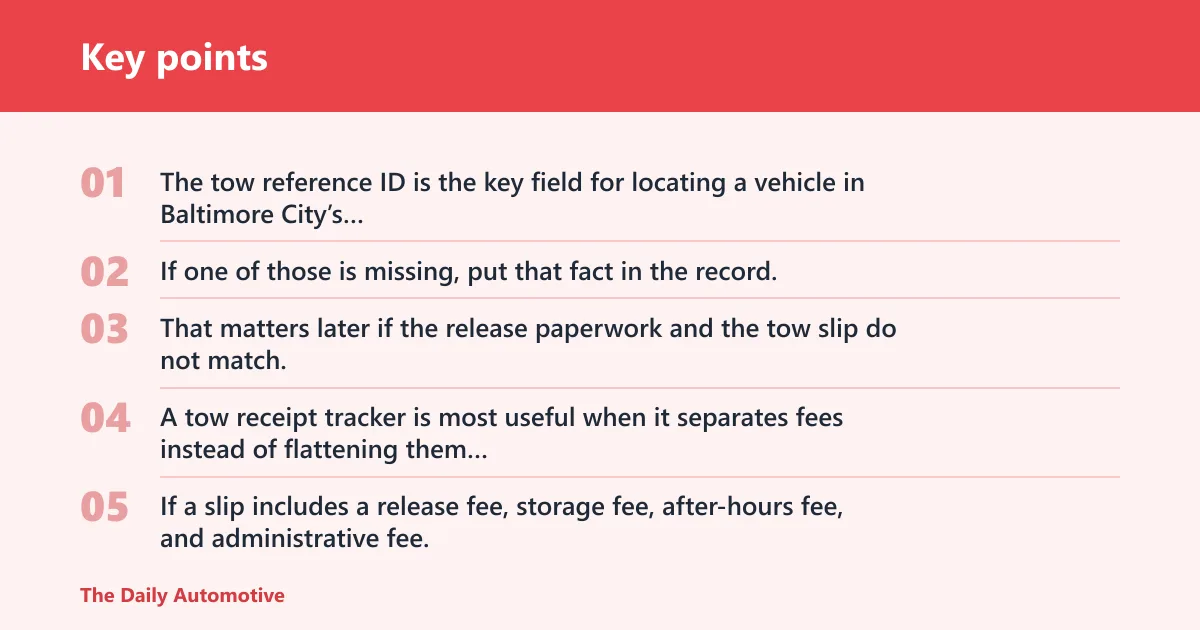
The tow reference ID is the key field for locating a vehicle in Baltimore City’s tracking system, and it should be paired with the VIN and license plate/tag number. If one of those is missing, put that fact in the record. That matters later if the release paperwork and the tow slip do not match.
Fee breakdown and payment method
A tow receipt tracker is most useful when it separates fees instead of flattening them into one number. If a slip includes a release fee, storage fee, after-hours fee, and administrative fee, list each one. Then record whether you paid by cash, debit card, or credit card so you can match the bank record to the paper trail.
Claim-ready notes and missing fields
If the receipt lacks itemization, note that directly. If the VIN is unreadable, write that down too. If the tow yard gave a release paper but no detailed slip, store both together. A receipt app is only as useful as the completeness of the record you put into it.
What you need before pickup
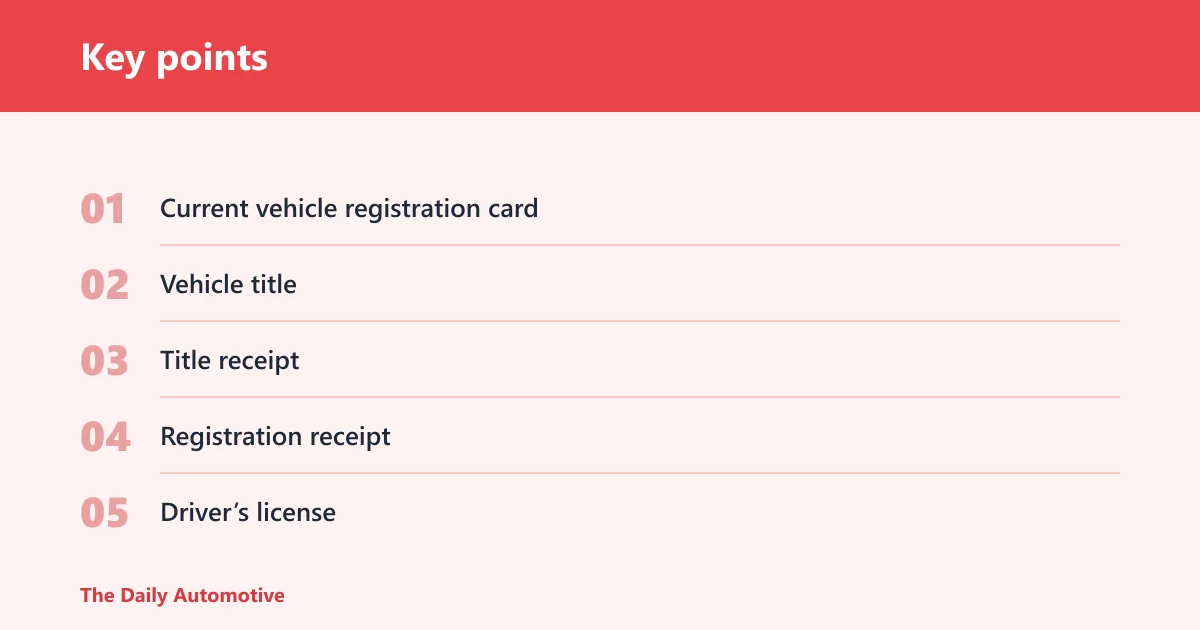
Before you go to the yard, verify the ownership and ID rules first. Baltimore City says proof of ownership can include a current vehicle registration card, a vehicle title, a title receipt, or a registration receipt. The registered owner’s name must appear on the title or registration. If you do not have a current driver’s license, two alternate identification forms are required.
Ownership documents accepted for release
- Current vehicle registration card
- Vehicle title
- Title receipt
- Registration receipt
Accepted ID and backup ID rules
- Driver’s license
- State-issued identification card
- Passport
- Two alternate IDs if there is no current driver’s license
Those details matter because a useful app should store the paperwork chain, not only the bill. If you photograph your title receipt and ID next to the tow slip, the app becomes a reference file for the release, the payment, and the later claim. If it cannot keep those together cleanly, a folder of labeled photos may work better.
Tow-yard hours and holiday closures
For Baltimore City retrieval, the yard details are specific. Pulaski Highway Tow Yard is at 6700 Pulaski Highway, Baltimore, MD 21237. Its retrieval hours run from 6:00 a.m. to 10:00 p.m., and it is closed for vehicle retrieval on City, State, and Federal holidays. Fallsway Tow Yard is at 410 Fallsway, Baltimore, MD 21202, and it operates 24 hours a day, 7 days a week, except for City, State, and Federal holidays. (Baltimorecity)
Suppose your car is at Pulaski Highway Tow Yard and you arrive after 10:00 p.m. The app can still hold the receipt and ownership documents, but it cannot change the retrieval window. In that case, the app is useful for documentation, while the yard schedule decides whether you can actually complete pickup that night.
Does it beat a notes app?

It beats a plain notes app only if the scan is reliable enough to preserve the fields you need later. A notes app can capture a photo of the slip, but it does not organize totals, dates, yard names, IDs, and claim notes as cleanly if the app’s receipt tools are better. If the listing text does not prove export or custom fields, that advantage may be smaller than it sounds.
When a receipt tracker is enough
Use the app when the tow was simple, the slip is readable, and you mainly need one place to keep the bill, release receipt, and a few notes about ownership and pickup time. It is also reasonable for a single-vehicle reimbursement claim where the paperwork is straightforward and the insurer only needs a clean copy of the bill.
When a spreadsheet or scanner is better
Use a spreadsheet if you need to track multiple vehicles, multiple fees, or repeated tows across a month. Use a scanner or PDF folder if the slip must be shared with an insurer, employer, landlord, or fleet manager in a fixed file format. If the app does not confirm exports, that is a strong reason to keep a separate file system.
When to keep a separate claim folder
Keep a claim folder when the tow is disputed, when the receipt is missing line-item detail, or when you need to match the tow slip to photos, messages, and proof of ownership. A folder can hold the release receipt, title or registration document, ID copy, yard photos, and any written dispute notes in one place.
How to organize towing receipts by vehicle, date, and yard location
Start by naming each file or record with the vehicle identifier, the date, and the yard. That makes it easier to separate one tow from another. If the app does not support folders or tags that are confirmed by the listing, use a consistent naming system in the receipt title or the note field.
- Record the tow reference ID first.
- Add VIN and license plate/tag number.
- Enter tow yard name and address.
- Log the release date and time.
- Split each charge into its own line.
- Attach the matching ID and ownership document notes.
- Mark the claim as submitted, pending, or disputed.
That order matters because Baltimore City’s tracking system uses the VIN, plate/tag number, and tow reference ID to locate a towed vehicle. If you log those at the top of the record, the file stays useful even if the receipt photo is blurry or the slip gets folded.
Frequently asked questions
Is Towing Receipt Tracker App worth it for storing tow bills and impound receipts?
Yes, but only as a storage and organization tool if you need to keep tow bills, release slips, and claim notes together. The supplied facts verify AI-powered receipt scanning, iPhone-only support, and $39.99/year pricing, but they do not confirm towing-specific fields or exports. That limits how far you should trust it.
Can I use a receipt tracker app for towing reimbursements and insurance claims?
Yes, if the app lets you keep the tow yard name, tow reference ID, vehicle ID, fee breakdown, and payment method in one place. If the listing does not prove export or sync, keep a backup folder of photos and PDFs so the claim does not depend on one phone.
What details should a towing receipt tracker capture from a tow slip?
At minimum: date and time, tow yard name, tow reference ID, VIN or plate, each fee type, amount, payment method, required ID shown, ownership document used, and claim status. For Baltimore City towing, the tow reference ID, VIN, and license plate/tag number are especially important for location and release tracking.
Does the app work better than a notes app or receipt scanner for towing paperwork?
It is better than a notes app only if it keeps scanned receipts organized enough to support a claim. It is weaker than a dedicated scanner or PDF folder if you need fixed file exports, desktop access, or a broad document archive. If the listing does not prove those features, do not assume them.
What if I need the tow yard address, release hours, and ownership documents too?
Store them with the receipt, not separately. Keep the ownership document note in the same record.
What should I do before visiting a tow yard with my documents?
Check the yard’s hours, confirm which ownership document you have, and bring the required ID. Baltimore City accepts a current vehicle registration card, vehicle title, title receipt, or registration receipt, and if you do not have a current driver’s license, two alternate IDs are required. Put those details in the app before you leave.
Products related to this article
Sponsored / affiliate links. As an Amazon Associate I earn from qualifying purchases. I may earn additional commission from eligible campaigns.