Best Car Scratch Remover for Deep Scratches (2026): 4 Top Picks
Meguiar’s M105 Ultra-Cut Compound removes genuinely deep scratches that basic swirl removers can’t touch — but only if your fingernail doesn’t catch on primer or bare metal first. Using the wrong product on the wrong scratch wastes hours of buffing and risks burning through the clear coat. This guide covers the fingernail test, four tested scratch removers from $8.88 to $21.97, and the right way to apply each one.
Insert your Affiliate Disclosure reusable block here.
Quick Answer
Run your fingernail across the scratch: if it glides smoothly, Carfidant’s kit or Meguiar’s Ultimate Compound will buff it out by hand. If your nail catches, step up to Meguiar’s M105 with a polisher. If you see bare metal or primer, no compound will fix it — you need touch-up paint or a body shop.
Will a Scratch Remover Even Work? Test Your Scratch First
The fingernail test tells you which paint layer a scratch has reached before you buy anything. Drag your fingernail firmly along the scratch. If your nail slides over it smoothly, the damage is in the clear coat only — the cheapest and easiest layer to fix. If your nail catches or snags, the scratch has broken through into the colored base coat. If you can see gray, white, or bare metal at the bottom of the groove, it’s reached the primer or the metal itself, and no compound sold as a “scratch remover” will fix it — see our full deep scratch depth guide for wet-sanding and body-shop options.
| Fingernail Test Result | What It Means | Best Fix |
|---|---|---|
| Nail glides smoothly | Clear coat only | Carfidant kit or Meguiar’s Ultimate Compound |
| Nail catches slightly | Into the base coat (color layer) | Meguiar’s M105 with a polisher |
| Nail catches hard / gray or bare metal visible | Primer or metal exposed | Color-matched touch-up paint, or a body shop |
Matching the product to the damage matters more than picking the “strongest” one. A light filler won’t touch a deep gouge, and an aggressive compound is overkill — and riskier — on a surface scratch. For a broader DIY walkthrough covering every scratch type, our complete scratch-repair guide is a good companion to the product picks below.
1. Carfidant Scratch and Swirl Remover Kit — Best for Light-to-Moderate Scratches
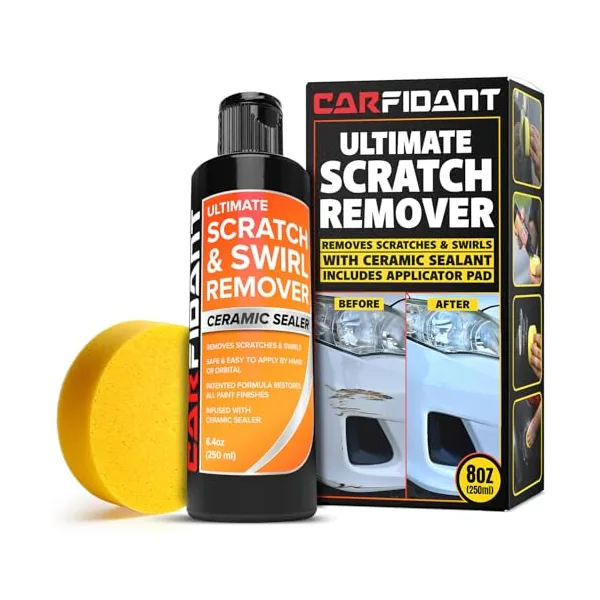
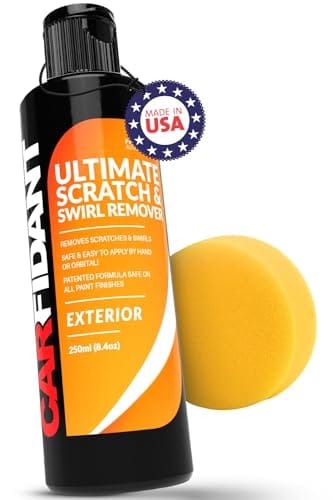
The Carfidant Scratch and Swirl Remover Kit pairs a polishing compound with a foam buffer pad, so the whole process — apply, buff, wipe — stays simple enough for a first-timer. It’s built for clear-coat-level damage: scratches your fingernail glides over, plus swirl marks and light oxidation. It works on any paint color since it’s a clear compound rather than a color match.
Pros
- Includes a buffer pad, so no separate tool purchase is needed
- Works on any paint color — not a color-match product
- Effective on light-to-moderate scratches and swirl marks
- Simple enough for hand application by a first-time user
Cons
- Won’t touch a scratch that catches your fingernail — that’s base-coat or deeper damage
- Deeper clear-coat scratches may need 2–3 passes, not one
2. Color-Match Touch-Up Paint Pen — Best for Chips and Gouges Into Primer
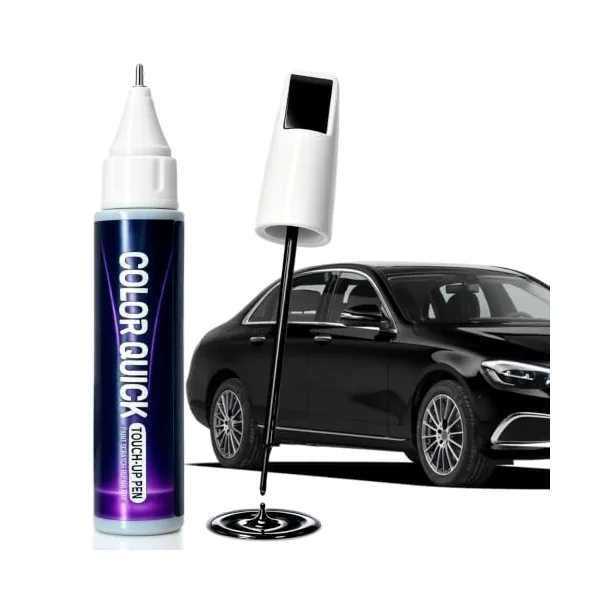
Once a scratch fails the fingernail test — meaning it’s cut into the base coat or exposed primer — no compound will fill the groove back in. A touch-up pen does, because it deposits actual paint rather than polishing the surrounding clear coat. This 2-in-1 pen ships with a fine tip for pinpoint chips and a brush head for longer scratches, and cures to a waterproof, UV-resistant finish.
Pros
- Fills gouges compounds can’t — the only real fix once primer or metal is exposed
- Two applicators in one pen (fine tip + brush) for different scratch widths
- Seals the exposed metal against rust while you wait for a full repair
- Cheapest option in this guide
Cons
- Color match is close, not perfect — always test on a hidden spot (door jamb) first
- Cosmetic fix only for larger gouges; won’t restore structural clear coat
3. Meguiar’s Ultimate Compound — Best All-Around Pro-Grade Pick
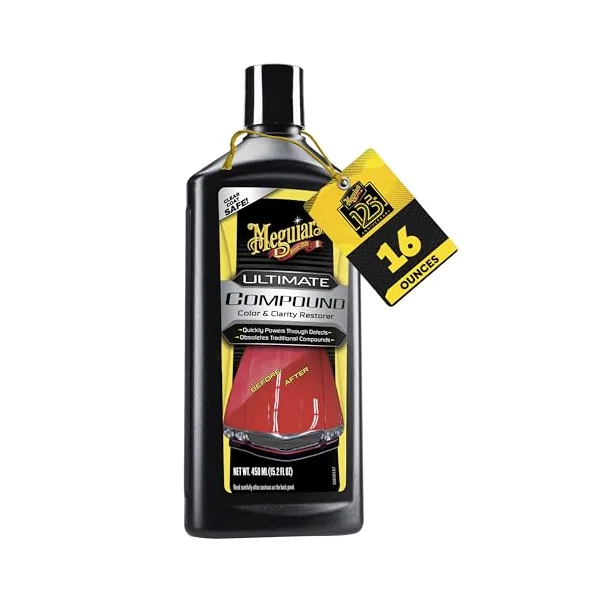
Meguiar’s Ultimate Compound sits between the Carfidant kit and the M105 below: stronger than a basic swirl remover, but still safe to apply by hand. It’s clear-coat and single-stage-paint safe, removes water spots and light oxidation along with scratches, and comes in a 15.2 oz bottle — enough for several full-panel jobs rather than one spot fix.
Pros
- Works by hand or with a DA polisher — no machine required
- Restores gloss and clarity, not just scratch removal
- Safe on both single-stage and clear-coat finishes
- Large bottle covers multiple jobs
Cons
- Takes real effort to work in and buff out by hand
- Not aggressive enough for scratches that catch your fingernail — that’s what M105 below is for
“Unlike traditional compounds that can leave behind fine scratches and haze, Meguiar’s cutting compounds work quickly to remove below-surface defects and restore color and clarity without scratching or swirling.”
4. Meguiar’s M105 Ultra-Cut Compound — Best for Truly Deep Scratches
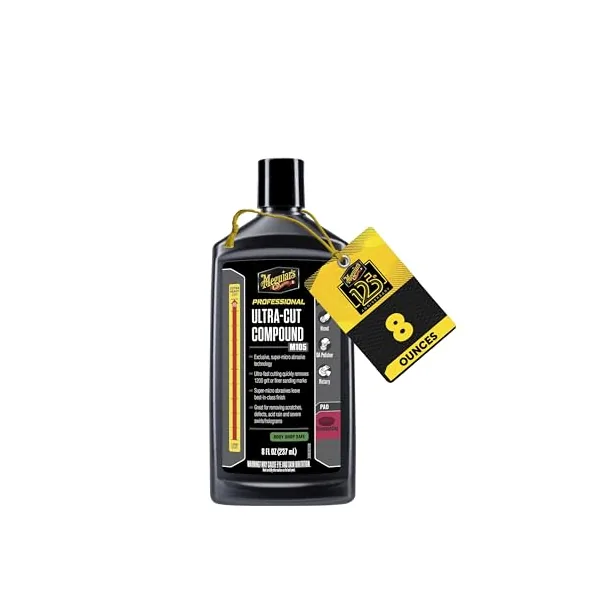
This is the one product in this guide actually built for the scratches your fingernail catches on. M105 is Meguiar’s professional-grade compound, formulated for a rotary or dual-action (DA) polisher rather than hand application. Its micro-abrasive technology cuts fast enough to remove up to 1,200-grit sanding marks, which is why body shops use it after wet-sanding out a deep scratch rather than a consumer-grade product.
📊 M105’s micro-abrasive formula removes 1,200-grit sanding marks or finer — Source: Meguiar’s official M105 product page
Pros
- Strongest cutting power of any product in this guide
- Removes moderate-to-heavy defects: deep scratches, oxidation, acid rain etching
- Body-shop safe on all glossy finishes and clear coats
Cons
- Slow and less effective by hand — really needs a rotary or DA polisher
- More aggressive cut means higher burn-through risk on edges and body lines if you’re inexperienced
- Overkill for light swirls — use the Carfidant kit or Ultimate Compound instead
How These 4 Scratch Removers Compare
| Product | Price | Application | Best For |
|---|---|---|---|
| Carfidant Scratch & Swirl Kit | $21.97 | By hand, included pad | Light-to-moderate scratches & swirls |
| Touch-Up Paint Pen | $8.88 | Fine tip / brush | Chips & gouges into primer |
| Meguiar’s Ultimate Compound | $13.97 | By hand or DA polisher | All-around moderate defects, gloss restore |
| Meguiar’s M105 Ultra-Cut | $15.11 | Rotary or DA polisher (machine) | Truly deep scratches, heavy oxidation |
How to Apply a Car Scratch-Removing Compound
The application steps are nearly identical across all three compounds above — only the tool changes (hand pad vs. polisher). For a full paint-correction walkthrough with more detail on machine technique, see our step-by-step cut-and-buff guide.
- Wash and clay the panel: Remove dirt and embedded contaminants first so you’re not grinding grit into the paint while buffing.
- Run the fingernail test: Confirm the scratch is clear-coat or base-coat depth before applying a compound — primer-deep damage needs touch-up paint instead.
- Apply a dime-sized amount: Spread the compound onto the pad and work one 2×2 ft section at a time, not the whole panel at once.
- Work in overlapping passes: By hand in straight lines, or with a DA/rotary polisher on low-medium speed, until the compound turns clear and hazy.
- Wipe off residue and inspect in sunlight: Check the scratch under direct light and repeat a second pass on any spot that’s still visible.
Common Mistakes When Removing Car Scratches
- Skipping the wash-and-clay step — buffing over dirt grinds grit into the paint and creates new micro-scratches while you’re trying to remove one.
- Matching the wrong product to the damage depth — a light compound won’t touch a scratch that reaches primer, and M105 is overkill (and riskier) on a surface swirl.
- Using a rotary polisher without practice — high-speed rotary tools can burn through clear coat at edges and body lines; beginners should stick to hand application or a DA polisher.
- Skipping the spot test on touch-up paint — always test color match on a hidden area, like inside the door jamb, before applying it to a visible panel.
- Buffing in direct sun or on a hot panel — the compound dries too fast to work with, making it harder to see progress and easier to over-apply.
Frequently Asked Questions
What Is The Best Car Scratch Remover For Deep Scratches?
For scratches your fingernail catches on, Meguiar’s M105 Ultra-Cut Compound is the best pick — it’s a professional-grade compound built for a rotary or DA polisher and removes up to 1,200-grit sanding marks. For lighter clear-coat scratches, Carfidant’s Scratch and Swirl Remover Kit is easier to use by hand.
How Does Carfidant Scratch Remover Work?
Carfidant Scratch Remover uses a polishing compound to level out clear-coat scratches and swirls. It comes with a buffer pad for easy hand application and restores your car’s paint without needing a color match.
Can Black Touch-Up Paint Fix Deep Car Scratches?
Touch-up paint fills scratches that have cut through to the base coat or primer — damage a compound can’t buff out. It provides a close color match, but it’s a cosmetic fix, not a structural repair, and works best on smaller chips and gouges.
Is Meguiar’s Ultimate Compound Good For Scratches?
Yes, for light-to-moderate scratches and swirls — it removes defects, adds gloss and shine, and works on both single-stage and clear-coat finishes. For genuinely deep scratches that catch your fingernail, Meguiar’s M105 has stronger cutting power.
How To Use A Polishing Compound For Car Scratches?
Wash and clay the panel first, then apply a dime-sized amount of compound to a buffer pad. Work it into the scratch in overlapping passes — by hand or with a polisher — until the compound turns clear, then wipe off the residue and inspect in direct sunlight.
How Do I Know If A Scratch Is Too Deep For A Scratch Remover?
Drag your fingernail across the scratch. If it catches or you can see gray primer or bare metal underneath, no compound will fix it — you’ll need color-matched touch-up paint for shallow gouges or a body shop for anything deeper. Compounds only work on clear-coat and base-coat-level damage.
What’s The Difference Between Meguiar’s Ultimate Compound And M105?
Ultimate Compound is a hand-safe, all-around product for light-to-moderate scratches and swirls. M105 is Meguiar’s professional-grade compound built for a rotary or DA polisher, with stronger cutting power that removes up to 1,200-grit sanding marks — the better choice for genuinely deep scratches.
Conclusion
Start with the fingernail test, not the product page. If your nail glides smoothly, Carfidant’s kit or Meguiar’s Ultimate Compound will buff the scratch out by hand. If it catches, Meguiar’s M105 with a polisher has the cutting power to actually fix it. And if you can see primer or bare metal, skip the compounds entirely and go straight to a color-matched touch-up paint pen — or, for anything beyond a pen, our paint restoration guide.
Whichever product you pick, wash and clay the panel first and test on a hidden spot before working on a visible one. That single habit prevents most of the mistakes that turn a 20-minute fix into a repaint. For the full detailing routine this fits into, see our car detailing service guide.
Products related to this article
Sponsored / affiliate links. As an Amazon Associate I earn from qualifying purchases. I may earn additional commission from eligible campaigns.