Best Car Vacuums for a Spotless Vehicle (2026): We Compared
Choose the Dyson V11 Origin if you want one vacuum for car and home cleanup, especially when pet hair, seat debris, and floor mats show up in the same job. It is the stronger all-around cordless option here, but buyers who only need a car vacuum should still consider a simpler 12V unit.
Top pick and quick verdict
For car-only use, the right choice changes with the mess. Corded 12V models win when you need steady suction for longer sessions, while cordless handhelds work better when you want to grab crumbs fast and clean away from the vehicle.
Quick comparison
| Product | Badge | Best for | Price | ||
|---|---|---|---|---|---|
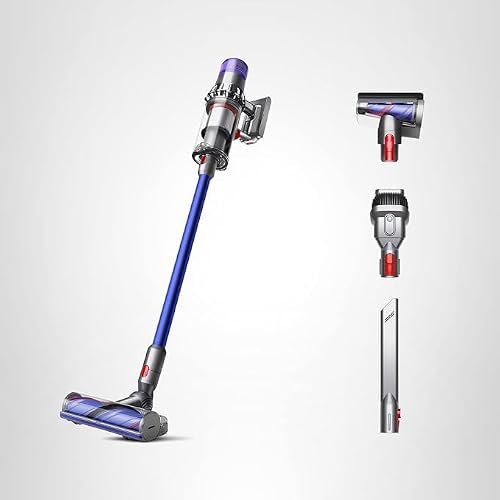 |
Dyson V11 Origin Cordless Vacuum, 185AW, 3 Power Modes, UpDyson | Our pick | Dyson V11 · 185AW · Cordless | $587.31
Price as of 25 Oct 2026
|
View |
 |
Hoover ONEPWR WindTunnel Emerge Cordless Stick Vacuum, SelfHoover | Budget pick | Hoover ONEPWR · Self-Standing · Cordless | $199.99
Price as of 25 Oct 2026
|
View |
Use the table that follows as a buying filter, not a spec sheet to memorize. Match vehicle size, debris type, and cleaning frequency to the vacuum class that avoids the most common failure mode.
The most common mistake is buying on suction alone. That can leave you with a weak battery, a tiny bin, or a nozzle that clogs the first time you hit sand or pet hair.
How we chose
The ranking favors the vacuum class that fails least often for the job at hand. Suction source, runtime, reach, and cleanup friction mattered more than marketing language.
We weighed four things: power source and runtime, attachments and reach, maintenance and long-term cost, and whether the tool fits dry debris only or needs wet-dry capability.
We also leaned on published roundup results and product specs. That matters because the best pick for a compact sedan is rarely the best pick for a three-row SUV.
Dyson V11 Origin: best for mixed home and car use
Based on the manufacturer’s specs and published buyer feedback, the Dyson V11 Origin fits readers who want one cordless vacuum that can move from the garage to the cabin without swapping tools. Its stronger all-purpose setup makes sense for pet hair, floor mats, and larger cleanup jobs.
The drawback is simple: it is not a purpose-built car vacuum, so it can be more machine than some drivers need. It is also a cordless design, which means battery management matters more than it does on a 12V plug-in model.
Car and Driver’s tested roundup named the Fanttik Slim V10 APEX the best overall pick, while also calling Dyson Car+Boat the most powerful model. That matters here because it shows how much buyers should separate raw power from fit-for-task design.
Hoover ONEPWR WindTunnel Emerge: best for lighter cordless cleaning
Based on the published product details, the Hoover ONEPWR WindTunnel Emerge makes sense for drivers who want a lighter cordless vacuum for quick cabin cleanup, light pet hair, and routine dusting. Its self-standing design also helps if storage space is tight.
The tradeoff is that a lighter cordless stick tends to be less focused on car-specific reach than a dedicated handheld with a crevice tool or pivoting nozzle. For deep detailing, that can mean more passes around seat rails, console edges, and footwells.
This is a better fit for readers who want one vacuum that can handle the car and still serve as a general household cleaner. If your only goal is seat seams and floor mats, a dedicated handheld or 12V car vacuum is usually the better tool.
Which one should you buy?
If you need one vacuum for both the driveway and the house, start with the Dyson V11 Origin. If you want a lighter cordless cleaner for quick touch-ups and modest debris, the Hoover ONEPWR WindTunnel Emerge is the simpler pick. If your car work is frequent and focused, a 12V plug-in car vacuum still makes more sense than either one.
For pet hair, choose the model or attachment set with a motorized brush. For crumbs in seat seams, prioritize a crevice tool and a narrow nozzle. For SUVs and vans, runtime and bin capacity matter more than headline suction because the job is longer and the cleanup cycle repeats.
Say your SUV carries two kids, a dog, and a week of trail dust. A cordless handheld can work for the first ten minutes, then turn into a battery-management exercise. A corded 12V vacuum avoids that fade and keeps suction stable through the whole cabin.
Car vacuum decision matrix
Use this matrix to match the vacuum class to the vehicle, the mess, and how often you clean. It is the fastest way to avoid buying the wrong tool for a job that is either too small, too long, or too wet for the machine.
| Vehicle and cleaning pattern | Mess type | Recommended vacuum class | Power source | Expected runtime | Best attachments | Wet/dry limitation | Ownership pain points |
|---|---|---|---|---|---|---|---|
| Compact car, quick weekly cleanup | Crumbs, dust, light grit | Cordless handheld | Rechargeable lithium-ion battery | About 10 to 20 minutes is common | Crevice tool, small brush, pivoting nozzle | Usually dry debris only | Battery aging, small bin, filter clogging on fine dust |
| Sedan, routine family use | Seat seams, sand, pet hair | Corded 12V car vacuum | Vehicle accessory outlet | Consistent power while plugged in | Crevice tool, motorized brush, narrow nozzle | Best for dry debris only | Cord management, outlet access, frequent bin emptying |
| SUV, monthly deep clean | Sand, tracked dirt, pet hair | Corded 12V or stronger cordless with brush | 12V outlet or battery | Long sessions favor corded power | Motorized brush, crevice tool, pivoting head | Dry debris only unless rated wet-dry | Clogged filters, larger debris jamming narrow nozzles |
| Van, heavy family or work use | Mixed dirt, pet hair, wrappers, sand | Shop vac or corded vacuum class | Wall power or high-capacity plug-in tool | No battery limit on corded units | Wide nozzle, crevice tool, brush | Dry-only is common; check wet-dry rating separately | Storage, hose drag, larger footprint |
| Any vehicle after spills | Liquid spills, mud, wet food | Wet-dry shop vac, not a typical car vacuum | Wall power usually | No battery concern | Crevice tool, squeegee-style wet pickup tools | Wet-dry capability required | Bulk, cleaning the tank, more storage space |
Quick comparison
Powders, crumbs, and pet hair do not ask for the same tool. The right class depends on whether you need steady suction, fast grab-and-go cleanup, or enough reach to cover a bigger cabin without stopping.
Corded 12V car vacuum: best for steady power
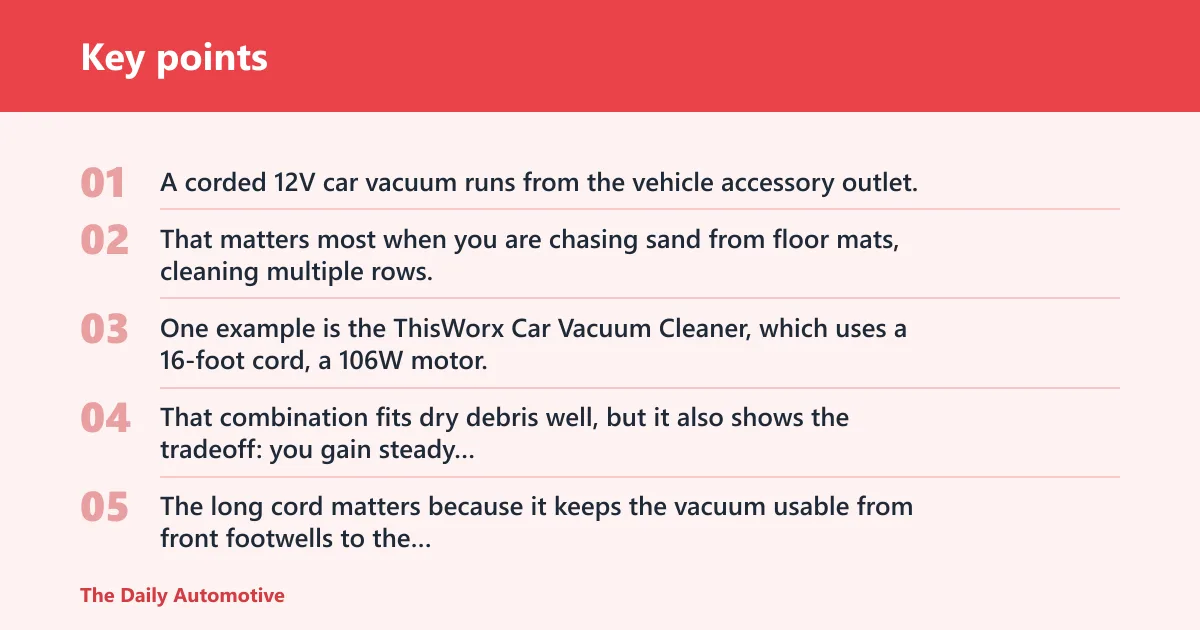
A corded 12V car vacuum runs from the vehicle accessory outlet, so it avoids battery fade during long cleaning sessions. That matters most when you are chasing sand from floor mats, cleaning multiple rows, or working through a sedan, SUV, or van in one pass.
One example is the ThisWorx Car Vacuum Cleaner, which uses a 16-foot cord, a 106W motor, and is described as dry vacuum only. That combination fits dry debris well, but it also shows the tradeoff: you gain steady power, not wet-spill cleanup.
Best use cases in sedans and daily drivers
The long cord matters because it keeps the vacuum usable from front footwells to the trunk without stopping to recharge. For a sedan with routine crumbs, that often beats a cordless unit that fades after a short burst on high power.
For daily drivers, corded 12V models are especially useful when the mess is spread out. Seat seams, under-seat debris, and door pockets all clean better when suction does not weaken halfway through the job.
Limits on wet spills and bulky debris
Most 12V car vacuums are dry-debris tools, and that is where many buyers go wrong. If a model is not explicitly rated wet-dry, assume it is not the right answer for spilled drinks, damp food, or slushy mess.
Large debris can also clog a narrow nozzle or fill a small bin quickly. That creates a different failure mode: the vacuum still runs, but it spends more time choking on the mess than removing it.
Cordless handheld vacuum: best for quick cleanups
Cordless handheld car vacuums use rechargeable lithium-ion batteries, and typical runtime lands around 10 to 20 minutes. That is enough for quick crumbs, light dust, and spot cleaning, but high mode shortens that window fast.
Car and Driver noted that the Fanttik V10 battery ran just under 14 and a half minutes on high, and that it gets clogged quickly. That is a clear example of why runtime and clogging matter together, not separately. (Caranddriver)
Where portability wins
Portability matters when you clean outside the vehicle, in a parking lot, or in a driveway without chasing an outlet. A cordless unit can move from the back seat to the cargo area without a cord wrapping around seat rails.
That freedom is useful for small cars and quick touch-ups. It is less useful when you need to clean a three-row SUV from front to back, because the battery may force a pause before the job is finished.
What battery aging changes over time
Battery life drops as batteries age. That means a cordless vacuum that starts with a useful 10 to 20 minute window can become a shorter-session tool later, especially if you often use the high setting.
Replacement filters and batteries also add long-term cost. A washable filter can reduce maintenance expense, but only if suction does not fall off because the filter is clogged or neglected.
What attachments matter most for car detailing?
The attachment that matters most depends on the mess. For seat seams and vents, a crevice tool is the baseline. For pet hair, a motorized brush matters more. For under-seat work, a nozzle or pivoting head usually solves the reach problem better than raw suction alone.
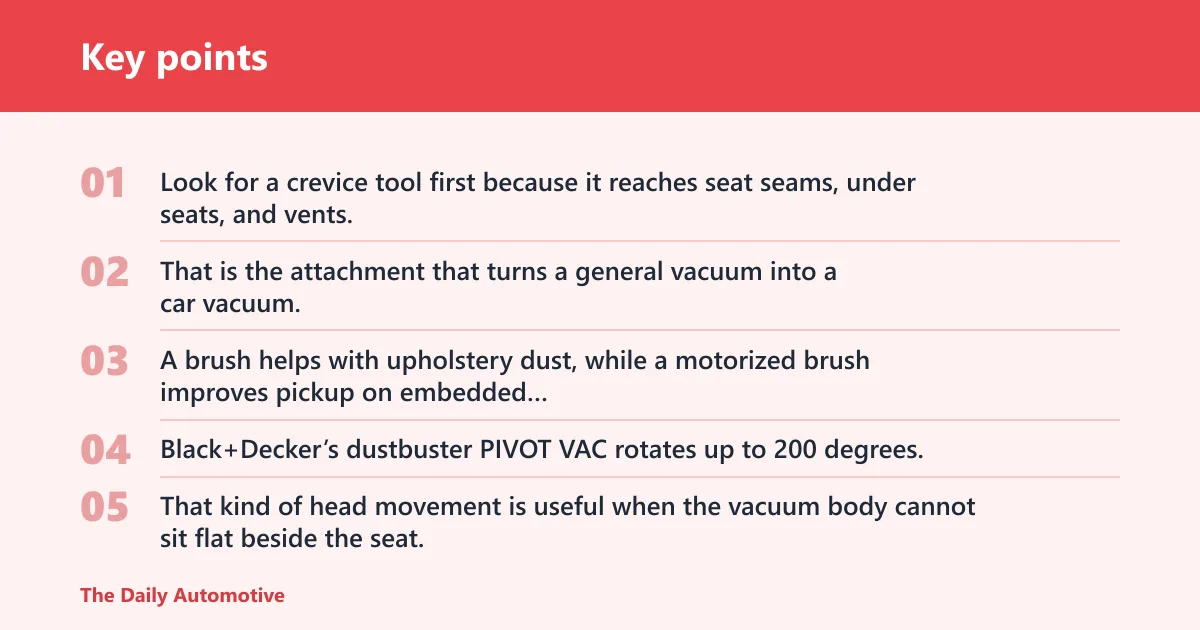
Look for a crevice tool first because it reaches seat seams, under seats, and vents. That is the attachment that turns a general vacuum into a car vacuum. A brush helps with upholstery dust, while a motorized brush improves pickup on embedded pet hair.
Black+Decker’s dustbuster PIVOT VAC rotates up to 200 degrees, which is the kind of articulation that helps in footwells and tight console angles. That kind of head movement is useful when the vacuum body cannot sit flat beside the seat.
Crevice tool
Use this for seat seams, under seats, and vents. It is the most important attachment for crumbs and grit because narrow spaces trap debris that a wide nozzle leaves behind.
Motorized brush attachment
This matters most for pet hair and embedded debris on upholstery. A motorized brush lifts fibers better than suction alone, which is why it is the attachment to look for when cloth seats hold onto hair.
HEPA and washable filters
HEPA filters help capture fine dust, while washable filters can lower long-term maintenance cost. The tradeoff is that filter clogging reduces suction, so cleaning the filter is part of the job, not an afterthought.
Dustbin capacity and emptying friction
Small bins need frequent emptying, and that slows longer detailing sessions. Larger bins are better when you are doing a full SUV or van because they reduce stop-start cleanup friction and lower the odds of losing suction to overfilling.
Which car vacuum is easiest to empty and clean? Usually the one with a larger bin, simple latch, and washable filter. Fewer parts to disassemble means less mess on your hands and less time spent shaking debris loose.
How much suction do I need in a car vacuum?
You need enough suction to move the debris you actually have, not the highest number on the box. Fine dust is easier than sand, and crumbs are easier than pet hair packed into upholstery. Higher suction can help, but it often brings more weight and bulk.
Suction is often marketed in pascals or motor watts, but those numbers do not tell the full story by themselves. A narrow nozzle, a clogged filter, or a full bin can make a strong motor feel weak in real use.
For seat seams and mats, suction plus nozzle shape matters more than raw output alone. For pet hair, suction should be paired with a motorized brush. For larger SUVs, runtime and bin size start to matter as much as suction.
Are cordless car vacuums better than 12V plug-in models?
Neither class is better in every case. Cordless handhelds are better for speed, portability, and short cleanups, while 12V plug-in models are better when you want steady suction through a longer session or need to clean a larger vehicle without battery fade.
Pick cordless if you clean light crumbs often, move between vehicles, or want a vacuum that is easy to grab. Pick 12V if you detail a sedan, SUV, or van more thoroughly and do not want runtime to decide when you stop.
How long should a car vacuum battery last?
A practical cordless car vacuum should run about 10 to 20 minutes per charge, with less time on high power. That range is enough for fast touch-ups, but not ideal for deep-cleaning a large SUV or van unless you can recharge and resume.
Battery age changes that calculation. As cells wear, runtime drops, and a unit that once handled the whole cabin may start requiring a second charge before the job is done.
Which car vacuum works best for crumbs in seat seams?
A crevice tool is the key feature for crumbs in seat seams. A narrow nozzle reaches the split between cushions better than a wide floor head, and a pivoting head helps when the seam is tucked under a bolstered seat or console edge.
If crumbs are dry and the cabin is small, a cordless handheld is often enough. If the crumbs are mixed with sand or pet hair, a corded 12V model has the steadier suction needed to keep the nozzle from losing pull as the bin fills.
What is the best car vacuum for pet hair?

For pet hair, choose the vacuum with a motorized brush and enough suction to lift fibers from upholstery. That combination matters more than a high headline number because hair sticks to cloth, mats, and seams in a way loose dirt does not.
Among the products here, the Dyson V11 Origin is the stronger all-around choice for mixed pet hair and household use. In car-specific buying, models that pair a brush attachment with steady suction usually outperform bare-bones handhelds.
Do car vacuums work on wet spills?
Only if the model is explicitly rated wet-dry. Most car vacuums are dry-debris tools, and using them on wet spills risks clogging, mess inside the bin, or simple failure to pick up liquid at all.
For spilled drinks, damp food, or mud, a wet-dry shop vac is usually the right tool. A standard car vacuum should be treated as a dry-only cleaner unless the manufacturer says otherwise.
Frequently asked questions
Which car vacuum is easiest to empty and clean?
The easiest vacuum to empty usually has a larger dustbin, a simple latch, and a washable filter. Small bins demand frequent dumping, which slows longer detailing sessions and can leave dust on the filter if the design is awkward.
What car vacuum works best for crumbs in seat seams?
A corded 12V or cordless handheld with a crevice tool is the best fit. The narrow attachment gets into the seam, and a pivoting head helps reach the angle under the seat. If the crumbs are mixed with sand, steady suction becomes more important.
Products related to this article
Sponsored / affiliate links. As an Amazon Associate I earn from qualifying purchases. I may earn additional commission from eligible campaigns.