Cooper Discoverer Tire Review for Light Trucks
Cooper Discoverer tires can be a smart buy for light trucks, but only if you match the sub-model to the job. Road+Trail AT and Stronghold AT suit most daily drivers and towing setups. Rugged Trek adds more bite. STT TEK3 and ST/C belong on trucks that see rougher terrain, and the older S/T needs a live size check before you plan around it.
What the Cooper Discoverer line does for trucks

The Discoverer name covers a family, not one tire. Cooper splits the line by use case: everyday all-terrain options, more aggressive mud-terrain choices, and a rocky-road ST/C variant built around cut and chip resistance.
That matters on a light truck. A half-ton used for commuting and weekend hauling needs different tread behavior than a truck that spends time on gravel, washboard roads, or muddy trail access. Pick the wrong Discoverer, and the tradeoff usually shows up as noise, shorter wear, or a load mismatch.
What light-truck buyers should check before picking a size or load range
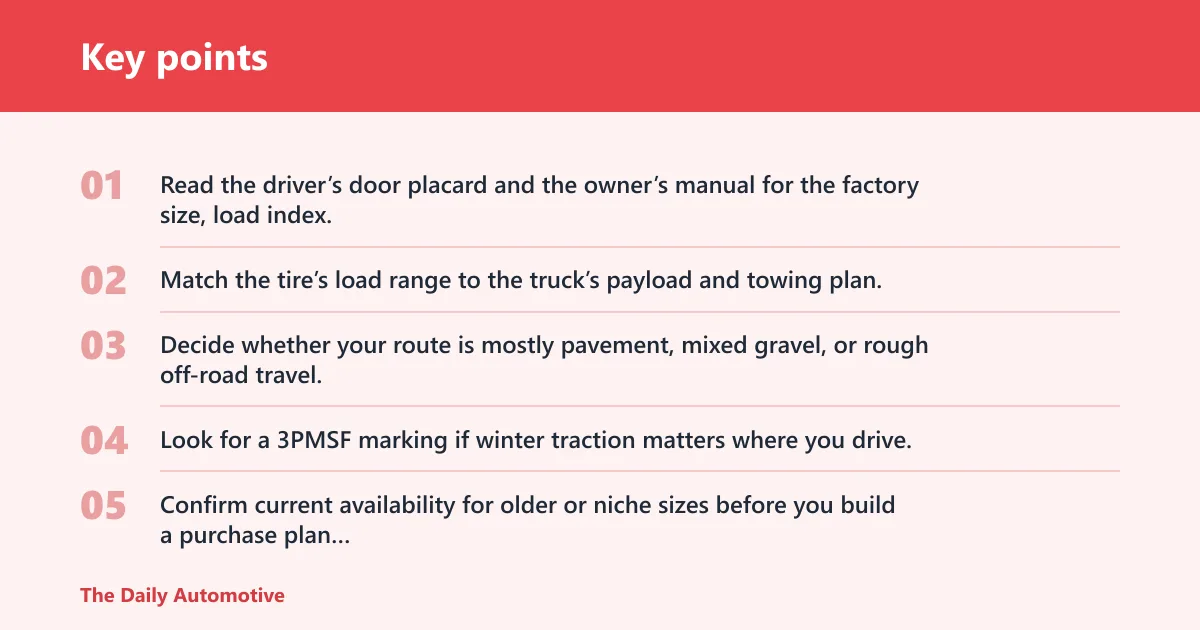
- Read the driver’s door placard and the owner’s manual for the factory size, load index, and speed rating.
- Match the tire’s load range to the truck’s payload and towing plan; never exceed the vehicle ratings in the manual.
- Decide whether your route is mostly pavement, mixed gravel, or rough off-road travel.
- Look for a 3PMSF marking if winter traction matters where you drive.
- Confirm current availability for older or niche sizes before you build a purchase plan around them.
Say your Silverado spends 90% of the week on highway commuting and only sees a graded driveway on weekends. A quieter all-terrain Discoverer usually makes more sense than a mud tire, because tread aggression adds noise and can trim paved-road comfort.
Cooper Discoverer light-truck fitment matrix
| Model | Use case | Road mix | Noise expectation | Winter confidence | Off-road bias | Owner priority | Avoid this if… |
|---|---|---|---|---|---|---|---|
| Road+Trail AT | Everyday driving, light adventure, truck/SUV use | Mostly pavement with regular gravel or dirt access | Moderate | Good if you want a 3PMSF-rated all-terrain in the lineup | Light to moderate | You want a balanced daily tire with a 65,000-mile warranty | You want the most aggressive mud or rock bite |
| Stronghold AT | Truck and light-duty hauling with all-terrain use | Pavement plus work-site or back-road travel | Moderate | Good if the 3PMSF designation matters in your region | Moderate | You want durability cues and a 60,000-mile warranty | You prioritize the longest tread life over trail grip |
| Rugged Trek | Truck/SUV all-season use with extra tread presence | Mostly pavement with a clear off-road lean | Moderate to higher than road-focused A/Ts | Good if you want 3PMSF support in an all-season format | Moderate to high | You want 60,000-mile warranty coverage and more visual tread depth | You want the quietest highway tire in the family |
| S/T | Older all-terrain pattern for street, sand, rock, mud, trail, and snow | Mixed use with more off-road emphasis than a highway tire | Moderate to high | Depends on the exact listing; check current specs | Moderate to high | You want a broad-utility all-terrain and can verify current availability | You need a current, easy-to-find size or a quiet daily driver |
| STT TEK3 | Mud-terrain use for trucks that need maximum bite | Trail, mud, and rough terrain with limited pavement emphasis | High | Lower than the more road-biased all-terrains | High | You want self-cleaning channels and a 3-ply carcass/sidewall design | You drive mostly highway or want the quietest ride |
| ST/C | Coarse rocky-road and terrain use | Rough roads, rock, and cut-prone surfaces | Moderate to high | Depends on the exact size and application; confirm listing details | High on rocky terrain | You want cut, chip, and lug tear resistance focus | You spend most of your time on smooth pavement |
Which Discoverer fits your driving mix?
For highway-first use, Road+Trail AT is the cleanest starting point because it is built around everyday driving and still leaves room for light weekend travel. Stronghold AT is the better call when truck durability and load-minded use matter more than a softer ride.
For mixed use, Rugged Trek gives you a stronger off-road look and 3PMSF support without jumping straight to a mud tire. If your routes include gravel, campground access, or muddy shoulders, it is easier to live with than a full mud-terrain and more capable than a pure pavement tire.
Picture a Tacoma that hauls tools during the week and tows a small trailer twice a month. Road+Trail AT fits that pattern better than STT TEK3, because the mud tire’s traction bias is usually wasted on mostly paved miles.
Quick picks for common truck use
Best for highway driving: Road+Trail AT. It is the most straightforward pick for daily pavement use with a 65,000-mile warranty.
Best for wet roads and gravel: Stronghold AT if the truck is carrying work or towing weight; Rugged Trek if you want more off-road bias with all-season labeling.
Best for real mud and rough trails: STT TEK3. It is the family’s mud-terrain answer, not a compromise on pavement.
Pros and cons
Strengths
- Clear split between daily-driving A/T options and more aggressive off-road choices.
- Multiple 3PMSF-equipped options for buyers who need winter traction in the lineup.
- Warranty coverage reaches 70,000 miles on some Discoverer models, with 65,000-, 60,000-, 55,000-, and 45,000-mile coverage elsewhere in the family.
- Specialized models exist for rocky terrain, mud, and mixed truck/SUV duty instead of forcing one tread to do everything.
Tradeoffs
- The more aggressive the tread, the more likely you are to pay in road noise and pavement manners.
- Older models like the S/T need a current size check before you build a purchase around them.
- The STT TEK3 and ST/C are too terrain-focused for drivers who mostly want a quiet commuter tire.
- Warranty length and winter marking vary by model, so you cannot assume one Discoverer choice covers every need.
Cooper Discoverer road+Trail AT, Stronghold AT, and Rugged Trek
These three are the most useful starting point for many light-truck owners. Road+Trail AT is the daily-driver choice, Stronghold AT is the load-minded all-terrain, and Rugged Trek is the more aggressive all-season option with truck and SUV fitment.
Road+Trail AT
Road+Trail AT carries a 65,000-mile warranty and is positioned for everyday driving with adventure use layered in. If your truck lives on pavement but still sees dirt roads, campsite access, or winter weather, this is the easiest Discoverer to justify.
Stronghold AT
Stronghold AT comes with a 60,000-mile warranty and 3PMSF status. It is the best fit here for truck and light-duty owners who want all-terrain behavior with a stronger durability story than a softer road-first tire.
Rugged Trek
Rugged Trek also carries a 60,000-mile warranty and 3PMSF status, with truck/SUV fitment. It leans harder toward a rougher look and more off-pavement intent, so it makes sense when you want more bite without moving into mud-terrain territory.
Cooper Discoverer S/T, STT TEK3, and ST/C
These are the more specialized Discoverer choices. The S/T is the older all-terrain-style option, STT TEK3 is the mud-terrain choice, and ST/C is the rocky-road specialist. They are not interchangeable, and that distinction matters on a light truck.
S/T
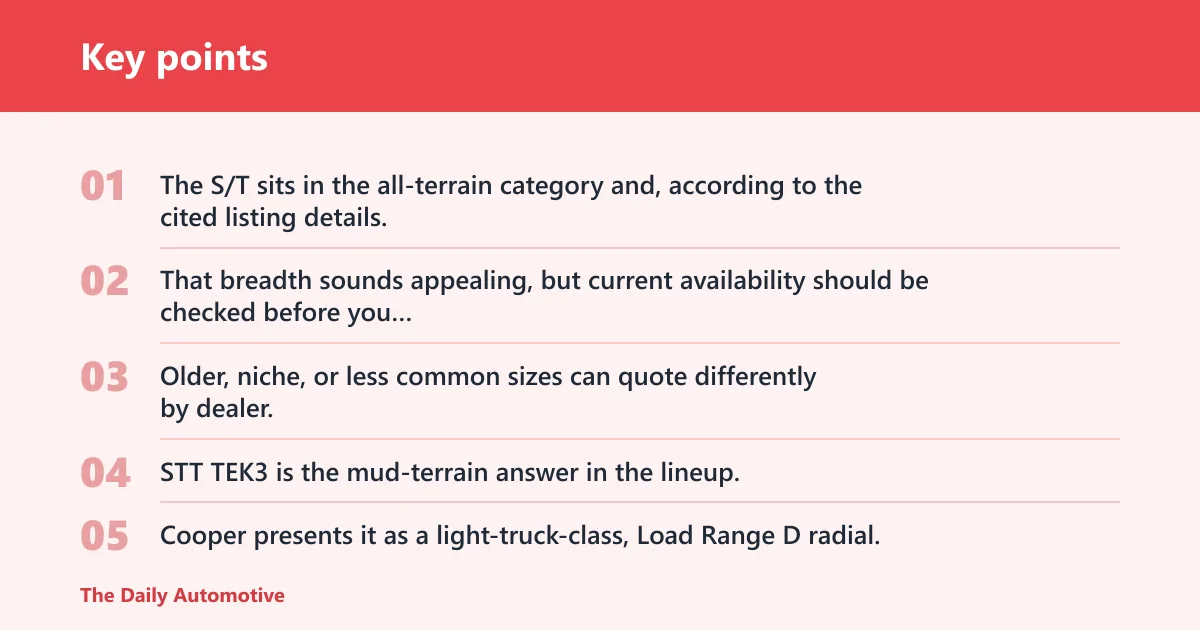
The S/T sits in the all-terrain category and, according to the cited listing details, is rated across street, sand, rock, mud, trail, and snow. That breadth sounds appealing, but current availability should be checked before you plan around it, because an older model can be harder to source in the exact size you need.
Price context matters here too. Older, niche, or less common sizes can quote differently by dealer, so compare it against newer Discoverer options before you assume it is the value pick.
STT TEK3
STT TEK3 is the mud-terrain answer in the lineup. Cooper presents it as a light-truck-class, Load Range D radial, with sizes up to about 37 inches and a 3-ply carcass and sidewall construction. The tread uses siped lugs and self-cleaning channels, which tells you exactly where it is aimed: mud, loose soil, and rough trail work.
If your truck sees wet pasture roads, deep ruts, and occasional rock, STT TEK3 makes sense. If it spends most of its life on pavement, the tradeoff is usually too steep.
ST/C
ST/C is the rocky-road specialist. Cooper targets it at coarse rocky-road and terrain use, claims up to 90% improvement in cut, chip, and lug tear resistance, and uses a nylon overlay for tread pattern strength and belt separation protection.
That makes it a better fit than the S/T when the main threat is sharp stone and repeated abrasion. It is not the first choice for a driver who mainly wants highway quiet.
How long do Cooper Discoverer tires last on light trucks?
Life expectancy depends on the model, load, rotation habits, alignment, and how much off-road abuse the tread sees.
That is not a promise of actual mileage. It is a warranty framework, and the real result depends on the truck’s load, the alignment, and whether the tire is used within its intended road mix.
Cost and warranty value in plain terms
The cheapest tire up front is not always the better purchase. A longer warranty can lower replacement-mile economics if the tread design fits your route, while a more aggressive tire may wear faster on pavement even if it looks stronger on the truck.
A common first-timer mistake is buying a mud-terrain for a daily-driver truck because the tread looks right for one trail trip a month. The owner then gets more road noise and usually gives up tread life for capability that goes unused.
Who the Cooper Discoverer family
The Discoverer line makes the most sense for light-truck owners who split time between pavement and light off-road work. Think highway commuting, gravel roads, snow, job-site access, towing, and the occasional muddy pull-in.
It is less compelling if your truck is mostly a city commuter and you want the quietest ride possible. It is also the wrong family to force into severe mud or hard rock crawling unless you choose the more specialized STT TEK3 or ST/C for the actual terrain.
How to choose in practice
- Start with your road mix: highway, mixed, or off-road-heavy.
- Match the Discoverer family member to that use, not to the marketing name alone.
- Check 3PMSF status if winter traction matters.
- Confirm size availability and load range for your exact truck.
- Compare warranty length against the miles you expect to rack up before replacement.
Are Cooper Discoverer tires noisy on a truck?
Noise depends on which Discoverer you choose. Road+Trail AT and Stronghold AT stay more pavement-friendly than STT TEK3, and the STT is generally the kind of tire that trades quiet for terrain bite. The more open and aggressive the tread, the more likely you are to hear it.
If your truck is a daily driver, noise should be part of the buying decision, not an afterthought. A tire can be good off-road and still be the wrong choice for a 40-mile commute.
Frequently asked questions
Is the Cooper Discoverer good for light trucks?
Yes, if you choose the right variant for the job. The Discoverer family includes all-terrain, mud-terrain, and rocky-road options for truck and SUV use, so the fit depends on road mix, load need, and winter requirements rather than the brand name alone.
Which Cooper Discoverer tire is best for highway driving?
Road+Trail AT is the cleanest highway-first pick in this group because it is built around everyday driving and still leaves room for adventure use. Stronghold AT is the better choice when the truck needs more load-minded durability and a 3PMSF all-terrain setup.
What is the difference between the Cooper Discoverer S/T and STT?
The S/T is the broader all-terrain style option and has been rated across street, sand, rock, mud, trail, and snow. STT TEK3 is the mud-terrain choice, with Load Range D radial construction, up to 37-inch sizes, and a more aggressive tread for mud and rough terrain.
Which Cooper Discoverer tire is best for wet roads and gravel?
Stronghold AT is the safest all-terrain starting point when wet roads and gravel are both part of the plan, especially if truck duty and light towing matter. Rugged Trek is a reasonable second option when you want more off-road lean but still need all-season behavior.
Is the Cooper Discoverer ST/C better than the ST?
It is better for a different job. ST/C is aimed at coarse rocky-road use and claims up to 90% improvement in cut, chip, and lug tear resistance, with a nylon overlay for added tread and belt protection. The S/T is the broader mixed-use all-terrain option, so “better” depends on terrain.
What size Cooper Discoverer tires are available for trucks?
Availability varies by model and size. The STT TEK3 is offered up to 37 inches, while other Discoverer variants come in different truck and SUV fitments. Check the manufacturer’s listing for your model and confirm the size, load range, and current stock before ordering.
Cooper’s warranty and rebate context
Cooper’s Discoverer lineup spans multiple tread families and warranty lengths, which makes the warranty part of the buying decision.
That is useful when you compare cost per mile, but only if the tire fits your route. Cooper also offers a dealer fitment flow, and the brand’s rebate ecosystem includes the Goodyear Credit Card with up to $240 back in qualifying offers. Check the current dealer listing for the exact tire, size, and rebate terms before you buy.
If you want the shortest answer: choose Road+Trail AT for daily use, Stronghold AT for a tougher light-truck all-terrain setup, Rugged Trek when you want more off-road lean, STT TEK3 for mud, and ST/C for coarse rocky terrain. The older S/T can still work, but only after you verify current availability and size fit first.
Products related to this article
Sponsored / affiliate links. As an Amazon Associate I earn from qualifying purchases. I may earn additional commission from eligible campaigns.