Best Coolant Flush Products: Rust Removers, Cleaners & Kits Compared
Not every coolant flush job is the same problem. A car overdue for routine maintenance needs a gentle, non-acidic cleaner; a car with visible rust or oil in the coolant needs something stronger. Using the wrong one either wastes money or is genuinely ineffective on heavy contamination. This guide compares six current products across both use cases, cross-referencing manufacturer data against aggregated buyer feedback — not in-house lab testing. Our top picks: the Prestone AS105 for routine maintenance flushes, and the Irontite Thoro-Flush if you’re dealing with visible rust or scale.
Quick Answer
For routine maintenance, a non-acidic cleaner like Prestone AS105 is the safest, most widely compatible choice. If your coolant looks rusty or the system has visible scale, a stronger rust-specific product like Irontite Thoro-Flush or CRC Thermocure will actually dissolve what a mild cleaner can’t touch. Match the product’s strength to the actual problem — using a strong cleaner for routine maintenance is unnecessary risk, and using a mild one on heavy rust won’t work.
Quick Picks
- Best Overall (Routine Maintenance): Prestone AS105 — non-toxic, non-acidic, safe for all cooling system metals.
- Best for Rust and Scale: Irontite Thoro-Flush — dissolves rust, scale, oil, and sludge.
- Best All-in-One Budget Option: BlueDevil 3-in-1 — combines degreaser and flush in one bottle.
- Best Companion Tool: EPAuto Spill-Proof Funnel Kit — keeps the refill step mess-free.
How These Products Are Grouped
Rather than ranking six products on one scale, we grouped them by the actual problem they solve, since the right coolant flush product depends entirely on whether your system just needs routine refreshing or has real rust and scale to dissolve. The six categories below cover the situations a car owner is most likely to run into:
- Best Overall (Routine Maintenance): Prestone AS105
- Best for Rust and Scale: Irontite Thoro-Flush
- Best for Rust (Alternative): CRC Thermocure
- Best All-in-One Budget Option: BlueDevil 3-in-1
- Best Companion Tool: EPAuto Spill-Proof Funnel Kit
- Best Diagnostic Tool: Orion Motor Tech Pressure Tester
Comparison Table: All 6 Picks at a Glance
| Award | Product | Best For | Typical Price | Verdict |
|---|---|---|---|---|
| Best Overall | Prestone AS105 | Routine maintenance | $12-$15 | Non-acidic, safe for all metals |
| Best for Rust | Irontite Thoro-Flush | Visible rust/scale | $18-$25 | Dissolves what mild cleaners can’t |
| Best for Rust (Alt.) | CRC Thermocure | Rust removal, no fumes | $20-$24 | Milder application, still effective |
| Best All-in-One | BlueDevil 3-in-1 | Oil + rust + flush combined | $10-$14 | Budget pick that covers multiple issues |
| Best Companion Tool | EPAuto Funnel Kit | Mess-free refilling | $18-$22 | Prevents air pockets and spills |
| Best Diagnostic Tool | Orion Motor Tech Pressure Tester | Confirming leaks post-flush | $30-$40 | Verifies the system holds pressure |
Prices fluctuate by retailer — treat these as ballpark ranges.
Full Reviews: 6 Coolant Flush Products Worth Buying
Best Overall (Routine Maintenance): Prestone AS105
Best Overall • Approx. $12-$15
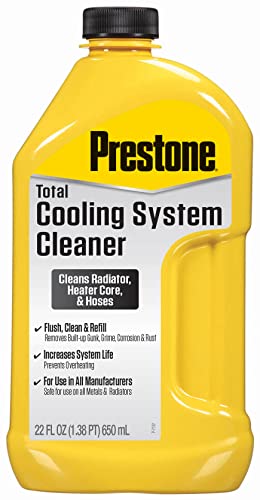
Prestone AS105 Total Cooling System Cleaner
| Formula | 2-in-1, non-toxic, non-acidic |
| Size | 22 oz |
| Best For | Routine maintenance |
| Metal Safety | All cooling system metals |
- Safe for all cooling system metals (aluminum, copper, cast iron)
- Non-acidic so it won’t damage seals or gaskets over time
- Widely available and inexpensive
- Designed for light-to-moderate deposits — won’t cut through heavy rust or scale
This is the right call for a car on a normal maintenance schedule (every 30,000-100,000 miles per most manufacturers) where the coolant just needs refreshing, not a rust-removal project. See our step-by-step coolant flush guide for the full DIY process this product fits into.
Best for Rust and Scale: Irontite Thoro-Flush
Best for Rust • Approx. $18-$25
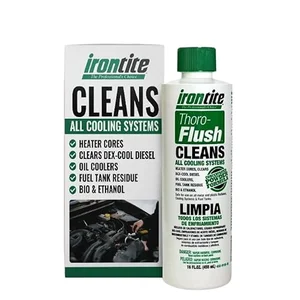
Irontite Thoro-Flush Coolant System Cleaner
| Formula | Rust/scale/oil/sludge remover |
| Size | Standard bottle |
| Best For | Heavy contamination |
| Track Record | Long-standing enthusiast/diesel use |
- Specifically formulated for heavy contamination — visible rust, scale, or oil intrusion
- Long-standing product with a real track record in enthusiast and diesel-truck communities
- Stronger chemistry means it’s overkill for a system that just needs routine refreshing
Visibly rusty or discolored coolant is the clearest sign you need a rust-specific flush product, not a mild maintenance cleaner.
Best for Rust (Alternative): CRC Thermocure
Best for Rust (Alt.) • Approx. $20-$24
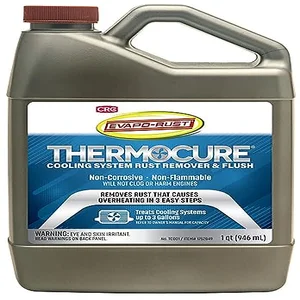
CRC Thermocure Coolant System Rust Remover
| Formula | Non-fume rust remover |
| Size | 32 oz |
| Best For | Rust removal in enclosed garages |
| Note | Similar use case to Irontite |
- Marketed around being non-toxic and low-fume compared to some competing rust removers
- Effective at restoring flow blocked by rust and mineral buildup
- Similar core use case to the Irontite pick above — choose based on price and availability
Matters most if you’re working in an enclosed garage where fumes are more of a concern.
Best All-in-One Budget Option: BlueDevil 3-in-1
Best Budget All-in-One • Approx. $10-$14
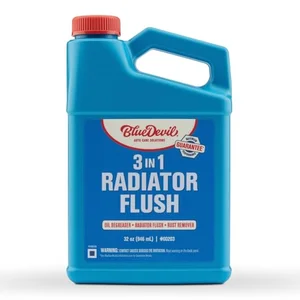
BlueDevil 3-in-1 Radiator Flush
| Formula | Degreaser + radiator flush combined |
| Size | Standard bottle |
| Best For | Suspected oil + rust/scale contamination |
| Price Tier | Budget |
- Blends a radiator flush with an oil degreaser — useful if you suspect both rust/scale and oil contamination
- Budget-friendly, covers two problems with one product
- A combined formula won’t out-perform a dedicated single-purpose rust remover on severe cases
A common combination after a head gasket issue, where both oil contamination and rust/scale are present.
Best Companion Tool: EPAuto Spill-Proof Funnel Kit
Best Companion Tool • Approx. $18-$22
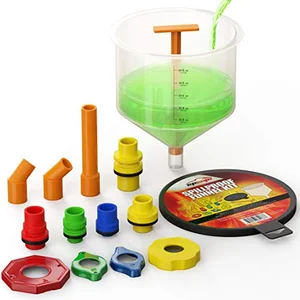
EPAuto Spill Proof Radiator Coolant Filling Funnel Kit
| Purpose | Mess-free, air-pocket-free refilling |
| Compatibility | Universal fitment kit |
| Best For | Any coolant refill after a flush |
| Type | Accessory, not a cleaning product |
- Solves a real problem the flush products themselves don’t — air pockets trapped during refill
- One of the most common reasons a fresh coolant flush still runs hot afterward
- An accessory, not a cleaning product — you’ll still need one of the flush products above alongside it
Air pockets trapped in the cooling system after a refill are one of the most common reasons a fresh flush still runs hot afterward.
Best Diagnostic Tool: Orion Motor Tech Coolant Pressure Tester
Best Diagnostic Tool • Approx. $30-$40
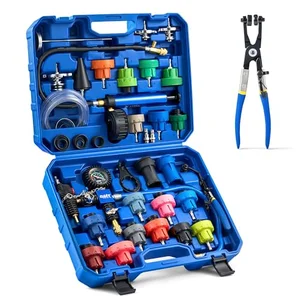
Orion Motor Tech Coolant Pressure Tester Kit
| Purpose | Confirms system holds pressure post-flush |
| Use Case | Diagnosing a suspected leak |
| Best For | After a flush prompted by a leak concern |
| Type | Diagnostic tool, not a cleaning product |
- Confirms there’s no leak reintroducing air or losing pressure after a flush
- Genuinely useful if the original problem that prompted the flush was a suspected leak
- Not needed for a routine, no-symptoms maintenance flush
This is for diagnosing an actual cooling-system problem, not a step every flush requires.
How We Picked These
We haven’t run these products through a lab — no controlled before/after rust-dissolution photography, no timed cleaning trials. What we did instead: cross-referenced each product’s manufacturer-published use case (routine maintenance vs. rust/scale removal) against real buyer feedback and independent radiator-flush comparison guides, and grouped picks by the actual problem they solve rather than a single “best” ranking that ignores the difference between a car on a normal maintenance schedule and one with visible rust. This is a genuinely useful, honestly-sourced buyer’s guide — not a hands-on lab review, and we’re not pretending otherwise.
Buying Guide: Matching the Product to the Problem
1. Check What’s Actually in Your Coolant First
Drain a small sample before buying anything. Rust-colored or brown coolant, visible flakes, or an oily sheen on the surface point to a stronger rust/scale/oil product like the Irontite or CRC picks above. Clean but simply old coolant (past its recommended interval) is a job for a gentle maintenance cleaner like the Prestone AS105.
2. Non-Acidic Matters More Than It Sounds
Acidic flush chemicals can degrade rubber hoses, gaskets, and seals over repeated use, even if they clean effectively in the moment. Products marketed as non-acidic (like the Prestone pick) are the safer default for routine use precisely because they won’t accumulate this kind of wear.
3. Bleed Air Pockets After Refilling
A flush is only half the job — refilling incorrectly traps air in the system, which can cause the engine to run hot even with fresh coolant in place. Running the engine with the heater on high after a refill (and using a spill-proof funnel, like our companion-tool pick) helps bleed trapped air out through the reservoir rather than leaving pockets in the radiator or heater core.
4. Match the Replacement Coolant to Your Manufacturer’s Spec
A flush product cleans the system, but what you refill it with matters just as much. Never mix coolant types unless the manufacturer explicitly says they’re compatible — mixing can cause gelling and reduced effectiveness. Check your owner’s manual for the specific coolant type your vehicle requires.
5. Confirm Material Compatibility — Not All Flush Products Suit Every Radiator
Modern cooling systems mix aluminum, cast iron, brass, plastic, and rubber components, and not every flush chemical is safe on all of them. Read the product label to confirm it is rated safe for your radiator’s actual materials (an all-aluminum radiator has different tolerances than an older cast-iron system) — the Irontite and Lubegard-style formulas that explicitly list cast iron, aluminum, brass, and plastic compatibility are the safer default if you are unsure. This matters more than it sounds: an incompatible chemical can accelerate corrosion or weaken rubber hoses and gaskets, undoing the benefit of flushing in the first place. Also double-check your coolant type before flushing — OAT (Organic Acid Technology) coolant is not compatible with older conventional or HOAT formulas, so mixing types after a flush can cause the same gelling and reduced-effectiveness problems a flush was meant to fix.
Frequently Asked Questions
How do I know if I need a rust remover instead of a regular coolant flush?
Drain a small coolant sample and look at it. Rust-colored, brown, or cloudy coolant, or any visible flakes or oily film, means you need a rust/scale-specific product. Clean coolant that’s simply overdue for a change is fine with a gentle maintenance cleaner.
How often should I flush my coolant system?
Most manufacturers recommend every 30,000 to 100,000 miles depending on the coolant type (conventional vs. long-life/extended-life formulas). Check your owner’s manual for the specific interval.
Can I use a coolant flush product that’s too strong for my car?
Using a stronger rust-removal product on a system that only needs routine maintenance isn’t dangerous, but it’s unnecessary and doesn’t offer any benefit over a gentler cleaner — save the stronger products for systems with actual rust or scale buildup.
Do I need special tools to do a coolant flush myself?
The core job just needs basic hand tools and a drain pan, but a spill-proof funnel kit makes the refill step significantly cleaner and helps prevent trapped air pockets. A pressure tester is optional and mainly useful if you suspect a leak.
Why does my car still run hot after a coolant flush?
The most common cause is a trapped air pocket from the refill step, not a failed flush. Running the engine with the heater on high after refilling helps bleed air out through the reservoir; a spill-proof funnel reduces the chance of trapping air in the first place.
Conclusion
The right coolant flush product comes down to one question: is this routine maintenance, or are you dealing with actual rust and scale? For routine upkeep, the Prestone AS105 is a safe, non-acidic default. For a system with visible contamination, the Irontite Thoro-Flush or CRC Thermocure will actually dissolve what a mild cleaner can’t touch. Whichever you choose, pair it with a spill-proof funnel during the refill to avoid the trapped-air problem that causes so many otherwise-successful flushes to still run hot afterward.
Products related to this article
Sponsored / affiliate links. As an Amazon Associate I earn from qualifying purchases. I may earn additional commission from eligible campaigns.