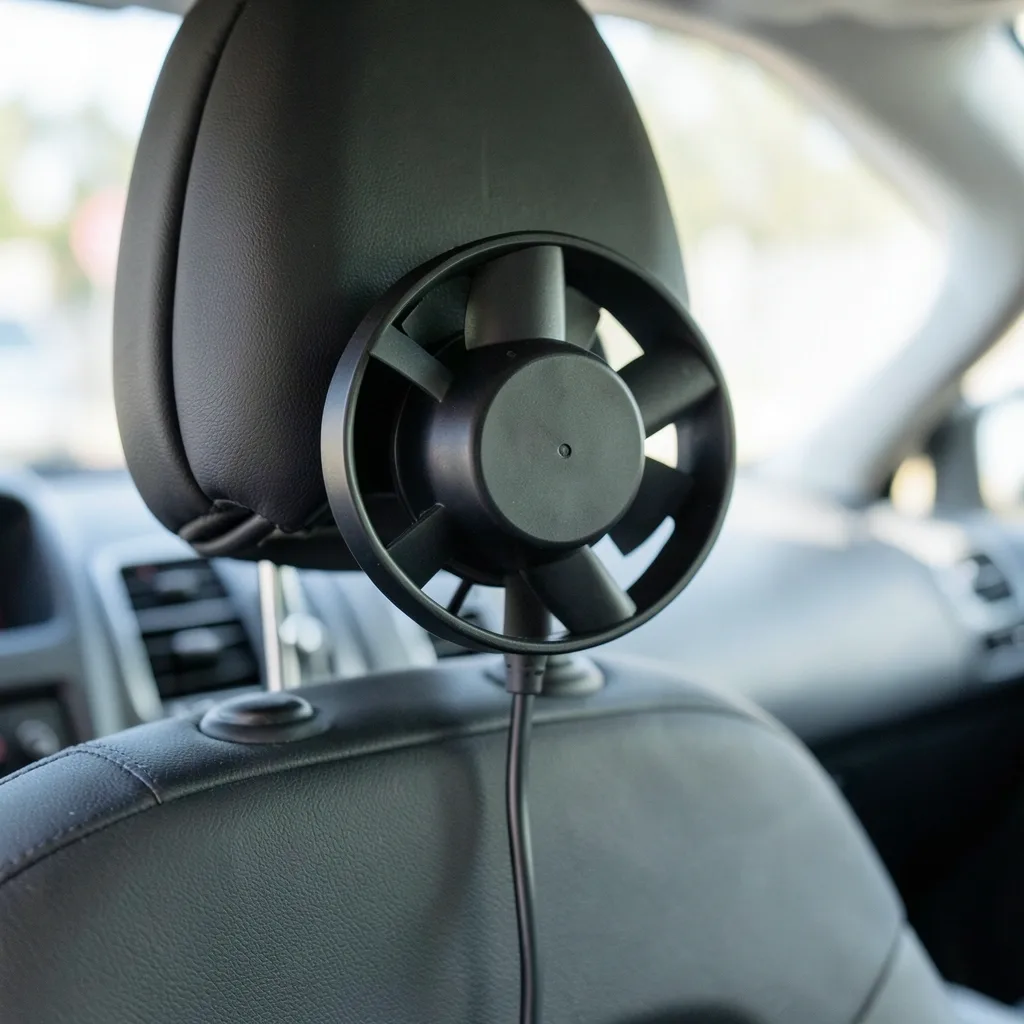
Best Car Fans: Top 12V Clip-On Picks for Backseat Cooling
The best 12V clip-on car fans for backseat cooling match the cabin layout. Dual-row minivans need long-reach, adjustable heads, while sedans usually need a compact clip-on aimed at the rear vents. Bad placement leaves passengers hot and the front system working harder. This guide ranks 12V clip-on picks by backseat fit, mounting style, and vehicle type.
Quick comparison
| Product | Badge | Best for | Price | ||
|---|---|---|---|---|---|
 |
RoadPro RPSC8572 12-Volt Dual Fan with Mounting Clip,RoadPro | Our pick | Dual fan · 12V · clip-on | $22.99
Price as of 29 Oct 2026
|
View |
 |
Hynoo 12V Car Clip Fans, Adjustable Dual Head Clip Fan 360°Hynoo | Budget pick | Dual head · 12V · clip-on | $23.79
Price as of 29 Oct 2026
|
View |
 |
12 Volt Oscillating Fan, 6-Inch 2-Speed Clip-On Car Fan |AOWEITOUR | Upgrade pick | 6-inch · 2-speed · oscillating | $23.39
Price as of 29 Oct 2026
|
View |
 |
Bestview 12V Car Fan, 8-Inch Clip On Cooling Fan for TruckBestview | Also great | 8-inch · 2-speed · clip-on | $12.08
Price as of 29 Oct 2026
|
View |
Use this page to match the fan to the cabin, not to chase the loudest airflow claim. Cord length, clip fit, and head movement matter more once the fan has to reach a second row or third row.
The table below is built for layout-first shopping. Check seat position, mount risk, and how much aim control you need for kids, pets, or rear passengers.
How we chose
Selection uses manufacturer specs, listing details, and published buyer feedback. The goal is simple: identify which fan style fits a sedan, SUV, minivan, pickup, or RV without blocking controls or creating a shaky mount.
We prioritized 12V cigarette lighter socket compatibility, clip strength, cord reach, rotation range, and whether the fan fits compact rear seating or larger cabins. Noise notes also matter, especially for sleeping children and long highway trips.
Where a listing gives only broad fit language, treat the vehicle manual and the product listing as the final check. For mixed fleets and work trucks, confirm whether the fan is 12V-only or explicitly rated for 24V before buying.
Backseat-fit decision matrix
This matrix is the shortest path to the right style. Choose by cabin geometry first, then by passenger type and mounting risk. The same fan can be fine in a sedan and awkward in a pickup rear bench.
| Vehicle type | Seating layout | Cord-length need | Clamp-risk | Ideal fan style |
|---|---|---|---|---|
| Sedan or compact car | Single rear bench | Short to medium | Moderate on thin seatbacks | Compact single-head or 4-inch dual-head |
| Hatchback | Tight rear cargo and bench area | Short to medium | Higher if the clip meets trim | Compact clip-on with strong clamp |
| SUV | Second row, sometimes third row | Medium to long | Moderate; mount height matters | Dual-head or larger 6-inch single-head |
| Minivan | Second row and third row | Long | Moderate; avoid loose trim | Dual-head with full tilt or a larger 6-inch fan |
| Pickup cab | Rear bench or jump-seat area | Long | High if the clip must reach hard trim | Dual-head with long cord or heavy-duty single-head |
| Truck or RV | Wider cabin, varied seat spacing | Long to very long | High because of vibration and movement | Heavy-duty fan with stable mount and long cord |
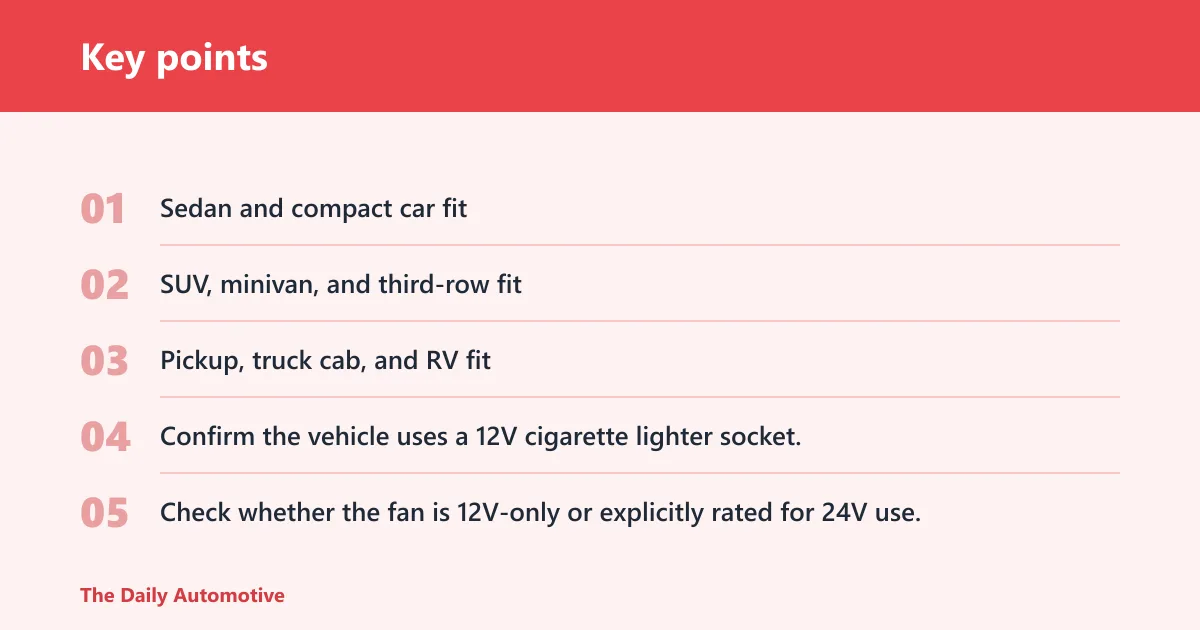
- Sedan and compact car fit: choose a smaller housing and shorter reach to avoid crowding the rear seat.
- SUV, minivan, and third-row fit: choose longer cord reach and better head articulation so air reaches the farthest passengers.
- Pickup, truck cab, and RV fit: choose a sturdier mount and check that the cable can reach the target seat without tension.
Mounting-height guide: aim the fan so the air path clears front-seat controls, the steering wheel zone, and side airbags. In the rear, a slightly higher mount often aims better toward the face or upper torso without blasting knees.
Checklist for fit
- Confirm the vehicle uses a 12V cigarette lighter socket.
- Check whether the fan is 12V-only or explicitly rated for 24V use.
- Measure the path from the socket to the rear seat, not just straight-line distance.
- Look for a clamp that matches the seatback, console edge, or dash lip.
- Keep the fan out of airbag zones and away from the driver’s view.
RoadPro RPSC8572: best for small cars
This is a good fit for sedans and hatchbacks that need a straightforward clip-on near the rear bench. The adjustable dual fans and heavy-duty clip mount make more sense when the cabin is tight and the fan must stay put on a narrow seatback or console edge.
Its variable speed operation gives you more than an on-off choice, which helps when a rear passenger wants light airflow instead of a blast. The drawback is size: a dual-fan housing can feel busy in a small cabin if the mounting point is already crowded.
If the rear seat is close to the front row, this style can work well. If the clip has to grip soft trim or an awkward angle, check the mounting surface before relying on it for a long trip.
Hynoo 12V clip fans: best for SUVs
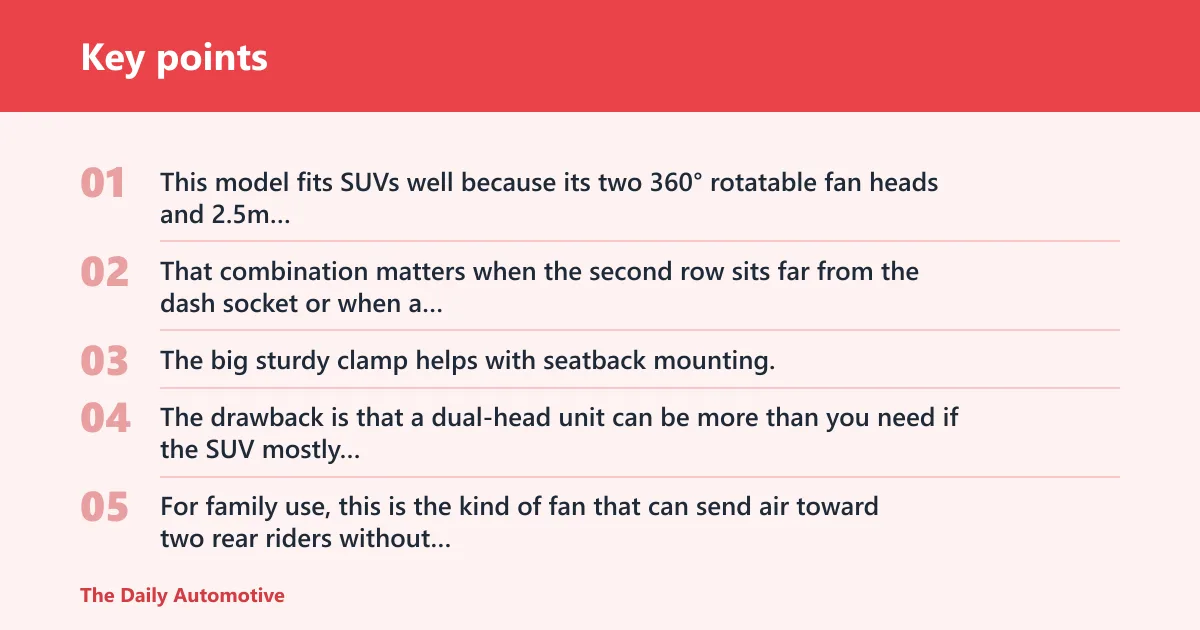
This model fits SUVs well because its two 360° rotatable fan heads and 2.5m cigarette-lighter cord suit wider cabin layouts. That combination matters when the second row sits far from the dash socket or when a passenger in the outboard seat needs independent aiming.
The big sturdy clamp helps with seatback mounting, which matters in SUVs where trim shapes vary from row to row. The drawback is that a dual-head unit can be more than you need if the SUV mostly carries one rear passenger at a time.
For family use, this is the kind of fan that can send air toward two rear riders without forcing the front row to give up comfort. It is still worth checking the cable path before buying, since cable reach is the first thing that fails in a larger cabin.
AOWEITOUR 6-inch clip fan: best for minivans
This is the minivan pick because a 6-inch fan suits larger cabins, and the listing pairs that size with 360° adjustable airflow. In a van with second-row captain’s chairs or a third row, a bigger fan head can help cover more distance from a single mounting point.
The 2-speed operation keeps the control simple. The drawback is that a larger housing can be awkward if the only usable mount is on a narrow trim edge or near a sliding seat track.
Minivan buyers should think about two things first: where the fan will clip, and whether the cord can reach the row that actually needs cooling. A larger fan helps only if it stays stable.
Bestview 8-inch fan: best for trucks
This is the pickup and work-cab choice because it uses an 8-inch fan with a heavy-duty anti-slip clamp and 360° rotation. The larger head suits a broader cab where the rear bench sits farther from the socket and the fan may need to cover a wider passenger area.
The 2-speed switch keeps it simple, but the drawback is bulk. In a tighter truck cab, an 8-inch housing can be harder to place without blocking an armrest, storage bin, or rear-seat entry path.
For truck buyers, there is one extra check that matters: a 12V fan plugs into a cigarette lighter socket, but it is not automatically safe for a 24V work truck. If the listing does not explicitly support both voltages, do not assume it will work.
Rear-seat cooling for kids: best for children
For children, the best fan is the one that reaches the rear seat without blowing straight into a sleeping face. A dual-head design with 360° rotation is often the better fit because you can aim one stream higher and keep the cabin more even.
Noise matters here more than most buyers expect. “Quiet” should mean low enough that it does not wake a sleeping child or force the stereo volume higher on a long trip, even if that means choosing a fan with less aggressive airflow.
Suppose the child seat is on the right side of a minivan’s second row. A high-mounted, adjustable fan aimed slightly above shoulder level can cool the seat area without pushing air directly at the headrest.
Pet travel cooling: best for pets
Pets need stable airflow and a stable mount. A clip-on fan for a crate or backseat pet area should have a clamp that stays tight on the seatback or cargo barrier and a head that can point above the pet instead of directly at the nose.
Dual-head units can help if the pet rides with a child or another passenger, but a single-head fan is often easier to place in a narrow crate zone. The drawback with many compact models is the mount itself: a weak clip can slip when the vehicle hits rough pavement.
A common first-timer mistake is placing the fan too low, where the pet’s body blocks the airflow. A higher mount usually works better because it pushes air across the space instead of into bedding or trim.
RoadPro dual fan: best dual-head pick
This is the easiest dual-head pick for buyers who want broad rear-seat coverage without moving up to a much larger housing. Adjustable dual fans are useful when two passengers sit side by side and need slightly different aim.
The heavy-duty clip mount is the key feature here, because a dual-head body only helps if the fan stays aligned after bumps and door slams. The drawback is that a dual-head shape can take up more visual space than a single-head fan.
Choose this style when you need flexible aiming for kids, pets, or two adults in the second row. If the rear seat is narrow and only one passenger needs cooling, a single-head fan may be simpler.
Bestview 8-inch fan: best single-head pick
This is the simpler choice when you want one larger air outlet rather than two smaller heads. A single-head fan can be easier to place in a wide cab, especially if the mount point is limited and the airflow path needs to reach across an open rear bench.
The 8-inch size helps explain why it can suit trucks and vans: larger diameter usually means more cabin presence, and the fan is meant for passenger cooling rather than a tiny personal zone. The drawback is that it can feel oversized for compact cars.
Use this style when the cabin is wide enough that a single pointed stream can do the job. If you need to cool two rear riders at different angles, a dual-head model is usually the better tool.
Quiet passenger cooling: best for noise-sensitive trips
For babies, pets, and long highway drives, the better fan is usually the one that avoids high fan noise at cruising speed. The useful question is not whether a fan is “quiet,” but whether it stays unobtrusive when the cabin is already full of road and tire noise.
Some 12V clip-on fans offer dual-speed operation, which gives you a low setting for sleeping passengers and a stronger setting for parked or slow traffic use. That trade-off matters more than a vague noise claim on the box.
If a listing says the fan is designed for quiet operation, still check the rest of the setup. A loose clip or vibrating mount can make a quiet motor sound louder than expected.
XOOL 6-inch fan: best stepless-speed pick
This is the pick for buyers who want finer airflow control. The XOOL 12V 6-inch fan includes 360° tilt rotation and uses stepless speed regulation, so you can set the airflow more precisely than with a simple two-speed switch.
That matters in rear seats where a small change in direction can make the difference between comfortable and annoying. The drawback is that premium control features do not fix a poor mounting position; if the seat layout is wrong, the fan still may not reach the target.
Stepless speed regulation is most useful for families and road-trip drivers who want to fine-tune air without jumping between only two settings. The 6-inch size also suits larger cabins better than tiny rear-seat nooks.
Compact dual-head fan: best compact pick
A compact dual-head fan is the right pick when the rear area is tight and the mount point is limited. One competitor lists a 4-inch dual-head fan for compact spaces, which is the sort of size that can fit a small cabin without crowding the seatback.
This style makes sense in a sedan, hatchback, or a tightly packed second row where a larger housing would interfere with passengers or the seat track. The drawback is obvious: smaller heads can mean less broad coverage than a larger single-head fan.
If your backseat passengers sit close to the socket and do not need long-range coverage, compact can be the smarter choice. It is easier to place and usually easier to live with.
XOOL 6-inch fan: best 6-inch pick
The 6-inch category is where rear-seat cooling starts to favor larger cabins. The XOOL 12V 6-inch fan is described as better for larger cabins, and that matches the basic geometry problem in SUVs, vans, and some trucks.
This fan style is also the one to consider when you need 360° tilt rotation and stepless speed regulation in a single unit. The drawback is space: a 6-inch fan can feel oversized in a narrow sedan or a trim-heavy rear bench.
Use it when cabin size, not just outlet position, is the real problem. A larger head is useful only if the fan can be mounted without stealing passenger room.
Which one should you buy?
If you want the easiest match by vehicle type, start with the table. Sedans and hatchbacks usually favor compact or dual-head options, SUVs lean toward dual-head or mid-size single-head models, minivans benefit from longer reach, and pickup or RV buyers should prioritize cord length and a stable mount.
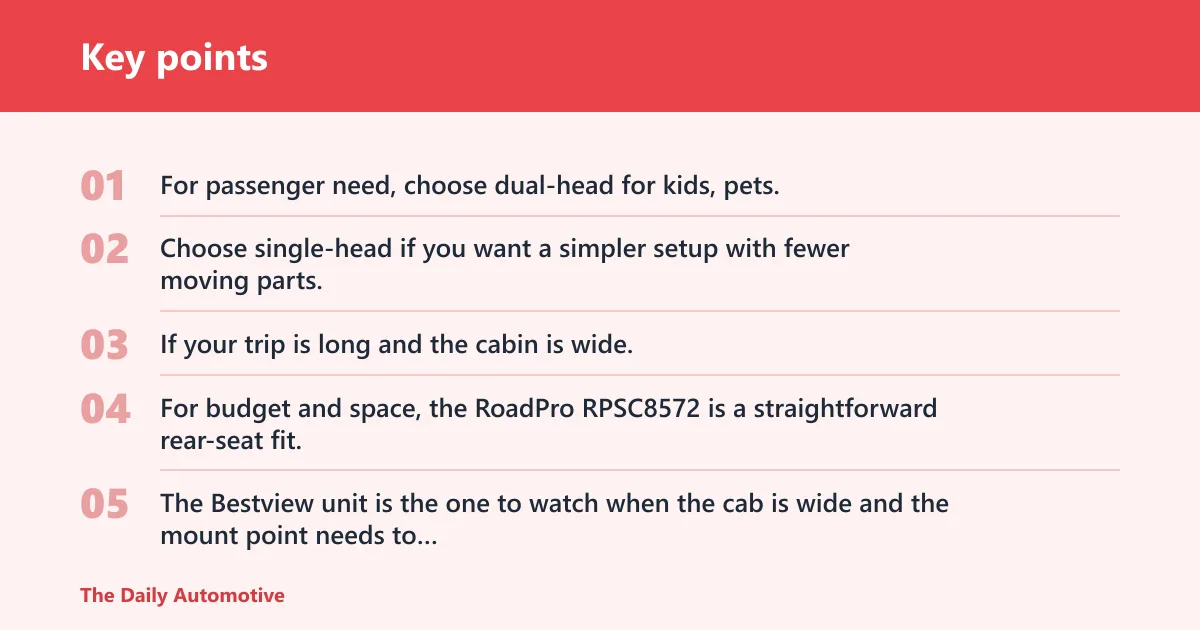
For passenger need, choose dual-head for kids, pets, or two rear riders who need different angles. Choose single-head if you want a simpler setup with fewer moving parts. If your trip is long and the cabin is wide, a 6-inch or larger fan can make more sense than a tiny one.
For budget and space, the RoadPro RPSC8572 is a straightforward rear-seat fit, while the Hynoo and AOWEITOUR models add more reach or cabin coverage. The Bestview unit is the one to watch when the cab is wide and the mount point needs to be stout.
A common mistake is choosing a clip-on fan for raw speed first and then discovering the backseat headrest or door pocket has nowhere practical to mount it. If the clip cannot hold, the cord cannot reach, or the fan lands in an airbag zone, the strongest-looking model is the wrong one.
When to avoid a clip-on fan
Skip a clip-on fan if the only safe mount point blocks airbags, controls, or the driver’s view. Also skip it if the vehicle is 24V and the fan is 12V-only, unless the listing explicitly says it is rated for both. In those cases, a different power solution is the safer choice.
Frequently asked questions
What is the best 12V clip-on car fan for backseat cooling?
The best choice depends on cabin layout, not just airflow. Minivans and larger SUVs usually need a long-reach, adjustable fan with broad coverage, while a sedan often does better with a compact clip-on aimed at the rear seat. Match the fan to the seating row first, then check clamp fit and cord reach.
Do 12V clip-on car fans work in SUVs and trucks?
Yes, many do, but the fit has to match the cabin. SUVs and trucks often need longer cords and stronger clips because the rear seat sits farther from the socket and the mount point can be less forgiving. Check the vehicle layout and confirm the fan reaches the target seat without stretching the cable.
How many amps does a car fan draw?
Many low-current fans draw around 0.5 to 1 amp, while higher-powered models can pull 2 amps or more. That matters when you are comparing light-duty comfort use against a larger fan meant to move more air. Always check the listing for your exact model before you plug it in.
Is a dual-head car fan better than a single-head fan?
Dual-head fans are usually better when you need broader rear-seat coverage or want to aim air at two passengers. A single-head fan can be better when the cabin is tight, the mount is limited, or you only need one direct stream. The better option depends on space, reach, and passenger count.
Will a 12V car fan work in a 24V truck?
Not unless the fan is explicitly rated for 24V use. A standard 12V cigarette lighter socket fan is made for 12V systems, and a 24V truck is not a safe place to guess. Check the product listing carefully before buying for a work truck or mixed fleet vehicle.
How long should the power cord be for rear-seat cooling?
Long enough to reach the rear passenger area without tension is the real rule. In listings, 2.5m cord examples appear on dual-head models, while a heavy-duty truck fan may list a 10-foot DC power cord. Measure the route from socket to seat, not just the straight line.
Are clip-on car fans noisy?
They can be, especially at higher output. Quiet operation matters most for babies, sleeping passengers, and long highway trips, where a constant whir can become tiring. If a fan offers multiple speeds or stepless control, you can usually keep noise down by running it lower when full airflow is not needed.
Products related to this article
Sponsored / affiliate links. As an Amazon Associate I earn from qualifying purchases. I may earn additional commission from eligible campaigns.