Best for Car Radiator Coolant: Top Picks by Vehicle
If the cooling-system history is unknown, a cautious approach is to verify the OEM-specified coolant before servicing the system; if the existing coolant cannot be verified, avoid mixing chemistries. A poor coolant match can contribute to sludge, gel, water-pump wear, overheating, and damage to the radiator or heater core. This guide compares top coolant picks by failure risk, service history, and chemistry so you can choose the right product for a car, truck, or light-duty diesel.
Best coolant for most cars
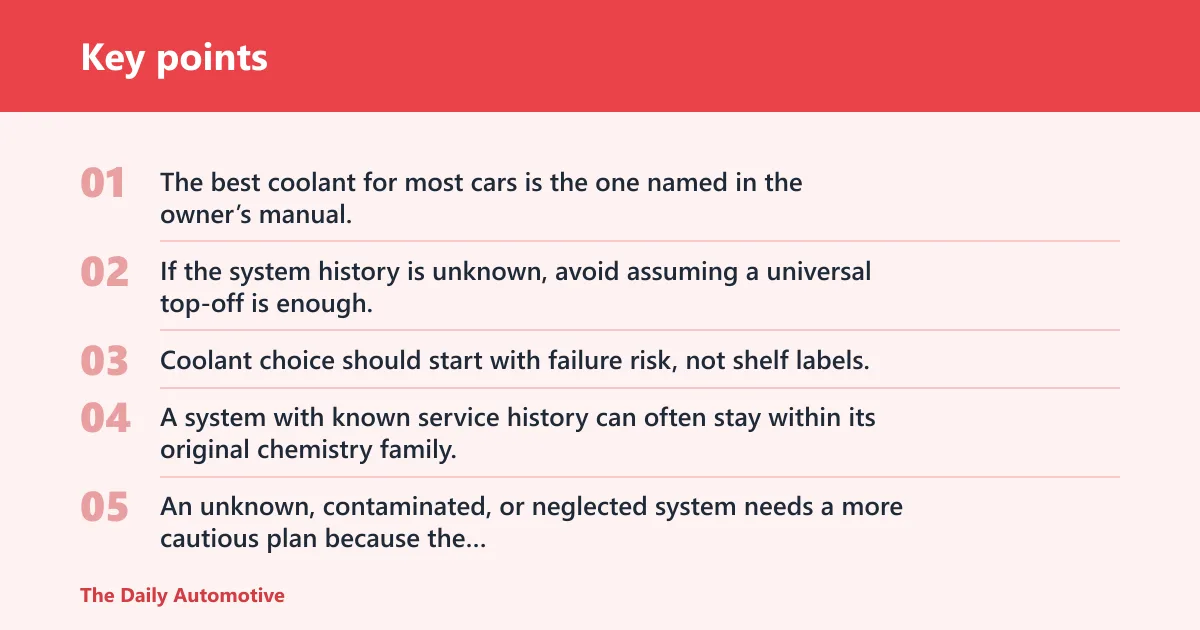


The best coolant for most cars is the one named in the owner’s manual, with chemistry matched to the vehicle’s actual service history before brand or color. If the system history is unknown, avoid assuming a universal top-off is enough; for a full refill, choose the exact OEM spec after a proper service.
Coolant choice should start with failure risk, not shelf labels. A system with known service history can often stay within its original chemistry family. An unknown, contaminated, or neglected system needs a more cautious plan because the wrong blend can create sludge, gel, corrosion, or pump seal wear.
Quick picks by need
- Unknown top-off only: Prestone All Vehicles Antifreeze + Coolant, because it is positioned as a universal compatibility option for top-off situations and any-coolant color claims.
- Toyota, Honda, Lexus, Acura, Nissan: Zerex Asian Vehicle coolant, which uses HOAT chemistry and is silicate-free and borate-free.
- Ford, Chrysler, Mercedes: Zerex G-05, a HOAT coolant used across those applications; it also includes nitrite for diesel cavitation protection.
- Older vehicles: IAT coolant, the traditional green family with shorter service life and older-car fitment.
- Long-life GM-style applications: OAT coolant, including GM Dex-Cool-type formulas where the manual calls for it.
- Waterless conversion: Evans waterless coolant only after complete water removal, never as a casual swap.
What coolant should you buy?
Buy the coolant that matches the owner’s manual specification first, because year-make-model requirements can differ even within the same brand. If you know the exact chemistry already in the system, stay within that family unless you are doing a full flush. If you do not know what is inside, treat mixing as a risk, not a shortcut.
Match the spec before the color
Color alone is not a reliable buying signal. Green, orange, yellow, blue, and pink appear across multiple chemistries, and a dyed bottle does not guarantee compatibility. Use the manual, the service record, or a clearly verified coolant label to identify the right family.
Use service history to decide on a flush
If the system has documented OAT, HOAT, or IAT history and the fluid still looks clean, a top-off with the matching chemistry is usually the lowest-risk move. If the history is missing, the coolant is rusty or sludged, or the system was topped off with unknown fluid, plan a drain-and-fill before switching chemistry families.
Match chemistry before you match brand
Brand matters less than formulation. OAT coolant fits long-life service plans, HOAT blends add corrosion protection with a hybrid package, and IAT is the older green family with shorter life. The manual’s chemistry call is the priority, and the brand should follow that spec.
Coolant decision table
| Existing coolant history | Likely risk | Safest next step | Flush first? | Examples by vehicle family |
|---|---|---|---|---|
| Unknown or mixed | Sludge, gel, seal wear, overheating | Identify the OEM spec; if unknown, drain and refill with the correct chemistry | Yes | Any vehicle with no records, mixed-fleet household, used-car purchase |
| Known OAT history | Lower corrosion risk when left alone; mixing can still cause trouble | Top off with the same OAT formula; use a complete flush if switching families | Only if changing chemistry | GM Dex-Cool applications and other OAT systems |
| Known HOAT history | Compatibility loss if replaced with the wrong formula | Stay with HOAT that matches the spec | Yes, if moving to OAT or IAT | Ford, Chrysler, Mercedes, some Asian vehicles |
| Known IAT history | Shorter service life, corrosion if overdue | Use IAT only where the manual calls for it; refresh on schedule | Yes, if upgrading to a different chemistry | Older vehicles with traditional green coolant |
| Diesel with cavitation concern | Liner pitting, cooling-system damage under load | Use the diesel-approved coolant spec, such as nitrite-containing HOAT where required | Usually yes before switching specs | Pickups, heavy-duty vehicles, some fleet diesels |
| Waterless conversion target | Conversion failure if any water remains | Remove all water first, then fill with the waterless formula | Yes, completely | Gasoline, light-duty diesel, LP, and CNG applications |
Is Prestone universal coolant safe for any car?
Prestone All Vehicles Antifreeze + Coolant is a cautious universal-style top-off option when you cannot verify what is already in the system, but it is not a free pass to ignore factory specs. Use it as a temporary bridge, not a substitute for a correct full refill. For any complete service, the OEM recommendation still wins.
That distinction matters. A universal coolant can reduce immediate mismatch risk during a small top-off, but it does not erase the need for a flush when moving between incompatible chemistries or when the existing coolant is contaminated. Universal compatibility positioning is about forgiveness, not magic.
Top-off versus full refill
Top-off use is the narrow case where universal coolant makes sense: the reservoir is slightly low, the service history is unclear, and you need to prevent air from entering the system before a proper service. For a full refill, use the exact coolant called for by the manual after draining the old fluid.
Why color still does not settle it
Prestone’s broad compatibility claim does not mean every dyed coolant is interchangeable. A red, orange, yellow, or blue coolant can still be the wrong chemistry for a given car. The bottle label and the spec sheet matter more than color.
What coolant do Asian and European cars need?
Many Asian and European applications use manufacturer-specific coolant requirements, so you should not buy by brand name alone. Zerex Asian Vehicle coolant is the clear fitment-oriented pick here because it uses HOAT chemistry and is silicate-free and borate-free, which aligns with some Toyota, Honda, Lexus, Acura, and Nissan requirements.
Zerex Asian Vehicle coolant
This coolant is aimed at Asian vehicle fitment, not generic guessing. The silicate-free and borate-free position matters because those additive choices help avoid conflicts with systems that were designed around a specific HOAT package.
HOAT in Ford, Chrysler, Mercedes, and some Asian vehicles
HOAT coolant blends organic-acid durability with added corrosion protection from the hybrid package. It is common in Ford, Chrysler, Mercedes, and some Asian vehicles, but the exact spec still varies by model year and platform. Some systems also require nitrite content, especially where diesel cavitation protection is part of the formula.
What if the manual names a different coolant?
Follow the manual. A vehicle that specifies a Ford, Chrysler, or Mercedes HOAT formula should not be refilled with a random universal coolant just because the bottle says it fits many cars. Compatibility claims are broad; OEM requirements are narrow.
What coolant is best for older cars and diesels?
Older cars often do best with IAT coolant if that is what the manual specifies, because the traditional green family matches many older cooling systems and service intervals. Diesels need more care: if the engine is sensitive to cavitation, use the coolant specification the manufacturer calls for, which may include nitrite depending on the application.
IAT for older vehicles
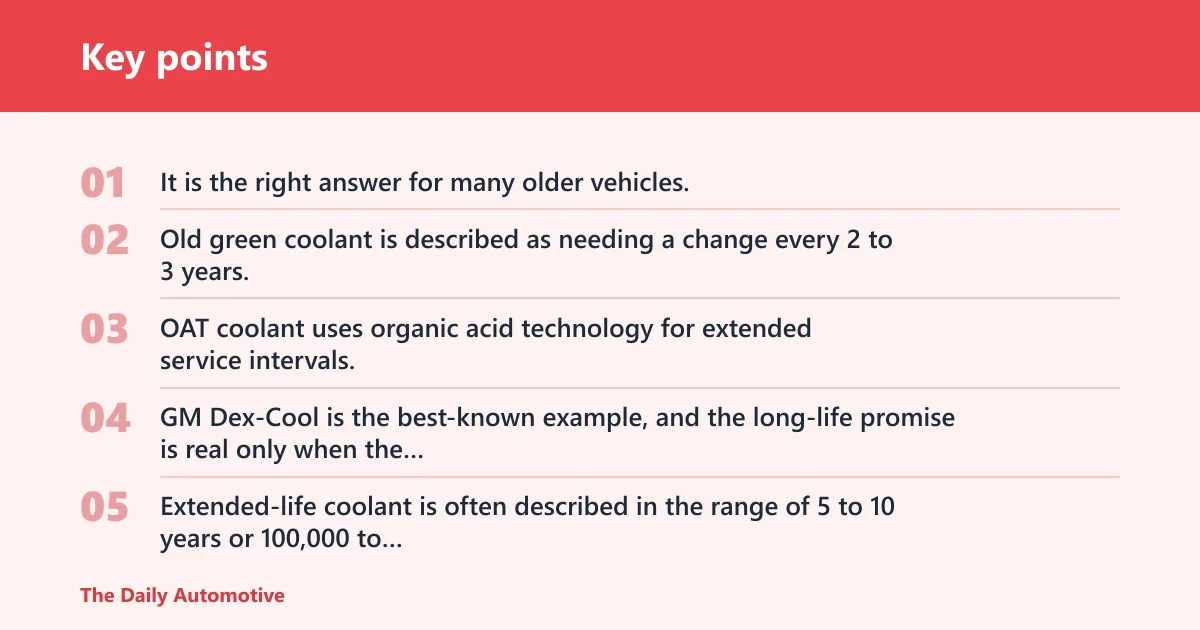
IAT is the classic green coolant family. It is the right answer for many older vehicles, but it does not carry the long service life of newer formulas. Old green coolant is described as needing a change every 2 to 3 years, so overdue service can become a corrosion problem fast.
OAT for long-life applications
OAT coolant uses organic acid technology for extended service intervals. GM Dex-Cool is the best-known example, and the long-life promise is real only when the system is clean and the coolant matches the spec. Extended-life coolant is often described in the range of 5 to 10 years or 100,000 to 150,000 miles, depending on the OEM schedule.
Zerex G-05 for diesel and mixed-duty use
Zerex G-05 is a HOAT coolant for passenger cars and pickups, and it is described as lasting up to 150,000 miles or about 5 years. Its nitrite content can be important in some diesel applications because it helps protect against cavitation damage in cylinder liners and related cooling components where that formula is called for by the manual.
Waterless coolant conversion
Waterless coolant is not a casual swap. Evans waterless coolant is suitable for gasoline, light duty diesel, LP, and CNG engines, but conversion requires complete water removal before fill. If any water remains, the new formula is compromised and the conversion can fail.
Say your 12-year-old sedan has a cloudy reservoir and no maintenance records. The safest move is not to guess by color. Inspect the system and refill with the OEM-specified coolant rather than risk turning mixed fluid into sludge.
Suppose a 2016 diesel pickup is running fine but the coolant was topped off twice with unknown fluid. That truck needs a spec check before anything else. If the system calls for a nitrite-containing HOAT, use that exact formula after a proper service, because cavitation protection matters under load.
How to choose between concentrate and premixed coolant
Concentrate is usually the better value when you need a full fill and can control the mix ratio with clean water. Premixed coolant is the safer choice when you want to avoid dilution mistakes or when you do not trust the water you would otherwise use. The decision hinges on water quality and fill precision.
When concentrate makes sense
Use concentrate when you are performing a complete service, you know the system capacity, and you have distilled water available. This is often the practical choice for a planned flush because it gives you control over the final mixture.
When premixed is the safer choice
Premixed coolant reduces the chance of using the wrong water or making an off-ratio fill. It is especially useful for top-offs and for DIY owners who want one less variable during a service. For any cooling system, bad water can create scale and corrosion over time.
Why water quality matters
Hard tap water can leave mineral deposits in passages, heater cores, and the radiator. That extra scale cuts heat transfer and can contribute to overheating. If you use concentrate, mix it with the correct water, not whatever is available at the hose bib.
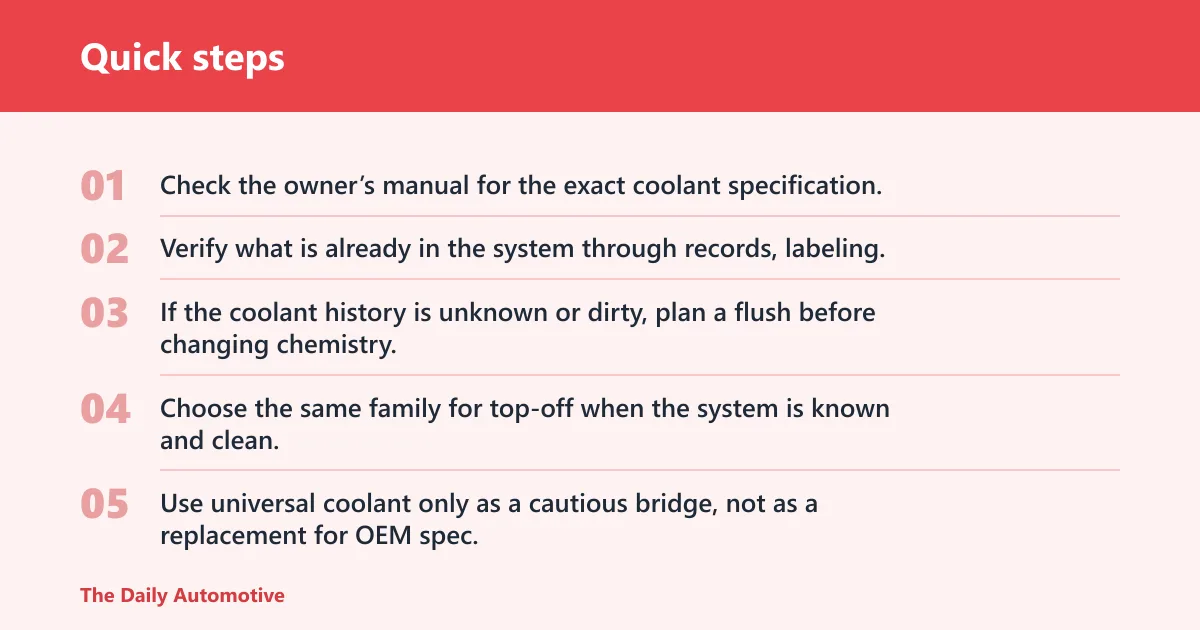
- Check the owner’s manual for the exact coolant specification.
- Verify what is already in the system through records, labeling, or a documented service history.
- If the coolant history is unknown or dirty, plan a flush before changing chemistry.
- Choose the same family for top-off when the system is known and clean.
- Use universal coolant only as a cautious bridge, not as a replacement for OEM spec.
- Pick concentrate or premixed based on water quality and how much control you want over the final mix.
Frequently asked questions
What is the best coolant for my car radiator?
The best coolant is the one listed in your owner’s manual, because vehicle-year-make-model requirements override color and brand. If the system history is unknown, a universal top-off product can be a short-term hedge, but a full refill should still match the factory chemistry after a drain.
Can I mix different coolant colors in my car?
No, not unless the manufacturer says the underlying chemistries are compatible. Color alone does not prove compatibility, and mixing the wrong formulas can create sludge, gel, or corrosion. If you cannot verify what is already inside, treat a mixed-color system as a flush candidate.
What type of coolant does my car need?
Look up the exact coolant spec in the owner’s manual and match that first. Most cars will call for IAT, OAT, or HOAT in a specific formulation, and some platforms also require diesel-specific additives or a waterless-approved conversion process. The manual settles the question.
How long does extended-life coolant last?
Old green coolant is much shorter-lived and is described as needing a change every 2 to 3 years.
What coolant should I use for a diesel engine?
Use the coolant that the diesel manufacturer specifies, especially if cavitation protection is required. Zerex G-05 is a HOAT option for passenger cars and pickups, and its nitrite content supports diesel liner protection where that formula is called for by the manual.
Products related to this article
Sponsored / affiliate links. As an Amazon Associate I earn from qualifying purchases. I may earn additional commission from eligible campaigns.