Best Trucks for Towing: Top Picks for Heavy-Duty Performance
Half-ton pickups can often handle many travel trailers and boats up to about 9,000 to 12,000 pounds, but the right tow rig depends on payload, tongue weight, wheelbase, and trailer type. Heavy fifth wheels and loaded horse trailers usually need a three-quarter-ton or one-ton truck. Choose the wrong class and you can run out of payload, control, or braking margin before you reach the rated tow limit. This guide matches truck classes to trailer types, explains the setup and safety gear you need, and points to the towing tech that matters most.
Best trucks for towing by trailer type
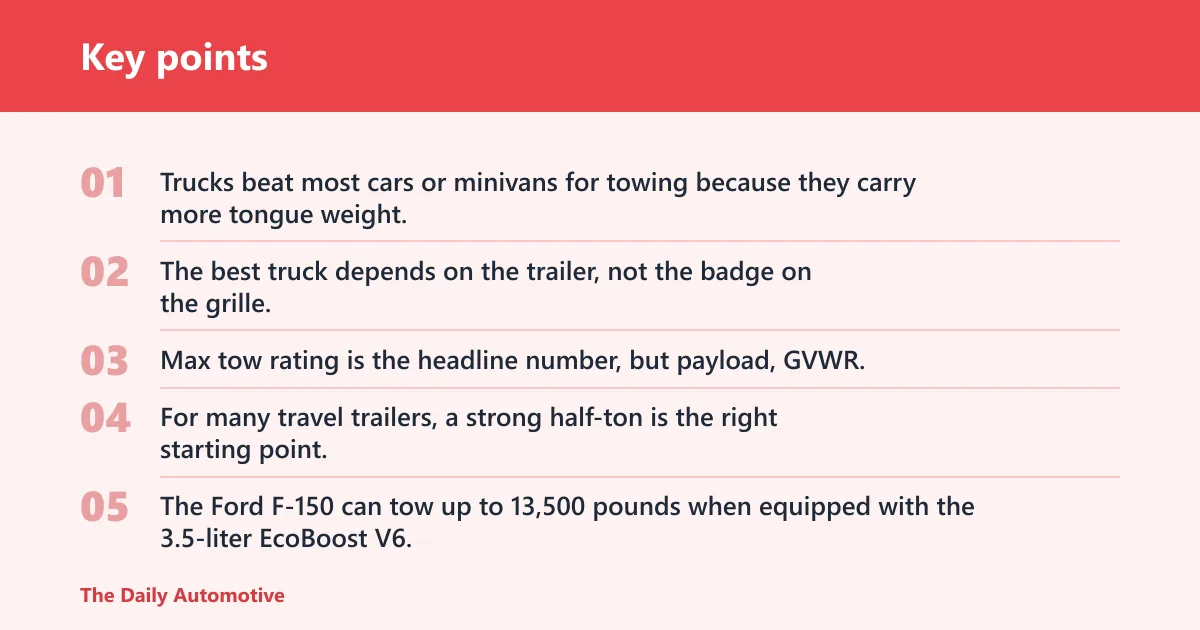


Trucks beat most cars or minivans for towing because they carry more tongue weight, accept heavier hitch hardware, and offer tow-specific drivetrains. The best truck depends on the trailer, not the badge on the grille. Max tow rating is the headline number, but payload, GVWR, and trailer setup decide whether the truck works in the real world.
Travel trailers and campers
For many travel trailers, a strong half-ton is the right starting point. The Ford F-150 can tow up to 13,500 pounds when equipped with the 3.5-liter EcoBoost V6, and Ford pairs that setup with a 10-speed automatic transmission. That gives you room for a midsize camper, but you still need to check tongue weight, passengers, and cargo against payload.
The Ram 1500 is another good match for lighter-to-midweight campers. Its maximum towing capacity is about 11,600 pounds, and the standard-output 3.0-liter Hurricane twin-turbo inline-six can be ordered with the Max Tow Package and an integrated trailer brake controller. That makes it a practical choice when the trailer is well inside the truck’s payload margin.
Boats and utility trailers
Boats and utility trailers often weigh less than travel trailers, but they can still challenge payload and rear-axle control. A midsize truck such as the GMC Canyon, with a maximum towing capacity of 7,700 pounds, fits many small to medium boats and utility rigs. The Hyundai SANTA CRUZ, at 5,000 pounds, suits lighter boats, small landscape trailers, and compact utility loads.
For these trailers, hitch setup matters as much as tow rating. A trailer with a tall profile can need better sway control than a heavier but lower trailer. If the boat or utility load pushes the truck near its payload limit, step up a class even if the tow number looks comfortable on paper.
Horse trailers and equipment trailers
Horse trailers and equipment trailers often bring a large tongue load, shifting the decision toward heavier trucks. A loaded horse trailer can push beyond what many half-ton payload ratings can support once passengers, fuel, tack, and cargo are counted. Equipment trailers with compact machines can look manageable until the trailer brakes, axle placement, and tongue weight are added to the math.
Say your trailer weighs 8,500 pounds empty on paper, but the horses, water, and tack add another 2,000 pounds. The trailer may still fall within a rated tow number, yet the tongue weight and cargo in the cab can push the truck past GVWR first. That is where a heavier truck class matters more than a bigger tow rating.
Fifth wheels and commercial loads
Fifth wheels and commercial loads usually point straight to a heavy-duty truck. Ford Super Duty models are the right category for serious towing, including gas 250 and diesel 350 configurations, fifth-wheel use cases, and commercial towing. The hitch location over the rear axle improves stability and lets the truck carry and control more trailer weight.
The Ford F-450 Super Duty ranks first among heavy-duty trucks with a maximum towing capacity of 40,000 pounds. That number is for buyers who need the heavy-duty towing benchmark, not a casual weekend trailer. For commercial equipment, gooseneck work, or a large fifth wheel, the truck class and hitch class should match the job from the start.
Towing match table
This table pairs common trailer categories with the truck class that makes sense before you start shopping trims. Use it as a filter, then confirm the exact cab, bed, drivetrain, axle ratio, and hitch equipment for the stickered rating on the specific truck.
| Trailer category | Typical loaded trailer weight | Recommended truck class | Must-have equipment | Payload caution | Realistic fit |
|---|---|---|---|---|---|
| Travel trailer | 6,000 to 10,000 pounds | Half-ton | Integrated trailer brake controller, tow/haul mode, trailer-sway control | Passengers and cargo can erase the margin quickly | Half-ton, sometimes HD |
| Boat trailer | 3,000 to 8,000 pounds | Half-ton or midsize | Brake controller if the trailer has brakes, tow/haul mode, good mirrors | Check tongue weight and wet-bunk weight carefully | Half-ton, midsize, or EV for lighter boats |
| Horse trailer | 8,000 to 14,000 pounds | HD | Brake controller, tow/haul mode, trailer-sway control, weight-distributing or gooseneck setup | Animal load, water, and gear make payload the key limit | HD |
| Equipment trailer | 7,000 to 16,000 pounds | HD | Brake controller, tow/haul mode, heavy-duty hitch hardware | Machine weight and tongue load can exceed half-ton payload fast | HD |
| Fifth wheel | 12,000 to 20,000 pounds | One-ton HD | Fifth-wheel hitch, brake controller, tow/haul mode | Cab, bed, axle, and hitch weight all matter | HD only |
Which half-ton trucks tow best?
A half-ton is enough when the trailer stays within the truck’s tow rating and, more important, within payload after passengers, fuel, and cargo are counted. That is why the best half-ton towing trucks are not the ones with the biggest brochure number. They are the ones with the right engine, hitch, and payload margin for the trailer you actually own.
Ford F-150 towing setup
The F-150 stands out because it combines a 13,500-pound maximum tow rating with towing tech that helps with setup and stability. Ford offers smart scales to help with tongue weight and payload checks, smart hitch for backing up to the trailer tongue, and trailer blind-spot monitoring. Those features matter when the trailer is large enough that small setup errors become costly.
The 3.5-liter EcoBoost V6 is the engine tied to the F-150’s max tow rating, and the 10-speed automatic transmission is part of that tow package combination. That matters because configuration changes towing capacity. Engine choice, cab size, bed length, drivetrain, axle ratio, and hitch hardware can all move the number up or down.
Ram 1500 towing setup
It also offers an integrated trailer brake controller, which helps coordinate truck and trailer braking. That is the kind of equipment that matters more than a basic max rating when the trailer has its own brakes.
Use a half-ton when the trailer is well matched to the truck’s payload and wheelbase. A common first-timer mistake is to compare tow ratings and stop there. If the hitch weight, passengers, and camping gear push the truck to its GVWR, the trailer may still be under the brochure limit while the truck is already out of margin.
When a half-ton is enough
A half-ton works best for lighter travel trailers, smaller boats, and moderate utility trailers, especially when tongue weight is controlled and the truck is not loaded with people or cargo. If you need more than one or two adults in the cab, a bed full of gear, and a heavy trailer at the same time, the safer answer is often a heavier truck class.
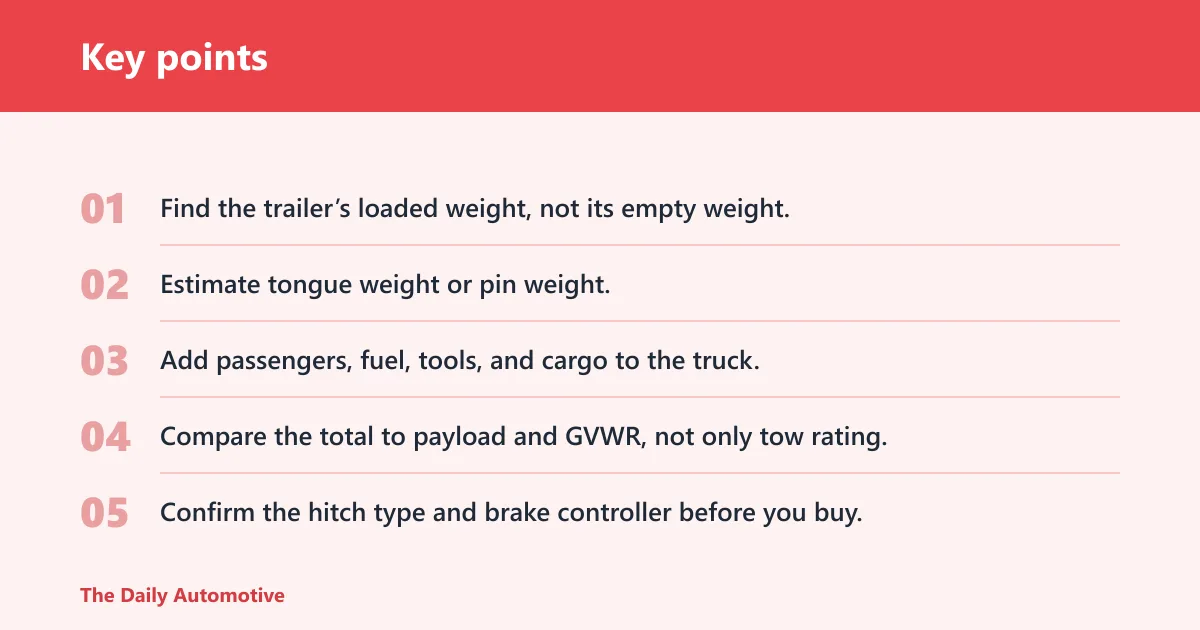
- Find the trailer’s loaded weight, not its empty weight.
- Estimate tongue weight or pin weight.
- Add passengers, fuel, tools, and cargo to the truck.
- Compare the total to payload and GVWR, not only tow rating.
- Confirm the hitch type and brake controller before you buy.
Do you need a heavy-duty truck?
Yes, if the trailer is large, heavy, or carried on a fifth-wheel or commercial hitch. Heavy-duty trucks give you more payload, stronger frames, and more braking margin. They are the better answer for heavy fifth wheels, loaded horse trailers, and equipment that can move a half-ton past its payload limit long before it reaches its tow number.
Ford Super Duty for fifth wheels
Ford Super Duty models are the serious-towing choice in this lineup, with gas 250 and diesel 350 configurations for buyers who need more than half-ton duty. They fit fifth-wheel and commercial towing use cases better because they are designed to carry more weight on the rear axle and handle heavier hitch loads with less strain.
Why the F-450 is the benchmark
The Ford F-450 Super Duty leads the heavy-duty class here with a 40,000-pound maximum towing rating. That figure puts it at the top of the benchmark list, but it is also a signal about intended use. If you are hauling large commercial loads or a large fifth wheel, this is the sort of truck class that belongs in the conversation.
Where HD trucks beat half-ton models
Heavy-duty trucks usually win on payload, hitch stability, and braking reserve, which is why they are better for larger trailers even when a half-ton’s tow rating appears close on paper. They also leave more room for passengers, fuel, and gear without pushing GVWR too quickly. That extra margin matters on long grades and in crosswinds.
Picture a crew-cab half-ton with four adults, fuel, firewood, and a trailer with a heavy tongue load. The tow rating may still look fine. The payload sticker may not. That is the point where an HD truck becomes the correct tool.
What features matter most for towing?
The most useful towing features are the ones that improve control, not just the ones that make a brochure longer. Start with an integrated trailer brake controller, then look for tow/haul mode, trailer-sway control, and trailer blind-spot monitoring. Those systems help the driver control the trailer before a problem turns into a correction.
Integrated trailer brake controller
An integrated trailer brake controller coordinates tow vehicle and trailer braking, and the adjustment lets you balance braking effort for the load. That matters when the trailer has electric brakes and the combined rig needs smoother stops. It is not a luxury item on a real tow rig; it is part of the safety setup.
Tow/haul mode and shift logic
Tow/haul mode changes transmission behavior under load. It usually holds gears longer, downshifts more decisively, and reduces hunting on grades. That helps the truck stay in a useful power band while also reducing heat and making downhill control easier.
Trailer-sway control and blind-spot monitoring
Trailer-sway control helps counter trailer movement that starts to slide sideways. It is most useful when wind, passing traffic, or uneven loading begins to move the trailer off line. Trailer blind-spot monitoring adds another layer of awareness, especially on longer trailers where mirrors alone leave gaps.
Are electric trucks good for towing?
Electric trucks can tow well, but they are not frictionless tow rigs. The GMC Hummer EV Pickup is commonly reported with a maximum towing capacity of about 12,000 pounds and all-wheel drive, which puts it in the conversation for substantial trailers. The catch is range loss under tow, plus charging-planning time that becomes part of the trip plan.
GMC Hummer EV Pickup towing fit
The Hummer EV Pickup can be a realistic match for some campers and utility trailers, especially where all-wheel drive and strong low-speed control help on ramps or rough ground. But its tow rating does not erase the need to budget for payload, tongue weight, and the charging stops that come with heavy towing.
Range loss and charging-plan tradeoffs
Electric towing usually cuts range enough that a long tow route needs more stops than the same route in a gas or diesel truck. That changes how you plan: route, charger access, trailer weight, weather, and speed all affect how practical the trip will be. For short local hauling, EV towing can work well. For long-distance heavy towing, the planning burden grows fast.
What is the difference between max tow rating and payload?
Max tow rating is the heaviest trailer the truck is rated to pull under the manufacturer’s test conditions. Payload is the amount the truck can carry in the cab, bed, and hitch area before reaching GVWR. They are related, but they are not the same number, and payload is often the first limit to run out.
Passengers, fuel, cargo, and trailer tongue weight all count against payload. That is why a truck can be rated for a large trailer yet still be overloaded once the family, tools, cooler, and hitch weight are added. The safer move is to treat payload and GVWR as hard limits, not suggestions.
Frequently asked questions
What truck is best for towing heavy trailers?
A heavy-duty truck is the best answer for most heavy trailers. Ford Super Duty models are built for serious towing, and the F-450 Super Duty sits at the top of the heavy-duty group with 40,000 pounds of maximum towing capacity. For fifth wheels, horse trailers, and commercial loads, HD trucks give you more payload and braking reserve.
How much can a Ford F-150 tow?
The Ford F-150 can tow up to 13,500 pounds. That figure requires the 3.5-liter EcoBoost V6, and the truck pairs its towing engines with a 10-speed automatic transmission. The exact number depends on configuration, so cab, bed, drivetrain, axle ratio, and hitch equipment still matter.
Which heavy-duty truck has the highest towing capacity?
Among the trucks covered here, the Ford F-450 Super Duty has the highest towing capacity at 40,000 pounds. That makes it the benchmark for heavy-duty towing in this group. It is aimed at very large trailers, commercial work, and fifth-wheel setups that need more than a half-ton can provide.
What features matter most for towing a truck?
The most useful features are an integrated trailer brake controller, tow/haul mode, and trailer-sway control. Trailer blind-spot monitoring is also valuable on long trailers. These features improve control and braking, which matter more than a simple max tow number when the trailer is loaded and the road is not flat.
Do I need a half-ton or heavy-duty truck for towing?
Choose a half-ton for lighter travel trailers, boats, and smaller utility trailers when payload stays comfortable. Step up to a heavy-duty truck when trailer weight, tongue weight, passengers, or cargo push the half-ton near GVWR. Fifth wheels and loaded horse trailers usually belong in the HD category from the start.
Which trucks are best for towing a camper or fifth wheel?
For a travel camper, the Ford F-150 and Ram 1500 can be strong matches if the trailer and payload stay within range. For a fifth wheel, a Ford Super Duty is the better choice, and the F-450 is the benchmark when trailer size climbs. Fifth-wheel hitches and payload margin are the deciding factors.
Products related to this article
Sponsored / affiliate links. As an Amazon Associate I earn from qualifying purchases. I may earn additional commission from eligible campaigns.