Best Cars for Towing Behind an RV: Top Choices for RV Enthusiasts
The best cars for towing behind an RV are factory-flat-towable models with the exact model year and drivetrain your manual allows, and they must stay within your motorhome’s hitch and tow-rating limits. Miss that match, and you can overheat transmissions, exceed braking limits, or lose coverage after a tow setup failure. This guide shows how to check tow eligibility by year, transmission, transfer case, and RV capacity, then points you to the most reliable candidates.
What flat towing means
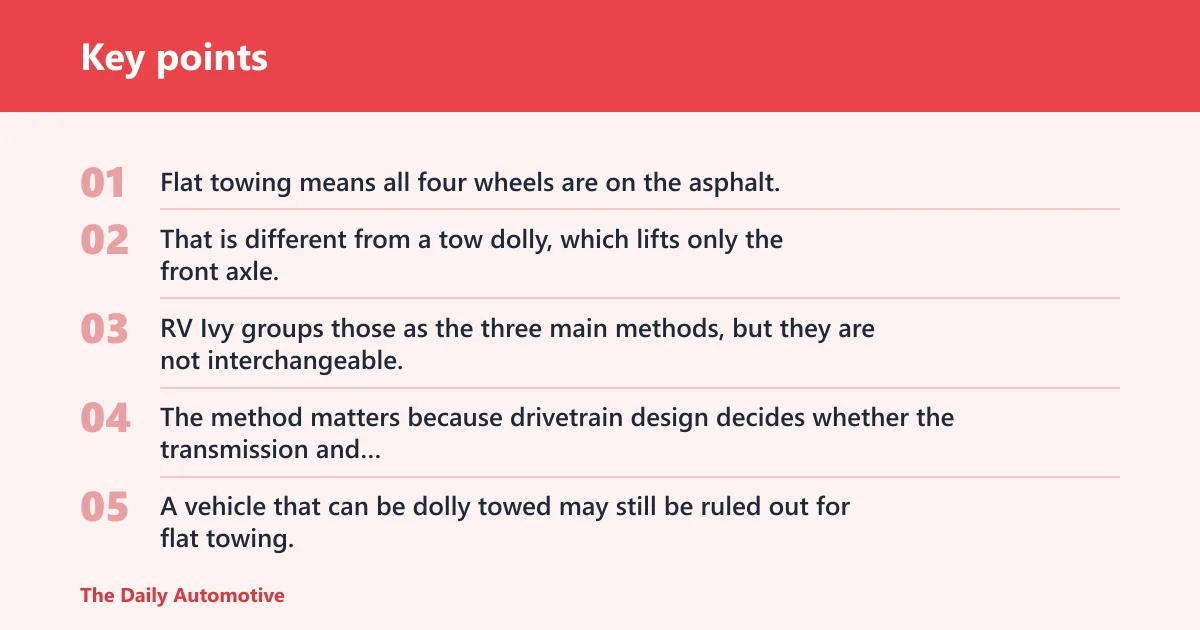


Flat towing means all four wheels are on the asphalt. That is different from a tow dolly, which lifts only the front axle, and different again from a trailer, which carries the whole vehicle off the road surface. RV Ivy groups those as the three main methods, but they are not interchangeable.
The method matters because drivetrain design decides whether the transmission and transfer case can survive being pulled with the engine off. A vehicle that can be dolly towed may still be ruled out for flat towing. A vehicle that needs a trailer may never be approved for four-down towing at all.
Why drivetrain and transmission decide eligibility
Flat towing approval usually depends on the exact drivetrain and transmission, not just the badge on the tailgate. Manual and automatic versions can differ. Four-wheel-drive systems can differ too, especially when the transfer case lacks a true neutral position.
That is why a short model list is not enough. A Jeep Wrangler, for example, has long had a flat-towable reputation, but year, trim, and transmission still matter. The same warning applies to Honda CR-V, Ford F-150, and other common tow candidates.
What RV capacity and hitch rating must match
Your motorhome has limits, and the towed vehicle has weight. Both have to fit the setup. Check the coach’s tow rating, hitch rating, and braking capacity before you shop for a car. A small SUV that looks light enough can still push you over the limit once the tow bar, base plate, and braking system are installed.
Suppose a coach is rated for a modest tow load and you choose a mid-size truck instead of a compact SUV. The truck may be technically towable, but the combination can still exceed the hitch rating. That is a setup problem, not a preference issue.
How do you know if a car can be flat towed?
Start with the owner’s manual for the exact model year, trim, drivetrain, and transmission. If the manual does not approve four-down towing, stop there. If it does, match the required steps exactly, because the wrong procedure can damage the drivetrain even when the vehicle itself is eligible.
Owner’s manual checks before you buy
- Confirm the exact model year.
- Confirm the trim level and drivetrain.
- Confirm the transmission type.
- Look for explicit approval for flat towing.
- Check the speed, distance, and preparation steps listed by the manufacturer.
- Verify that the tow rating and hitch rating on your RV exceed the loaded vehicle and hardware weight.
That sequence matters more than a dealer promise or a forum post. Manufacturer guidance is the only safe starting point, and it can change from one year to the next.
Transmission, transfer case, and trim mismatches
A common first-timer mistake is assuming one trim tells the whole story. It does not. A 4WD version may be approved while a 2WD version is not. A manual transmission may be approved while the automatic in the same body style is not. A transfer case with neutral can be the difference between towable and off-limits.
That is why year-by-year eligibility is the real decision point. Most competitor lists skip that. They name a model and move on. You need the configuration details before you buy the car or the tow equipment.
Red flags that rule a vehicle out
- No flat-tow approval in the owner’s manual.
- Wrong drivetrain, especially when 4WD or neutral transfer case is required.
- Wrong transmission, such as an automatic not listed for four-down towing.
- Missing transfer case neutral when the manual requires it.
- Tow weight that exceeds the coach’s hitch rating or tow rating.
- Owner’s manual limits that conflict with the tow route you plan.
Best SUV and car choices for flat towing
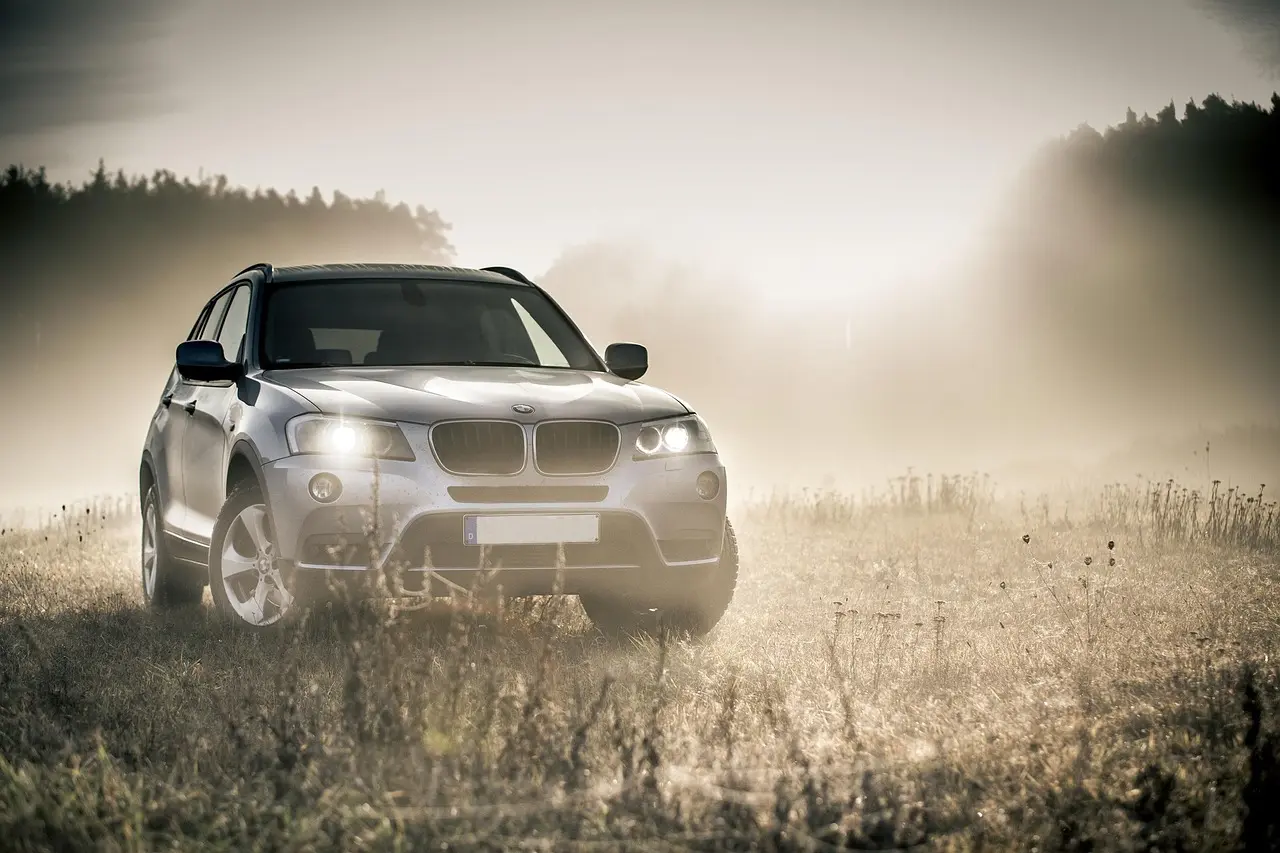
For most RV owners, the strongest candidates are the Jeep Wrangler and select midsize SUVs with manual approval in the owner’s manual. Honda’s CR-V remains a key cutoff case because 2014-and-earlier examples are the usual flat-tow point, while later versions generally are not. Compact options exist too, but their trim and transmission rules are tighter.
Jeep Wrangler
The Jeep Wrangler is the safest default answer for many RV owners because it has a long flat-tow reputation, 4WD availability, and both manual and automatic variants that have been approved in certain years and trims. Curb weight varies widely by model year and configuration, with sources placing it roughly around 3,200 to 4,449 pounds.
That spread matters. A two-door, a four-door, different axles, and different trim packages can change the final number and the tow setup. If you want one vehicle that is widely known for flat towing, the Wrangler still leads the conversation, but the manual must confirm the exact version.
Jeep Grand Cherokee Trailhawk
The Grand Cherokee Trailhawk is a specific towable SUV option, not a blanket approval for every Grand Cherokee. The Trailhawk trim with 4WD and Active Drive II, paired with the 9-speed automatic, is the configuration that gets cited in flat-tow discussions. Check the exact year before buying.
That specificity is the point. A Grand Cherokee badge alone is not enough. The towable setup depends on the trim and drivetrain package, and the wrong version can fall outside the manual’s approval list.
Honda CR-V
The Honda CR-V belongs on any short list because 2014-and-earlier models are the familiar flat-tow cutoff. It is a compact SUV, and curb weight is around 3,400 pounds. Later model years should not be assumed towable without a manual check, because the approval changed.
If you want a compact SUV that is easier to park and daily-drive than a truck, the CR-V can still be a strong candidate. Just do not treat all CR-V years alike. The cutoff is the decision point.
Chevrolet Spark
The Chevrolet Spark manual-transmission variant is one of the lightest budget options, with weight roughly around 2,200 to 2,500 pounds. That low mass helps when an RV has a modest tow rating or when you want the least demanding setup possible. Automatic versions are a different question and need manual confirmation.
It is a good fit for owners who want a small runabout at the campsite and in town. The tradeoff is size and comfort. It is a city car first, tow car second.
Ford Maverick hybrid
The Ford Maverick Hybrid is the hybrid-specific case worth checking. Its towability is tied to the hybrid configuration, and 2023 and 2025 are the model-year references that matter most in current shopping. Do not assume every Maverick is eligible just because the badge is the same. (Motortrend)
This is a compact pickup with a practical footprint for urban use and campground errands. But hybrid-specific guidance changes the equation, so the manual must be the final word.
Best trucks for flat towing
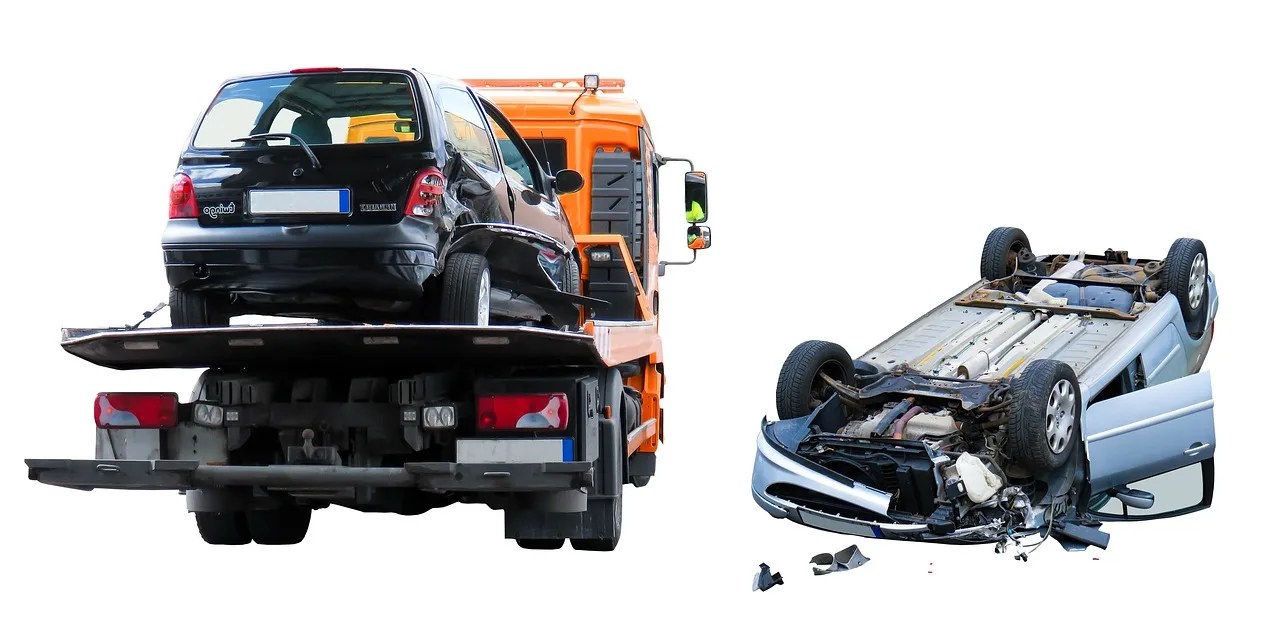
Trucks can work well behind an RV, but they are usually heavier and more likely to push a hitch rating than a compact SUV. The best-known options are the Chevrolet Colorado, GMC Canyon, Ford F-150, and Ram 1500, with 4WD and transfer-case requirements leading the decision.
Chevrolet Colorado
The Chevrolet Colorado is a mid-size truck option, but only the 4WD version with a transfer case that includes neutral belongs on the flat-tow list. The Chevrolet Colorado’s curb weight is roughly 4,300 to 4,600 pounds, so coach capacity matters more here than with a small SUV.
That makes the Colorado a good match for larger motorhomes that have real tow capacity. It is not a casual pick for a lighter RV.
GMC Canyon
The GMC Canyon follows the same basic logic as its Colorado sibling: 4WD is the critical requirement, and the transfer case must support neutral. Like the Colorado, it sits in the mid-size truck class, so the final weight still needs to fit the coach.
If you want a truck bed for gear and a comfortable daily driver at the destination, the Canyon is a sensible option. Just verify the exact year and trim before you buy.
Ford F-150
The Ford F-150 appears on many truck lists because older 4WD models with a manual shift transfer case can be flat towed when the manual says so. Model-year differences matter here. Newer setups may change the answer, and automatic transmission versions need the exact manual approval.
Because the F-150 is so common, it is easy to assume every version works. That is the wrong assumption. Treat the transfer case and the year as the deciding factors.
Ram 1500
The Ram 1500 is often recommended in 4WD-only guidance, including roundups that point to 2010-2018 examples. It is a half-ton pickup with independent rear suspension, and those details can make it a comfortable road vehicle. Tow eligibility still depends on the exact drivetrain and year.
Do not buy one because it is a Ram 1500 and hope for the best. Check the manual, then match the coach rating.
Flat tow decision table
Use this as a first-pass filter, not a final approval list. The owner’s manual for the exact vehicle still decides the answer.
| Model | Model years | Drivetrain/transmission requirements | Approximate curb weight | Tow method allowed | Red-flag exclusions |
|---|---|---|---|---|---|
| Jeep Wrangler | Year and trim specific | 4WD variants; manual and automatic versions vary by year | About 3,200 to 4,449 pounds | Flat tow when the manual allows it | Wrong year, wrong trim, or non-approved transmission |
| Jeep Grand Cherokee Trailhawk | Trailhawk years only | 4WD with Active Drive II and 9-speed automatic | Varies by year and equipment | Flat tow only if the manual approves that exact setup | Non-Trailhawk trims and mismatched driveline equipment |
| Honda CR-V | 2014 and earlier | Manual approval required; later years must be checked separately | About 3,400 pounds | Flat tow for approved years | Post-2014 models without manual approval |
| Chevrolet Colorado | Year specific | 4WD with transfer case neutral | About 4,300 to 4,600 pounds | Flat tow when equipped correctly | 2WD versions and transfer cases without neutral |
| GMC Canyon | Year specific | 4WD with neutral-capable transfer case | Varies by year and trim | Flat tow when equipped correctly | 2WD versions and non-neutral transfer cases |
| Ford F-150 | Older models vary by year | 4WD with manual shift transfer case on older approvals | Varies widely | Flat tow only for approved configurations | Wrong year, wrong drivetrain, or non-approved transfer case |
| Ram 1500 | Often cited for 2010-2018 guidance | 4WD-only guidance; exact year and drivetrain matter | Varies by cab and trim | Flat tow when manual-approved | 2WD versions and unlisted transmissions |
| Chevrolet Spark | Manual-transmission variants only | Manual transmission approval required | About 2,200 to 2,500 pounds | Flat tow for approved manual versions | Automatic versions and unlisted trims |
| Ford Maverick Hybrid | 2023 and 2025 relevance | Hybrid configuration only, with manual approval required | Varies by equipment | Flat tow only if the manual allows the hybrid setup | Non-hybrid versions and unlisted years |
What equipment do you need to tow a car behind an RV?
At minimum, you need a tow bar system rated for the vehicle’s weight, a base plate mounted to the towed vehicle, safety chains, lighting or electrical connections, and a supplemental braking system. In most states, supplemental braking is required for legal and safety compliance, rather than just as a convenience item.
Tow bar system
The tow bar connects the motorhome to the towed vehicle. It has to be rated for the car or truck you plan to pull, not just “close enough.” If the rating is wrong, the setup is wrong.
Base plate and safety chains
The base plate is installed on the towed vehicle and gives the tow bar a mounting point. Safety chains add a second connection layer. Both belong in the setup, along with the electrical hardware needed for signals and lighting.
Electrical connection and lighting
Lighting lets traffic behind you see braking and turn signals from the towed vehicle. That matters at night, in rain, and in heavy traffic. Electrical connections should match the RV and the towed vehicle so signals work the way they should.
Supplemental braking system
A supplemental braking system helps the towed vehicle slow down with the motorhome. It is part of most legal setups because the tow load can be significant. If the state you travel in requires it, skipping it is not worth the risk.
Picture a compact SUV that is approved for flat towing, but the owner pairs it with a tow bar that is below the vehicle’s actual loaded weight. The setup may still connect, but the rating mismatch creates a failure risk the first time the coach needs a hard stop.
What if your vehicle cannot be flat towed?
If your vehicle is not approved for flat towing, a tow dolly or a trailer may be the better answer. RV Ivy notes those as the other two main methods. They cost more, take more storage space, and add setup time, but they can carry vehicles that are not approved for four-down towing.
When a tow dolly makes more sense
A tow dolly can work when front-wheel-drive vehicles are the goal and the manual allows the arrangement. It usually costs less than a full trailer and takes up less room. It also adds weight and requires more hookup steps than flat towing.
When a trailer is the better fit
A trailer is the safer choice when the car has no flat-tow approval and the dolly setup is not allowed or practical. It is also the better answer if you want to avoid drivetrain risk entirely. The tradeoff is storage, cost, and hitch load.
Cost and storage tradeoffs
Flat towing usually wins on convenience. Dollies and trailers usually win on compatibility. If your RV storage bay is already tight, a trailer can be a poor fit. If your car is not flat towable, though, that convenience gap may be worth paying for.
Does towing behind an RV affect the car warranty?
It can, if you tow the car in a way the manufacturer does not approve. Warranty risk usually comes from mismatched drivetrain use, ignored prep steps, or towing a configuration that the owner’s manual does not allow. Follow the manual exactly and keep records of the setup.
What is the best car to tow behind an RV?
The Jeep Wrangler is usually the strongest all-around pick, because it has broad flat-tow recognition, 4WD availability, and multiple approved configurations across years and trims. That said, the best choice for you may be a lighter compact like the Honda CR-V, a budget Spark, or a truck if your coach can handle the weight.
Frequently asked questions
What cars can be flat towed behind an RV?
Cars and light trucks that can be flat towed are the ones the manufacturer explicitly approves for the exact year, trim, drivetrain, and transmission. Common examples include certain Jeep Wrangler versions, Honda CR-V years through 2014, some Chevrolet Spark manuals, and selected trucks with the right transfer case.
Can a Jeep Wrangler be flat towed?
Yes, many Jeep Wrangler configurations are flat-towable, which is why it is such a common RV choice. The exact year, trim, manual or automatic transmission, and 4WD setup still matter. Check the owner’s manual before you buy or hitch up.
Can a Honda CR-V be towed behind an RV?
Yes, but the usual cutoff is 2014 and earlier. Later CR-V model years are not automatically approved. If you are shopping used, confirm the exact year and follow the manual’s towing steps before you commit to the setup.
What trucks can be flat towed behind an RV?
Common truck candidates include the Chevrolet Colorado, GMC Canyon, Ford F-150, and Ram 1500, but only in the configurations the manual allows. For these trucks, 4WD and the correct transfer case or older manual-shift setup are often the deciding factors.
What if my car cannot be flat towed?
If the manual rules it out, use a tow dolly or a trailer instead. A dolly can fit some front-wheel-drive cars. A trailer is the broader fallback when you want to avoid drivetrain risk or the vehicle is not approved for four-down towing.
Products related to this article
Sponsored / affiliate links. As an Amazon Associate I earn from qualifying purchases. I may earn additional commission from eligible campaigns.