The Best Way to Learn Auto Repair: Start with Basics
Start with maintenance, then basic diagnostics, then one repair at a time. Skip bodywork until you can service brakes, fluids, belts, and sensors with confidence. If you ignore that sequence, you waste money on tools, misread symptoms, and turn a cheap fix into a costly one. This guide lays out a low-cost learning path, the right skill order, and where mechanical repair ends and auto body work begins.
Essential Tools and First Repair Steps
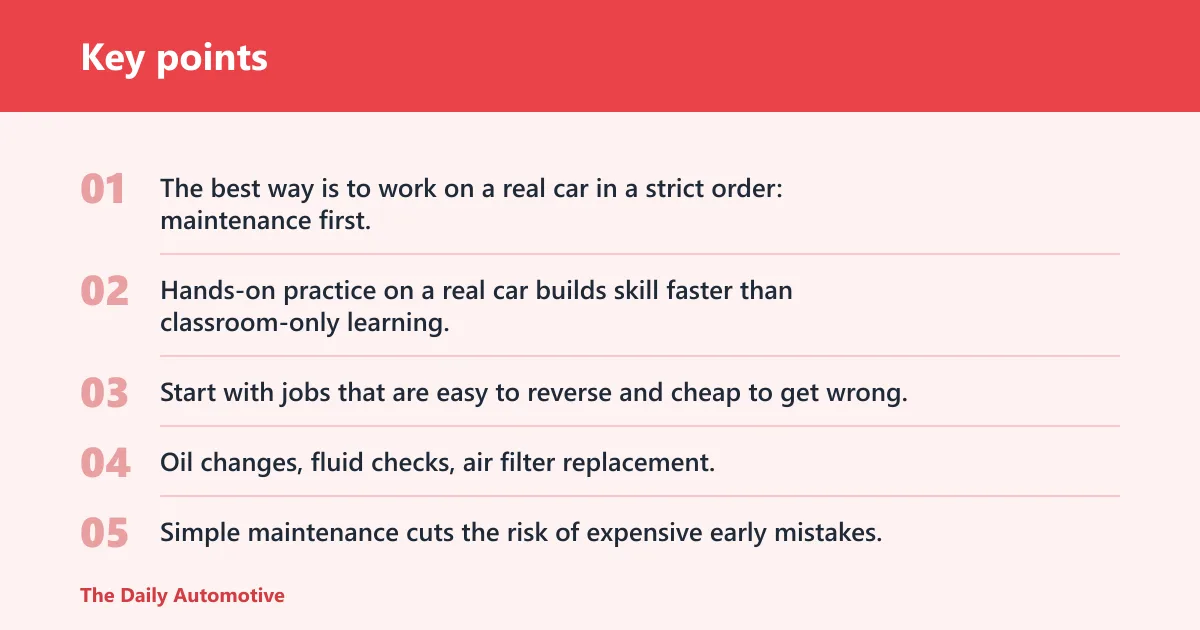


The best way is to work on a real car in a strict order: maintenance first, then simple mechanical repairs, then diagnostics, then harder systems such as brakes, steering, alignment, and electronics. Hands-on practice on a real car builds skill faster than classroom-only learning, and a vehicle-specific shop manual keeps each job tied to the correct procedure.
Start with jobs that are easy to reverse and cheap to get wrong. Oil changes, fluid checks, air filter replacement, and tire pressure checks teach you how fasteners feel, how parts fit, and how to avoid common mistakes.
Start with maintenance, not major repairs
Simple maintenance cuts the risk of expensive early mistakes. A stripped drain plug, a pinched gasket, or an under-torqued wheel lug is much easier to avoid when the job is straightforward and the system is familiar.
A common first-timer mistake is jumping straight to a no-start diagnosis because a video made it look simple. If the battery terminals are corroded or the air filter is packed with debris, the real fix may be basic maintenance, not a complex part swap.
Learn on a real vehicle, not theory alone
Reading about auto repair helps, but it does not build the feel for fasteners, hoses, clips, connectors, and access problems. You need repeated practice on real parts, under the hood and under the car, so the sequence becomes familiar before the work gets expensive.
ATI notes there are nearly 275 million vehicles registered in the United States, and that scale helps explain why practical repair skill matters. The market is large, but the learning path is still personal: one vehicle, one system, one job at a time.
Use a shop manual and videos together
A proper shop manual plus video tutorials is the best combo for beginners. The manual gives vehicle-specific torque values, sequences, and cautions. Videos help you see access points, clip locations, and the order of disassembly before you put a wrench on the car.
Video alone is not enough. Models differ by engine, year, and trim, and even a simple service can change across versions. The manual is the authority for the exact vehicle in front of you.
📊 ATI cites more than 45,000 auto mechanics needed between now and 2026. Source: AUTO.
How do you learn auto repair from scratch?

Build your first repair sequence from oil changes to brake service, then move outward to steering, alignment, and electronics. If you can identify parts, follow a manual, and complete maintenance cleanly, you can move to more complex systems without skipping the basics.
Build a first-job sequence
- Check tire pressure and top off washer fluid.
- Inspect oil level, coolant level, brake fluid, and power steering fluid if the vehicle uses it.
- Replace the engine air filter.
- Change oil at the recommended interval of 5,000 miles or 6 months.
- Rotate into brake pad inspection and basic brake service.
- Move to belts, hoses, spark plugs, and simple sensor replacement.
- Only then start deeper diagnostics and system-level troubleshooting.
This order works because each step teaches a larger set of habits. You learn labeling, safe lifting, torque control, inspection, and how to stop and verify before reassembly.
Choose an older practice vehicle if you can
Older vehicles are simpler and easier to work on, which lowers the financial risk of learning. They often have fewer electronics, less crowded engine bays, and fewer special procedures than newer models with tightly integrated systems.
That does not mean old cars are cheap to fix in every case. It means they are easier to understand at the beginner stage, especially if the car is already paid off and not needed for daily transport.
Learn one system at a time
Do not mix systems too early. Learn engine maintenance first, then brakes, then steering and alignment basics, then electronics and overall engine performance. That sequence keeps the scope manageable and helps you spot what changed when a symptom appears.
Suppose a car develops a rough idle after a filter change and a loose intake clamp. A beginner who knows only part names may start replacing sensors. A beginner who follows the sequence checks the simple air path first, then moves to diagnostics only if the easy causes are ruled out.
What tools do you need to start?
Start with basic hand tools and safety gear, then add diagnostics tools after you can complete maintenance confidently. The starter kit should cover most first jobs without turning the garage into a parts pile of tools you cannot yet use well.
Starter hand tools and safety gear
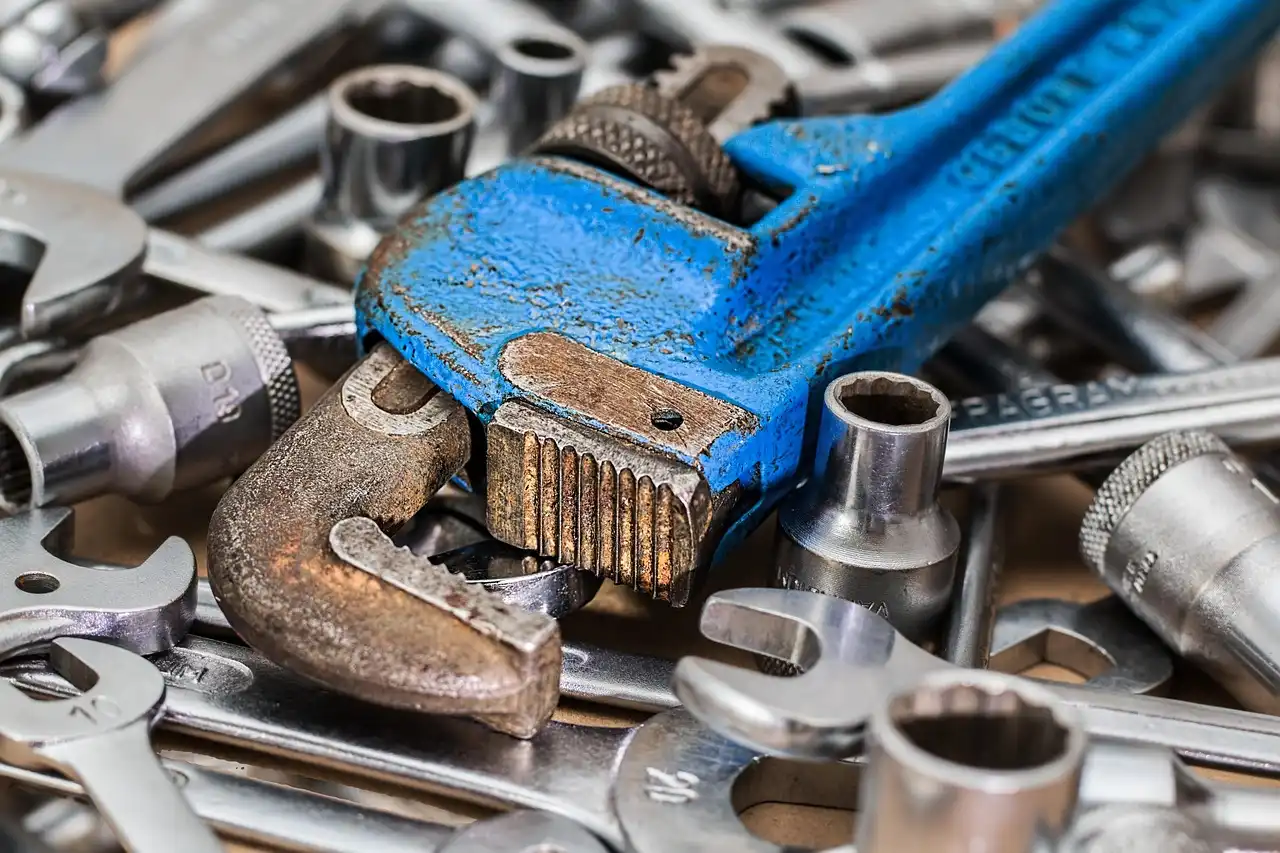
The beginner tool list should include a socket set, wrench set, screwdrivers, pliers, jack, jack stands, multimeter, and torque wrench. That set covers fluids, covers, batteries, wheels, basic electrical checks, and reassembly with correct clamping force.
Use the jack only for lifting. Use jack stands to support the car. That distinction matters every time you work under a vehicle. (wikihow.com)
When to buy a multimeter and torque wrench
Buy the torque wrench early, not late. Wheel lugs, drain plugs, spark plugs, and brake fasteners all benefit from correct torque, and beginners often tighten by feel too much. A multimeter becomes valuable once you begin testing batteries, fuses, grounds, sensors, and basic circuits.
Which tools wait until later
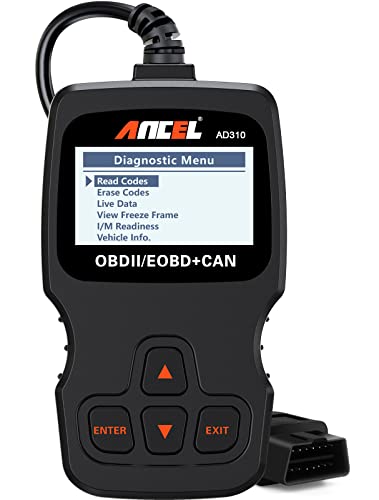
Wait on advanced scan tools, specialty pullers, air tools, and large diagnostic sets until you can identify the system you are testing. Those tools pay off only after you understand the job flow and can explain the symptom in plain terms.
Mechanical repair and body work are different learning tracks
Mechanical repair and auto body work overlap only at the car itself. Mechanical work deals with systems that make the vehicle run and stop. Body work deals with panels, paint, dents, alignment of exterior parts, and finish quality. Learn them on separate tracks.
What belongs in mechanical repair
Mechanical repair can include oil changes, brakes, steering and alignment basics, belts, hoses, sensors, battery testing, and engine repair. It also includes overall engine performance, which means learning how air, fuel, spark, compression, and exhaust affect how the car runs.
What belongs in auto body work
Auto body work can cover dent repair, panel replacement, filler work, sanding, primer, masking, paint application, and finish correction. It also includes measuring panel gaps and checking how body parts fit after replacement.
That path needs different tools, different space, and different tolerances than brake or engine work. A body repair mistake may not stop the car, but it can ruin finish quality and add more labor than the original damage.
How to choose the right path for your goal
If your goal is to save money on ownership, start with mechanical repair. If your goal is collision repair or paint work, start body training separately and do not treat it as an extension of oil changes and brake pads.
Learning roadmap: 12 jobs from easy to harder
This roadmap shows a beginner-to-competent path with difficulty, required tools, risk, and the best practice order. It separates mechanical repair from auto body work so you can choose the right branch instead of mixing tracks too early.
| Job | Track | Difficulty | Required tools | Risk level | Best practice order |
|---|---|---|---|---|---|
| Tire pressure check | Mechanical | Very easy | Tire gauge | Low | First |
| Fluid level check | Mechanical | Very easy | Flashlight, rag | Low | First |
| Engine air filter replacement | Mechanical | Easy | Screwdrivers, basic hand tools | Low | Second |
| Oil change | Mechanical | Easy | Socket set, wrench set, jack, jack stands, torque wrench | Medium | Second |
| Battery swap and terminal cleaning | Mechanical | Easy | Wrench set, pliers, multimeter | Medium | Third |
| Wiper blade and light bulb replacement | Mechanical | Easy | Screwdrivers, pliers | Low | Third |
| Brake pad inspection | Mechanical | Moderate | Socket set, jack, jack stands, torque wrench | Medium | Fourth |
| Brake pad and rotor service | Mechanical | Moderate | Socket set, torque wrench, jack, jack stands | High | Fourth |
| Spark plug replacement | Mechanical | Moderate | Spark plug socket, torque wrench, basic hand tools | Medium | Fifth |
| Sensor testing with a multimeter | Mechanical | Moderate to hard | Multimeter, shop manual | Medium | Fifth |
| Dent repair and panel replacement | Body work | Hard | Body hammers, dollies, trim tools, sanding tools | Medium | Separate branch |
| Primer, filler, and paint preparation | Body work | Hard | Sanders, masks, masking materials, body fillers | High | Separate branch after panel basics |
After this first tier, move into leak diagnosis, brake hydraulics, cooling system service, charging-system testing, and then drivability problems. Body work should stay on its own branch unless your goal is collision repair or refinishing.
Should you self-teach, get an apprenticeship, or go to school?
The right path depends on budget, structure, and whether you want hobby skills or shop work. Self-teaching costs less and moves at your pace. Apprenticeship or training program options add supervision and shop time. School adds formal structure and can help people with little experience.
Cost and structure of each path
Self-teaching is usually the cheapest route, but it depends on discipline and good references. An apprenticeship or training program adds structure, supervised mistakes, and hands-on experience in a shop environment. Formal school can be the most organized route for people who need sequence and feedback.
ATI says formal training helps students get hands-on experience in a shop environment, and that matters when learning has stalled on driveway work alone. It also frames auto mechanic school as a route that can pay off for people with little experience.
Who benefits most from ASE certification
ASE certification is commonly treated as a credential technicians use to signal formal training and competence. It matters most for people aiming at paid shop work, because it gives employers a common reference point for skill level and subject knowledge.
When supervised shop time matters most
Supervised time matters most when the work involves brakes, steering and alignment, electrical diagnosis, or any repair that can create a safety issue if done wrong. A trained instructor or lead technician can stop small mistakes before they become expensive ones.
How long does it take to get competent?
Competence depends on how often you work, what you work on, and whether you are aiming for hobby-level service or job-ready skill. A hobbyist can become useful with maintenance and simple repairs sooner than someone preparing for a paid shop role.
Skill timeline for a hobbyist
A hobbyist who practices regularly can learn basic maintenance, tire checks, air filters, oil changes, and simple part swaps in a short span of repeat sessions. The key is repetition on the same vehicle, because memory and tool handling improve with every service interval.
Skill timeline for a job-ready beginner
A job-ready beginner needs broader system knowledge, better diagnostic habits, and supervised repair time. That path usually means formal training or an apprenticeship, plus study of engine repair, brakes, steering, alignment, and electronics such as the oxygen sensor and powertrain control module.
Signs you are ready for more complex work
You are ready to move up when you can read the manual, complete maintenance without guesswork, torque parts correctly, identify the likely system behind a symptom, and explain why a test is being done. If those steps still feel shaky, stay with lower-risk jobs a bit longer.
Frequently asked questions
What’s the best way to learn car mechanics?
The best way is to work on a real vehicle, use a vehicle-specific shop manual, and start with maintenance before moving to repairs. That sequence teaches tool use, part identification, and safe procedure in the order you will need them.
How do I learn auto body repair?
Learn auto body repair as a separate track from mechanical work. Start with panel fit, dent repair, sanding, filler, and surface prep, then move to primer and paint preparation. Body work needs different tools and different standards than brake or engine jobs.
How do I learn auto body work?
Start with one panel and one repair type, not a whole car. Practice on damaged panels, learn how to read body lines, and focus on fit and finish before paint. If you want collision work professionally, formal body training is worth serious attention.
How long does it take to learn auto body repair?
Basic body repair takes time because finish quality is harder to judge than a mechanical fix. A beginner can learn the sequence of dent repair and prep work fairly quickly, but consistent results usually require repeated practice, better tools, and real feedback from experienced people.
What tools do I need to start learning auto repair?
Start with a socket set, wrench set, screwdrivers, pliers, jack, jack stands, multimeter, and torque wrench. That set supports maintenance, basic brake work, battery checks, and simple diagnostics without pushing you into advanced tooling too early.
Is auto repair school better than self-teaching?
School is better if you need structure, supervised shop time, or a path toward paid work. Self-teaching is better if your goal is low-cost ownership maintenance. Apprenticeship sits between them and often offers the best mix of guidance and real repair volume.
Products related to this article
Sponsored / affiliate links. As an Amazon Associate I earn from qualifying purchases. I may earn additional commission from eligible campaigns.