Bike Rack for Car Hitch: Secure and Easy Transport for Your Bikes
A hitch-mounted bike rack is the right choice if you need secure transport and can match the rack to your hitch size, bike frames, and rear-hatch clearance; many four-bike racks need a 2-inch receiver. Pick the wrong setup and you can block cargo access, stress carbon frames, or buy a rack that cannot carry e-bikes or fenders safely. This guide explains fit limits, tilt and swing-away access, lock options, and which rack style fits mixed bike loads best.
Best overall: Thule Verse. It supports 60 lb per tray, fits 1.25-inch and 2.0-inch hitches, and accepts tires up to 4.75 inches wide. That mix covers a broad range of modern bikes without forcing you into a single-use rack. (Caranddriver)
Top hitch rack picks


Best value: Thule Outpace. It is a tray rack for two bikes, with a rating of about 55 lb per bike. That is enough for many adult bikes and some heavier models, while keeping the rack simpler than many premium carriers.
Best budget: Hollywood Racks HR200Z. It holds two bikes at 45 lb per bike, which fits lighter adult bikes and many hybrid or commuter setups at a lower spec level than e-bike-focused racks.
Best for e-bikes: Thule Epos. It carries bikes up to 75 pounds each, which is the kind of headroom heavy e-bikes usually need. If your bike is close to that limit, you should still check wheelbase, tire width, and frame shape before buying.
Bike rack decision table
This table turns common bike-owner setups into rack requirements. Start with the receiver size, then check weight, rear access, and clearance risks. A rack that misses one of those points can fit on paper and fail on the car.
| Scenario | Minimum hitch size | Needed capacity | Tilt-away needed? | Common fit failure risks |
|---|---|---|---|---|
| One-bike setup | 1.25-inch or 2-inch, depending on rack | At least the bike’s actual weight, with margin | Useful, not always required | Short wheelbase trays may miss long wheelbases; hatch contact on some hatchbacks |
| Two-bike household | Usually 2-inch for broader rack choice | Per-bike limit plus enough spacing between bikes | Helpful for daily cargo access | Handlebar overlap, frame clash, bumper interference |
| Family use | 2-inch is the safer default | Higher total rack limit and easy loading height | Often yes | Mixed frame sizes, child bikes, step-through frames, strap routing problems |
| E-bike use | 2-inch is common for heavier racks | Match the heaviest bike first | Recommended if rear cargo access matters | Weight limit too low, tray flex, wheelbase too long, battery weight ignored |
| Fat-tire bike | Usually 2-inch for stability and capacity | Enough for wide tires and heavier frames | Useful, but not the main constraint | Tire width limit too narrow, strap too short, tray sidewalls too close |
| Tight-garage parking | Either size, but folded depth matters | Only as much as the bikes require | Yes, if you need to open the rear regularly | Folded rack still sticks out, bumper contact, garage door clearance issues |
How do you choose the right hitch rack?
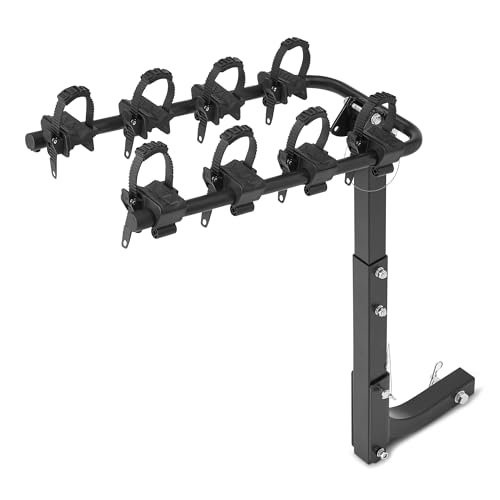
The right rack starts with the receiver, then the bike mix, then rear access. Tray racks usually fit more bike shapes and heavier bikes. Hanging racks can be simpler and cheaper, but they depend more on top tubes and can be less friendly to step-through frames, fenders, and some carbon bikes.
Match the receiver size
Check whether your vehicle has a 1.25-inch or 2-inch receiver. A 2-inch hitch usually opens up more rack choices, especially for heavier or four-bike setups. A 1.25-inch hitch can work well for lighter two-bike use, but the rack selection narrows fast once weight climbs.
Some racks fit both sizes directly. For example, the Thule Verse fits 1.25-inch and 2.0-inch hitches, and the Swagman XTC2 fits 1¼-inch and 2-inch receiver tubes. That matters because adapter sleeves are not the same as a direct fit, and some accessories change how firmly the rack sits.
Check bike weight and tire limits
Weight limits need to be read two ways: per-bike and total rack capacity. A rack can be rated for two bikes yet still fail on a single heavy e-bike if the per-bike limit is too low. The rack must clear your heaviest bike, not your lightest one.
Specific examples matter here. Thule Verse supports 60 lb per tray, Thule Outpace carries two bikes at 55 lb per bike, Hollywood Racks HR200Z holds two bikes at 45 lb per bike, Swagman XTC2 has a 35 lb per bike limit, Küat Sherpa 2.0 holds up to 40 pounds each, and Thule Epos carries bikes up to 75 pounds each.
Decide on tray or hanging style
Tray or platform racks support the wheels, which helps with mixed frame shapes, step-through bikes, and heavier bikes. Hanging racks suspend the bike by the frame and can cost less, but they ask more of the frame shape and often need extra attention for fenders or unusual tubes.
A tray rack is the safer default if your household includes different bike types. A hanging rack can still make sense when the bikes are similar, the budget is tighter, and you do not need the extra wheel support.
Plan for rear access and storage
Tilt-away designs let the rack move down so you can reach the hatch or tailgate. That is useful on many SUVs, wagons, and hatchbacks. Fold-up storage keeps the rack closer to the vehicle when it is empty, which helps in parking and garage storage.
Tilt-away and swing-away are not the same. Tilt-away is for access directly behind the vehicle. Swing-away moves the whole rack out to the side, which helps when rear doors or tailgates need a much wider opening. If your hatch still hits the rack when tilted, a tilt feature alone will not solve the problem.
Start with your heaviest bike and your most awkward vehicle feature. If the heaviest bike is an e-bike, look for a higher per-bike limit first. If the vehicle has a deep hatch or tailgate, focus on tilt-away or swing-away clearance. If your garage is tight, folded depth matters as much as loading capacity.
- Confirm the hitch receiver size on the vehicle.
- Check the heaviest bike’s weight, wheelbase, and tire width.
- Choose tray or hanging style based on frame shapes and fenders.
- Decide whether tilt-away access is required for your cargo area.
- Check folded storage depth if the rack will stay on the vehicle.
- Verify lock points for the hitch, frame, and wheels.
Higher price often buys better convenience, stronger materials, or more flexibility, but only if the rack actually fits the vehicle and the bikes. The best rack is the one that clears the hatch, matches the hitch, and holds the heaviest bike without compromise.
What hitch size do you need?
Most drivers should start with the receiver size printed on the vehicle or hitch. A 1.25-inch receiver can support many light and midweight two-bike racks. A 2-inch receiver is usually the better starting point if you want heavier capacity, four-bike options, or a more stable-feeling platform with fewer compromises.
1.25-inch vs 2-inch receivers
A 1.25-inch hitch can be enough for lighter bikes and compact racks. A 2-inch hitch is the safer pick for e-bikes, fat-tire bikes, and larger family loads. It also tends to offer a deeper catalog of trays, tilt mechanisms, and locking hardware.
Some racks are built for both sizes, but the vehicle still matters. A small crossover with a low bumper and a deep rear hatch may create contact even when the receiver size is technically correct. Receiver size is a starting point, not the whole answer.
When hitch extenders create problems
Hitch extenders can create extra clearance behind a spare tire, bumper, or tailgate, but they also add leverage. That extra distance can increase wobble, reduce ground clearance, and make a rack feel less planted under load. They can also shorten the effective weight margin of the setup.
A common first-timer mistake is choosing an extender to solve bumper contact, then discovering the rack now sits farther out and bounces more on rough pavement. If you need an extender, treat it as a last step, not a routine add-on.
Vehicle fit and bumper clearance
Some vehicle shapes create trouble even with the right rack. Deep rear bumpers, steep hatch angles, rear-mounted spares, and tall liftgates can interfere with tilt or folding functions. A rack may mount correctly yet still make the hatch useless once loaded.
Picture a compact SUV with a high liftgate and two bikes on a tray rack. The rack may tilt enough for partial cargo access, but the hatch can still stop short if the handlebars sit too close to the glass. That is why rear geometry matters as much as hitch size.
Can it carry your bike mix?
It can, if the rack matches the heaviest bike, the widest tire, and the longest wheelbase in the group. Mixed households create the hardest fit problems. A rack that suits a lightweight road bike may fall short on a single e-bike, and a rack for an e-bike may feel oversized for smaller bikes.
E-bikes and heavy frames
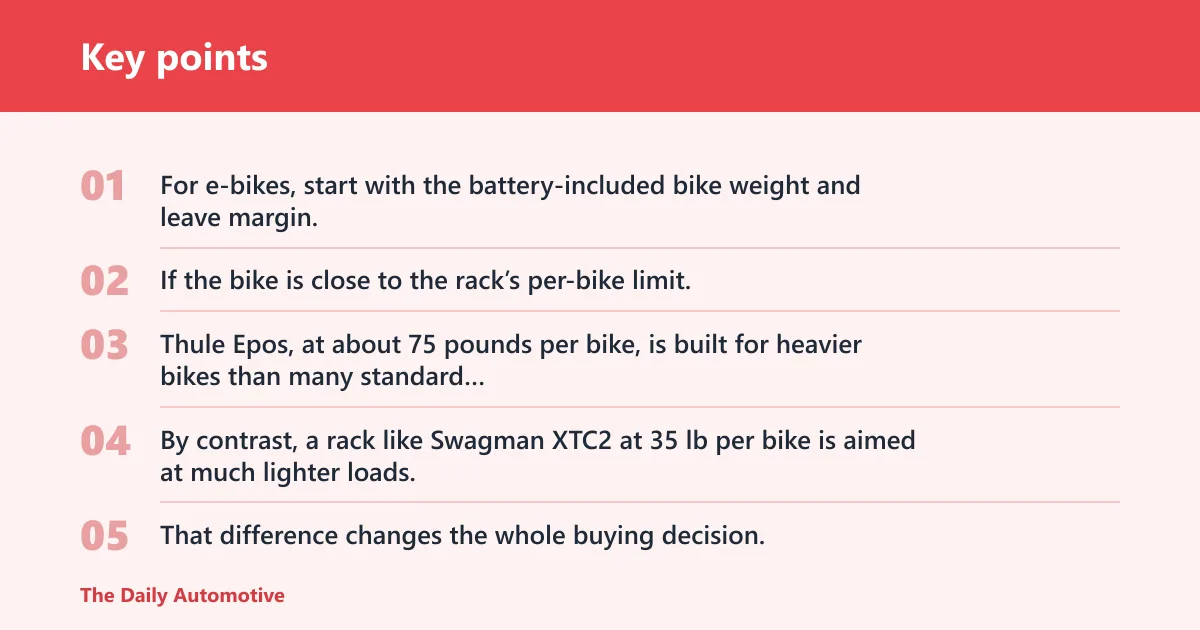
For e-bikes, start with the battery-included bike weight and leave margin. If the bike is close to the rack’s per-bike limit, choose a stronger rack rather than hoping the rating is “close enough.” Weight belongs on the spec sheet, not in a guess.
Thule Epos, at about 75 pounds per bike, is built for heavier bikes than many standard tray racks. By contrast, a rack like Swagman XTC2 at 35 lb per bike is aimed at much lighter loads. That difference changes the whole buying decision.
Fat tires and wide rims
Fat tires need more than a strong tray. You need enough tire width clearance, secure wheel straps, and side spacing that does not pinch the tire sidewall. Thule Verse lists tire compatibility up to 4.75 inches wide, which places it in the fat-tire-capable group.
If your tire width is near the rack limit, check how the strap locks down and whether the wheel tray shape leaves enough room for the tread. A rack can technically fit a wide tire and still be awkward to secure.
Step-through frames, fenders, and long wheelbases
Step-through frames often work better on trays than hanging racks because the frame shape does not need a top tube. Fenders add another point of contact risk, especially with wheel hooks or straps that sit close to the tire. Long wheelbases can run out of tray length if the rack is compact.
One practical rule: if the bike has a nonstandard frame shape, full fenders, or a long wheelbase, prefer a tray rack with wheel support and clear strap routing. That reduces the number of points where the rack can touch the wrong part of the bike.
How secure is the rack?
Security features should be judged by what they lock. A hitch lock protects the rack from being pulled out of the receiver. A frame clamp or arm holds the bike to the rack. A wheel strap helps keep the bike from shifting, but it does not stop theft by itself.
Integrated hitch locks
An integrated hitch lock secures the rack’s connection to the vehicle. That helps prevent quick removal of the whole rack. It does not secure the bike by itself, and it does not stop someone from removing loose accessories if the bike is left partially unlocked.
If the rack includes a locking hitch insert, that feature is most useful for overnight parking, trailhead stops, and apartment lots. It is less useful if the bike itself is not also secured to the carrier.
Frame clamps and wheel straps
Frame clamps can hold the bike more firmly than a simple strap, but they must be used carefully on carbon frames and unusual shapes. Wheel straps are easier to use on many trays, and they reduce side-to-side movement when the tray geometry is right.
The strongest setup is the one that locks the rack to the hitch and the bike to the rack. If only one part is secure, theft risk remains on the other part.
What different lock points actually protect
Ask a simple question: what would a thief need to remove first? If the hitch is locked but the bikes are not, the bikes can still be taken. If the bikes are strapped but the rack is not locked to the receiver, the whole unit can be removed. Each lock point covers a different failure mode.
Rear access and storage
Tilt-away racks help with hatch access. Fold-up racks help with storage. If you need both, check whether the rack can do both without blocking the camera, plate, or lights. The two features solve different problems.
Tilt-away designs
Tilt-away is the feature to look for when you need to reach the cargo area with bikes loaded. It is most useful for groceries, camping gear, and day bags. It is not a cure for every vehicle shape, because some hatches still hit the rack before they fully open.
Fold-up position
Fold-up storage keeps the rack close to the vehicle when it is empty. That helps in parking spots and garages. It can still leave enough depth to matter, so check the folded length if your garage is tight or the vehicle already parks close to a wall.
When a swing-away setup is still needed
Choose swing-away only when tilt-away will not give enough clearance. That usually means a rear door or tailgate that needs a wide, unobstructed opening. Swing-away systems are more complex and heavier, so they make sense for specific vehicle shapes rather than general use.
How do you keep bikes secure on a hitch rack?
Use the rack’s lock points in layers. Lock the hitch insert, then secure the bike frame or wheel attachment, then tighten wheel straps fully. If the rack includes a cable lock, use it as a theft deterrent, not as the only protection. The goal is to make removal slow and obvious.
Say your household has one 52 lb e-bike and one 28 lb hardtail. That mix rules out a 35 lb-per-bike rack immediately, even if the second bike is light. The correct choice is based on the heaviest bike, not the average.
Suppose your SUV has a rear hatch that clears the rack when empty but not when loaded with two bikes. Tilt-away may fix the cargo issue; a fold-up position will not. If the hatch still contacts the bikes, you need more rear clearance or a different rack geometry.
Quick picks
Use this as a fast filter before you compare details. The right rack depends on the bikes you own and the vehicle you drive.
| Pick | Best for | Key spec | Trade-off |
|---|---|---|---|
| Thule Verse | Mixed bike ownership and wider tire coverage | 60 lb per tray; 1.25-inch and 2.0-inch hitches; up to 4.75 inches wide tires | More rack than a simple commuter setup may need |
| Thule Outpace | Two-bike households that want a tray rack | Two bikes at 55 lb per bike | Less heavy-duty than e-bike-focused carriers |
| Hollywood Racks HR200Z | Budget-conscious two-bike use | Two bikes at 45 lb per bike | Lower weight ceiling than stronger tray racks |
| Swagman XTC2 | Lighter bikes and simpler receiver fit | 35 lb per bike; 1¼-inch and 2-inch receiver tubes | Not a fit for heavier bikes |
| Küat Sherpa 2.0 | Light to midweight bikes with premium fit priorities | Up to 40 pounds each | Not the choice for heavy e-bikes |
| Thule Epos | Heavier e-bikes | Up to 75 pounds each | More capability than many casual riders need |
How much weight can a hitch bike rack hold?
That depends on both the rack and the hitch. A rack’s per-bike rating is the first limit to check, then the total rack limit, then the vehicle’s hitch rating. If any one of those is lower than the bike load, that lower number wins.
Per-bike limit versus total rack limit
A two-bike rack may list two separate per-bike limits and a total limit for the whole carrier. Use the lower relevant figure when comparing to your bikes. If one bike is heavy and one is light, the heavier bike sets the standard for the whole purchase.
When a rack is suitable for e-bikes
An e-bike-ready rack should have enough per-bike capacity for the heaviest bike you plan to carry, plus secure wheel retention and stable mounting. Many e-bikes also need more room for long wheelbases and wider tires. A low weight limit removes the rack from consideration quickly.
Are platform or hanging hitch bike racks better?
Platform racks are usually better for mixed bike loads, step-through frames, and heavier bikes. Hanging racks can be simpler and cheaper, but they rely more on frame shape and can be awkward with fenders or odd tubing. If your bikes are very different from one another, a platform rack is the safer bet.
If your bikes are similar, lighter, and easy to hang, a hanging rack can still make sense. But for most households comparing secure and easy transport, platform racks solve more fit problems.
Are hitch bike racks better than trunk racks?
For security and stability, hitch racks are usually the better choice. They mount to the vehicle’s receiver hitch, which keeps the load lower and typically steadier than a trunk rack. They also tend to make loading easier than lifting bikes onto a roof rack, and they can improve cargo access compared with packing bikes inside the vehicle.
Trunk racks still have a place if your vehicle lacks a hitch and the bikes are light. But they usually depend more on the vehicle’s body panels and can be less secure against theft and movement than a properly matched hitch rack.
Frequently asked questions
What is the best hitch bike rack for a car?
The best rack depends on your hitch size, bike weight, and rear clearance. For broader fit and heavier bikes, Thule Verse is a strong starting point because it supports 60 lb per tray, fits 1.25-inch and 2.0-inch hitches, and accepts tires up to 4.75 inches wide.
How do I choose a hitch bike rack for my car?
Match the receiver size first, then check the heaviest bike, tire width, and wheelbase. After that, decide whether you need a tray rack, a hanging rack, tilt-away access, or fold-up storage. A rack that fits your vehicle shape matters more than brand rank.
Can a hitch bike rack carry an e-bike?
Only if the rack’s per-bike rating is high enough. Many standard racks are not suitable for e-bikes. Look for a higher-capacity tray rack such as Thule Epos, which carries bikes up to 75 pounds each, and confirm the vehicle hitch rating too.
Do hitch bike racks let you open the trunk?
Sometimes. Tilt-away racks are made for rear access, but clearance depends on the vehicle’s hatch shape and the bikes loaded on the rack. Fold-up storage does not open the cargo area. If your tailgate needs wide clearance, swing-away may be the better answer.
Products related to this article
Sponsored / affiliate links. As an Amazon Associate I earn from qualifying purchases. I may earn additional commission from eligible campaigns.