Interstate Car Battery Review: Is It Worth It?
Interstate is a sound replacement battery when you match the line to the vehicle: AGM for start-stop systems and heavy accessory loads, flooded for basic cars, and the better buy only when the warranty and retailer support beat the price. Pick the wrong type and you can cut battery life, lose start-stop function, or pay twice after a premature failure. This guide breaks down Interstate’s main battery lines, warranty terms, and when a competing brand is the better buy.
Verdict on Interstate batteries


Interstate is worth considering, but not as a default buy. Value depends on line, chemistry, fit, and the retailer selling it. If you need a conventional replacement and the price is competitive, Interstate can make sense. If your vehicle has start-stop, heavy electronics, or strict OEM battery requirements, the exact line matters more than the badge.
Interstate’s typical real-world lifespan is 3 to 5 years. That is normal for a mass-market replacement battery, not outstanding, and heat, short trips, and chronic undercharging can shorten it. The better decision is often not “Interstate or not,” but “which Interstate line, and under which warranty?”
Best-fit use cases
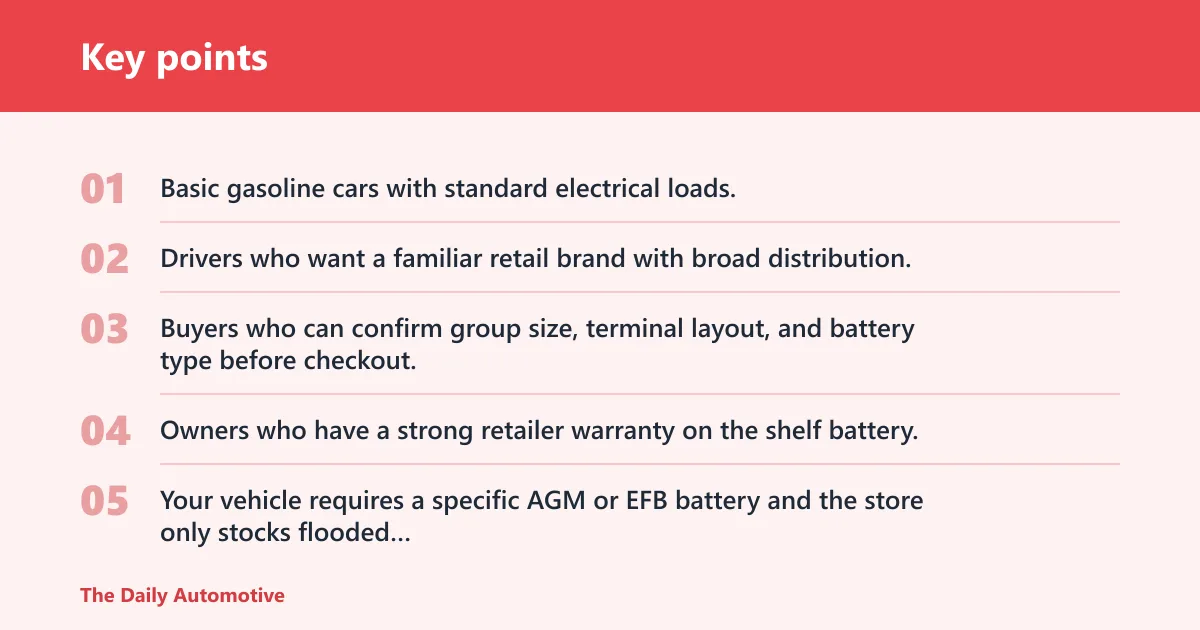
- Basic gasoline cars with standard electrical loads.
- Drivers who want a familiar retail brand with broad distribution.
- Buyers who can confirm group size, terminal layout, and battery type before checkout.
- Owners who have a strong retailer warranty on the shelf battery, not just a long printed term.
When to pass on Interstate
- Your vehicle requires a specific AGM or EFB battery and the store only stocks flooded lead-acid.
- You drive mostly short trips and can only buy an entry-level line with a short warranty.
- You live in sustained heat and the available battery is a lower-tier flooded unit.
- The retailer’s warranty terms are weak enough that a cheaper competing battery is safer value.
Interstate battery decision matrix
Use this table to match the Interstate line to the job, not to the brand name alone. The right answer changes with climate, charging pattern, and how much the vehicle asks from the battery.
| Use case | Recommended Interstate line | Battery type | Key spec to verify | Likely warranty risk | Avoid if conditions |
|---|---|---|---|---|---|
| Cold climate | MTP or MTZ | Flooded or AGM, depending on vehicle spec | CCA must meet or exceed OEM requirement | Medium if you buy a low-CCA base line | Your car calls for AGM and you buy flooded instead |
| Hot climate | MT or MTZ | Flooded for basic cars; AGM for demanding cars | Reserve capacity plus heat-tolerant build | Medium to high if the battery sits in engine heat | You plan to keep the car long term and only see stop-and-go traffic |
| Short-trip driving | MTZ or a correct AGM option in MTX | AGM preferred | Reserve capacity and recharge behavior | High if the alternator rarely restores full charge | You rarely drive long enough to recover from starts and accessory use |
| Start-stop vehicles | MTX | AGM or EFB | Must match original battery type | High if you replace AGM/EFB with flooded | You cannot confirm the OEM battery type from the label or manual |
| High-electronics vehicles | MTX or MTZ | AGM | Reserve capacity and correct group size | Medium if accessory loads outpace capacity | You only compare CCA and ignore reserve capacity |
| Budget replacement | M or MT | Flooded lead-acid | Fit and minimum CCA | Low upfront, higher if the warranty is short | Your vehicle needs AGM, EFB, or a larger reserve |
Which Interstate line should you buy?
Start with the vehicle’s original battery type, then choose the closest Interstate line that matches it. Interstate M is the entry-level automotive line. MT is the core traditional battery line for hot to moderate climates. MTP is positioned for cold to moderate climates, while MTX adds AGM and EFB options for start-stop vehicles. MTZ is the premium line in the family.
M and MT positioning
M and MT fit the simplest replacement jobs. M is the entry-level line, so it makes the most sense when you want a basic flooded battery and the vehicle does not ask for anything special. MT is the safer mainstream pick when climate is warmer and the vehicle is a standard non-start-stop model.
MTP and MTX for higher-demand vehicles
MTP is the stronger choice when cold starts matter more, especially if your vehicle needs a conventional battery with better cold-climate focus. MTX is the line to watch for start-stop applications because it includes AGM and EFB options. That distinction matters. A start-stop car with the wrong chemistry can suffer poor charge acceptance or system faults.
MTZ and premium fit considerations
MTZ sits at the premium end of the product family. That does not mean every driver needs it. It makes the most sense when the vehicle has higher accessory demand, tighter performance expectations, or a buyer wants the stronger line and can justify the cost. MTZ also matters when the warranty and retail support are clearly better than cheaper options.
What to verify on the label
- Confirm the group size printed for your vehicle.
- Check whether the battery is flooded, AGM, or EFB.
- Verify cold cranking amps meet or exceed the OEM requirement.
- Check reserve capacity if the car has many electrical loads.
- Match terminal position and hold-down style.
Is an Interstate AGM worth it?
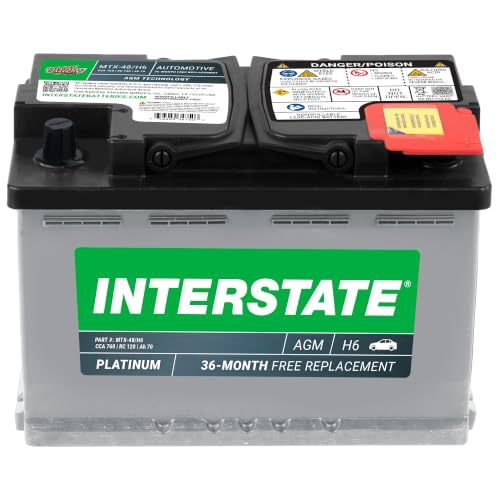
An Interstate AGM is worth the extra cost when the vehicle calls for it, when accessory loads are high, or when the battery lives in a harsh environment. AGM batteries use absorbed glass mat construction and are sealed, spill-proof designs with better vibration resistance. They are not the best answer for every car, but they are often the correct one for modern vehicles.
AGM versus flooded lead-acid
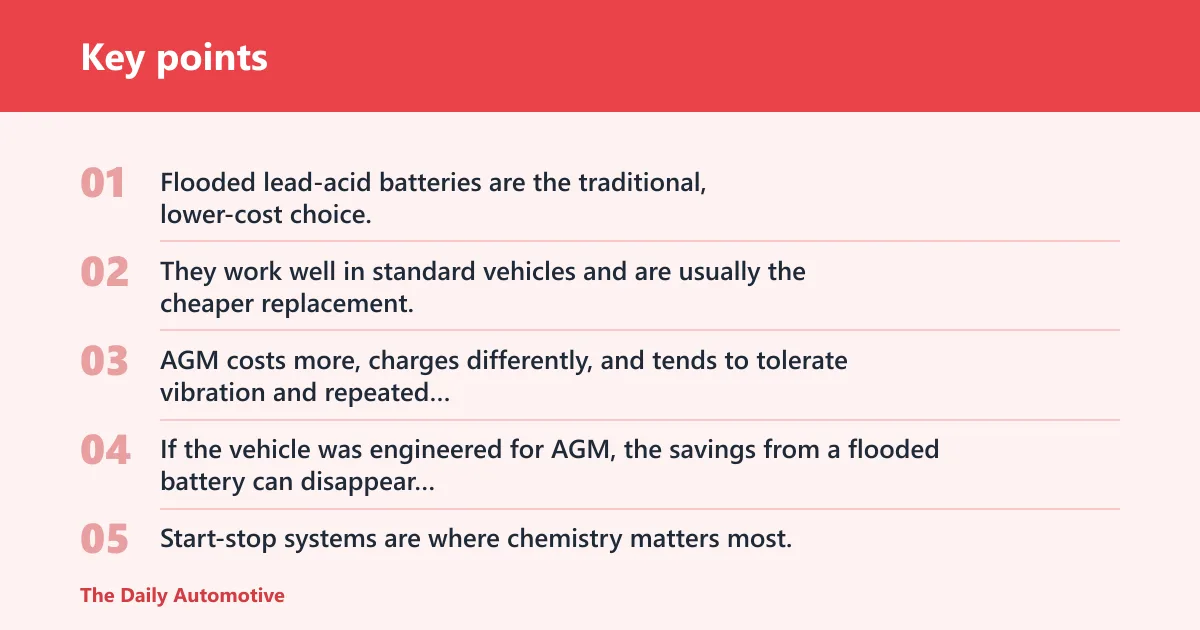
Flooded lead-acid batteries are the traditional, lower-cost choice. They work well in standard vehicles and are usually the cheaper replacement. AGM costs more, charges differently, and tends to tolerate vibration and repeated cycling better. If the vehicle was engineered for AGM, the savings from a flooded battery can disappear fast if performance suffers.
Start-stop compatibility
Start-stop systems are where chemistry matters most. Many of these vehicles require AGM or EFB, and replacement should match the original battery type and charging strategy. Swapping to a flooded battery in a start-stop car can shorten life and may upset system operation. Interstate MTX is the line that matters here because it includes AGM and EFB options.
Accessory loads and vibration resistance
AGM is also the better match for vehicles with lots of electronics, longer idling with accessories running, or mounting locations that see more vibration. Picture a crossover with remote start, heated seats, and repeated school-run trips in winter. The battery gets hit with frequent starts and limited recharge time, so the AGM’s better charge acceptance and durability become practical advantages.
When flooded is still the smarter buy
Flooded lead-acid still wins on price for simple vehicles. A common first-timer mistake is buying AGM because it sounds better, then paying extra for capability the car does not need. If your sedan has no start-stop system, few accessories, and a standard charging setup, an MT or similar flooded Interstate can be the smarter purchase.
What to check before you buy
Battery shopping is mostly about fit and requirements. The wrong group size, terminal layout, or battery type can create more trouble than any difference between brands. A battery that starts the car today is not a good buy if it does not match the vehicle’s actual specification.
Group size and dimensions
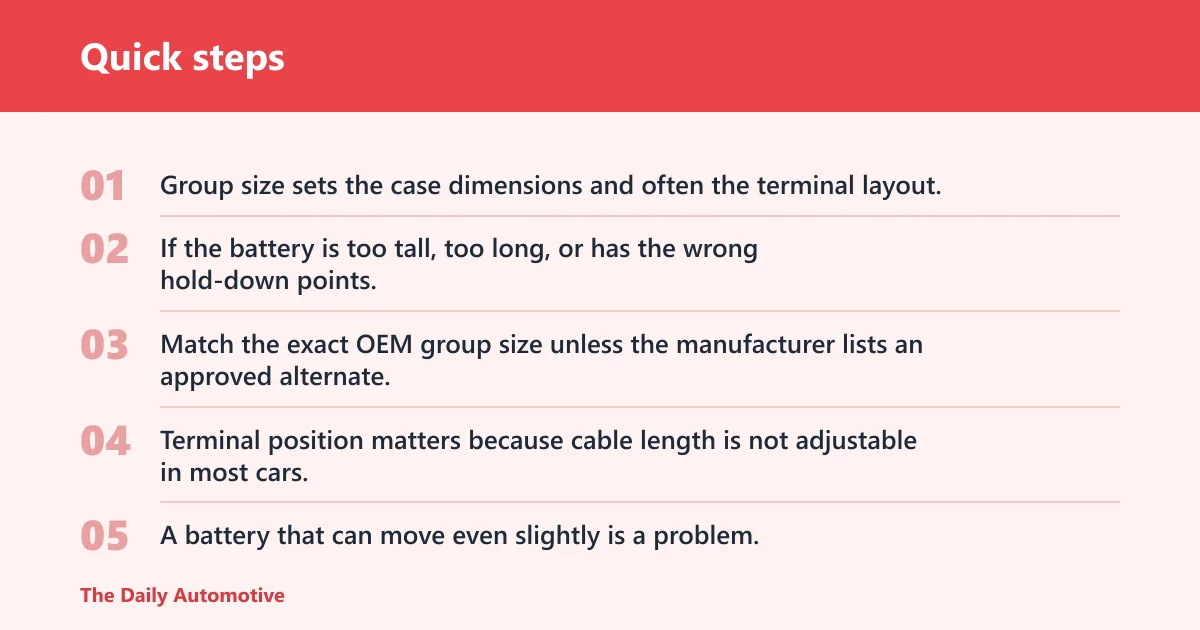
Group size sets the case dimensions and often the terminal layout. If the battery is too tall, too long, or has the wrong hold-down points, it may not fit safely. Match the exact OEM group size unless the manufacturer lists an approved alternate.
Terminal position and hold-down style
Terminal position matters because cable length is not adjustable in most cars. So does the hold-down style. A battery that can move even slightly is a problem, especially in vehicles that see vibration or rough roads. Secure fit is part of battery life.
CCA and reserve capacity
CCA measures starting power, especially in cold weather. It should meet or exceed the vehicle requirement. Reserve capacity matters too because it shows how long the battery can support loads if charging is weak or accessories stay on. CCA alone is not enough for a vehicle that sits at idle with the lights, fan, and infotainment running.
OEM battery type match
If the original battery was AGM or EFB, replace it with the same type unless the vehicle maker allows otherwise. That rule is especially important for start-stop systems and some newer charging strategies. The battery case may look similar, but the internal construction is not interchangeable in practice.
Say your compact SUV uses a group 48 AGM battery and you mostly drive five-minute errands. A cheap flooded replacement may crank the engine today, but repeated short trips can leave it undercharged and shorten its life fast. Matching the AGM spec is the safer buy.
Pros and cons
Pros
- Broad line range from entry-level to premium.
- Clear fit for many mainstream vehicles.
- MTX gives start-stop buyers AGM and EFB options.
- MTZ offers the premium tier in the family.
- Widely distributed through major retail channels.
Cons
- Not every Interstate battery is built to the same standard or chemistry.
- Warranty value changes a lot by retailer.
- Short-trip and hot-weather use can shorten life quickly.
- Wrong chemistry choice can disable start-stop performance.
- Some channels offer proration instead of a free replacement.
How long do Interstate batteries last?
Interstate batteries typically last 3 to 5 years in real-world use. That range is normal, but it is not guaranteed. Heat, short trips, parasitic drain, and undercharging are the biggest life killers. The battery can be fine on paper and still fail early if the vehicle never gives it a full recharge.
What shortens battery life
Hot weather speeds chemical aging. Short-trip driving leaves the battery undercharged. High accessory loads pull more reserve capacity than a basic flooded unit may comfortably provide. Parasitic drain from an electrical fault can drain even a new battery. These are the failure patterns to watch, not just age alone.
Warranty terms and retailer differences
Warranty value depends on the purchase channel. Interstate’s warranty terms vary by retailer and model, and that can matter more than the brand name on the case. Costco’s Interstate battery warranty is a prorated refund, not a free replacement, so the advertised coverage length is not the whole story. MTZ has a 48-month advertised free-replacement period, MTX 36 months, MTP 30 months, and MT 24 months.
Suppose you buy a battery for a truck that lives in a hot garage and sees only short city hops. A 48-month free-replacement label looks better than a 24-month label, but the practical value is even higher if the retailer honors a straight exchange instead of a prorated refund. That difference changes the real cost of failure.
Who makes Interstate car batteries?
Interstate batteries are primarily made by Clarios, formerly Johnson Controls, and Interstate also sources some batteries from East Penn Manufacturing. That answer matters less than the exact line, type, and warranty attached to the battery you are buying. Two Interstate batteries on different shelves may not be the same product in the ways that affect ownership.
The distribution model also matters. Interstate sells through multiple retail channels, so the warranty terms and the stock on hand can vary. A premium line sold with one store’s free-replacement policy can be a better buy than a cheaper-looking battery sold with weak support.
Are Interstate car batteries good?
Yes, Interstate batteries are generally good as replacement batteries, but only when the line matches the vehicle. The brand’s spread from M to MTZ is useful because it covers basic cars, colder climates, and start-stop vehicles. The weakness is not the name; it is assuming every Interstate battery is interchangeable.
Frequently asked questions
Are Interstate car batteries the best?
No single battery brand is the best for every car, and Interstate is no exception. It can be a very good choice when the line, chemistry, and warranty fit the vehicle. If the retailer terms are weak or the wrong chemistry is stocked, another brand can be the better purchase.
Are Interstate batteries good for start-stop vehicles?
Yes, if you buy the right line. Interstate MTX includes AGM and EFB options, which are the types most start-stop vehicles require. Do not treat a flooded battery as an acceptable substitute unless the vehicle maker specifically allows it. Start-stop systems are sensitive to battery chemistry and charge behavior.
Are Interstate batteries good in hot weather?
They can be, especially the MT line that is described as the core traditional battery line for hot to moderate climates. Heat still shortens battery life, though, so a battery in a hot region may age faster than the same battery in mild weather. Strong warranty support matters more there.
How long are Interstate batteries good for?
In typical real-world use, Interstate batteries are good for 3 to 5 years. That range can shrink quickly in hot climates, with short-trip driving, or when the charging system never fully restores the battery. The best way to protect that lifespan is to buy the correct chemistry and reserve capacity.
Does the retailer warranty matter more than the Interstate brand?
Often yes. The brand matters, but the retailer warranty can decide how painful a failure becomes. A free-replacement period is more valuable than prorated coverage, and Costco’s Interstate warranty is prorated. The same battery line can become a better or worse deal depending on where you buy it.
Which Interstate battery line fits my vehicle?
Use M for entry-level replacement, MT for hot to moderate climates, MTP for colder climates, MTX for start-stop vehicles that need AGM or EFB, and MTZ for the premium fit. Then confirm group size, terminal layout, CCA, reserve capacity, and the original battery type before you buy.
Products related to this article
Sponsored / affiliate links. As an Amazon Associate I earn from qualifying purchases. I may earn additional commission from eligible campaigns.