Booster Seat vs Car Seat
A child should move from a 5-point restraint seat to a booster only after outgrowing the restraint, usually at age 4 or later, and only if the child can sit correctly with the seat belt fitting low and flat. Switching too early can let the belt ride on the belly or neck, which raises injury risk in a crash. This guide explains booster-seat readiness, belt fit, and the legal minimums that matter most.
Booster seat vs car seat: the short answer
| Decision factor | Booster Seat | Car Seat | Winner |
|---|---|---|---|
| How it protects | Raises the child so the vehicle belt fits the body better. | Uses a five-point restraint to hold the shoulders, hips, and crotch area. | Car Seat |
| Depends on child behavior | Requires the child to sit upright the whole ride. | Contains a child better if they slump, sleep, or lean. | Car Seat |
| Vehicle belt dependence | Needs a lap-and-shoulder belt. | Does not depend on the vehicle belt for primary restraint. | Car Seat |
| Fit in different vehicles | Can work well only when the seat, headrest, and belt geometry fit the child. | More forgiving across vehicles when installed per the manuals. | Car Seat |
| Ease of moving between cars | Usually lighter and easier to transfer. | Often bulkier and more installation-sensitive. | Booster Seat |
| Long-run value after the restraint stage | Can be the better next step once the child is ready. | Still the safer choice while the child needs containment. | Tie |
How the comparison breaks down
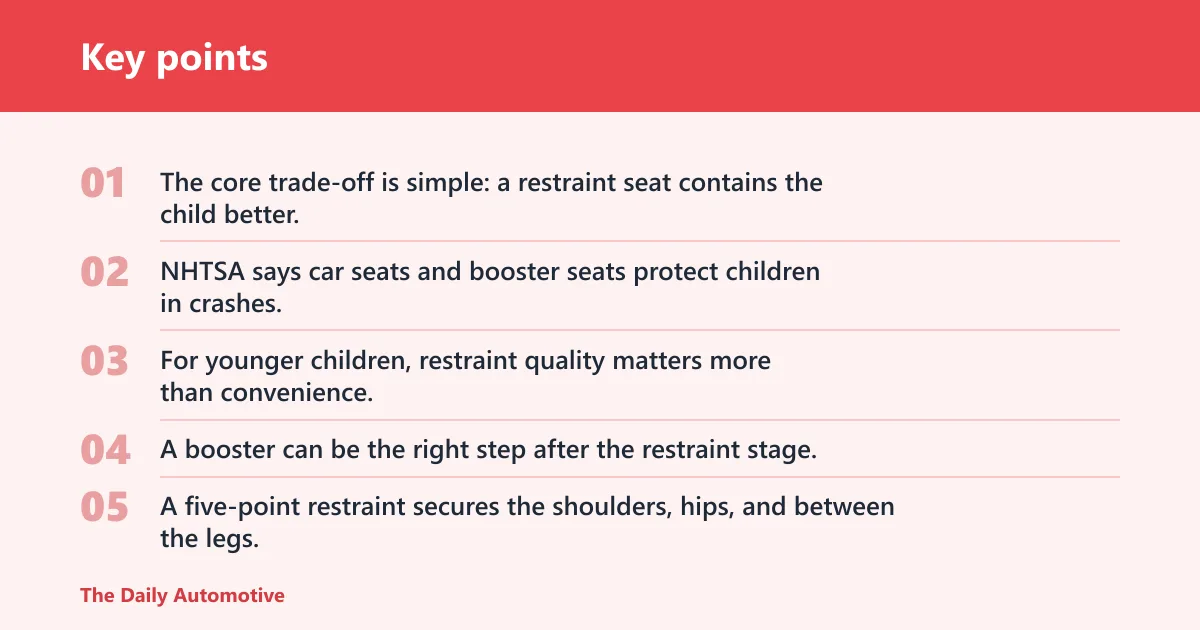
The core trade-off is simple: a restraint seat contains the child better, while a booster seat depends more on correct belt fit and correct behavior. NHTSA says car seats and booster seats protect children in crashes, and it says to choose the right seat and use it correctly every time.
For younger children, restraint quality matters more than convenience. A booster can be the right step after the restraint stage, but only if the child is ready to stay seated properly and the vehicle belt fits the way it should.
Containment versus belt positioning
A five-point restraint secures the shoulders, hips, and between the legs. That kind of containment is why a restraint seat is still the better pick when a child wiggles, falls asleep, or tries to lean out of position.
A belt-positioning booster seat has no built-in restraint in booster mode. It works by raising the child so the lap-and-shoulder belt can sit in the right spots.
Vehicle fit matters more than the label
One seat can be better in one car and worse in another. Low headrests, lap-only belts, and awkward belt angles can make a booster a poor fit even if the child is old enough for one.
That is why the vehicle owner’s manual and the child seat manual both matter. If the manuals disagree with a generic rule, follow the manuals for that model pair.
Value is tied to the child’s stage
A long-use restraint seat can make sense if the child still needs containment. A booster can be the smarter buy once the belt fits properly and the child can sit correctly without reminders every minute.
Cost should follow readiness, not the other way around. A cheaper switch is not a safer switch.
📊 NHTSA says car crashes are a leading cause of death for children ages 1 to 13. Source: Nhtsa.
Booster seat decision table
| Common child profile | Safest restraint stage | Why this choice fits |
|---|---|---|
| 3 years old, average size, cannot sit still, lap-and-shoulder belt available, headrest present | Forward-facing car seat with restraint and tether | At this stage, most children still need containment more than belt positioning. |
| 4 years old, tall for age, can sit still, lap-and-shoulder belt available, headrest present | Booster Seat if the restraint is outgrown and the child passes the belt-fit check | Size and behavior may support booster use if the seat belt fits low and flat. |
| 5 years old, average size, sometimes slouches or falls asleep, lap-and-shoulder belt available, headrest present | Car Seat with restraint | Sleeping and slouching can throw off booster fit and move the belt out of position. |
| 6 years old, tall, sits correctly most rides, lap-and-shoulder belt available, headrest present | Booster Seat | This is the kind of child who may fit a booster well if the lap belt stays low and the shoulder belt crosses the chest. |
| 7+ years old, average size, sits correctly, lap-and-shoulder belt available, strong head support in the vehicle | Booster Seat or seat belt alone only if the child passes the seat-belt fit test | At this stage, the belt fit test decides whether the booster is still needed. |
| Any age, any size, lap-only belt only | Car Seat with restraint | A booster needs a lap-and-shoulder belt; a lap-only belt is not enough for booster mode. |
| Any age, booster-ready size, but no usable head support behind the child | High-back booster or Car Seat with restraint | A backless booster should wait until the vehicle gives proper head support. |
When to move from rear-facing to forward-facing
Rear-facing is the safest stage for young children, and NHTSA says children under age 1 should always ride rear-facing. Keep rear-facing as long as possible within the seat’s limits, then move to forward-facing only when the child has outgrown rear-facing limits. (Nhtsa)
Rear-facing limits come first
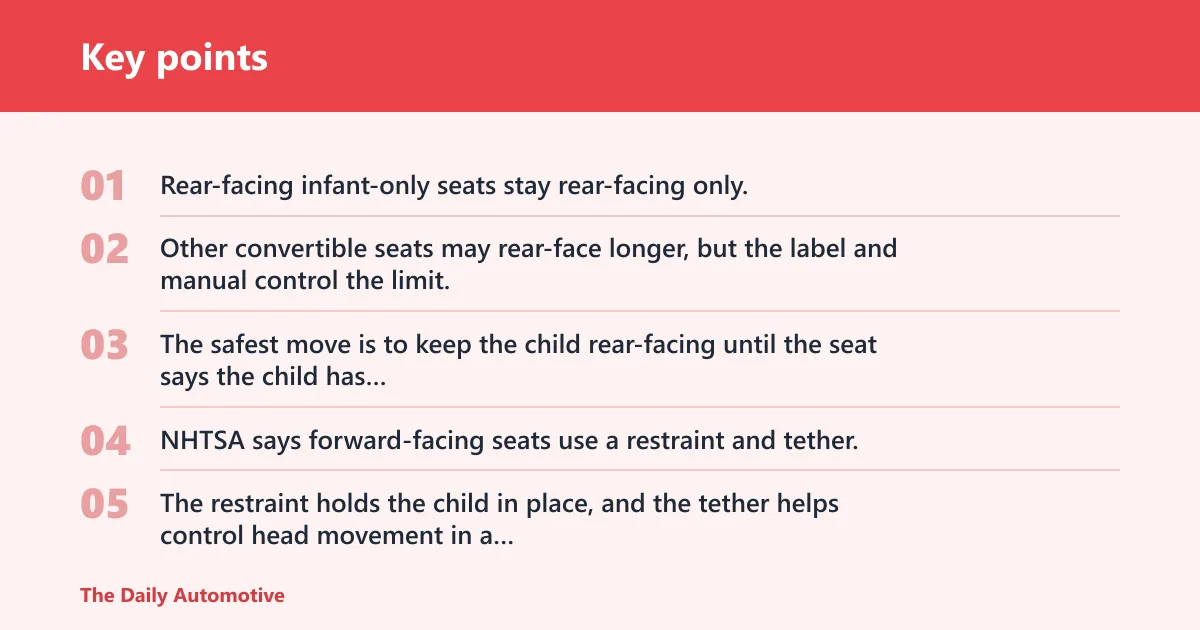
Rear-facing infant-only seats stay rear-facing only. Other convertible seats may rear-face longer, but the label and manual control the limit. The safest move is to keep the child rear-facing until the seat says the child has outgrown that mode.
What the restraint and tether do
NHTSA says forward-facing seats use a restraint and tether. The restraint holds the child in place, and the tether helps control head movement in a crash.
Use the forward-facing restraint until the seat’s height or weight limits are reached. Only then does booster mode enter the discussion.
When a booster is actually ready
Booster readiness depends on size and the ability to sit properly, not age alone. Cleveland Clinic says many children are not ready to leave a booster until about 4 feet 9 inches, but the better check is whether the child can pass the belt-fit test in that specific vehicle.
Size check
The child should be large enough that the belt can lie correctly across the body. If the shoulder belt cuts into the neck or the lap belt slides onto the stomach, the booster is not doing its job.
Sit-still check
A booster only works if the child stays upright. A child who slouches, twists, sleeps sideways, or unbuckles needs more containment than a booster gives.
Say your 5-year-old sits properly at the start of the trip but falls asleep and curls forward on the freeway. That child is not yet a good booster candidate in that vehicle, even if the age sounds close.
Vehicle belt check
- Check that the lap belt lies low on the upper thighs, not the stomach.
- Check that the shoulder belt crosses the middle of the shoulder and chest, not the neck or arm.
- Confirm that the child can keep that position the whole ride.
- Make sure the booster and vehicle seat work together in that car, not just in theory.
A common first-timer mistake is treating legal age as the finish line. The better question is whether the belt fits and the child can hold position every time.
High-back booster vs car seat
A high-back booster can be the better bridge when the child is ready for belt positioning but still needs head and torso support. It may be especially useful in vehicles with low headrests or seats that do not support a child well in a backless booster.
When head support matters
High-back boosters provide head and neck support. That matters when the vehicle seatback does not reach high enough behind the child or when the child tends to nap in the car.
Backless boosters are more portable and lighter, but they require proper vehicle head support. If the vehicle does not support the child correctly, do not default to a backless booster.
When a backless booster can work
A backless booster can work when the vehicle seat already gives the right belt fit and head support. Some models convert from high-back to backless, but the manual decides when that is allowed.
Picture a child who fits the lap-and-shoulder belt well in a sedan with a tall seatback and adjustable headrest. In that car, a backless booster may be fine if the manual allows it and the belt fit stays correct.
Choose booster seat if… / Choose car seat if…
Choose the booster seat if the child fits the seat belt correctly, can sit upright the whole ride, and the vehicle has a lap-and-shoulder belt plus usable head support. Choose the car seat if the child still needs a restraint for containment, the belt does not fit well, or the vehicle setup makes booster geometry poor.
Choose booster seat if…
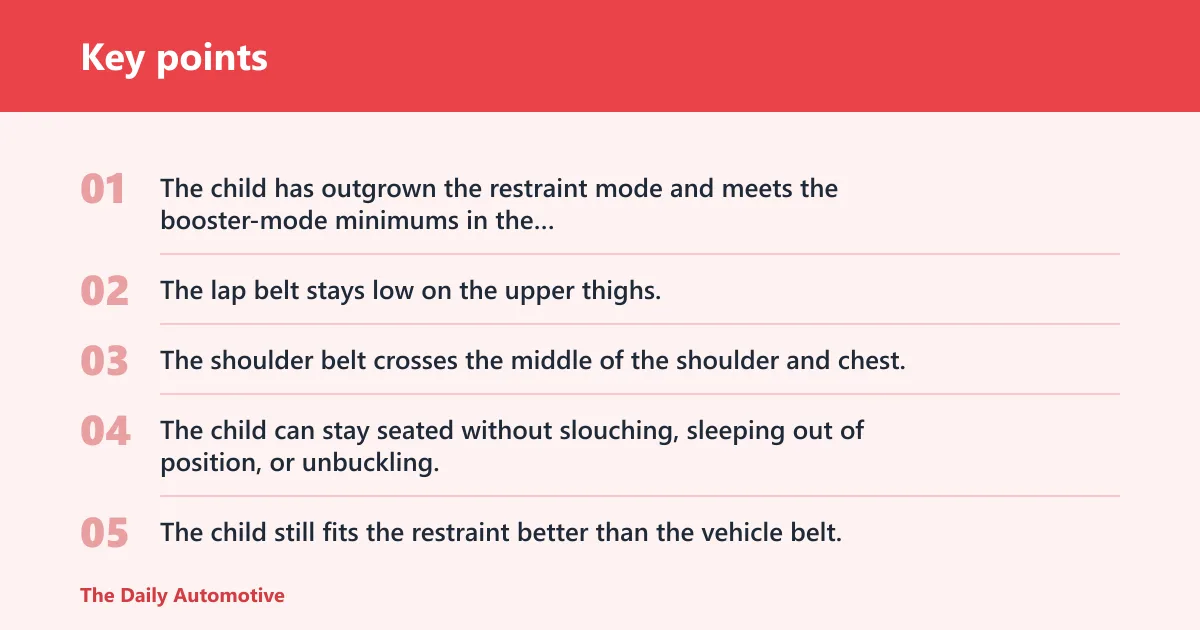
- The child has outgrown the restraint mode and meets the booster-mode minimums in the manual.
- The lap belt stays low on the upper thighs.
- The shoulder belt crosses the middle of the shoulder and chest.
- The child can stay seated without slouching, sleeping out of position, or unbuckling.
Choose Car Seat if…
- The child still fits the restraint better than the vehicle belt.
- The child cannot sit correctly for the full ride.
- The vehicle only offers a lap belt in that seating position.
- The vehicle’s head support or belt path makes booster fit poor.


What the law says in Texas and California
Child passenger safety law sets the floor, not the goal. Texas and California each have minimum requirements, but the legal minimum is not the same thing as the safest choice for a specific child, seat, and vehicle.
Law as the floor
Use the law as a baseline only. NHTSA says to keep children in the back seat at least through age 12, and many families should keep a child there until 13 if the vehicle setup allows it.
Why manual and belt fit still come first
If a state minimum says a child may ride in a booster, that does not mean the child is ready in every car. The seat manual, vehicle owner’s manual, and belt-fit check still decide whether the setup is actually safe.
How to use a booster seat properly so the seat belt fits right
A booster seat works only when the vehicle belt sits on the body the way it should. That means the lap belt stays low on the upper thighs and the shoulder belt crosses the chest and middle of the shoulder, with the child sitting upright the whole ride.
Use this fit check every ride
- Lap belt: low on the upper thighs, not the stomach.
- Shoulder belt: across the chest and middle of the shoulder, not the neck.
- Posture: upright, with no slouching or leaning.
- Behavior: no unbuckling, twisting, or putting the shoulder belt under the arm.
Common failure cases
Sleeping can pull the shoulder belt off position. Slouching can move the lap belt up onto the belly. Unbuckling means the child was not ready for booster mode in that vehicle.
Lap-only belts are another hard stop. A booster seat relies on the vehicle’s standard seat belt, so a lap-only belt is not the right setup for booster mode.
Booster seat vs car seat requirements
The requirement question has two layers: legal minimums and actual fit. State law may allow a switch before the child is truly ready, but the manuals and the belt-fit test set the safer standard.
What the manuals should answer
The vehicle owner’s manual tells you where the seat can go and how the belt or lower anchors should be used. The child seat manual tells you when that specific seat can move between restraint and booster modes, if it can at all.
Where NHTSA helps
The NHTSA Car Seat Finder is an official seat-selection resource based on age and size, with ratings and guidance. It is a good starting point when the vehicle manual and child seat manual leave room for interpretation.
Frequently asked questions
What is the difference between a booster seat and a car seat?
A booster seat raises a child so the vehicle’s lap-and-shoulder belt fits better. A car seat in restraint mode uses built-in straps to secure the shoulders, hips, and crotch area. The restraint gives more containment; the booster depends on belt fit and child behavior.
When can a child start using a booster seat instead of a car seat?
Start only when the child has outgrown the restraint mode and can sit correctly with the seat belt in the right place. Age helps, but it does not decide the switch by itself. The vehicle belt, the child seat manual, and the child’s posture all have to line up.
Booster seat vs car seat age: what matters more, age or size?
Size and maturity matter more than age alone. A child may be 4 or 5 and still need a restraint if they cannot sit still, while an older child may be ready for a booster if the belt fits well and the child stays upright.
Booster seat vs car seat safety: which is safer for a 5-year-old?
There is no universal winner for every 5-year-old. If the child still needs containment, a restraint seat is safer. If the child fits the belt correctly, sits correctly, and the vehicle supports the setup, a booster seat can be the better choice.
What are the booster seat requirements in Texas or California?
Texas and California set minimum legal requirements, but those are only the floor. The better standard is whether the child passes the seat-belt fit test in that car and whether the child seat manual allows booster mode for that child’s size.
How long should a child stay in a booster seat before using the seat belt alone?
Stay in a booster until the vehicle belt fits the child correctly without it. The lap belt should sit low on the upper thighs, and the shoulder belt should cross the middle of the shoulder and chest. Many children are not ready to ditch the booster until about 4 feet 9 inches.
Products related to this article
Sponsored / affiliate links. As an Amazon Associate I earn from qualifying purchases. I may earn additional commission from eligible campaigns.