Caliper for Cars: Enhance Brake Performance with Premium Assemblies
Premium brake calipers matter when you need repeated high-load stops, corrosion resistance, or a matched upgrade kit. For normal street driving, a quality stock-size replacement often delivers the same braking distance. Choose badly, and you can buy expensive parts that still fade, drag, or fit poorly. This guide explains when premium calipers are worth it, which supporting parts matter, and how to verify fitment before you spend.
What premium calipers change
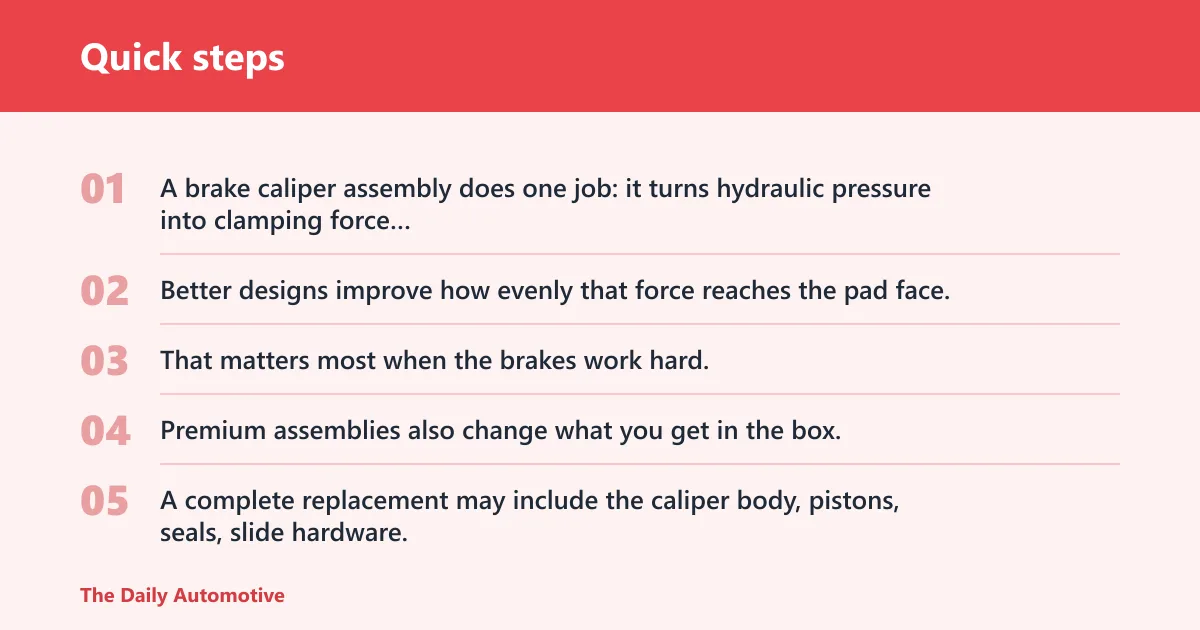


A brake caliper assembly does one job: it turns hydraulic pressure into clamping force on the pads. Better designs improve how evenly that force reaches the pad face, how consistently the pedal feels, and how well the housing resists heat and corrosion. That matters most when the brakes work hard, not just when the part looks nicer through the wheel.
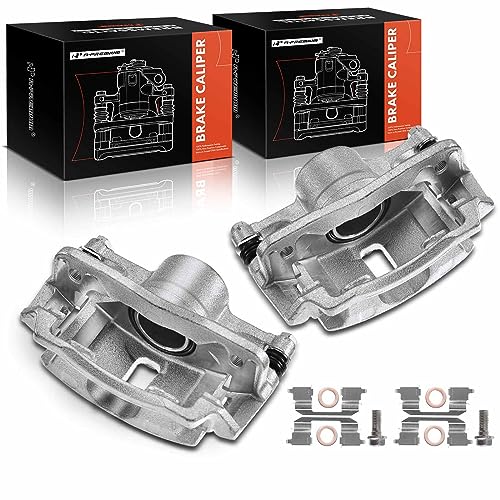
Premium assemblies also change what you get in the box. A complete replacement may include the caliper body, pistons, seals, slide hardware, brackets where applicable, and an EPB motor on rear applications. Some brands sell brand new, never rebuilt units; others sell remanufactured calipers that reuse the core housing after service work.
Why rigid housings and machining matter
Stiffness and machining quality affect NVH performance. Less flex helps the pads stay square to the rotor, which can reduce taper wear, chatter, and a long pedal that feels vague under heat. Precision machining also helps the piston bores and pad abutments stay aligned, which is one reason premium calipers are often quieter when the rest of the brake stack is matched correctly.
Material choice matters too. ADVICS says its calipers are made from both iron and aluminum alloy, and AP Racing builds road calipers with conventional seals plus a dirt seal. Those details do not make every caliper better for every car, but they do show how design choices affect heat tolerance, seal life, and serviceability.
What a complete assembly should include
Do not assume “caliper” means the same thing from every seller. A complete assembly should cover the body, pistons, seals, slide pins or bushings where used, bleed screws, pad retainers, and the correct mounting hardware for the axle. Rear units may also include an EPB actuator, which changes both the electrical and mechanical install work.
Brake caliper decision matrix
The right caliper depends on how the vehicle is used. For daily commuting, the smartest spend is often a correct OE-size replacement with fresh pads, rotors, and fluid. For towing, spirited driving, or track work, a premium caliper can make sense when the rest of the system matches the added thermal load and pedal demand.
| Driving use case | Caliper type | Piston count | Rotor pairing | Pad priority | Install risk |
|---|---|---|---|---|---|
| Daily commuting | OE-fit replacement or quality remanufactured assembly | 1- or 2-piston | Stock diameter, OE-style surface | Low noise, consistent bite, long wear | Low if fitment is exact |
| Towing and heavy loads | Heavy-duty OE-fit or matched upgrade kit | 2- or 4-piston | Larger rotor where the vehicle supports it | Heat tolerance and stable pedal feel | Medium; check wheel and line clearance |
| Spirited street driving | Premium fixed or high-quality performance assembly | 4-piston | Matched rotor with proper venting | Friction stability and acceptable NVH | Medium; pad and wheel fitment matter |
| Track use and repeated heat cycles | Purpose-built performance kit | 6- or 10-piston | Rotor designed for repeated high heat | High-temp compound and controlled wear | High; requires full system verification |
Picture a midsize SUV that tows a trailer on weekends. If the current calipers are not seized and the pedal still feels normal, a rotor, pad, and fluid refresh may solve the real complaint better than a larger caliper. By contrast, a heavy car used on mountain grades can justify a caliper upgrade when the original parts overheat before the rest of the system does.
Do you need a caliper upgrade?
You need an upgrade only when the current calipers are the limiting factor. If braking problems come from worn pads, warped or uneven rotors, old fluid, swollen hoses, or contaminated pad surfaces, a new caliper will not cure the root cause. A caliper upgrade makes sense when the existing unit is worn, damaged, undersized for the use case, or incompatible with a planned rotor and pad package.
When pads, rotors, fluid, and hoses are enough
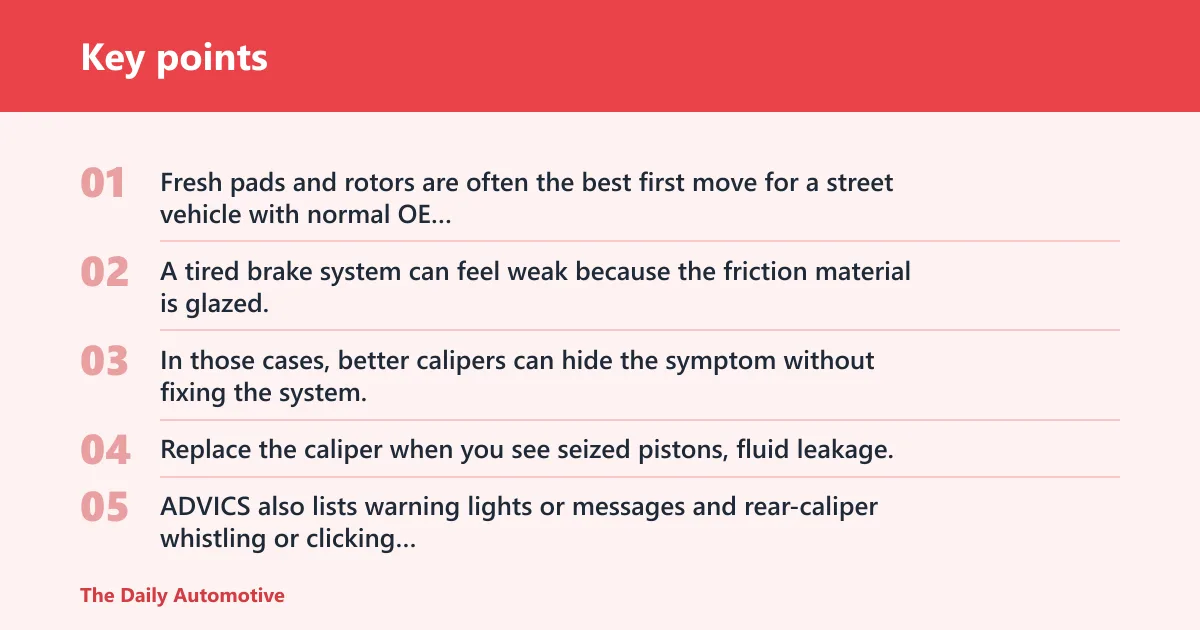
Fresh pads and rotors are often the best first move for a street vehicle with normal OE calipers. A tired brake system can feel weak because the friction material is glazed, the fluid has absorbed moisture, or the hoses are expanding under pressure. In those cases, better calipers can hide the symptom without fixing the system.
When caliper wear or damage justifies replacement
Replace the caliper when you see seized pistons, fluid leakage, uneven pad wear from a sticking slide or piston, brake drag after release, or one wheel that runs hotter than the others. ADVICS also lists warning lights or messages and rear-caliper whistling or clicking sounds as EPB fault signs when the rear brake includes an actuator.
Suppose one front wheel has a burnt smell after a short drive and the inner pad is much thinner than the outer pad. That pattern points more toward a sticking caliper than a rotor problem, and it usually means the caliper assembly needs attention before more pads disappear.
New versus remanufactured assemblies
New assemblies are the cleaner choice when you want fresh bores, seals, and hardware with less uncertainty. Remanufactured calipers can be a practical option if the rebuilder replaces worn internals and pressure-tests the unit, but the quality of the core and the service work matters. For buyers focused on long-term consistency, a new caliper often reduces unknowns.
Cost context matters here. A remanufactured caliper can save money up front, while a complete new assembly may cost more but reduce the odds of repeat labor. If the vehicle needs the caliper plus brackets, hardware, and an EPB actuator anyway, the labor savings from doing the job once can outweigh the part-price gap.
How many pistons make sense?
More pistons do not automatically mean better braking. Piston count changes pressure distribution across the pad, pedal modulation, and pad wear shape. For many street cars, 1- or 2-piston calipers are enough. Fixed 4-piston units can be a sweet spot for stronger repeatability. Larger 6- and 10-piston designs are best reserved for heavier performance duty where the whole package supports them.
1- and 2-piston designs for OE-style use
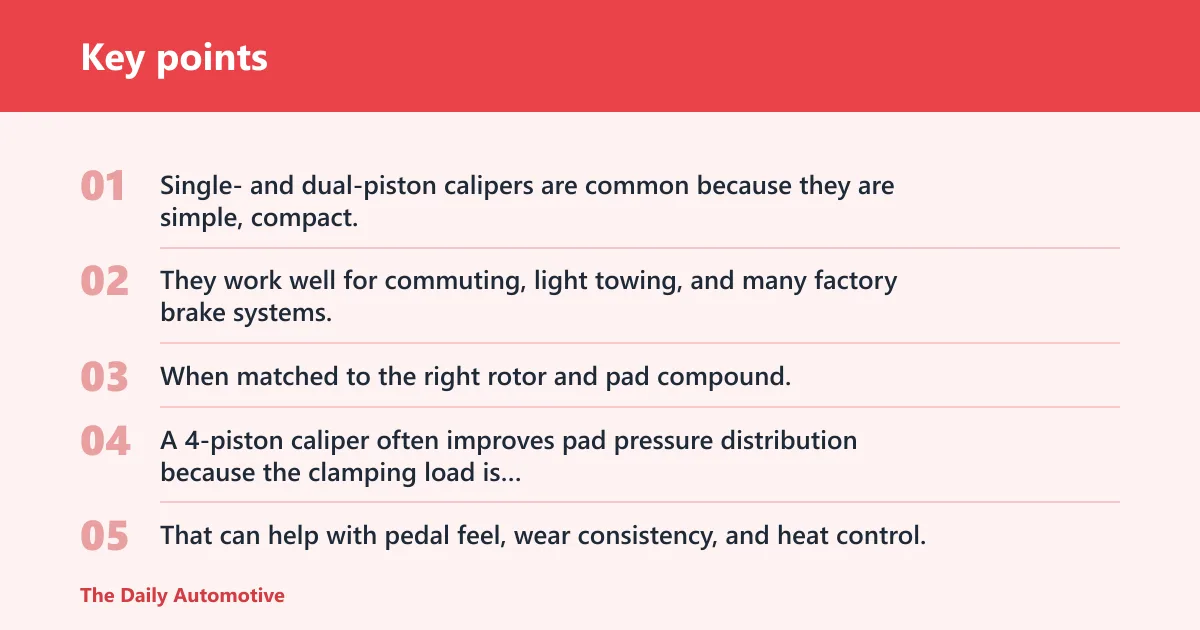
Single- and dual-piston calipers are common because they are simple, compact, and easy to package. They work well for commuting, light towing, and many factory brake systems. When matched to the right rotor and pad compound, they can stop a car smoothly without the extra cost or wheel-clearance issues of a larger performance caliper.
4-piston layouts for balanced performance
A 4-piston caliper often improves pad pressure distribution because the clamping load is spread more evenly across the friction material. That can help with pedal feel, wear consistency, and heat control. For many street-driven performance cars, this is the first layout that feels meaningfully more controlled without turning the brake system into a track-only setup.
6- and 10-piston setups and their tradeoffs
AP Racing offers 2-piston, 4-piston, 6-piston, and 10-piston calipers. Higher piston counts can help support large pad areas and heavy thermal loads, but they also raise cost, complexity, and fitment demands. They are most sensible when the rotor, master cylinder feel, wheel clearance, and pad compound are all part of the same design.
Pressure distribution, modulation, and pad wear
Better pressure distribution can improve modulation, which is the driver’s ability to meter brake force before lockup. The tradeoff is that some multi-piston calipers want very specific pad shapes and compounds to avoid uneven wear or odd NVH. If the caliper and pad are mismatched, the extra pistons can become expensive decoration.
What should match with the caliper?
A caliper upgrade only works well when the rotor, pad, and fluid choices fit the new hardware. Rotor pairing affects heat control and judder reduction. Pad compound affects bite, noise, dust, and wear rate. Fluid and hoses determine whether the pedal stays firm under repeated use. Miss one piece and the system may feel worse, not better.
Rotor diameter and surface compatibility
The rotor must match the caliper’s bracket spacing, friction sweep, and diameter. Larger rotors improve heat capacity when the vehicle supports them, but they can also create wheel clearance problems. Surface compatibility matters too: a pad designed for a plain rotor may behave differently on a slotted or drilled rotor, especially during break-in.
Pad compound and NVH expectations
Brake pads are where friction material match matters most. A performance pad may give better high-temp stability, but it can also raise noise, dust, and cold bite tradeoffs. If the goal is a quieter commuter car, pad compound pairing matters as much as the caliper body itself. The same source says its calipers are designed for “Optimal NVH Performance,” but pad choice still shapes the final result.
Heat management, fade resistance, and judder control
Heat management is the reason many people consider premium calipers in the first place. A better caliper can help the system stay consistent by supporting larger pads and better airflow around the rotor. That can cut fade and brake judder when the rest of the setup is correct. Fluid condition and rotor mass still matter just as much.
Fitment checks before you buy
Fitment is where expensive mistakes happen. You need a vehicle-specific application, the correct axle, confirmed model and year match, and enough room for the caliper body, rotor, and wheel. A caliper that fits the knuckle but touches the wheel barrel is still the wrong part.
- Match the exact model, year, trim, and axle position.
- Confirm rotor diameter, rotor thickness, and offset requirements.
- Check wheel barrel and spoke clearance with the proposed caliper shape.
- Verify brake line routing, banjo bolt style, and sealing hardware.
- Confirm whether the kit includes pads, brackets, clips, and new bolts.
- For rear calipers, verify EPB compatibility before ordering.
- Use the seller’s confirmed fit tool and compare the VIN-based listing if available.
Hardware, banjo bolts, and brake line routing
Many “bolt-on” claims hide small but costly details. A caliper may need specific banjo bolts, copper washers, or bracket hardware. Brake line routing can also change with a larger body or a different mounting ear. If the included hardware is incomplete, the job can stall mid-install and force a second parts run.
Rear calipers and EPB systems
An EPB actuator is the motor and gear unit that applies and releases the rear parking brake electronically. On rear brake calipers, it replaces a hand lever or cable mechanism and must match the caliper body and vehicle electronics. If the wrong actuator is fitted, the system can throw warnings or refuse to calibrate properly.
Motor gear unit and warning signs
The same source states EPB actuator kits include installation hardware, including bolts and gaskets. It also lists warning lights or messages as a sign of a faulty EPB actuator, along with whistling or clicking sounds from rear calipers. Those clues matter because a rear brake issue may be electrical, mechanical, or both.
Installation hardware and scan-tool needs
Rear EPB work often requires more than wrench time. The caliper or actuator may need a service mode or scan-tool command so the motor retracts correctly before installation. If the hardware is not supplied, or the actuator does not match the caliper, the rear brakes may bind or set faults after reassembly.
Frequently asked questions
What kind of brake caliper is best for my car?
The best caliper is the one matched to your vehicle, rotor, wheel space, and driving load. For normal commuting, OE-size replacements are usually the right call. For towing, repeated descents, or track use, a premium fixed caliper with the correct rotor and pad package makes more sense.
Are premium caliper assemblies worth it over rebuilt calipers?
They are worth it when you want new bores, seals, and hardware with less uncertainty, or when the vehicle sees repeated heat cycles. Rebuilt calipers can be fine if the core and service work are good, but they depend more on the rebuilder’s process and part quality.
How many pistons should a performance brake caliper have?
For many street cars, about 4 pistons is a practical target. Two-piston calipers work well for OE-style use, while 6- and 10-piston layouts usually belong in heavier or more demanding setups. More pistons can improve pressure distribution, but they also raise cost and fitment demands.
What signs mean my brake caliper needs replacement?
Watch for seized pistons, fluid leaks, uneven pad wear, brake drag after release, pull during braking, or one wheel heating more than the others. On rear EPB systems, warning messages and clicking or whistling from the rear caliper can point to actuator trouble.
Do I need new rotors and pads when replacing calipers?
Often yes, especially if the old parts show wear, heat spotting, or uneven contact. If the caliper failed by dragging or leaking, the pads and rotors may already be compromised. At minimum, inspect rotor thickness, surface condition, and pad wear before reusing anything.
How do I know if a caliper will fit my vehicle?
Check the model, year, trim, axle position, rotor diameter, and wheel clearance before ordering. Then confirm the hardware, brake line fitting, and EPB compatibility if the rear axle uses an actuator. A fitment tool is useful only when the listing matches the vehicle exactly.
Products related to this article
Sponsored / affiliate links. As an Amazon Associate I earn from qualifying purchases. I may earn additional commission from eligible campaigns.