How to Start a Car With a Dead Battery (Safe Jump-Start Steps)
To jump-start a dead battery, connect the red clamps to both positive terminals first, then the black clamp to the good battery’s negative terminal, and the last clamp to a bare metal point on the dead car’s engine, not to the dead battery itself.
That last connection is the part most guides get wrong or leave vague, and it is the one that actually matters for safety: a dead battery still vents hydrogen gas, and a spark too close to the terminal can ignite it. Get the order right and jump-starting a car takes about five minutes with jumper cables and a second vehicle, or even less with a portable jump starter pack you keep in the trunk. If you drive a manual and have no cables or helper at all, push-starting is a last resort that can also get you moving.
Recognizing A Dead Battery
BEST FOR ROADSIDE JUMP-STARTS
 |
NOCO Boost GB20 Jump Starter – $79.95 A pocket-size jump starter with spark-proof clamps lets you restart a dead battery alone, without waiting for another car or a tow truck.
|
A dead battery usually announces itself before the engine refuses to turn over at all. Headlights that look dim or yellowish instead of bright white, an engine that cranks slowly for a second or two longer than usual, or a single sharp click when you turn the key are all signs the battery no longer has enough voltage to spin the starter motor. If the key turns and you get nothing at all – no click, no crank, no dashboard lights, no radio – the battery is very likely dead rather than just weak. It is worth ruling out a dead battery specifically before assuming a bigger problem, since a battery that will not hold a charge is one of the most common and cheapest car problems to fix.
| Cause | Description |
|---|---|
| Old battery | Most car batteries last 3 to 5 years; internal capacity fades even with normal use. |
| Lights or accessories left on | Headlights, interior lights, or a phone charger left running overnight can drain a battery by morning. |
| Cold weather | Below-freezing temperatures cut a battery’s effective cranking power by roughly 30 to 50 percent. |
| Loose or corroded connections | A loose cable or corrosion buildup on the terminals restricts current even if the battery itself is fine. |
| Parasitic drain | A faulty component (a dome light, alarm module, or infotainment unit) that stays powered when the car is off can slowly drain a healthy battery over several days. |
Safety Precautions Before You Start
Keep a pair of insulated gloves and safety glasses in the car; battery acid and sparks are the two real hazards here, not electric shock, since a 12-volt system cannot shock you the way household current can. Park both vehicles on level, dry ground, set the parking brake, and turn off the ignition and every electrical accessory (headlights, radio, phone chargers) in both cars before you touch a single cable. Never lean directly over the battery while connecting cables, since that is exactly where any spark or gas venting would happen, and keep a phone handy in case you need to call for help.
How To Jump-Start A Car (Correct Cable Order)
Position the working car close enough that the jumper cables reach both batteries without stretching, then turn both engines off. From here, the order of the four connections is what keeps the job safe:
- Clip one red (positive) clamp to the positive terminal on the dead battery.
- Clip the other red (positive) clamp to the positive terminal on the good battery.
- Clip one black (negative) clamp to the negative terminal on the good battery.
- Clip the last black (negative) clamp to a bare, unpainted metal point on the dead car’s engine block or frame – a bolt head works well – not to the dead battery’s negative terminal.
That fourth connection is the one to get right. Grounding to the engine block instead of the battery itself keeps any spark several inches away from the hydrogen gas a battery can vent, which is what actually causes the rare battery explosions you may have heard about. A simple way to remember the sequence is “red on dead” first, black on good, then ground the last clamp away from the dead battery.
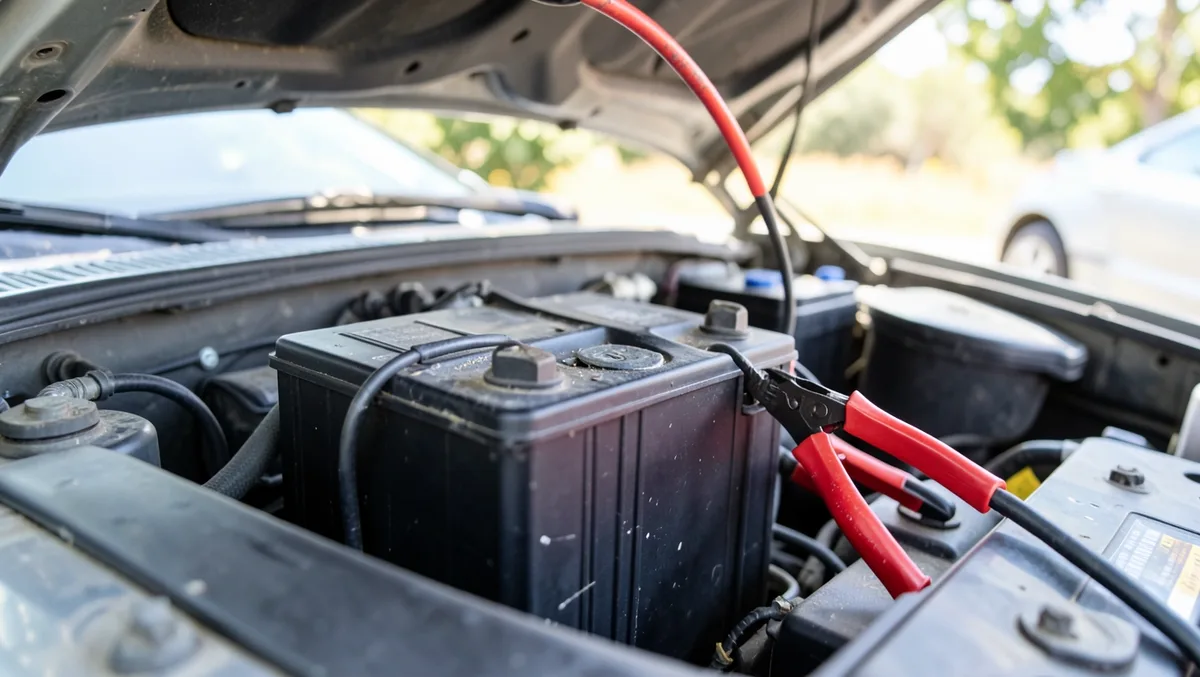
With all four clamps connected, start the working car and let it run for about two to three minutes so it can begin charging the dead battery. Then try starting the car with the dead battery. If it starts, let both engines run for a few minutes before disconnecting anything. Remove the cables in the exact reverse order you connected them: the ground clamp off the dead car’s engine first, then the negative clamp off the good battery, then both positive clamps. Once you are moving, drive for at least 15 to 20 minutes so the alternator can recharge the battery you jumped.
If the car still will not start after a few tries, stop. Repeated cranking on a battery that is not responding usually means the problem is not a simple discharge, and continuing to force it risks damaging the starter or alternator.
Using A Portable Jump Starter Pack
A portable jump starter removes the biggest hassle of jump-starting: finding a second car and a willing driver. These lithium battery packs are small enough for a glovebox, and most current models include reverse-polarity protection and spark-proof clamps that will not activate if you connect them backward. Match the unit’s peak-amp rating to your engine size (a 4-cylinder gas engine typically needs 400 to 600 amps, a V8 or diesel engine 1,000 amps or more) rather than buying on price alone, since an underpowered unit simply will not have enough current to crank a bigger engine.
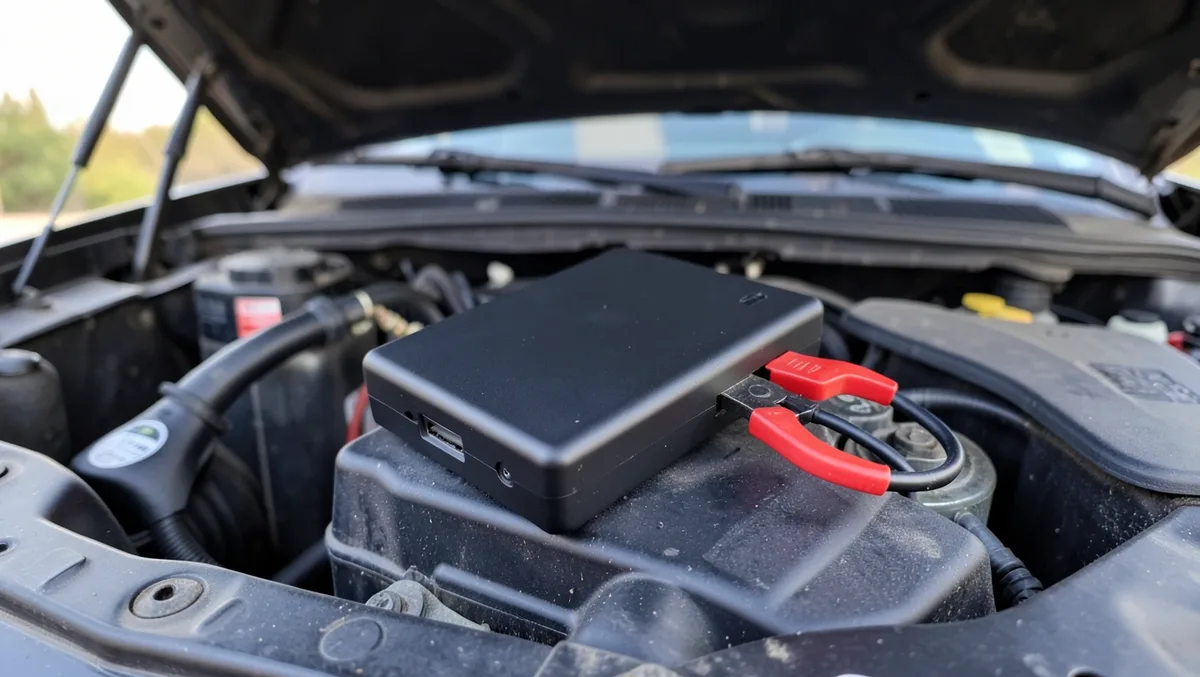
Make sure the pack is charged, then connect it the same careful way as a second car: red clamp to the battery’s positive terminal, and the black clamp to a clean, unpainted metal ground point on the engine rather than directly to the dead battery’s negative post whenever your specific unit’s manual allows it – many packs include spark-proof clamps that make a direct connection safer than with a second car, but grounding away from the battery is still the more cautious habit. Power on the unit, wait the few seconds most manufacturers recommend, and try the ignition. Once the car starts, disconnect the clamps in reverse order (red first, then black) and switch the pack off before storing it.
Push-Starting A Manual Transmission Car
Push-starting only works on manual transmission cars, and only if the battery is genuinely the problem rather than something else in the starting or fuel system. You need a flat stretch of road (a downhill slope makes it easier but is not required), at least two people to push, and enough open space ahead to build up walking-to-jogging speed safely.
Turn the key to the “on” position without cranking the starter, shift into second gear, and press the clutch pedal all the way down. As the car reaches roughly 5 to 10 mph, release the clutch quickly. The sudden resistance turns the engine over using the car’s own momentum, and the engine should catch within a second or two. If it doesn’t start on the first try, press the clutch back in, coast, and try again once you have speed back.
Battery Maintenance Tips
Check your battery every few months for cracks, bulging, or leaks around the case, and confirm the hold-down clamp is still snug – a battery that shifts around while driving can crack internally. A simple voltmeter (or the reading on many portable jump starters) tells you the real story: a healthy, fully charged battery reads about 12.6 volts with the engine off.
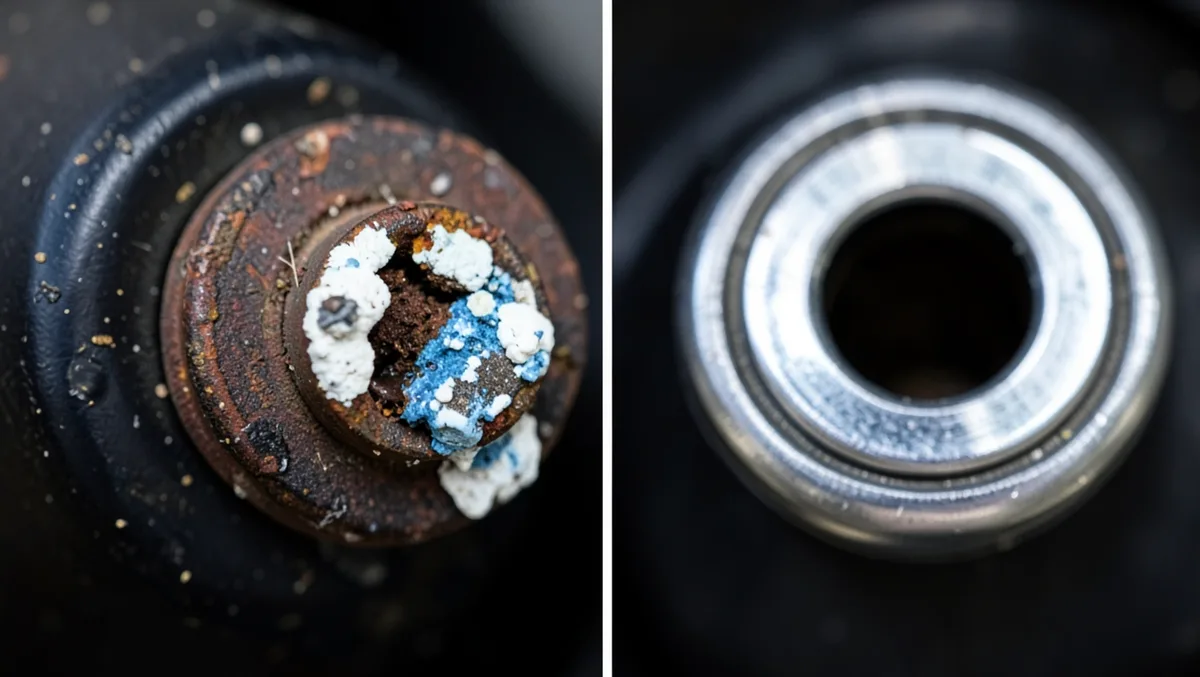
The white or bluish crust that builds up on terminals is corrosion, and it restricts current the same way a loose connection does. Disconnect the negative terminal first, then the positive, and scrub the buildup off with a mix of baking soda and water on an old toothbrush. Rinse with a little plain water, dry the terminals completely, and reconnect positive first, negative last – the opposite order from removal. A thin coat of dielectric grease or a felt anti-corrosion washer on each terminal afterward slows the buildup from coming back.
Preventing Future Battery Problems
Most dead-battery calls are preventable. Double-check headlights and interior lights are off before you walk away from the car, and unplug phone chargers or accessories that draw power even with the ignition off. If you park a vehicle for more than a couple of weeks, a battery tender (a low-amperage trickle charger, not a fast charger) keeps the battery topped off without overcharging it. Have the battery and charging system tested at an oil change or tire rotation, since most auto parts stores will run a free load test that catches a failing battery weeks before it strands you.
When To Replace The Battery
Most car batteries last 3 to 5 years, and age is the single biggest predictor of failure – a battery that is 4 years or older and already needed a jump-start once is a strong candidate for replacement rather than a repeat jump. Other warning signs include a swollen or misshapen case, a rotten-egg smell near the battery, and repeated slow cranking even right after a full charge.
When you do replace it, match the physical group size to your vehicle and check the cold cranking amps (CCA) rating against your owner’s manual, especially if you live somewhere with cold winters, since CCA measures how much current the battery can deliver at 0 degrees Fahrenheit. Buying from a brand with a longer free-replacement warranty period usually costs a little more upfront but saves money if the battery fails early.
Frequently Asked Questions
Is there a way to start a car with a dead battery?
Yes. Jump-start it with jumper cables and a working vehicle, or with a portable jump starter pack. Connect the red clamps to both positive terminals first, then the black clamp to the good battery’s negative terminal and the final clamp to a bare metal point on the dead car’s engine, not the dead battery’s own negative terminal.
How do you start a car with a dead battery without cables?
Push-start it, but only if you drive a manual transmission car. Turn the key to “on,” shift into second gear, press the clutch, and have two people push the car to about 5 to 10 mph. Release the clutch quickly and the engine’s momentum should turn the engine over and start it.
What should you do if your car battery dies and you can’t jump it?
Call roadside assistance or a tow service. If the battery is more than 4 to 5 years old, plan on replacing it rather than repeat jump-starting it. In the meantime, turn off every electrical accessory to preserve whatever charge remains, and keep a portable jump starter in the car so you are not stuck waiting for help next time.
How do you start an automatic transmission car if the battery died?
The same way as any other car: jump-start it with jumper cables and a working vehicle, connecting positive to positive, then negative to negative on the good battery, and grounding the last clamp to bare metal on the dead car rather than its battery. Push-starting does not work on automatics, so if cables or a helper are not available, use a portable jump starter instead.
Conclusion
Starting a car with a dead battery is a five-minute job once you know the order: red to both positive terminals first, black to the good battery’s negative terminal, and the last clamp grounded to bare metal on the dead car, never to its battery. Jumper cables, a portable jump starter, or a push-start on a manual car will all get you moving again. The bigger win is preventing the next one – keep terminals clean, watch for a battery older than 4 years, and a dead battery becomes a rare inconvenience instead of a routine one.
Products related to this article
Sponsored / affiliate links. As an Amazon Associate I earn from qualifying purchases. I may earn additional commission from eligible campaigns.