Can A Uk Diesel Nozzle Fit A Petrol Car
Lots of people wonder if they can use a diesel fuel nozzle in a petrol car. It seems like a simple question, but it can be confusing, especially if you’re not a car expert. We’ll sort this out for you very easily.
This guide will show you exactly what you need to know, step by step. Let’s get this figured out so you can feel confident next time you’re at the pump. We will cover everything you need to know about whether Can a UK Diesel Nozzle Fit in a Petrol Car? and why it matters.
Petrol Vs Diesel Fuel Nozzles
Understanding the difference between petrol and diesel fuel nozzles is the first step to answering if a UK diesel nozzle fits a petrol car. These nozzles are not interchangeable because the fuels they dispense are very different. Petrol, also known as gasoline, is lighter and more volatile than diesel fuel.
Diesel fuel is denser and oilier. This difference in properties means the fueling systems in cars designed for each type of fuel are also quite different. They are designed to handle specific fuel types safely and efficiently.
Think of it like trying to fit a square peg into a round hole; they simply aren’t made to go together.
Physical Differences in Nozzle Design
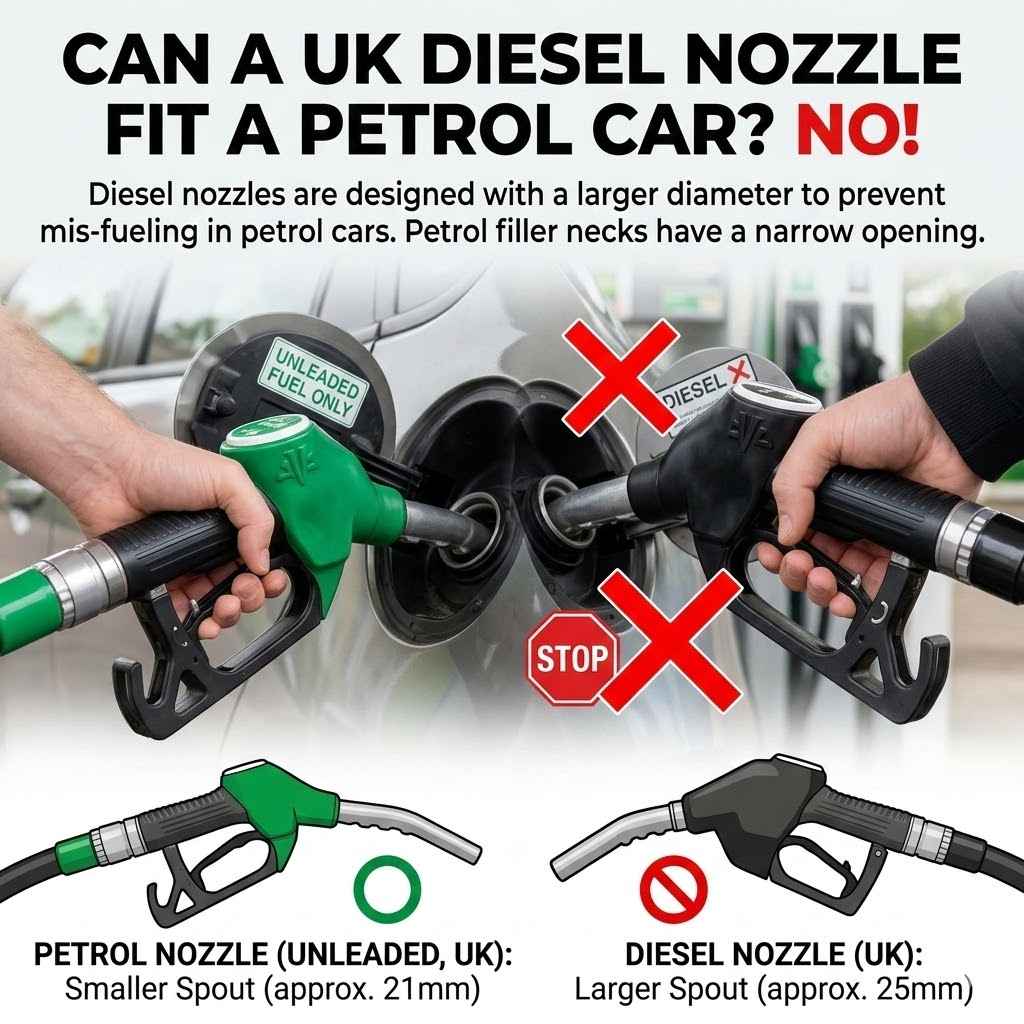
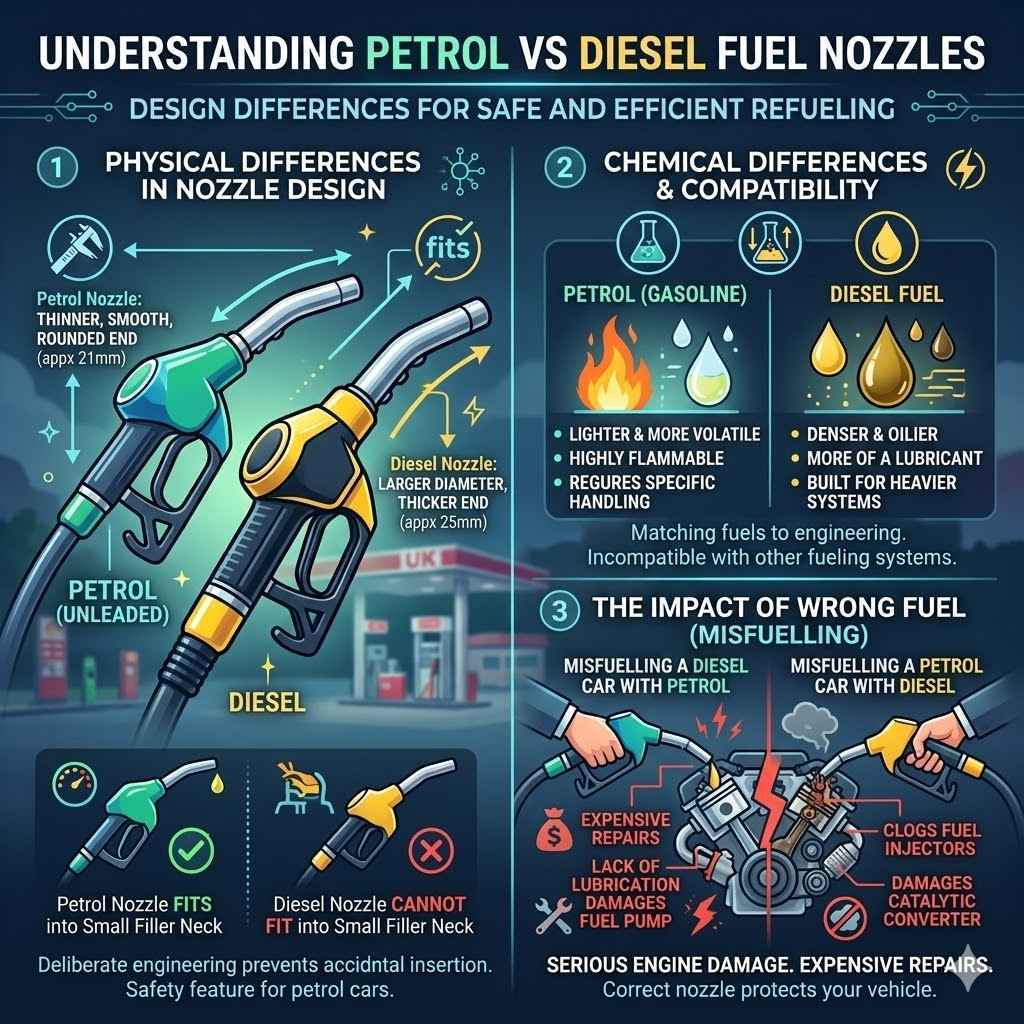
The most obvious reason a diesel nozzle won’t fit a petrol car is their physical design. UK petrol station nozzles for unleaded petrol are typically thinner and have a smooth, rounded end. This allows them to fit easily into the smaller, more delicate filler necks of petrol car fuel tanks.
They are also designed with a mechanism that shuts off the flow when the tank is full.
Diesel nozzles in the UK, on the other hand, are generally larger in diameter and often have a thicker, sometimes slightly squared-off end. This design is intentional. It prevents them from accidentally being inserted into the filler neck of a petrol car.
This is a safety feature designed to stop drivers from putting the wrong fuel in their vehicle. The thicker size is meant to only fit into the wider opening of a diesel car’s fuel tank.
It’s important to note that these physical differences are a major part of the answer to whether a UK diesel nozzle fits a petrol car. They are a deliberate engineering choice.
Chemical Differences and Compatibility
Beyond just how they look, the chemicals in petrol and diesel are fundamentally different. Petrol is highly flammable and requires different handling and storage than diesel. Diesel fuel is more of a lubricant.
Mixing these fuels can cause serious damage to a car’s engine. Petrol in a diesel engine can lead to expensive repairs because it doesn’t have the necessary lubricating properties and can damage the fuel pump. Diesel in a petrol engine can clog the fuel injectors and damage the catalytic converter.
The nozzles are designed to match the specific fuel. Petrol nozzles are made to dispense a lighter, more volatile liquid, while diesel nozzles are built for a heavier, oilier substance. Trying to force the wrong nozzle into a tank not only risks misfuelling but also highlights the incompatible nature of the systems.
The design ensures you can only put the correct type of fuel into your vehicle.
This compatibility issue is a key reason why you cannot use a diesel nozzle in a petrol car. It’s about more than just a tight fit; it’s about the integrity of the fueling system and the engine itself.
Why You Cannot Put Diesel Fuel In A Petrol Car
The question of whether a UK diesel nozzle fits a petrol car leads to a more critical point: what happens if you try to use the wrong fuel? Putting diesel fuel into a petrol car is a common mistake that can lead to significant problems for your vehicle. This is because petrol and diesel engines operate on completely different principles, and their fuel systems are designed to handle specific fuel types.
When you put the wrong fuel in, you disrupt these delicate systems, potentially causing severe and costly damage.
Engine Operation Differences
Petrol engines work by compressing a mixture of petrol and air, which is then ignited by a spark plug. This process is called spark ignition. The fuel needs to be atomized into a fine mist to mix properly with air and burn efficiently.
Petrol’s volatile nature makes it suitable for this rapid ignition process.
Diesel engines, on the other hand, use compression ignition. They compress only air to a very high pressure and temperature. Then, diesel fuel is injected into this hot, compressed air.
The heat causes the diesel fuel to ignite spontaneously, without the need for a spark plug. Diesel fuel is less volatile and has lubricating properties that are essential for the diesel engine’s fuel pump and injectors.
These fundamental differences mean that petrol and diesel are not compatible. Using the wrong fuel in either type of engine will lead to malfunctioning or complete engine failure.
Impact on Fuel Systems
A petrol car’s fuel system is designed to handle petrol. This includes the fuel tank, fuel pump, fuel lines, and fuel injectors. Petrol is relatively clean and does not have the lubricating qualities of diesel.
The fuel injectors in a petrol engine are precisely engineered to spray a fine mist of petrol. If diesel fuel is introduced, its thicker, oilier nature can clog these injectors, preventing them from spraying fuel correctly or at all.
The fuel pump in a petrol system is also not designed for the viscosity of diesel. Diesel fuel has lubricating properties that petrol lacks. Running a diesel pump on petrol, while less damaging initially, can still lead to wear over time as the petrol doesn’t provide the same lubrication.
However, putting diesel into a petrol system is far more damaging.
Diesel fuel can leave deposits and gum up the sensitive components of a petrol fuel system, leading to poor engine performance, stalling, and ultimately, very expensive repairs. The fuel pump might struggle and overheat trying to move the thicker fuel. The injectors will certainly become blocked.
Consequences of Misfuelling
If you accidentally put diesel into a petrol car, the consequences can be severe. The car might run poorly for a short time, perhaps sputtering or losing power. In some cases, the engine might not start at all.
If you drive the car with diesel in the tank, you risk significant damage to the fuel pump, fuel injectors, and potentially the engine itself. The damage can be extensive and costly to repair.
The lubricating nature of diesel can cause wear and tear on parts of a petrol fuel system not designed for it. At the same time, the lack of lubrication in petrol can harm a diesel engine. Misfuelling is a problem that needs immediate attention.
The best course of action is to stop the car immediately, do not try to start it, and call for roadside assistance to have the fuel tank drained and flushed by professionals.
Statistics show that misfuelling incidents still occur regularly. According to some surveys, around 1 in 300 drivers admit to misfuelling their vehicle at some point. This highlights the importance of understanding the differences and taking precautions at the pump.
Why You Cannot Put Petrol Fuel In A Diesel Car
Now, let’s look at the other side of the coin. While we’ve established that a UK diesel nozzle won’t fit a petrol car, it’s equally important to understand why putting petrol into a diesel car is also a very bad idea. This scenario can cause just as much, if not more, damage to a diesel engine and its complex fuel system.
The differences in how diesel and petrol engines operate mean they require entirely different fuel properties. When these properties are mixed up, it leads to serious mechanical failures.
The Lubrication Factor
One of the most critical differences is lubrication. Diesel fuel is inherently oily and acts as a lubricant for the diesel engine’s fuel system components. This includes the high-pressure fuel pump and the fuel injectors, which operate under extreme pressure.
The diesel fuel prevents these parts from rubbing against each other and causing wear and tear.
Petrol, on the other hand, is a solvent. It evaporates easily and contains very little to no lubricating properties. When petrol is introduced into a diesel engine’s fuel system, it strips away the protective layer of diesel fuel from the pump and injectors.
This leads to rapid wear and friction between the metal parts. Imagine trying to run a machine designed for oil using water; it would quickly break down due to lack of lubrication.
The damage caused by a lack of lubrication can be immediate and catastrophic. The fuel pump can seize up, and injectors can be ruined. This is a primary reason why putting petrol in a diesel car is so detrimental.
Impact on Diesel Engines
Diesel engines are built for durability and high torque, relying on the specific properties of diesel fuel to function. The high compression ratios and the self-ignition process require a fuel that can withstand these conditions without igniting prematurely. Petrol is far too volatile for this.
When petrol gets into a diesel engine, it doesn’t ignite properly through compression. Instead, it might burn erratically or not at all. This can lead to rough running, misfires, loss of power, and knocking sounds from the engine.
Furthermore, the petrol can wash away the lubricating film from the cylinder walls, leading to increased wear and potential damage to pistons and rings.
The electronic control units (ECUs) that manage modern diesel engines are also sensitive. Incorrect fuel can cause them to send wrong signals, further disrupting engine operation and potentially leading to more serious electronic failures.
Damage to Fuel Pumps and Injectors
Diesel fuel pumps and injectors are precision-engineered components designed to handle the pressure and viscosity of diesel. They often have very tight tolerances. Petrol, being a much thinner and less viscous fluid, can cause these components to overheat and seize due to the lack of lubrication.
The seals and internal parts made to work with oily diesel may be damaged by the solvent-like properties of petrol.
The cost to replace a diesel fuel pump or a set of diesel injectors can be very high, often running into thousands of pounds. This is a direct consequence of using the wrong fuel. The damage is not superficial; it affects the core components of the fuel delivery system.
The situation is so serious that it’s often recommended to completely flush the entire fuel system and replace contaminated components.
A study by The AA in the UK found that misfuelling was responsible for an estimated 15,000 breakdowns annually, with diesel in petrol cars and vice-versa being the most common causes. This underscores the significant financial and practical implications of making this mistake.
Why The Nozzle Design Prevents Misfuelling
The physical differences in nozzle sizes are a deliberate safety feature. This is the primary reason why a UK diesel nozzle cannot fit into a petrol car’s fuel filler neck. Car manufacturers and fuel companies work together to create these safeguards to prevent costly and potentially dangerous mistakes at the petrol station.
The engineering behind these nozzles ensures that you can only use the correct fuel for your vehicle, protecting both your car and the environment.
Standardized Nozzle Diameters
In the UK and most of Europe, there are standardized nozzle diameters for petrol and diesel. Petrol filler necks are designed to accept a smaller diameter nozzle, typically around 21.5 mm. Diesel filler necks, on the other hand, are wider to accommodate a larger diameter nozzle, usually around 25 mm.
This difference of a few millimeters might not seem like much, but it’s enough to prevent a diesel nozzle from entering a petrol filler neck. The larger diesel nozzle simply won’t fit into the narrower opening of a petrol tank. This is a form of passive safety, meaning it works without requiring the driver to make any active decisions or checks beyond selecting the correct pump handle.
This standardization is crucial. It means that regardless of the brand of petrol station or the specific car model, the physical barrier exists. It’s a simple yet highly effective way to ensure that the correct fuel goes into the correct vehicle.
The design is robust and has prevented countless misfuelling incidents over the years. It’s a testament to smart engineering that protects everyday drivers.
Safety Features of Petrol Nozzles
Petrol nozzles also have their own set of safety features designed to protect the driver and prevent spills. Many petrol nozzles have a “trigger lock” mechanism that allows you to lock the trigger in place so the fuel flows continuously without you having to hold it down. However, this lock is often designed to disengage automatically when the fuel level in the tank reaches a certain point, preventing overflow.
Additionally, most modern petrol nozzles are equipped with a vapor recovery system. This means that as fuel is dispensed, the displaced vapors from the tank are drawn back into the pump and then into the station’s storage tanks. This reduces the amount of harmful fuel vapor released into the atmosphere, contributing to cleaner air.
The specific design of the petrol nozzle, with its smooth tip and precise dimensions, is optimized for dispensing volatile petrol safely and efficiently.
The combination of these features, including the physical size and the integrated safety mechanisms, makes the petrol nozzle uniquely suited for its intended purpose. It’s not just about dispensing fuel; it’s about doing it safely and with minimal environmental impact.
Environmental and Economic Considerations
Preventing misfuelling has significant environmental and economic benefits. Putting the wrong fuel in a car not only costs the driver a lot of money for repairs but also leads to environmental damage through lost fuel and potential emissions from damaged vehicles. A single misfuelling incident can result in:
- A car that runs poorly or not at all, leading to the need for recovery services.
- Expensive repairs to the fuel system, including the tank, fuel pump, and injectors.
- Potential damage to the engine, catalytic converter, and exhaust system.
- Environmental pollution from spilled fuel or increased emissions if the car is driven with the wrong fuel.
The economic cost to drivers can be substantial. Repair bills for misfuelling can range from a few hundred pounds for a simple tank drain to several thousand pounds for major engine or fuel system repairs. Beyond the direct costs to the individual, there are broader economic implications.
Fuel companies and repair shops deal with these incidents regularly, and the cumulative cost of misfuelling across the country is significant.
From an environmental perspective, preventing misfuelling reduces the amount of wasted fuel and prevents potentially harmful emissions from damaged vehicles. The standardized nozzle sizes play a vital role in this by acting as a simple yet effective barrier against such costly and damaging mistakes. It’s a clear win for drivers, mechanics, and the planet.
Can A UK Diesel Nozzle Fit In A Petrol Car A Detailed Look
We’ve thoroughly explored the physical and functional differences between petrol and diesel fuel systems. The answer to “Can a UK diesel nozzle fit in a petrol car?” is a resounding no. This is not by accident but by design.
The safety mechanisms in place are robust and work to protect you and your vehicle from costly errors. Let’s summarize the key points to reinforce this understanding and provide practical advice.
Recap of Key Differences
The core differences lie in the physical size of the nozzles and filler necks, and the chemical properties of the fuels themselves. Petrol nozzles are designed to be thinner to fit into the narrower filler necks of petrol cars. Diesel nozzles are larger to fit the wider filler necks of diesel cars.
This size difference is the most immediate barrier.
Chemically, petrol is volatile and requires spark ignition, while diesel is oilier, less volatile, and ignites under compression. Petrol lacks the lubricating properties that diesel fuel provides, which are essential for the high-pressure fuel systems of diesel engines. Conversely, diesel fuel can clog and damage the sensitive injectors and fuel pumps of a petrol engine.
The consequences of misfuelling are severe for both types of vehicles, leading to significant repair costs and potential long-term damage. Understanding these differences is key to avoiding mistakes at the pump.
Practical Advice for Refuelling
Always double-check which fuel your car requires. This information is usually found in your car’s owner’s manual, on the fuel cap, or on the inside of the fuel flap. Pay close attention when you pull up to the pump.
The labels on the pump handles clearly indicate whether they dispense petrol or diesel.
If you are unsure, it is always better to ask for assistance or check your vehicle’s documentation before you start pumping. Do not rely on guessing or assuming. The cost of correcting a misfuelling mistake far outweighs the small amount of time it takes to confirm the correct fuel type.
Remember, the physical design of the nozzles is there to help you. Use it as a guide.
If, by some rare chance, you find yourself in a situation where you think you might have used the wrong fuel, do not start the engine. Turn off the ignition immediately and call for roadside assistance. Professionals can safely drain and flush your fuel tank, preventing potential damage.
Frequently Asked Questions
Question: Can I force a diesel nozzle into a petrol car?
Answer: No, you should not try to force a diesel nozzle into a petrol car. The nozzles are designed with different diameters as a safety feature, and forcing it could damage both the nozzle and your car’s fuel filler neck.
Question: What happens if I accidentally put diesel in a petrol car?
Answer: If you accidentally put diesel in a petrol car, do not start the engine. The diesel can damage the fuel pump and injectors. You will need to have the fuel tank drained and flushed by a professional.
Question: What happens if I accidentally put petrol in a diesel car?
Answer: Putting petrol in a diesel car can damage the fuel pump and injectors due to a lack of lubrication. The engine may run poorly, misfire, or fail completely. The fuel system will likely need to be flushed, and parts may need replacing.
Question: Are all petrol nozzles the same size?
Answer: Petrol nozzles in the UK generally conform to a standard size to fit petrol filler necks. While there might be minor variations, they are consistently smaller than diesel nozzles.
Question: Can a petrol nozzle fit in a diesel car?
Answer: In most cases, a petrol nozzle is too small to fit properly into a diesel car’s larger filler neck. While you might be able to insert it a short way, it is unlikely to engage correctly for dispensing fuel, and it’s not designed for diesel fuel.
Conclusion
The question Can a UK diesel nozzle fit in a petrol car? is definitively answered by their differing designs. Diesel nozzles are larger, and petrol car filler necks are smaller.
This physical difference is a crucial safety measure. It prevents you from accidentally putting diesel into a petrol car, a mistake that causes significant engine and fuel system damage. Always confirm your car’s fuel type and choose the correct pump handle to avoid costly repairs and ensure your vehicle runs smoothly.