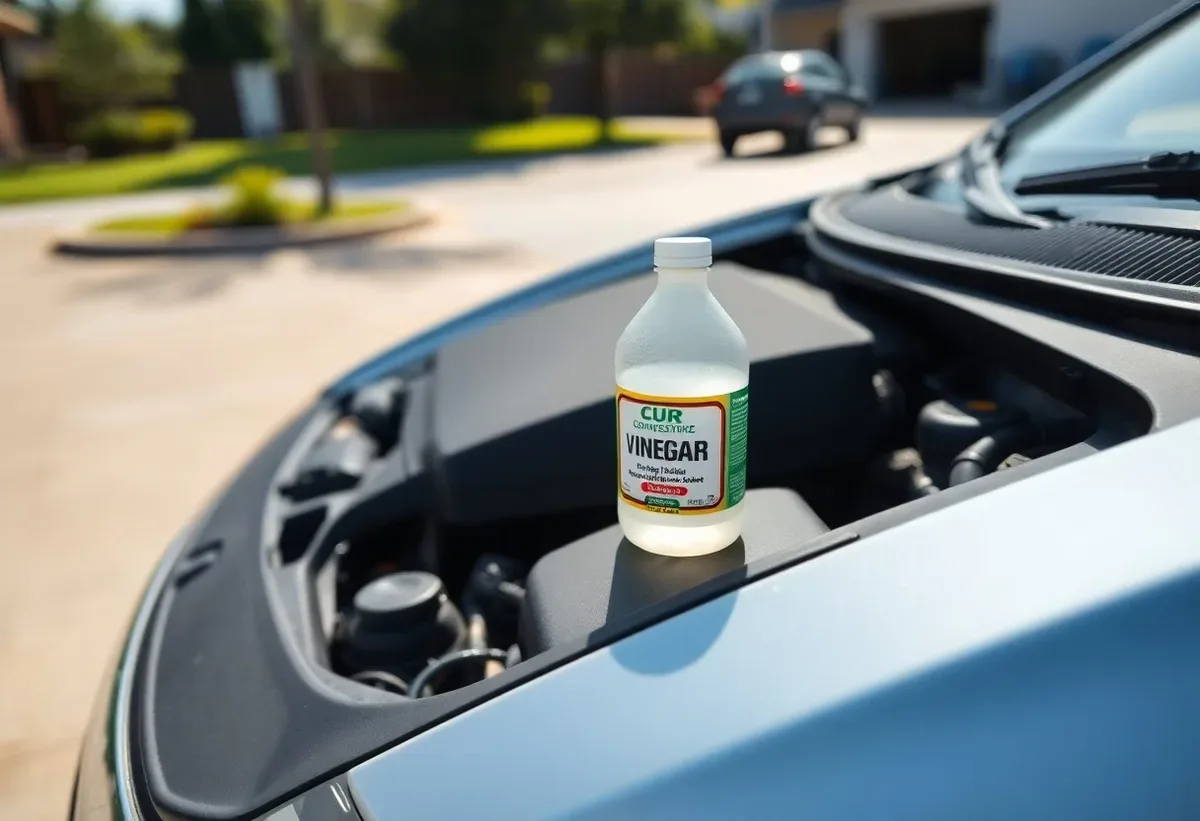
Can Vinegar Hurt Car Paint? Acetic Acid Risks Explained
Yes, vinegar can hurt car paint — but only under specific conditions. Household white vinegar is about 5% acetic acid (pH 2.4–3.4), acidic enough to etch clear coat if it’s used undiluted, applied to a hot surface, or left to dry. A brief, diluted (at least 1:1) rinse-and-go application carries far less risk. Below: the real chemistry, a safe dilution table, what damage actually looks like, and the pH-neutral soap most detailers use instead.
The Chemistry: Why Vinegar Can Etch Clear Coat
Standard household white vinegar contains roughly 5% acetic acid, which puts its pH between 2.4 and 3.4 — solidly on the acidic side of the scale. That’s weak compared to something like battery acid, but it’s still strong enough to soften and slightly swell the polymer resins that make up your car’s clear coat. Detailers call this “chemical etching”: the acid attacks the clear coat at a microscopic level, leaving tiny pits and irregularities that scatter light instead of reflecting it cleanly, which is why etched paint looks dull, hazy, or cloudy rather than glossy.
Three factors determine how much damage actually happens: concentration (undiluted vinegar straight from the bottle is far more aggressive than a diluted mix), dwell time (a few seconds followed by an immediate rinse is much safer than letting it sit for minutes or dry completely), and heat (a hot, sun-baked hood makes the water in the solution evaporate fast, leaving behind a concentrated puddle of acetic acid that attacks the finish far more aggressively than the same vinegar on a cool, shaded panel).
Safe Dilution Ratio for Using Vinegar on Car Paint
If you’re using vinegar to knock out stubborn water spots or mineral deposits, dilution is what separates “safe spot treatment” from “paint damage.” Most detailers recommend mixing at least equal parts vinegar and water (a 1:1 ratio), and some go as cautious as 1 part vinegar to 9 or 10 parts water for extra-sensitive dark paint. The table below breaks down the risk at each strength.
| Dilution Ratio | Approx. Acetic Acid Strength | Risk Level | Best For |
|---|---|---|---|
| Undiluted (straight from bottle) | ~5% | High — avoid on paint | Never recommended for car paint |
| 1:1 (vinegar : water) | ~2.5% | Low, if rinsed immediately | Standard ratio for spot-treating water spots |
| 1:3 to 1:10 (vinegar : water) | ~0.5%–1.25% | Very low | Extra caution on dark paint or fresh ceramic coating |
| Industrial-strength vinegar (~75%) | ~75% | Extreme — never use | Not intended for any automotive use |
One more thing diluted vinegar will still do: strip wax and sealant. Even at a safe 1:1 ratio, vinegar’s mild acidity breaks down the protective layer on your paint, so any area you treat needs to be rewaxed afterward.
Safer Alternative: Why Detailers Reach for pH-Neutral Car Soap Instead
Because vinegar’s acidity always carries some risk — and always strips wax — most professional detailers skip it entirely for routine cleaning. The gold standard is a dedicated pH-neutral car wash soap (close to pH 7), which lifts dirt and water spots without etching clear coat or breaking down your wax and sealant layer. Save diluted vinegar for the rare mineral deposit that pH-neutral soap alone won’t budge, and treat it as a spot fix rather than a wash routine.
Safer Than DIY Vinegar Solutions
Chemical Guys Mr. Pink Car Wash Soap
Best for: Routine washing and spot-cleaning water spots without any acid risk to clear coat.
Why we picked it: pH-neutral formula lifts mineral deposits and grime without etching paint or stripping wax the way vinegar can.
Main drawback: Costs more per wash than a bottle of vinegar, though it won’t risk your clear coat.
View Our Pick on AmazonCompare more paint-safe cleaning options
 Microfiber Wash Mitt Check on Amazon |
 Two-Bucket Wash Kit Check on Amazon |
 Carnauba Paste Wax Check on Amazon |
As an Amazon Associate we earn from qualifying purchases.
What Vinegar Damage to Clear Coat Actually Looks Like
Vinegar etching doesn’t look like a scratch or a chip — it’s more subtle. Look for a slightly hazy or cloudy patch exactly where the vinegar sat, a duller-than-surrounding-paint sheen that doesn’t buff out with a quick wipe, or a faint water-spot-like ring left behind after the liquid dried. On dark paint, etched spots often show up as a whitish or grayish film; on lighter colors it can just look like a dull patch that catches light differently than the rest of the panel. This is different from general clear coat oxidation, which spreads gradually across the whole car from UV exposure rather than appearing suddenly in the exact shape of a spill.
How to Use Vinegar on Car Paint Safely
- Mix a diluted solution. Combine at least 1 part white vinegar with 1 part water in a spray bottle. Never apply it straight from the bottle.
- Work in the shade on a cool panel. Avoid direct sun and hot metal — heat concentrates the acid as the water evaporates.
- Spot-treat only. Spray the diluted mix only on the water spot or mineral deposit, not the whole car.
- Agitate gently. Use a soft microfiber cloth, not a scrubbing motion, to lift the deposit.
- Rinse immediately with plain water. Don’t let the solution sit for more than a minute or two, and never let it air-dry on the paint.
- Dry the area. Use a clean microfiber towel to remove any remaining moisture.
- Reapply wax or sealant. Vinegar strips protection even when diluted, so the treated spot needs fresh wax afterward.
Debunking Common Myths About Vinegar and Car Paint
“Vinegar is basically the same as a store-bought car cleaner.” It isn’t — dedicated car wash soap is formulated to be pH-neutral specifically so it won’t touch clear coat or wax, while vinegar is acidic by nature and will affect both to some degree, diluted or not.
“If vinegar removes wax without visibly damaging the paint, it’s safe to use regularly.” Stripping wax isn’t damage-free — it leaves the clear coat unprotected against UV rays and road grime until you reapply protection, and repeated undiluted use compounds the etching risk over time.
“If there’s no visible damage right after using it, the vinegar didn’t hurt anything.” Light etching can be subtle at first and only becomes noticeable after several uses or once the wax layer wears off completely, so a single clean-looking wash doesn’t rule out gradual damage from a regular habit.
Frequently Asked Questions
Does vinegar strip car wax?
Yes, even diluted vinegar’s mild acidity breaks down wax and sealant. If you use vinegar anywhere on your paint, plan to reapply wax to that area afterward.
How long can vinegar sit on car paint before it’s dangerous?
A quick, diluted application followed by an immediate rinse (within a minute or two) carries low risk. Letting vinegar sit for several minutes, or allowing it to dry completely, is when etching becomes much more likely — especially on a hot, sun-exposed panel.
Is vinegar safe on car paint in direct sunlight?
No — avoid using vinegar on a hot or sun-baked surface. Heat causes the water in the solution to evaporate quickly, concentrating the acetic acid left behind and increasing the chance of etching. Always work in the shade on a cool panel.
Can vinegar remove water spots from car paint safely?
Yes, when diluted at least 1:1 with water and rinsed off right away, vinegar is an effective spot treatment for mineral deposits and water spots. Use it as an occasional fix, not a regular wash routine, and rewax the treated area afterward.
What’s the safe vinegar-to-water ratio for car paint?
At least equal parts vinegar and water (1:1) is the standard safe ratio, and diluting further to 1:3 or 1:10 adds extra caution on dark paint or a fresh ceramic coating. Never use vinegar undiluted straight from the bottle.
What should I use instead of vinegar for tough spots?
A dedicated pH-neutral car wash soap handles most dirt and grime without any acid risk. For stubborn mineral deposits or water spots specifically, a purpose-made automotive water-spot remover is a safer bet than DIY vinegar since it’s formulated not to strip wax or etch clear coat.
Conclusion
Vinegar can hurt car paint, but the real risk comes down to concentration, dwell time, and heat — not vinegar itself being universally dangerous. Used undiluted, left to dry, or applied on a hot panel, its 5% acetic acid can etch clear coat and dull the finish. Diluted at least 1:1 and rinsed off immediately, it’s a reasonably safe occasional spot treatment for water spots, though it will still strip wax. For everyday washing, a pH-neutral car wash soap avoids the guesswork entirely. For more on keeping your finish protected, see our guides on restoring old car paint and whether dish soap is safe for washing a car.
Products related to this article
Sponsored / affiliate links. As an Amazon Associate I earn from qualifying purchases. I may earn additional commission from eligible campaigns.
 Car Paint Scratch Remover with Hand Application, 100g / 3.53oz Exterior Paint for Daily Finish Upkeep and Light Scratch Care Car Remover Hand Apply Exterior Care Light Auto Finish Upkeep Water
 Car Scratch Remover for Vehicles, Car Paint Scratch Repair Kit for Light Scratches, Swirl Marks, Scuffs & Water Spots, Comes with Sponge, Safe for All Paint Colors, 100g, 1 Pack