Can You Rent Your Car to Uber? Requirements Explained
You usually can’t “rent your car to Uber” directly; you can rent a vehicle from Uber’s approved partners to drive, or rent your own car to another driver only through a platform that allows commercial ride-hail use. Miss this distinction and you can trigger insurance denials, account deactivation, or damage claims you can’t collect. This guide explains the two rental paths and gives you an owner-side checklist for eligibility.
Can you rent your car to Uber?



Usually, no. Uber’s vehicle marketplace is generally aimed at drivers who need a car for Uber, rather than private owners listing a personal vehicle directly on the platform like a typical peer-to-peer rental app. If you own the car, the key question is whether the rental path allows ride-hail use at all.
Why this phrase causes confusion
“Rent my car to Uber” is used to mean two different things. One is renting a car from Uber’s approved partners so you can drive for Uber. The other is renting your car to someone who intends to drive on Uber, which is a separate commercial use case and often blocked unless the rental platform and insurance both permit ride-hail driving.
What Uber Vehicle Marketplace is, and is not
Uber’s vehicle marketplace offers car rental and purchase options for Uber drivers. Uber says drivers should sign up first, then look at vehicle partners for more information. That means the program is a driver-access pathway, not a general listing service where any owner can hand over a car for Uber work in every market.
How does Uber’s car rental program work?
Uber’s car rental path starts with driver signup, then moves to vehicle access through approved partners. In some markets, a Greenlight hub step comes next for document review or in-person activation. Availability is limited to select cities, so you have to check each market on its own before you count on access.
Sign up to drive first
Uber instructs drivers to sign up before getting a vehicle. That order matters because the car offer is tied to a driver account and local eligibility. If the account is incomplete, the rental path can stop before a vehicle partner ever releases keys.
How vehicle partners and pick-up steps usually work
Once the driver account is approved, the next step is usually a partner-directed rental process. The exact handoff varies by city and partner, but the core structure is the same: confirm eligibility, pick an available vehicle, finish the required documents, and collect the car after approval. Uber says drivers can learn more from vehicle partners.
Where Greenlight hubs fit into the process
In some cities, Uber may use a Greenlight hub for in-person activation or document submission after signup. That hub step can be required when local rules or account checks need a face-to-face review. If the city requires it, skipping the hub can delay or block access to the vehicle program.

Can you rent your car for someone else to drive on Uber?
Only if the platform, insurance, and local rules permit commercial ride-hail use. Owner permission alone is not enough. If the driver is not the named insured, or if the rental agreement excludes Uber driving, a claim can be denied and the vehicle can become a coverage problem instead of an income source.
Why owner permission matters
Insurance often turns on who is allowed to drive and for what purpose. If the person using the car is not the owner, many policies require explicit permission. If the intended use is rideshare driving, the policy may also require that use to be disclosed or separately covered.
When this is blocked by policy or insurance
Some rental agreements prohibit commercial transport work entirely. Some policies do not cover time spent on app-based driving. And some markets only allow vehicle access through Uber’s approved partners, not through a private owner arrangement. If any one of those pieces fails, the rental can collapse before the first trip.
What are Uber’s vehicle requirements for rental cars?
Uber says eligible cars must meet age, mileage, and condition requirements, and the vehicle still has to pass the local approval process. Those checks are designed to keep the car usable for passenger service. A vehicle that looks acceptable on paper can still be rejected if documents, damage, or market rules do not line up.
Age, mileage, and condition
Uber’s guidance points to age requirements, mileage requirements, and condition requirements. Those three items work together. A car can be new enough but too worn, or low-mileage but not clean enough, or mechanically sound but outside the city’s local rules.
Document checks and approval steps
Expect document review before the vehicle is cleared. That can include driver account verification, vehicle records, and local compliance items. In Greenlight markets, in-person review can happen after signup and document submission. Until approval is complete, the car is not safely treated as active Uber-capable inventory.
Common rejection reasons
Common rejection reasons often include damage, missing paperwork, mismatched ownership, and insurance gaps. A car can also fail because the city does not support the program, because the mileage is too high for the local rules, or because the policy does not support ride-hail use.
Do I need insurance to rent my car to Uber?
Yes. Insurance matters in both directions: for the driver renting through Uber’s system and for the owner who wants a third party to use a car for ride-hail work. The named insured, liability coverage, and owner permission should all align with how the vehicle is actually used.
Named insured and owner consent
The named insured should match the real legal arrangement. If the person driving is not the owner, the owner usually needs to give permission, and the insurance file should not contradict that use. If ownership and insurance records do not match the driver arrangement, a claim can become harder to defend.
Liability coverage and coverage gaps
Liability coverage is the minimum issue to examine, but it is not the only one. You also need to know whether the policy covers commercial ride-hail use, whether app-on time is excluded, and whether damage during active driving is handled differently from damage while the car is parked. Do not assume ordinary personal auto insurance is enough.
What to verify before anyone drives
- Confirm whether the policy allows rideshare or commercial driving.
- Check that the named insured and the actual driver arrangement are consistent.
- Ask whether owner permission must be written, not verbal.
- Verify who pays for damage, downtime, and towing.
- Confirm what happens if the car is used outside the approved city or market.
Is Uber car rental available in my city?
Maybe, but only in select cities or markets. Uber says availability is limited, so you have to check local program access before counting on the car as a driver solution. A vehicle that qualifies in one market may not be offered in another, even if the car itself is eligible.
City-by-city access matters
Local access affects both the rental path and the approval path. Some cities use Greenlight hubs. Others may rely more heavily on digital review. The practical result is the same: a local program has to exist before a driver can move forward.
How to check without guessing
Start with the driver signup flow and the local Uber vehicle options shown for that market. If the city is not listed, assume the program is unavailable until confirmed otherwise. Do not buy, borrow, or register a car around a market that has not opened the program.
What is the difference between renting a car from Uber and renting my car to Uber?

Renting from Uber means a driver gets a vehicle through Uber’s approved partners to work on the platform. Renting your car to someone else for Uber use means you are the owner, and the driver is trying to use your vehicle for commercial trips. The second path carries more permission and insurance risk.
| Decision item | Rent to drive for Uber | Rent your car for others to drive on Uber |
|---|---|---|
| Ownership | Driver does not need to own the car | You own the car or control the lease |
| Insurance | Program-linked coverage and driver eligibility matter | Policy must allow commercial ride-hail use and named driver status must fit |
| City availability | Available only in select cities or markets | Depends on whether local law, platform rules, and insurance allow it |
| Vehicle condition | Must meet age, mileage, and condition requirements | Must also satisfy your insurer and any rental platform requirements |
| Approval steps | Sign up to drive first, then complete partner or hub steps | Get written permission, confirm coverage, then clear the platform’s commercial-use rules |
| Likely failure points | No local program, bad documents, failed vehicle inspection | Insurance exclusion, owner-consent dispute, or illegal commercial use |
Which path fits drivers, and which path fits owners?
If you want to drive and need a car, the Uber vehicle marketplace path is the relevant one. If you own a car and want someone else to use it for Uber work, you need a separate commercial arrangement with written permission, usable insurance, and local legality checked first.
What are the costs, wear, and earning tradeoffs?
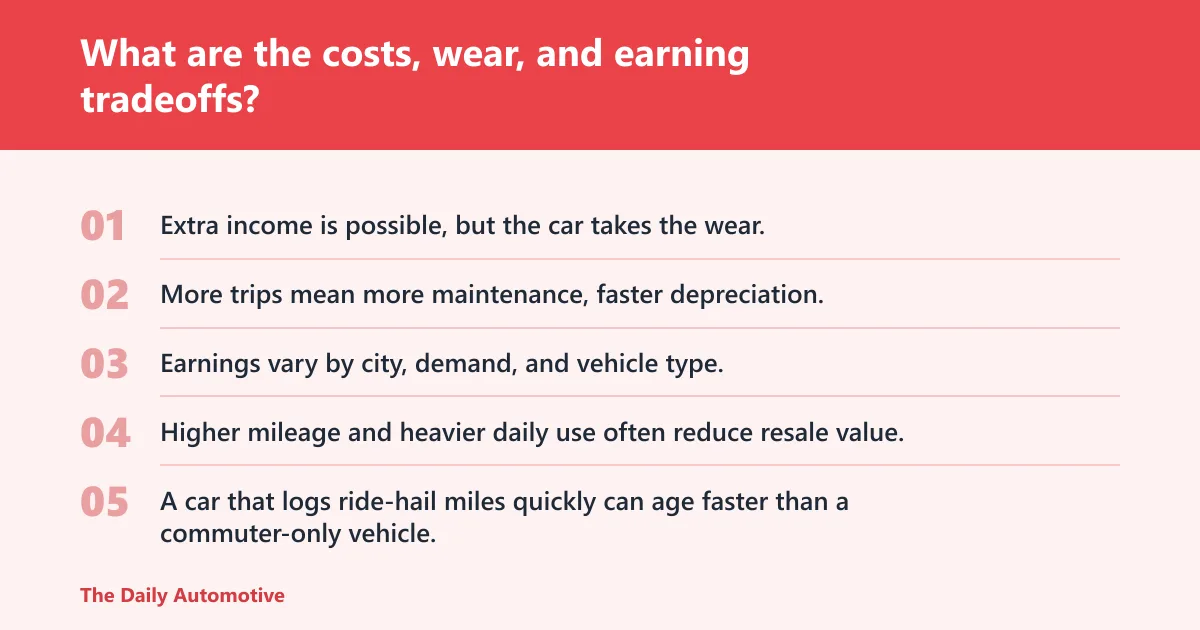
Extra income is possible, but the car takes the wear. More trips mean more maintenance, faster depreciation, and more downtime if repairs are needed. Earnings vary by city, demand, and vehicle type, so the same car can produce very different results in different markets.
Depreciation and resale value
Higher mileage and heavier daily use often reduce resale value. A car that logs ride-hail miles quickly can age faster than a commuter-only vehicle. Even if the vehicle stays mechanically sound, market buyers often discount high-use cars.
Maintenance and downtime
More driving raises operating costs. Tires, brakes, fluids, and cleaning become more frequent line items, and a repair visit can interrupt earning days. If the car is the only one in the household, downtime can become the real cost, not just the invoice total.
Why earnings vary by city and vehicle type
Uber’s earnings potential depends on local demand and the type of vehicle. A fuel-efficient car in a busy city may perform differently from a larger vehicle in a lower-demand market. Do not rely on a generic earnings estimate unless it is tied to the actual city and vehicle class.
Say your sedan has relatively high mileage and a worn front bumper. It may still run fine, but a local vehicle review can reject it if the condition standard is strict or the damage affects passenger safety. The owner then faces repair cost before any revenue starts.
Suppose a friend wants to drive your compact SUV for Uber in a city with no local marketplace access. Even with your permission, the arrangement can fail if the city is not supported or the insurance policy excludes commercial use. The problem shows up before the first ride, not after.
Frequently asked questions
Can you rent your car to Uber?
Usually not directly. Uber’s vehicle access program is designed for drivers who need a car, and it relies on approved partners and local availability. If you want another person to drive your car for Uber, you need a separate arrangement that explicitly allows commercial ride-hail use.
How does Uber’s car rental program work?
A driver signs up first, then checks local vehicle options through Uber’s approved partners. In some markets, a Greenlight hub may be part of document review or activation. The car must still meet local age, mileage, and condition rules before it can be used.
What are Uber’s vehicle requirements for rental cars?
Uber says eligible vehicles must meet age requirements, mileage requirements, and condition requirements. The car also has to pass the approval process in the local market. A clean-looking vehicle can still be rejected if the paperwork or market rules do not match.
Do I need insurance to rent my car to Uber?
Yes. You need a policy that matches the actual driver and actual use. Named insured status, owner permission, and liability coverage all matter. If the policy excludes commercial driving or ride-hail work, the rental can fail even if the car itself is eligible.
Is Uber car rental available in my city?
Only in select cities or markets. Uber’s vehicle access program is not universal, and local access can change the steps you must follow. Check the driver signup flow for your specific market before assuming a car will be available.
What is the difference between renting a car from Uber and renting my car to Uber?
Renting from Uber means a driver gets a vehicle through Uber’s approved partners to use for driving. Renting your own car to someone else for Uber use is a separate commercial arrangement and usually needs explicit permission, matching insurance, and local legality checks.
Products related to this article
Sponsored / affiliate links. As an Amazon Associate I earn from qualifying purchases. I may earn additional commission from eligible campaigns.