Can You Wrap a Car with Rust? Why You Should Fix It First
Minor surface rust can be repaired before a wrap, but bubbling paint, flaking scale, or any perforation is a hard stop until the metal is fixed. Wrap over active rust and the film may lift, trap moisture, and waste the install. This guide covers which rust is salvageable, which rust rules out vinyl, and what prep makes a panel wrap-safe.
Rust decision checklist table


| Rust type | Visual signs | Wrapping allowed? | Required repair step | Stop-ship warning signs |
|---|---|---|---|---|
| Surface rust | Minor orange discoloration; no bubbling; metal still solid | Yes, after repair | Sand or grind to clean metal, treat if needed, prime, and sand flat | Rust powder returns after sanding; pitting remains; metal feels thin |
| Bubbling paint | Raised blisters under paint, often near chips or edges | Not until inspected and repaired | Open the damaged area, remove corrosion, repair the substrate, then prime | Bubbles grow, crack, or weep rust stain |
| Edge rust | Rust along door edges, hood lips, trim lines, or panel folds | Only after full cleaning and sealing | Remove corrosion, smooth the edge, treat, and prime before wrap | Sharp flaky edge, lifting paint, or exposed bare steel |
| Seam rust | Rust at seams, joints, pinch welds, or overlaps | Usually no until a body shop inspects it | Clean and assess; repair or reseal the seam if metal loss is present | Rust bleeding from seams, swelling seam sealer, or trapped moisture |
| Flaking rust | Loose scale, peeling layers, rough crust, bare metal exposure | No | Remove all loose corrosion, then repair any pitting or thinning metal | Rust falls off when brushed, or the panel flexes nearby |
| Perforation | Pinholes, holes, or daylight through the panel | No | Weld, replace, or body-repair the panel before any wrap work | Visible hole, soft metal, or edge break-through |
| Rocker panel rust | Rust at the lower side sill, often with road salt exposure | Usually no until repaired | Inspect from both sides and repair any structural loss first | Crumbling lower edge, jacking-point damage, or swelling under trim |
| Wheel arch rust | Bubbling at the lip, flaking behind liners, or wet dirt trapped inside | Only after full repair | Remove liner, clean the lip, repair the arch, then prime and seal | Rust returns quickly after cleaning or the lip is thin |
Can you wrap surface rust?
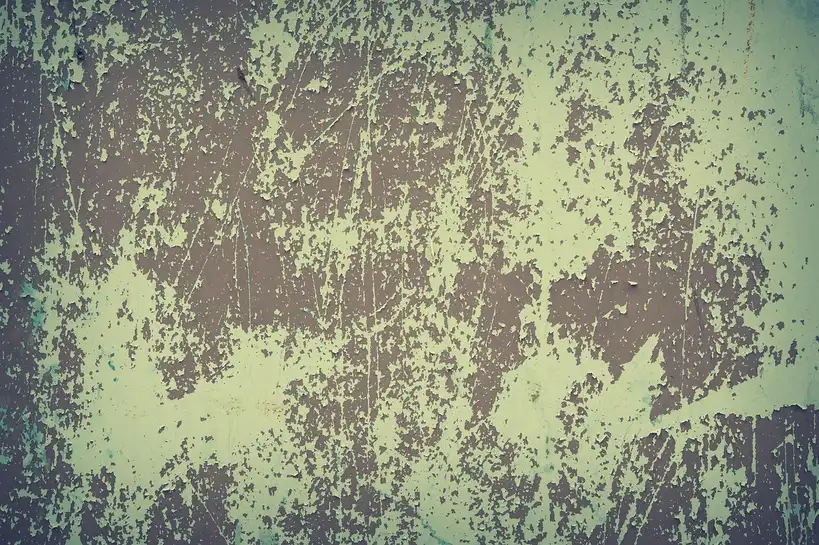
Yes, but only after the rust is removed back to solid metal and the panel is sealed and smoothed. Minor orange discoloration is not the same as loose corrosion. If sanding leaves a clean, stable surface and the repair is flat enough for vinyl, the panel can be wrap-ready.
What minor orange discoloration means
Light surface rust often starts as orange staining where paint has chipped or worn thin. It may still be confined to the top layer of metal. That is repairable if the steel remains firm, the area is small, and no bubbling, scaling, or soft spots appear around it.
Vinyl wrap film is typically described as a large sheet of adhesive-backed vinyl, and automotive film is roughly 3 to 5 mils thick. That thickness leaves little room for rough metal. Wrap needs a smooth, clean, solid substrate, or the adhesive will telegraph every defect.
How far sanding can take you before primer?
Sand or grind until every rust trace is gone and the metal is sound. If pits remain after cleaning, they must be dealt with before film goes on. A rust-resistant primer can follow, but it must cure, stay flat, and be sanded smooth.
Say your hood has a thumbnail-sized orange spot near a stone chip. If the spot sands to clean metal and the repaired area ends up flush after primer, that is a reasonable wrap candidate. If the same spot reveals a soft crater, the job has moved into body repair.
When a repaired spot is wrap-ready
A wrap-ready repair has three things: no active rust, no loose coating, and no sharp transition at the repair edge. The panel should feel smooth under a hand or a soft lighting check. If you can still feel a ridge, the vinyl will likely show it.
What rust must be fixed before wrapping?
Bubbling paint, edge rust, seam rust, flaking rust, and any perforation should be repaired before wrapping. Those are warning signs that corrosion has moved beyond a cosmetic stain. Once the metal is loose, porous, or thin, the wrap has a poor base and the rust can keep moving underneath.
Bubbling paint and edge rust
Bubbles in paint usually mean rust is working under the coating. Do not treat them as harmless blemishes. Edge rust matters too, because exposed folds and lips trap moisture and often hide corrosion that is worse on the inside than on the face you can see.
Wheel arches and rocker panels deserve extra attention. They collect grit, salt, and water, so a small blister on the outside may point to broader corrosion behind the panel lip. Those areas often need more than sanding if the steel is already thinning.
Seam rust, flaking rust, and perforation
Seam rust can creep between layers where a wrap cannot reach. Flaking rust is active corrosion, with loose scale and bare metal exposure. Perforation is often treated as a hard stop: holes mean the panel has lost material and typically needs welding, replacement, or body repair before film.
Deep rust or structural rot can create holes through the panel, and rust can weaken a vehicle’s structure. That is why a wrap is not a repair method. It is a finish layer, and it needs a stable base.
Why rocker panels and wheel arches raise the risk
Rocker panels sit low and take spray from the road. Wheel arches trap dirt behind liners and around the lip. If corrosion shows up in either place, assume the problem may extend farther than the visible stain. An installer may refuse the job or limit warranty coverage.
How pre-wrap rust repair works
Pre-wrap repair means removing rust, rebuilding the surface, and sealing it before vinyl goes on. The usual steps are sanding or grinding, treating corrosion where appropriate, filling pits if needed, priming, and flat-sanding again. The goal is a dry, smooth, sealed panel.
- Inspect the panel under bright light and around chips, seams, and edges.
- Remove loose paint and rust with sanding or grinding until only solid metal remains.
- Use rust converter or rust-resistant primer only where the metal condition allows it.
- Fill pits or low spots with body filler if the repair needs leveling.
- Sand the filler flush, then apply primer and sand the primer flat.
- Confirm the surface is clean, dry, and even before the wrap install.
Rust converter and rust-resistant primer
Rust converter and rust-resistant primer can be part of prep, but they are not a substitute for metal repair. They help after rust removal, not instead of it. If the panel is crumbling or perforated, chemical treatment will not restore strength or create a stable wrap surface.
Body filler and flat finishing
Body filler can fill pits or low spots left after corrosion is removed. It must be sanded flush before primer. If filler sits above the surrounding surface, the wrap may bridge over the ridge and show it in daylight. Flat finishing matters because vinyl does not hide uneven repair work well.
Paintless dent repair near rust
Paintless dent repair can help nearby dents before wrapping, especially if the panel is otherwise sound. It is useful for small dents adjacent to repaired rust, but it does not fix rust itself. The corrosion still has to be removed, treated, and sealed before any film goes on.
Why wrapping over rust fails
Wrapping over rust fails because the adhesive needs clean, even metal or paint to bond properly. Porous corrosion, loose scale, and flaky edges stop that bond. The result is poor adhesion, then bubbling, lifting, peeling, wrinkling, or an uneven finish that can spread as the panel flexes.
Adhesion problems on porous or flaky metal
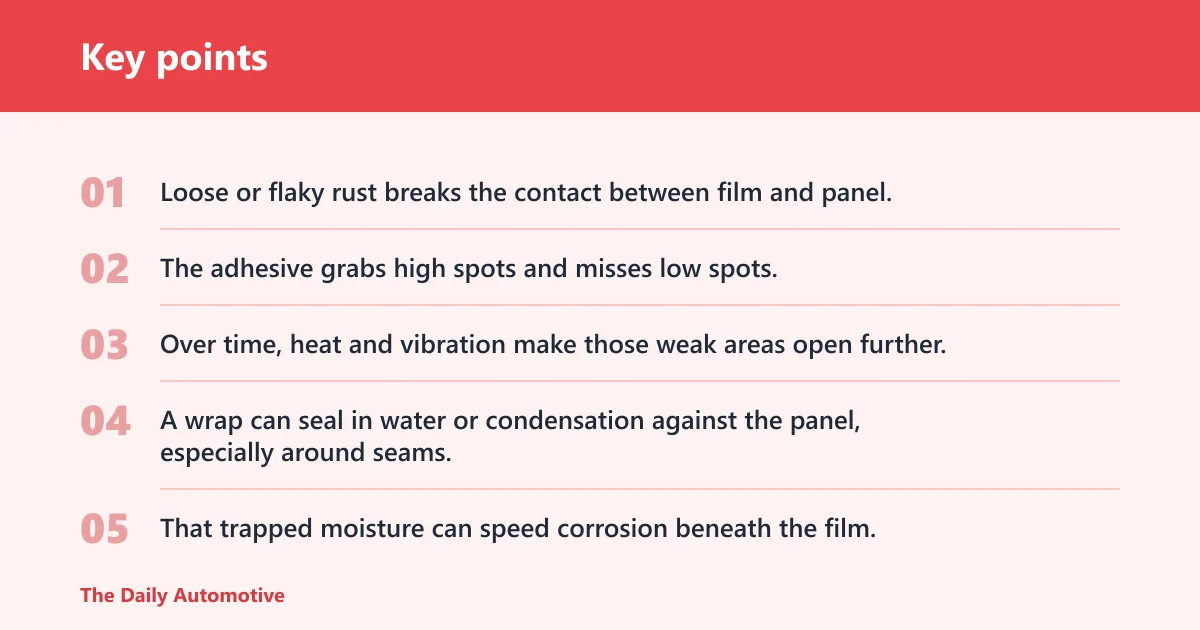
Loose or flaky rust breaks the contact between film and panel. The adhesive grabs high spots and misses low spots, so the wrap looks uneven from the start. Over time, heat and vibration make those weak areas open further. A wrap cannot bond well to rusted texture.
Moisture trapping beneath vinyl
Moisture trapping is the other major risk. A wrap can seal in water or condensation against the panel, especially around seams, edges, and wheel arches. That trapped moisture can speed corrosion beneath the film, which is why multiple installers and guides warn against wrapping active rust.
Suppose a rear quarter has a repaired bubble that was not fully dried before wrapping. The film may look fine on day one. Then a week of rain, overnight condensation, and road spray can let the rust continue under the vinyl, where the damage is harder to spot until the wrap starts lifting.
What happens when the wrap comes off later
When wrap is removed from a rusty panel, the underlying corrosion is often worse than before the install. Adhesive removal can also pull at weak paint edges. If the metal was not repaired first, you may uncover larger rust patches, more pitting, or new peeling around the original defect.
Can a wrap be applied after rust is sanded and primed?
Yes, if the rust is fully removed, the panel is repaired flat, and the primer is cured and sanded smooth. A wrap can go on a properly prepped panel. It should not go on rough primer, active corrosion, or a surface that still shows texture, pits, or loose edges.
JTAPE notes that a wrap can help protect a rust-free surface from rain and road salt, but it also says rust damage should be dealt with first. Driverclinics likewise warns that wrapping over rust is not generally recommended because trapped moisture can speed corrosion.
What the panel must look like first
Before wrapping, the panel should have a smooth, sealed finish with no visible rust bleed, no powdery corrosion, and no open pits. Primer should be flat and sanded. If you can feel roughness with a fingertip, the wrap will likely reveal it after installation.
Fix, wrap, or paint?
If the rust is minor and localized, fix it first, then wrap. If rust is widespread, perforated, or tied to structural damage, body repair or paint is usually the better call. The right choice depends on how much metal has to be repaired and how much finish work the panel needs afterward.
When wrapping makes sense after repair
Wrapping can make sense when the rust repair is limited to one or two panels, the metal is still sound, and the repair can be brought flat without major fabrication. In that case, the prep cost may be reasonable, and the wrap can cover a fresh, uniform finish once the bodywork is complete.
When paint or bodywork is the better call
If rust shows up on multiple panels, across seams, or on lower structure like rocker panels, the repair bill can climb quickly. In those cases, a repaint or body repair may be the smarter choice because the car needs corrosion work before any cosmetic finish. A wrap should not be used to hide a bad substrate.
Cost and time tradeoffs
Minor surface rust may need sanding, spot treatment, primer, and a short waiting period before wrap. Deep rust can mean cutting, welding, filler, primer, and then wrapping later. The first path is a prep job. The second is bodywork, and the time and cost are very different.
Frequently asked questions
Can you wrap a car with rust?
You can wrap a car only after the rust is repaired and the panel is smooth, sealed, and stable. Active rust, loose scale, bubbling paint, or holes are not wrap-safe. Vinyl needs a solid substrate, and installers may refuse rusty panels or exclude them from warranty coverage.
Will a car wrap hide rust bubbles or flaking paint?
No. A wrap may cover the area visually, but it does not fix the damage beneath it. Rust bubbles and flaking paint usually get worse under film because the adhesive cannot bond well to loose material, and moisture can remain trapped against the panel.
What kind of rust must be repaired before wrapping?
Any active rust must be repaired before wrapping, including bubbling paint, edge rust, seam rust, flaking rust, and perforation. Surface rust can sometimes be repaired if the metal is still solid and the panel can be sanded, primed, and finished flat enough for vinyl.
Does wrapping over rust make the corrosion worse?
It can. Wrap film may trap moisture against the metal, which can speed corrosion under the vinyl. That is especially risky around seams, wheel arches, edges, and rocker panels. The wrap may look fine at first, while the rust continues to spread underneath.
What happens when you remove a wrap from a rusty panel?
Removal can reveal rust that spread under the film, along with peeling paint, pitting, or a larger damaged area than expected. If the panel was not repaired first, adhesive removal may also disturb weak coating edges. The hidden corrosion often needs additional bodywork afterward.
Products related to this article
Sponsored / affiliate links. As an Amazon Associate I earn from qualifying purchases. I may earn additional commission from eligible campaigns.