Car Ignition Lock Cylinder Cost
Car ignition lock cylinder cost is often reported at about $80 to $400 for parts and labor, though a worn key may solve the problem for much less and a bad ignition switch can raise the bill. Guessing wrong can mean paying for a cylinder when the real fault is the key or switch, then dealing with a no-start or lockout again. This guide lays out likely fixes, common symptoms, and the price range for repair versus replacement.
Diagnosing key wear versus lock cylinder failure

The ignition lock cylinder is the mechanical part the key turns. It sits in or on the steering column assembly and lets you rotate the key from lock to accessory, run, and start. If it sticks, grinds, or refuses to turn, the fault may be in the cylinder, the key, or a related electrical part behind it.
A worn key can mimic cylinder failure. A key with rounded cuts may still enter the slot but not lift the pins or wafers cleanly, which makes the cylinder feel jammed even when the hardware is only partly worn. A spare key is the fastest check.
Suppose the spare key turns smoothly and the original key binds at the same spot every time. That points toward key wear first, not a failed cylinder. If both keys hang up in the same position, the cylinder or steering column hardware moves higher on the list.
Quick diagnostic check
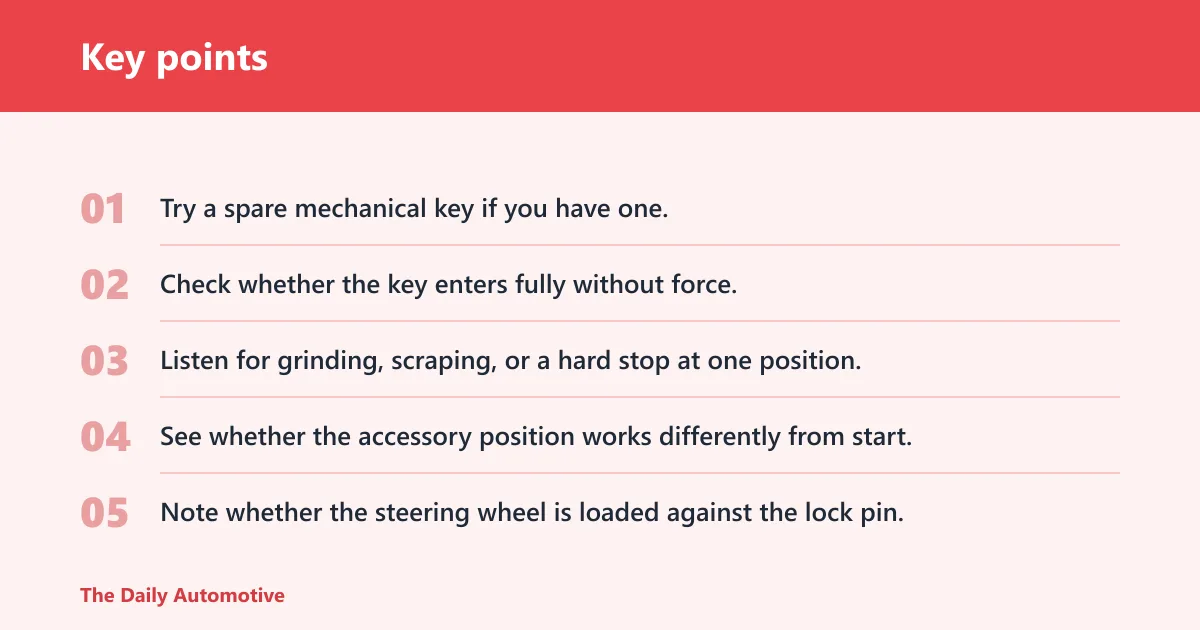
- Try a spare mechanical key if you have one.
- Check whether the key enters fully without force.
- Listen for grinding, scraping, or a hard stop at one position.
- See whether the accessory position works differently from start.
- Note whether the steering wheel is loaded against the lock pin.
Ignition cost matrix
The cost path depends on what actually failed. A worn key may need only cutting. A rebuildable cylinder can be cleaned, rekeyed, or repaired. A damaged cylinder may need full replacement. If the problem is electrical, the ignition switch can be the expensive part, not the cylinder itself.
| Likely fault | Likely symptoms | Typical added costs | Programming needed? | Better fit |
|---|---|---|---|---|
| Worn key only | One key sticks; spare key works better; turning feels rough but not locked | Key cutting, often $100-$200 per key if a new transponder key is needed | Sometimes, on transponder keys | Locksmith |
| Cylinder rebuild | Key enters but turns stiffly; intermittent bind; no major electrical fault | Cleaning, rekeying, or repair labor; often less than full replacement | Usually no on older keyed cars; maybe yes on newer immobilizer setups | Locksmith |
| Cylinder replacement | Worn wafers, broken key slot, or cylinder will not turn at all | Typical replacement cost can be $100-$500+; parts average about $150, with a range of $50-$700 | Often on transponder or immobilizer vehicles | Locksmith or dealer |
| Electrical ignition switch replacement | Accessories or start circuit fail; key turns but dash or starter behavior is wrong | Labor can climb fast if trim and column disassembly are needed; RepairPal lists the ignition lock cylinder and ignition switch separately | Sometimes, depending on the vehicle | Dealer or experienced shop |
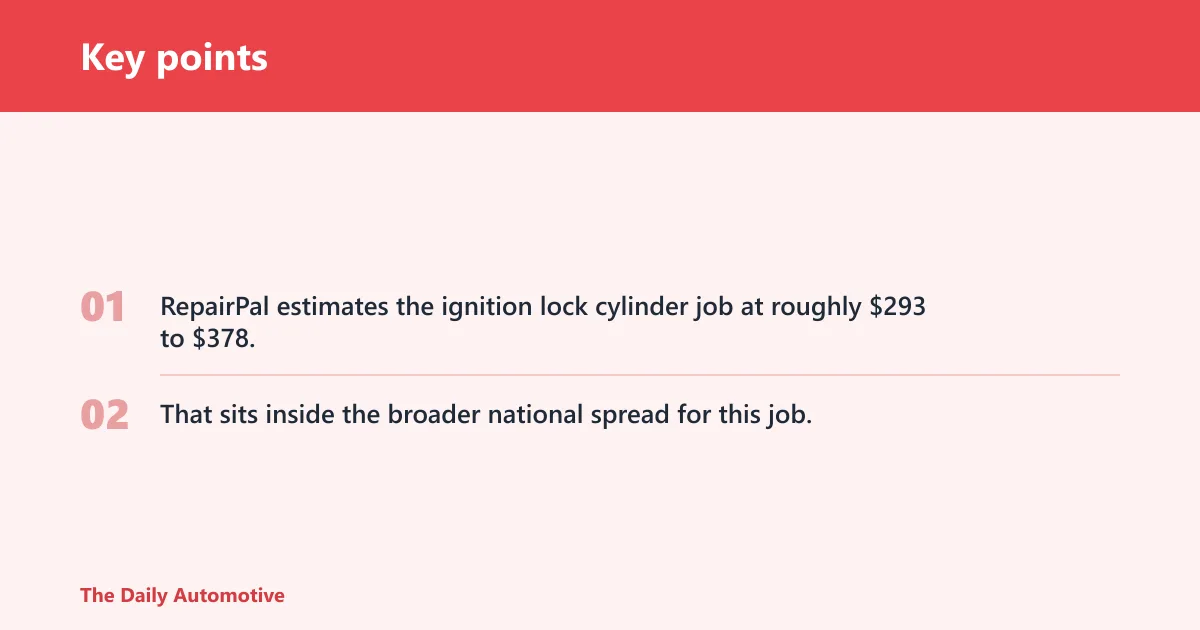
RepairPal estimates the ignition lock cylinder job at roughly $293 to $378, with parts around $195 to $235 and labor around $98 to $144. That sits inside the broader national spread for this job, where labor-only estimates can vary widely depending on teardown steps and replacement can take 1-4 hours.
Is the cylinder really the problem?
Not always. A sticky ignition can come from a worn cylinder, but the same complaint can show up with a bad key, a failing ignition switch, or even steering wheel load against the lock mechanism. The symptom matters more than the guess.
Signs of cylinder wear
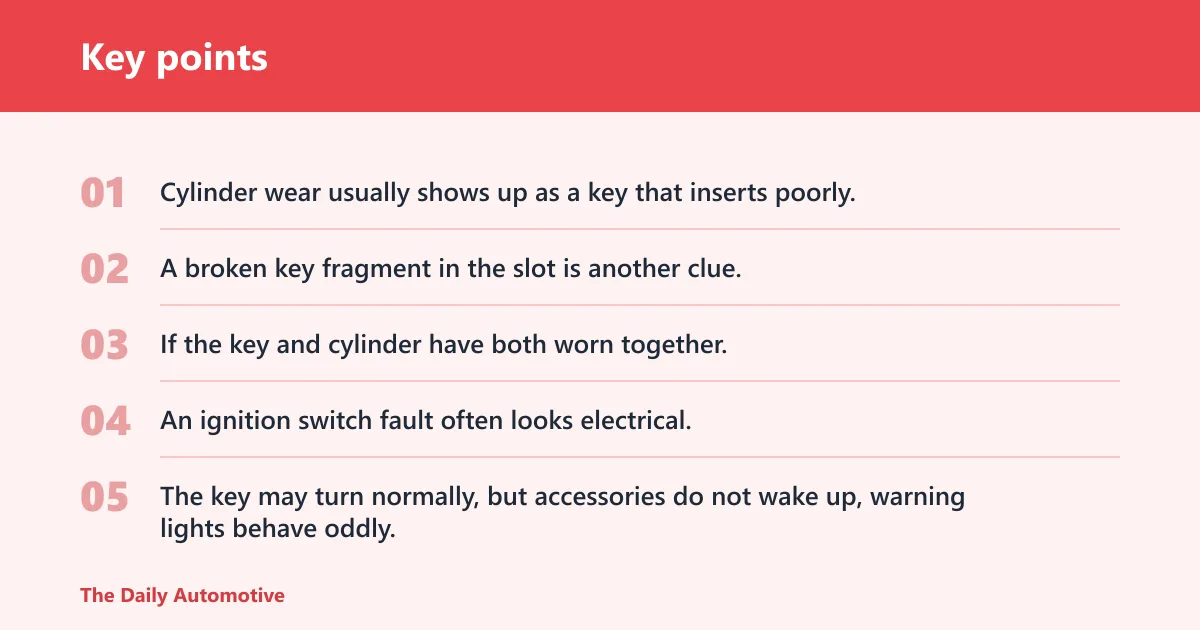
Cylinder wear usually shows up as a key that inserts poorly, turns only with jiggle pressure, or binds at the same point every time. A broken key fragment in the slot is another clue. If the key and cylinder have both worn together, the car may start only after careful movement.
Signs of switch failure
An ignition switch fault often looks electrical. The key may turn normally, but accessories do not wake up, warning lights behave oddly, or the starter does not respond as expected. Because the switch sits behind or separate from the cylinder, the lock can feel fine while the electrical side fails.
When battery or steering lock load is the better clue
A weak battery can make the starter act dead, which can complicate the diagnosis. Steering wheel pressure against the lock pin can also trap the key. A light pull on the wheel while turning the key is a useful check, not a repair.
A common first-timer mistake is assuming a jammed ignition means the whole switch is bad when the worn lock cylinder is the part that needs replacement. Forcing the key can snap it, damage the wafers, and turn a simple diagnostic problem into a broken-key extraction bill.
What changes the price?
Make, model, and year change access time, parts availability, and whether the cylinder can be rebuilt or must be replaced. Newer vehicles often add transponder or immobilizer work. Older keyed cars may be faster and cheaper, while some vehicle-specific jobs can still climb above $800 once labor and electronics are counted.
Access under steering column trim
Some cars let a technician reach the cylinder with limited trim removal. Others need steering column covers, switches, or adjacent modules removed first. More disassembly means more labor. That is why the same symptom can produce very different quotes from one vehicle to the next.
Anti-theft bolts and column disassembly
Anti-theft hardware can slow the job. Tamper-resistant bolts, column collars, and steering wheel or column disassembly add time and can push labor toward the upper end of the range. When the lock housing has been damaged during a theft attempt, parts and labor both climb.
Broken-key extraction and towing
These add-ons are easy to miss in a quote. Broken-key extraction, towing, rekeying, and new key cutting can each add cost. If the car is stuck in a parking lot or driveway and the key will not move, towing plus mobile labor can cost less than a dealer tow-plus-labor package, but not always.
Honda Civic ignition cylinder cost is listed at $27.99-$539, which shows how wide vehicle-specific pricing can be. Toyota Camry ignition cylinder labor is listed at $92-$327, which is a reminder that access time can matter as much as the part.
Can a locksmith replace it?
Yes, often. A locksmith can frequently rebuild, rekey, replace, or extract a broken key from the cylinder. For many non-encrypted or older keyed vehicles, mobile service can be the faster fit because it avoids a tow and may reduce labor overlap with dealership pricing, depending on local mobile-service fees and key availability.
Rekeying to match the existing door key
If the new cylinder needs to match the door key, a locksmith may rebuild or recode the cylinder so the original key still works. That can keep you from carrying separate door and ignition keys. It is most useful when the lock hardware is salvageable and the vehicle does not demand dealer-only electronics.
When dealer equipment is more likely needed
A dealer becomes the better fit when encrypted systems, VIN-based parts ordering, or vehicle-specific programming are involved. New keys can cost $100-$200 per key, and transponder or immobilizer programming can add $50-$400+. On those vehicles, the dealer may have the tools needed to finish the job correctly.
Does replacement need programming?
Programming is sometimes not needed on older keyed cars, while newer vehicles with transponder or immobilizer systems often do require it. A plain mechanical cylinder on an older car may not need any programming at all. Newer vehicles with transponder or immobilizer systems often do, especially if the ignition repair involves a new key or a matched cylinder set. The electronics, not the cylinder alone, drive the extra charge.
When programming is not needed
If the vehicle uses a simple mechanical key and the new cylinder is rebuilt or rekeyed to the old cuts, programming usually is not part of the bill. That is more common on older keyed cars without anti-theft chip keys. In those cases, labor and key cutting matter more than software.
Typical key-programming add-ons
Expect added charges when the job requires chip-key registration, immobilizer pairing, or a separate replacement key. Competitor estimates commonly place those add-ons at $50-$400+ for programming, plus $100-$200 per key. That is why a quote for the cylinder alone can look low until the electronic steps are added.
Can you replace it without the original key?
Yes, in many cases, but the job changes. Without the original key, the technician must diagnose the lock without a working pattern, and the bill may include extraction, rekeying, or a new cylinder. A dealer or VIN-based order may be the better route when the vehicle is heavily encrypted.
No-key diagnostic path
The first step is identifying whether the lock is jammed, broken, or simply keyed to a missing original. If the cylinder still turns with a correctly cut replacement, rekeying may be enough. If it does not turn or the keyway is damaged, replacement becomes more likely.
Locksmith rekey or replacement options
A locksmith can often build a solution on-site, especially when the vehicle is older or the cylinder can be removed without major teardown. That may include extracting broken pieces, rebuilding the lock, or replacing the cylinder and matching it to the door key. Mobile service is often cheaper than dealer towing.
Say your sedan has a worn key, the spare works, and the ignition only sticks in the winter. Start with the key. If the spare cures the problem, paying for a full cylinder replacement would waste money.
Suppose your crossover turns the key normally but the dash stays dark and the starter does nothing. That points away from the cylinder and toward the electrical ignition switch or another power issue, so a locksmith-only cylinder quote would miss the real fault.
How do you replace an ignition lock cylinder?
Replacement usually means removing steering column trim, releasing the old cylinder, and installing a matched part or rebuilt unit. The exact steps vary by vehicle, but the work often includes anti-theft fasteners, access panels, and a check that the new cylinder matches the key and start positions.
Basic replacement sequence
- Disconnect power as required by the vehicle procedure.
- Remove steering column trim or adjacent panels.
- Release the cylinder retaining mechanism.
- Remove the old cylinder or key assembly.
- Install the replacement or rebuilt cylinder.
- Verify key turn, accessory position, start position, and steering lock operation.
How do you remove the ignition lock cylinder?
Removal depends on access and on whether the lock is already in the correct release position. Some cylinders slide out after a release tab is depressed. Others need trim removal, a known key position, or deeper column work. If the key will not turn, removal may require more than a simple pull.
Frequently asked questions
What is an ignition lock cylinder?
It is the mechanical lock the key turns to switch the vehicle from lock to accessory, run, and start. It can stick, grind, or refuse to turn if the key is worn, the cylinder is damaged, or steering column pressure is loading the lock.
How much does an ignition lock cylinder cost?
Typical replacement cost can be $100-$500+, with parts averaging about $150 and ranging from $50-$700. Labor varies depending on access and teardown. Vehicle-specific quotes can fall below that range or exceed it once programming and towing are added.
How much does it cost to replace an ignition lock cylinder?
RepairPal’s current estimate is $293 to $378 for the job. New keys, broken-key extraction, towing, or immobilizer programming can push the final bill higher.
What is the difference between an ignition lock cylinder and an ignition switch?
The cylinder is the mechanical part the key turns. The switch is the electrical component behind or separate from it, and it controls accessory and start circuits. RepairPal treats them as separate parts, which matters because a turning key does not prove the switch is healthy.
Can a locksmith replace an ignition cylinder?
Yes. A locksmith can often rebuild, rekey, replace, or extract a broken key from the cylinder. For many older keyed cars, that is the cheapest route because it avoids towing and dealer labor. Newer encrypted vehicles may still need dealer tools for programming.
Does replacing the ignition lock cylinder require programming?
Not always. Older mechanical-key systems often do not need programming. The need depends on the car, not just on the cylinder itself.
How do you replace an ignition lock cylinder without the original key?
Without the original key, a locksmith or dealer must work from the lock, the VIN, or a replacement set. A locksmith may still rebuild or rekey the cylinder if the hardware is usable. If the vehicle is heavily encrypted, a dealer order and programming may be the cleaner fix.
Products related to this article
Sponsored / affiliate links. As an Amazon Associate I earn from qualifying purchases. I may earn additional commission from eligible campaigns.