Car Door Lock Repair Cost
Car door lock repair cost usually runs about $120 to $600, but a cylinder or handle fix may cost less, while an actuator or latch replacement can raise the bill. If you ignore it, you may lose key entry, trigger security faults, or end up paying for a full assembly you did not need. This guide breaks down symptoms, parts, and the repair-vs-replacement call so you can judge quotes before you book.
What car door lock repair cost includes
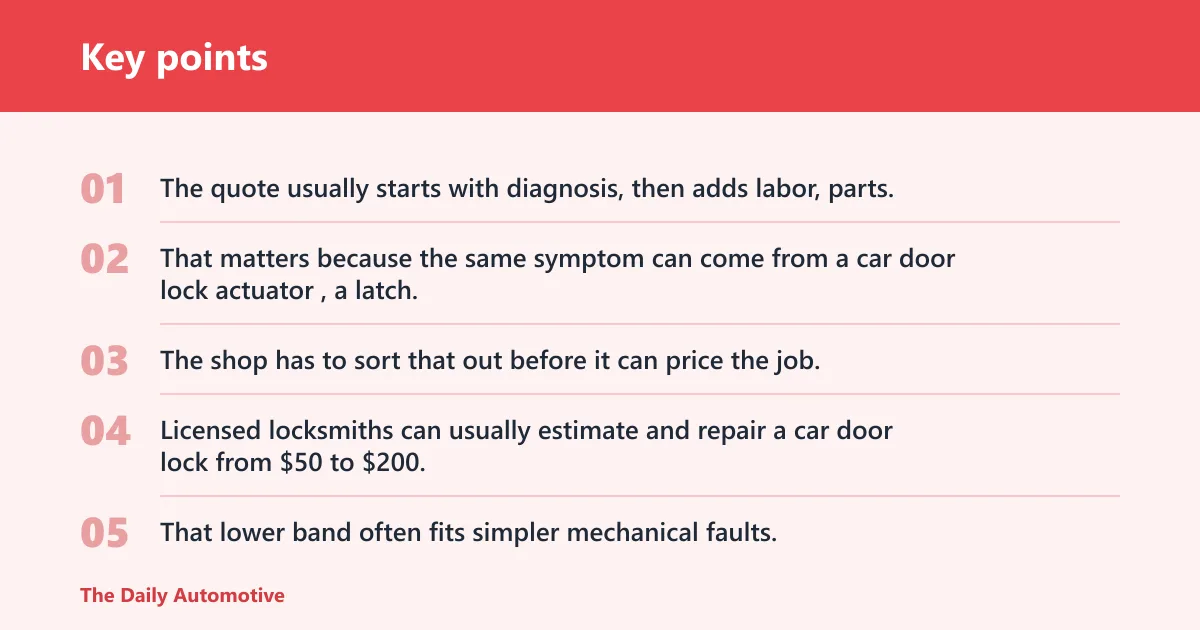


The quote usually starts with diagnosis, then adds labor, parts, and the time needed to reach the failed hardware. That matters because the same symptom can come from a car door lock actuator, a latch, a handle linkage, a cylinder, or the small motor inside an electric assembly. The shop has to sort that out before it can price the job.
Licensed locksmiths can usually estimate and repair a car door lock from $50 to $200. That lower band often fits simpler mechanical faults, but modern power-lock doors can cost more because today’s lock systems can be electrical devices and the service may involve more than a single part swap.
Older cars with standard hardware are often quicker to open and diagnose. Newer cars usually add trim clips, wiring, and integrated electronics, which adds labor rate pressure and part sourcing time. Final price changes with vehicle design, local labor rates, and how much damage the door hardware has taken.
Diagnosis and inspection
Diagnosis comes before pricing because the same symptom can mean different failures. A dead lock may be caused by a failed actuator, a seized latch, a broken wire, or a worn cylinder. A grinding sound often points toward an electric motor or actuator gear problem, while a handle that moves loosely can point to a linkage issue instead.
Parts versus labor
Part cost is only one piece of the quote. Labor can rise when the shop must remove the inner door panel, free stuck fasteners, and inspect the linkage behind the trim. If the replacement part is tied to electronics or sold only as a full assembly, parts pricing climbs fast.
Why access time changes the quote
Door panel removal tools are usually needed to reach internal lock parts without damaging clips or trim. That access step can be simple on one vehicle and slow on another. If the door has side-airbag hardware, tight clip spacing, or corrosion on the inner shell, the job takes longer and the quote follows.
Door lock cost matrix
| Symptom | Likely part | Access needed | Probable repair path | Cost pressure points | Red flags that push the job to full replacement |
|---|---|---|---|---|---|
| Grinding noise, slow movement, then dead lock | Car door lock actuator or motor | Inner door panel, linkage, wiring connector | Test power and ground, then replace the actuator or motor if brushes, gears, or the commutator are worn | Electrical testing, panel removal, part availability | Burned connector, water intrusion, integrated module, broken gear housing |
| Lock knob moves but door still will not latch | Car door lock mechanism | Door edge, latch assembly, rods or cables | Adjust linkage or replace the worn latch component if the rest of the mechanism is sound | Seized fasteners, rust, alignment time | Corroded latch body, bent shell, repeated failure after adjustment |
| Handle feels loose or opens only partway | Car door handle assembly | Handle bezel, trim panel, linkage | Replace the handle or repair the linkage if the latch itself still works | Broken clips, painted handle parts, trim damage | Cracked handle mount, broken return spring, damaged door skin |
| Key turns hard or will not turn | Car door lock cylinder | Outer handle area, cylinder retaining clip | Lubricate and test, then replace or rekey the cylinder if the keyway or tumblers are worn | Key code matching, rekeying time, cylinder sourcing | Broken key inside cylinder, stripped wafer pack, mismatched keying system |
| One door fails while others work normally | Wiring, actuator, or local latch issue | Door panel and connector inspection | Trace the failure path door by door instead of replacing every lock component | Diagnosis time, intermittent faults, test equipment | Repeated shorts, water-damaged connector, module failure, multiple failed doors |
For example, if a driver’s door makes a brief grinding sound when the fob is pressed and then stops unlocking after a few tries, that can point more toward actuator or small motor failure. That pattern points more toward an actuator or small motor failure than a handle or cylinder problem, so a quote should start with diagnosis instead of a full assembly price.
A common mistake is assuming the whole door lock needs replacing when a worn actuator or frozen linkage is what actually needs repair. On many doors, the handle assembly or a broken linkage creates a lock symptom, but the cylinder and actuator are still fine. That is why symptom-based pricing matters.
Is the actuator the problem?
If the lock makes grinding, clicking, or no movement at all, the actuator is high on the list. A car door lock actuator contains an electrical actuator and motor, so failure can show up as noise, slow travel, or dead operation. But those signs are not proof on their own; a broken wire or a jammed latch can look similar.
Grinding, clicking, or dead movement
Grinding usually means gears are slipping or a motor is struggling against resistance. Clicking can mean the actuator is trying to move but cannot complete the stroke. Dead movement may point to a failed motor, a bad connector, or a blown circuit feeding the door.
When the motor fails inside the actuator
The car door lock motor is a small DC motor in many designs. Wear to the brushes and commutator can create noise, weak movement, or a dead spot. A forum discussion describing a grinding lock noted worn brushes and carbon dust as typical faults, which fits the pattern of an aging motor inside the actuator.
Why actuator quotes vary by vehicle
Vehicle locking type changes labor complexity and parts pricing. Some cars use a stand-alone actuator, while others bundle the actuator with the latch or module. Modern locking systems can also tie the door into keyless entry, anti-theft logic, or multiple sensors, which raises diagnostic time and can move the job away from a simple repair.
Could it be the latch, handle, or cylinder?
Yes. The car door lock mechanism, the outer handle assembly, and the keyed cylinder fail in different ways, but drivers often hear only “the lock is broken.” The latch can wear internally, the handle linkage can pop loose, and the cylinder can seize or lose key feel while the electrical lock still works.
Lock mechanism wear and linkage damage
The latch and linkage assembly can fail partially or completely. If only one rod, clip, or moving piece is worn, repair may be cheaper than replacing the whole unit. If corrosion has locked the mechanism solid or the internal gear set is damaged, the shop may recommend replacement instead.
Outer handle problems that mimic lock failure
A broken handle can feel like a lock failure because the door will not open from the outside. The handle assembly includes the outer handle plus linkage, so a snapped clip or cracked plastic lever can stop the door from releasing even when the central lock itself works.
Keyed cylinder issues versus power lock faults
The car door lock cylinder is mechanical. If the key is hard to insert, hard to turn, or only works after jiggling, the cylinder or key cut may be the issue. If the remote works but the key does not, that points away from the actuator and toward the cylinder or the handle-side linkage.
What makes the price go up?
Labor rate, diagnosis time, panel removal time, and part sourcing time all shape the final quote. The bigger swings usually come from vehicle locking type, rust, broken clips, integrated electronics, and whether the part is sold separately or only as a larger assembly.
Vehicle locking type and trim complexity
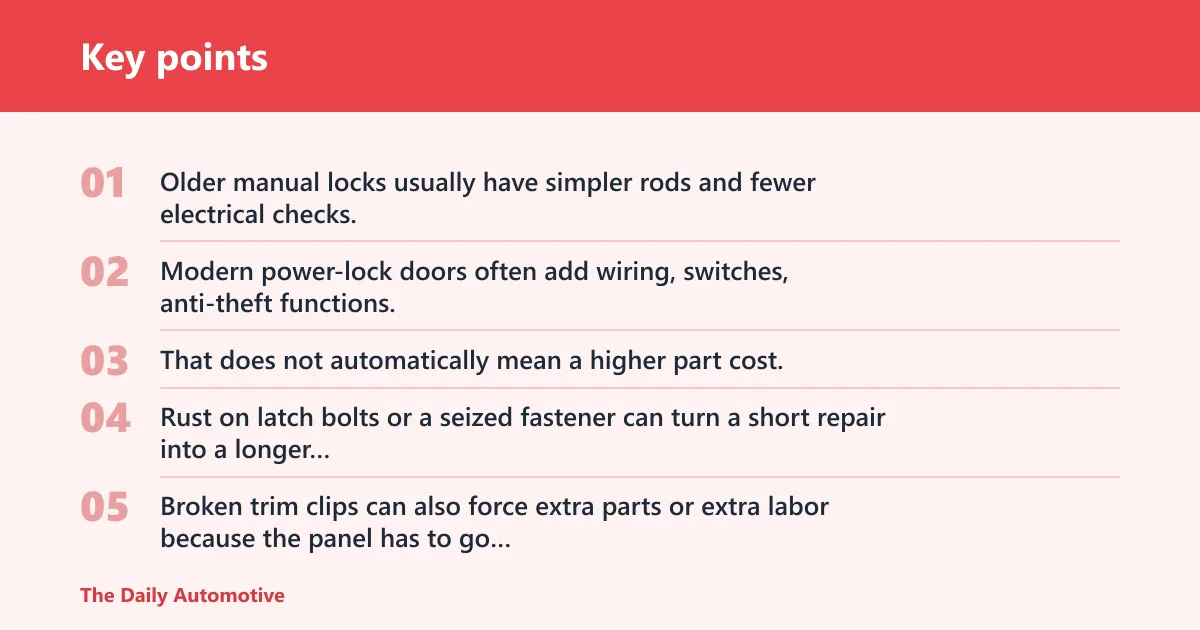
Older manual locks usually have simpler rods and fewer electrical checks. Modern power-lock doors often add wiring, switches, anti-theft functions, and module communication. That does not automatically mean a higher part cost, but it often means more labor and more chances for the quote to rise after inspection.
Rust, broken clips, and seized fasteners
Rust on latch bolts or a seized fastener can turn a short repair into a longer disassembly. Broken trim clips can also force extra parts or extra labor because the panel has to go back together without rattles. Damage to the door skin or inner support can push a repair toward replacement.
Integrated electronics and part sourcing delays
Some locks are sold with the actuator, latch, and electronics as one unit. That can make the part more expensive and lengthen sourcing time, especially on less common trims. A locksmith may still handle the diagnosis, but the parts path can be closer to dealer sourcing than to a simple hardware swap.
Local labor rate differences
Local shop pricing and locksmith pricing are not identical. A locksmith may be the faster route for a simple lock or cylinder issue, while a body shop may price lower on door-skin or handle damage that overlaps with collision repair. Dealership labor can be higher, but it may also be the better fit when the door module or OEM part matching is critical.
Repair or replacement?
Repair is usually cheaper when the damage is limited to one worn component and the rest of the assembly is sound. Replacement starts to make more sense when the latch is corroded, the actuator is tied to other electronics, or the handle and linkage have both failed. Full replacement is also safer when a part keeps failing after adjustment.
When one part can be repaired
Repair works best when the fault is local: a worn motor brush set, a loose linkage clip, a damaged cylinder, or a handle connection that has come apart. In those cases, the shop may replace only the failed component and leave the rest of the door hardware in place.
When the full assembly makes more sense
If the internal gears are stripped, the latch body is corroded, or the actuator is built into a sealed unit, replacement can save labor and repeat visits. That is especially true when the same door has already been opened once and the trim clips are weakened.
When replacement is safer than piecing it together
If the door locks intermittently, the connector is heat-damaged, or the mechanism has broken more than one part, piecing it together can become false economy. A full assembly may cost more up front, but it reduces the risk of paying labor twice.
Who should fix it?
A locksmith can often handle car door locks, especially cylinder, handle, and many actuator jobs. A dealership may be a better fit when the vehicle uses integrated electronics, coded parts, or a hard-to-source module. A body shop is the better call when the handle area or door panel has crash damage.
When a locksmith can handle the job
Locksmiths are often the right choice for diagnosis, cylinder work, and standard lock repair on older cars with common hardware. The lower end of the $50 to $200 range often comes from these simpler jobs, especially when the fix does not require major panel work or rare parts.
When a dealership is the better call
Dealership service is useful when the lock is tied into a vehicle-specific module, coded key system, or integrated electrical setup. If the part must match an exact trim, or if a software step is part of the repair, the dealer is often the cleaner route even if the labor rate is higher.
When a body shop is needed
If the handle mount is cracked, the door is misaligned, or the outer skin has been damaged, a body shop can address the structure and the hardware together. That matters because a perfect lock repair will not feel right if the door itself is bent or the handle opening is distorted.
How do you fix a car door lock?
You fix it by matching the symptom to the failed part, opening the door safely, testing the mechanism, and replacing only the damaged component when possible. The basic sequence is diagnosis first, then panel access, then part testing, then repair or replacement based on wear, corrosion, and integration.
- Check whether the symptom is at the key, handle, latch, or power lock switch.
- Confirm whether the other doors work, which helps narrow the fault to one door or a wider electrical issue.
- Remove the inner door panel with trim tools to avoid damaging clips and plastic mounts.
- Inspect the actuator, latch, handle linkage, and cylinder for broken parts, rust, or loose connectors.
- Test the motor, wiring, and mechanical travel before ordering parts.
- Replace the failed component, then verify smooth lock and unlock action from the key, switch, and remote.
Suppose a rear door on a compact sedan will lock from the switch but not from the key, and the handle feels normal. That pattern points more toward the cylinder or key-side linkage than the actuator, so ordering a full latch assembly first would be a costly guess.
Frequently asked questions
How much does it cost to fix a broken car door lock?
For many jobs, the cost falls somewhere between $120 and $600 once diagnosis, labor, and parts are included. A simple cylinder or handle fix can land lower, while an actuator, latch, or integrated electrical repair can push the total higher. The exact price depends on the failed part and how hard it is to reach.
How much is a car door handle repair?
A handle repair is often cheaper than a full lock assembly because the latch and actuator may still be fine. The final price depends on whether the handle itself is cracked, whether the linkage is broken, and whether the door panel has to come off. Painted or vehicle-specific handles usually cost more.
Is it cheaper to repair or replace a car door lock?
Repair is usually cheaper when one component is worn and the rest of the system still works. Replacement makes more sense when the lock is corroded, tied to electronics, or failing in more than one place. A shop should quote both paths if the door is already open and the damage is clear.
What makes a car door lock repair cost more?
Rust, broken clips, seized fasteners, integrated electronics, and rare parts all raise the bill. Labor rate also matters, especially when diagnosis time and panel removal time are high. Modern locking systems can add wiring tests, part matching, and longer sourcing delays that do not affect older mechanical locks as much.
Can a locksmith repair a car door lock, or does it need a dealership?
A locksmith can often repair a car door lock, especially on older vehicles or simple cylinder and latch jobs. A dealership becomes the better choice when the lock is tied to coded electronics, a vehicle-specific module, or a hard-to-source assembly. Body damage around the handle points more toward a body shop.
When is the lock motor the real problem?
The motor is a likely culprit when the lock grinds, clicks weakly, or stops moving after repeated tries. Worn brushes and carbon dust can cause those signs inside the actuator. If the handle, cylinder, and latch all feel normal by hand, the motor rises on the list fast.
Products related to this article
Sponsored / affiliate links. As an Amazon Associate I earn from qualifying purchases. I may earn additional commission from eligible campaigns.