Car Loan Origination Fee Cost
Compare it with the rate and term, because it raises both your drive-off cost and the total interest paid. Ignore it, and a low monthly payment can hide a more expensive loan. This guide shows how to compare fee-versus-rate offers and calculate the real cost before you sign.
What a car loan origination fee
A car loan origination fee is a one-time lender charge for processing, underwriting, and funding the loan. Lenders may call it a processing fee, underwriting fee, or administrative fee. It is separate from dealer add-ons, and it can be charged as a percentage of the loan amount rather than a flat dollar amount.
What the fee covers
U.S. News describes origination fees as a flat fee covering loan processing costs, and for auto loans they are often 1% to 2% of the loan amount. A $40,000 car loan with a 2% origination fee would cost $800. That fee may be deducted from loan proceeds, or it may be added to the balance.
How it differs from dealer fees
Do not mix lender origination charges with dealer document fees, acquisition fees, or add-on products. Those are different costs. A lender fee changes the financing math, while dealer fees and accessories change the purchase price or the amount you owe the dealership.
Say your lender approves a $24,000 loan and charges a 2% origination fee. If the fee is taken from the proceeds, you still owe the same loan amount, but you receive less cash at closing. If the fee is rolled into the balance, your payment and total interest both rise.
How the fee changes your out-the-door cost
The fee affects two numbers at once: cash due at signing and total borrowing cost. Paid upfront, it raises your drive-off cash. Rolled into the loan, it increases the financed amount and usually adds interest over the full term. That is why the monthly payment alone can mislead you.
Paid upfront versus financed
An origination fee may be deducted from loan proceeds, giving you less money upfront. Some lenders add the origination fee to the loan balance instead. Either way, the fee is real cost. The difference is whether you feel it immediately at signing or gradually through a larger loan balance.
Why the sticker payment can mislead
A lower payment can come from a longer term, a higher rate, or both. That is why loan term matters as much as the fee itself. A longer term usually lowers the monthly payment but raises total interest, which can erase the benefit of a lower fee or a waived fee.
Suppose two offers both finance a $24,000 car. One charges a fee and gives a lower APR. The other advertises no fee, but the APR is higher. The second offer can still cost more overall, even if the monthly payment looks close at first glance.
Can you compare loans by APR alone?
APR is often the cleaner comparison metric because it includes interest and most upfront finance charges, not just the note rate. It is the best single number for comparing lender offers. But APR alone is not enough if you need to know exactly how much cash to bring at signing.
What APR includes
APR can be higher even when the stated interest rate is lower, because APR folds in many of the costs tied to borrowing. That makes it better for comparing offers across lenders. It also helps you see when a seemingly cheap rate is padded by fees built into the loan price.
When APR still needs a fee check
APR does not always make the cash timing obvious. If the fee is deducted from proceeds, you will need more cash for the car itself even if the APR looks competitive. If the fee is added to the balance, the monthly payment may hide the extra cost unless you compare total finance charges.
Auto loan fee table
This table uses the same about-$24,000 loan amount and a 60-month term so fee structure, APR, and total cost can be compared without changing more than one variable at a time. The break-even point compares each fee-bearing offer against the no-fee, higher-APR option.
| Scenario | Loan amount | Fee % | Cash due at signing | Financed amount | APR | Estimated total interest | Total cost | Break-even months |
|---|---|---|---|---|---|---|---|---|
| Fee paid upfront | $24,000 | 2% | $480 | $24,000 | 6.50% | $4,248 | $28,728 | 39 |
| Fee rolled into the loan | $24,000 | 2% | $0 | $24,480 | 6.50% | $4,332 | $28,812 | 154 |
| No-fee, higher-APR alternative | $24,000 | 0% | $0 | $24,000 | 7.25% | $4,998 | $28,998 | — |
Here is the practical readout. The fee-paid-upfront offer saves about $270 in total cost versus the no-fee, higher-APR loan, but it requires $480 at signing. The rolled-in fee offer costs less than the no-fee alternative over the full term, but the savings are small enough that it does not catch up until long after a 60-month loan ends.
That is the trap. A waived fee is not automatically the better deal if the APR rises enough to offset the savings. A lower payment can also stretch the payoff period and increase total interest, which makes the fee trade-off harder to spot if you only compare the monthly number.
How much is the loan origination fee?
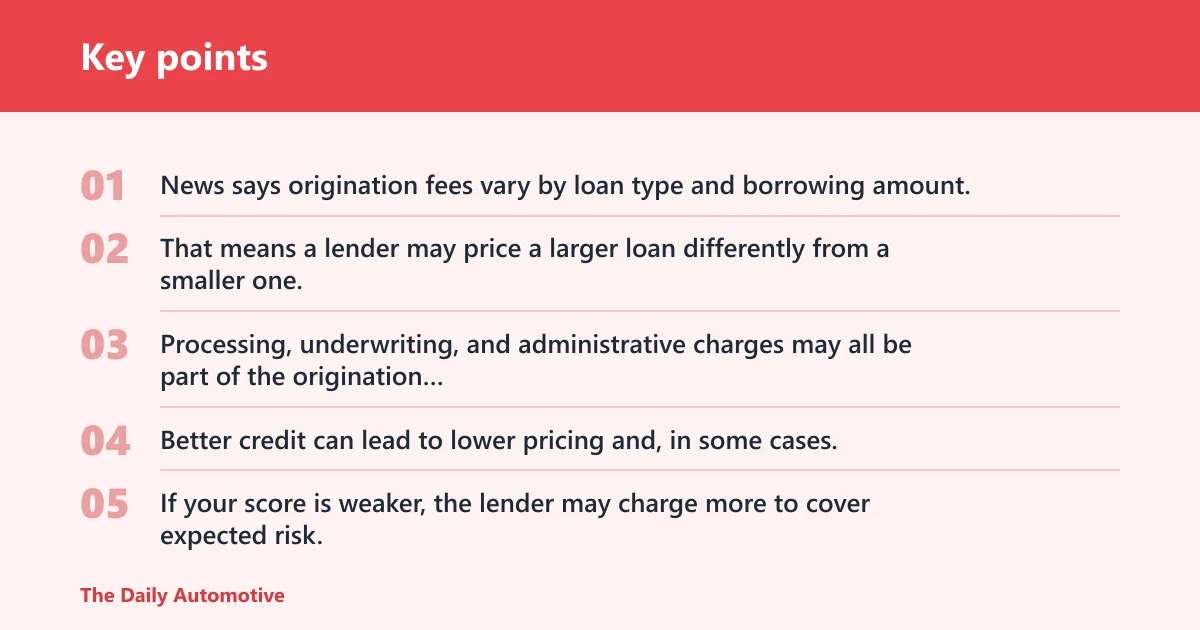
Auto loan origination fees are often 1% to 2% of the loan amount, but the exact number depends on the lender, the loan type, and the amount borrowed. Credit score matters too. Higher scores may qualify for lower fees or waivers, while weaker credit can lead to higher pricing.
What drives the fee size
U.S. The same source says origination fees vary by loan type and borrowing amount. That means a lender may price a larger loan differently from a smaller one, and the fee can appear under different labels. Processing, underwriting, and administrative charges may all be part of the origination cost.
How credit score can change pricing
Lenders use credit score to judge risk. Better credit can lead to lower pricing and, in some cases, a reduced fee or no fee at all. If your score is weaker, the lender may charge more to cover expected risk, which can make a fee-bearing loan harder to justify unless the APR is clearly lower.
Why term length changes the trade-off
Loan term affects both the monthly payment and total interest. Longer terms usually lower the payment, but they raise total cost. That matters when you compare a fee-bearing loan against a no-fee offer, because a lower payment over a longer term can still cost more over time.
Are car loan origination fees negotiable?

Sometimes, but not always. A lender may waive or reduce the fee depending on your credit profile, the loan amount, the vehicle, and current promotion rules. The strongest negotiating position usually comes from competing quotes. If the lender will not move on the fee, it may move on the rate instead.
When lenders may waive the fee
Some lenders waive fees for strong credit, existing members, automated payment enrollment, or special financing offers. Ent Credit Union, for example, shows some auto loan APRs as low as 5.74% for 36 months on 2023 and newer vehicles. That kind of pricing can come with different fee treatment than a standard offer.
What to ask before you sign
- Ask whether the origination fee is separate or built into the APR.
- Ask whether the fee is deducted from proceeds or added to the balance.
- Ask whether a lower fee changes the APR or the term.
- Ask whether the lender will match a competing quote from another lender.
Use multiple quotes, not one. Banks, credit unions, and online lenders can price the same borrower differently. That is especially true when one lender leads with a low rate and another leads with a lower fee. The better offer is the one that wins on total cost, not the one with the prettiest headline number.
How to compare lender offers the right way

Compare banks, credit unions, and online lenders on the same worksheet. Line up the loan amount, APR, term, origination fee, and any required down payment. Then compare total interest and total cost, not just the monthly payment. If one quote has a fee and another does not, normalize both before you decide.
Banks versus credit unions versus online lenders
Each lender type can price fees differently. A credit union may offer lower fees or a lower rate to qualifying members. Banks may charge more for convenience or speed. Online lenders may price aggressively but vary more in fee structure, so you need the fee line item as well as the APR.
What to line up on each quote
Check the APR, the stated interest rate, the origination fee, whether the fee is financed, and the loan term. If a quote shows an itemized fee, treat that as part of the cost comparison. If the lender bundles the fee, ask for the separate charge so you can compare offers on equal footing.
Questions to ask before accepting a fee
Ask whether the fee is a lender charge or a dealer charge. Ask whether it is negotiable. Ask whether the loan can be re-quoted with a different term. Ask for the total amount financed and the total of all payments. Those figures make it easier to see whether the fee is buying a lower-cost loan or just a different monthly payment.
Loan Estimate forms are a mortgage document, but they show the same comparison logic clearly: origination charges are listed in Section A, and comparing multiple estimates is the most effective way to reduce the fee. Auto loans do not use the same form, but the habit is the same. Compare itemized offers side by side.
Frequently asked questions
What is origination fee car loan?
It is a one-time lender charge for processing, underwriting, and funding the auto loan. Lenders may label it as a processing, underwriting, or administrative fee. The charge may be a percentage of the loan amount, and it can be deducted from proceeds or added to the balance.
How much does a car loan cost?
The cost depends on the loan amount, APR, term, and fees. A loan with a lower rate can still cost more if the fee is high or the term is long. Compare the total of all payments plus any upfront fee to see the real cost.
Do car loans have origination fees?
Some do, and some do not. Many lenders charge an origination fee, but others waive it or bundle it into the APR or loan balance. That is why you should ask for the fee separately and compare the APR, not just the monthly payment.
Is an origination fee included in APR?
Often, yes. APR is the better comparison standard because it includes interest and most upfront finance charges. But you should still check whether the fee is paid at signing or added to the balance, because APR alone does not always show the cash needed right away.
Products related to this article
Sponsored / affiliate links. As an Amazon Associate I earn from qualifying purchases. I may earn additional commission from eligible campaigns.